10 000 rublei 1921
About This Note
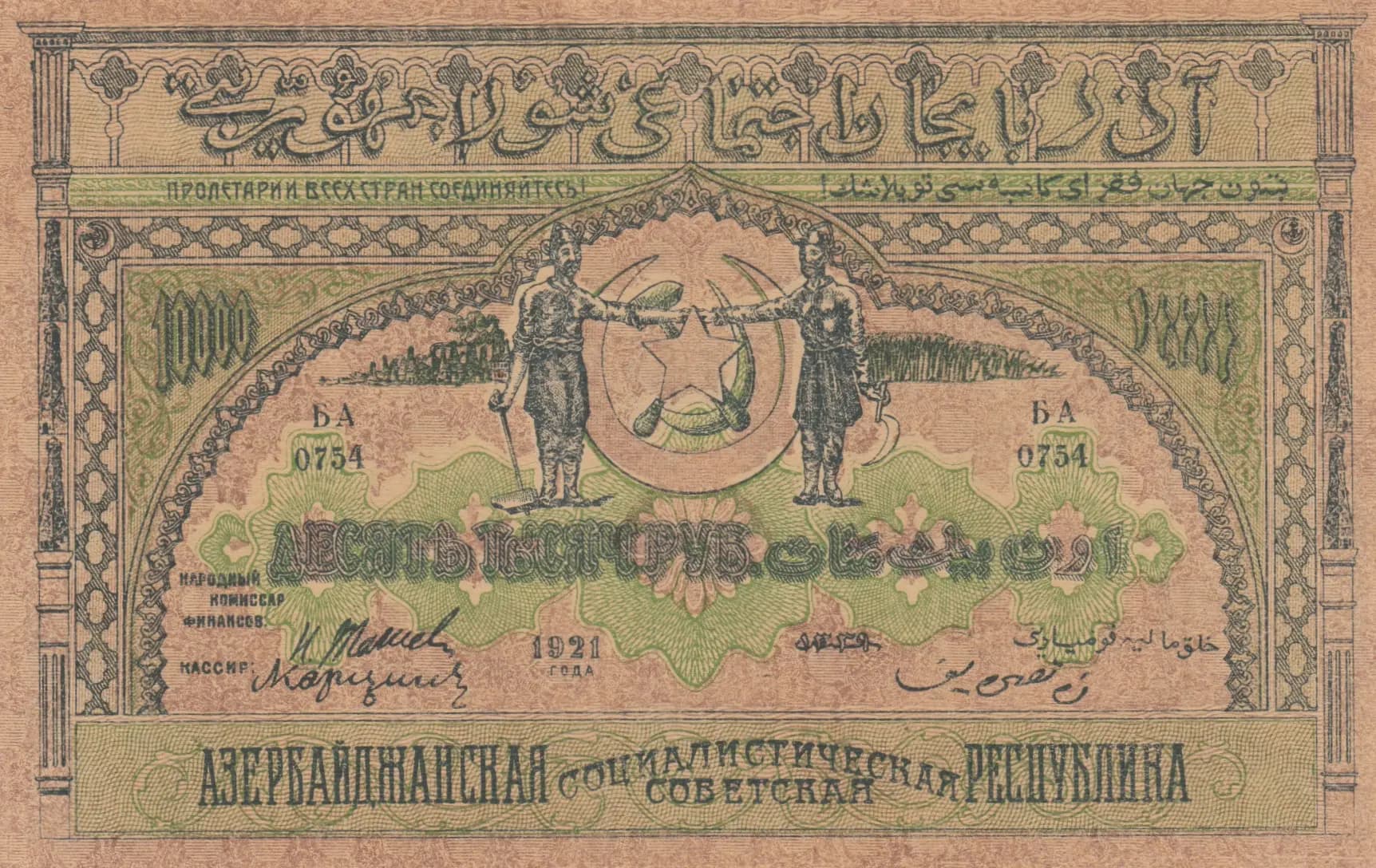
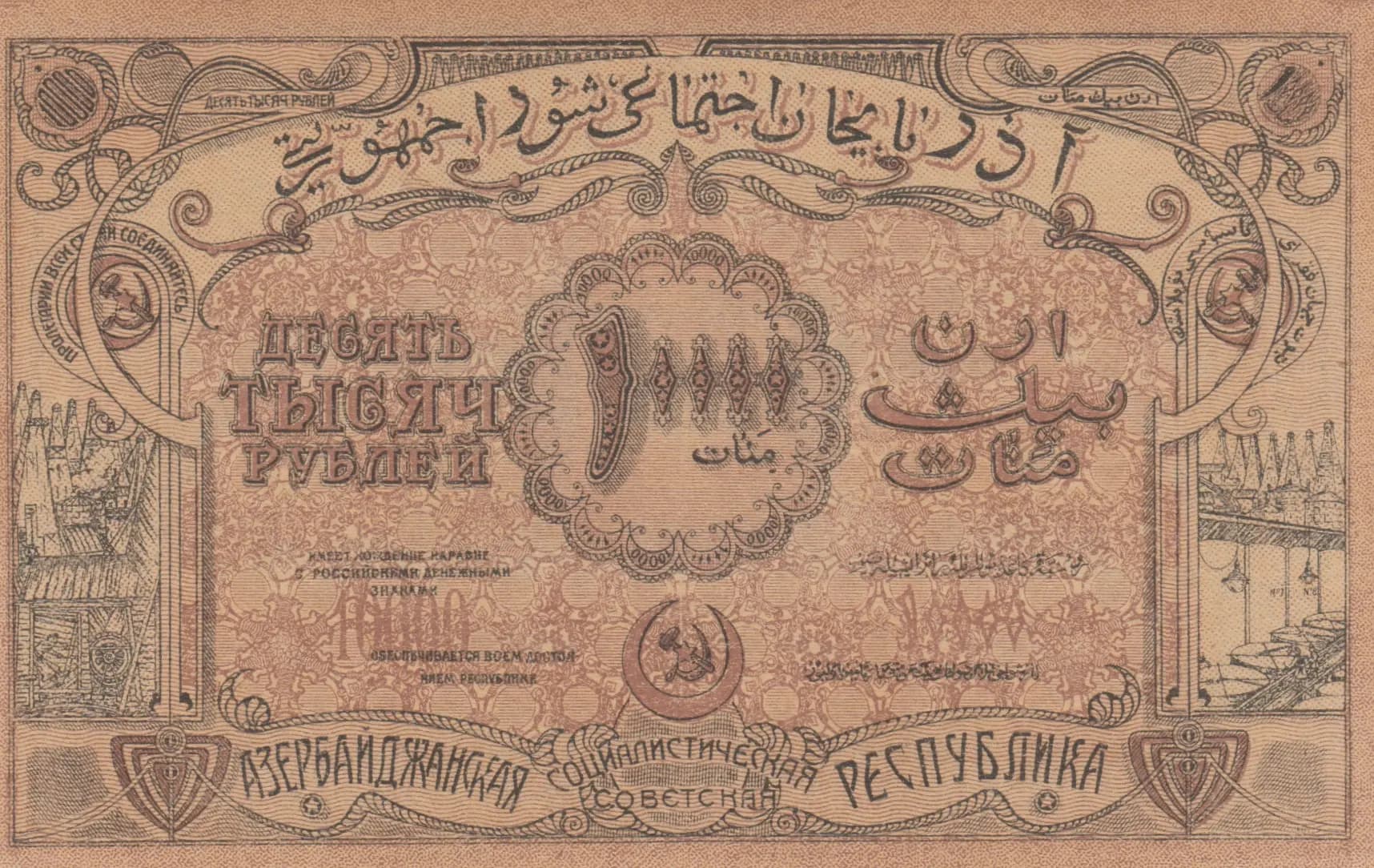
This Azerbaijan SSR 10,000 ruble note from 1921 displays the characteristic early Soviet design aesthetic with ornate Art Nouveau-influenced borders and hammer-and-sickle symbolism. The UNC condition grade is somewhat questionable given the visible age-related discoloration, foxing, and creasing observed throughout both sides—typical of notes from this volatile period that survived circulation. The presence of dual serial numbers (БА 0754 and БА 0751) and the mixed-language inscriptions make this a notable example of early Soviet regional currency from the immediate post-Revolution era.
Common. While early Soviet regional issues have historical significance, the 10,000 ruble denomination from Azerbaijan SSR in 1921 was part of substantial print runs to facilitate post-Civil War economic reconstruction across the Soviet territories. No evidence of restricted mintage, recall, or extreme scarcity exists for this Pick catalog number. Notes from this series appear with reasonable regularity in the collector market. The UNC grade claim may be aspirational given the observed foxing and creasing; the actual technical condition appears closer to VF-XF, which further supports a common classification.
Issued during the tumultuous early years of the Soviet state, this note represents Azerbaijan's brief period as an autonomous Soviet republic (1920-1922) following the Russian Civil War. The imagery prominently features the hammer and sickle symbol within a wreath, flanked by two standing figures in traditional clothing—symbolizing the revolutionary unity of workers and peasants across the former Russian Empire's diverse ethnic regions. The invocation of international proletarian solidarity ('Workers of all countries, unite!') and the emphasis on this being a state loan reflecting 'the sacred duty of all citizens' reflects the Soviet state's use of currency as propaganda during the reconstruction period following the Civil War.
The obverse features a symmetrical composition centered on a large hammer and sickle symbol encircled by a wreath, flanked by two standing figures in traditional robes—representative of workers and peasants united under Bolshevism. The vignette background depicts agricultural fields or harvest scenes, emphasizing the revolutionary state's agrarian base. Elaborate geometric and floral Art Nouveau-style borders frame the entire note with ornamental corner elements. The reverse showcases an equally ornate design dominated by elaborate scrollwork and floral motifs surrounding a scalloped central cartouche, with architectural elements visible in side panels and landscape scenes in the lower corners. The entire design employs fine line engraving with intricate detail work characteristic of early Soviet currency. Serial number prefixes 'БА' indicate Azerbaijan as the issuing authority. The color scheme throughout is predominantly tan/beige with green and dark brown/black printing on the obverse, and monochromatic brown on the verso.
FRONT SIDE: 'РСФСР' (RSFSR - Russian Soviet Federative Socialist Republic); 'ПРОЛЕТАРИЙ ВСЕХ СТРАН СОЕДИНЯЙТЕСЬ!' (Workers of all countries, unite!); 'ДЕСЯТЬ ТЫСЯЧ РУБЛЕЙ' (Ten thousand rubles); '1921 ГОДА' (Year 1921); 'НАРОДНЫЙ КОМИССАР ФИНАНСОВ' (People's Commissar of Finance); 'КАССИР' (Cashier); 'АЗЕРБАЙДЖАНСКАЯ СОЦИАЛИСТИЧЕСКАЯ СОВЕТСКАЯ РЕСПУБЛИКА' (Azerbaijan Socialist Soviet Republic); Serial numbers: 'БА 0754' and 'БА 0751'. BACK SIDE: 'ДЕСЯТЬ ТЫСЯЧ РУБЛЕЙ' (Ten thousand rubles); 'АЗЕРБАЙДЖАНСКАЯ СОЦИАЛИСТИЧЕСКАЯ СОВЕТСКАЯ РЕСПУБЛИКА' (Azerbaijan Socialist Soviet Republic); 'ГОСУДАРСТВЕННЫЙ ЗАЕМ РОССИЙСКОЙ ДЕНЕЖНОЙ ЗНАК' (State loan Russian monetary note); 'ОБЪЯВЛЯЕТСЯ ВЕЩИМ ДОЛГОМ ВСЕХ ГРАЖДАН' (Declared as the sacred duty of all citizens); Arabic text also present on verso.
Intaglio (engraved) printing on currency paper, utilizing multiple color applications on the obverse (green, black, and brown inks on tan/beige substrate) and single-color printing on the verso. The fine line work, geometric patterns, and ornamental borders are characteristic of high-security engraving techniques employed by Soviet state printing facilities during the 1920s. The technical execution suggests production by a major Soviet security printer, likely the State Printing Factory (Gosudarstvennaya Tipografiya) or similar facility under Commissariat of Finance oversight. The serial numbers were applied in separate impressions.
This example displays serial number prefix 'БА' (Cyrillic initials for Azerbaijan), confirming regional issuing authority. The presence of dual sequential serial numbers (БА 0754 and БА 0751) on the obverse is notable and may represent a printing or binding variety. Known varieties for P-S714 include different signature combinations of the People's Commissar of Finance and Cashier (these officials changed multiple times during 1921). The inclusion of Arabic text on the verso reflects Azerbaijan's ethnic and cultural composition and may represent a distinct variety, though this requires verification against comprehensive catalog references for this specific Pick number.