10 000 rublei 1919
“South Russia”
About This Note
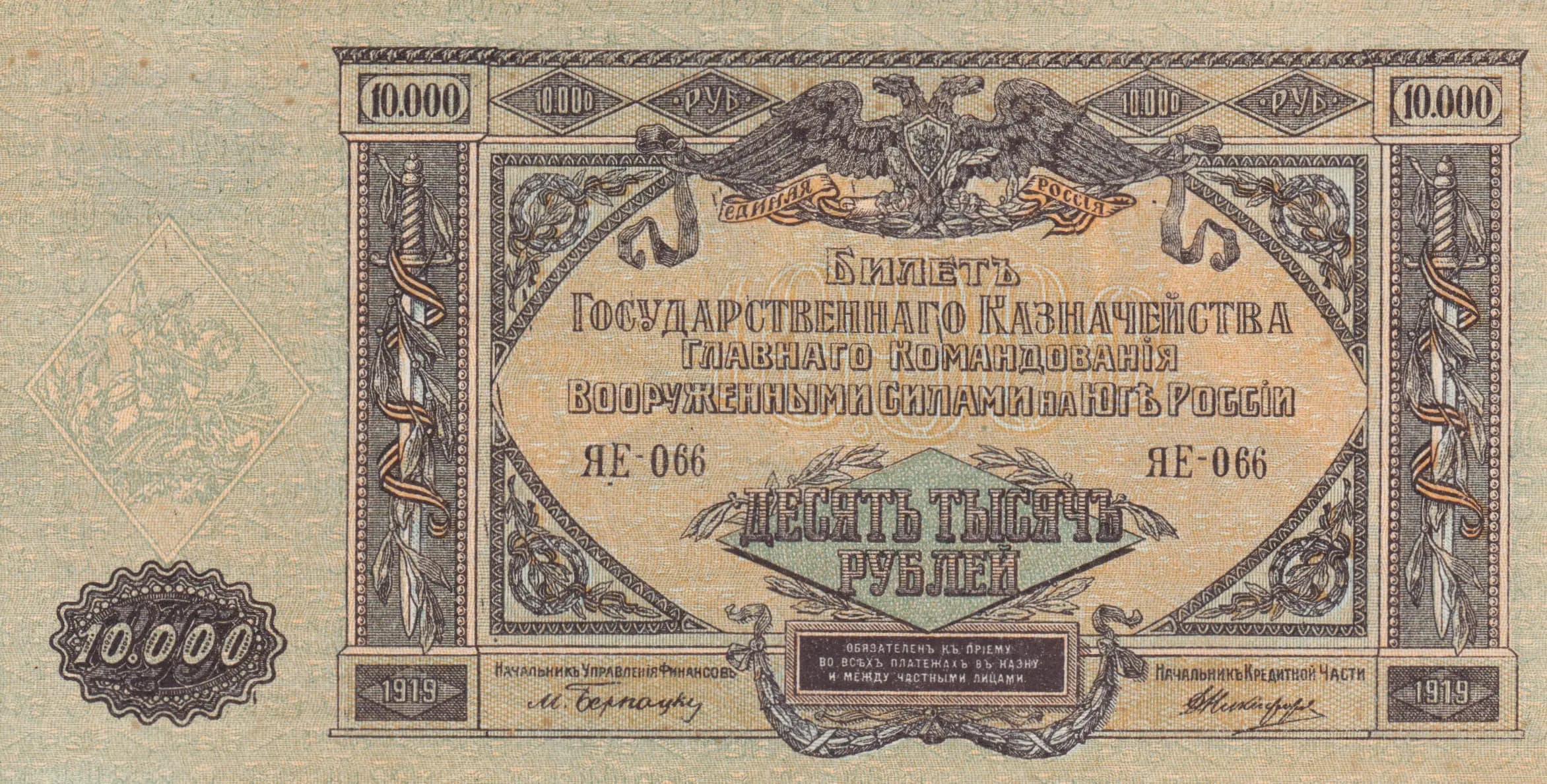
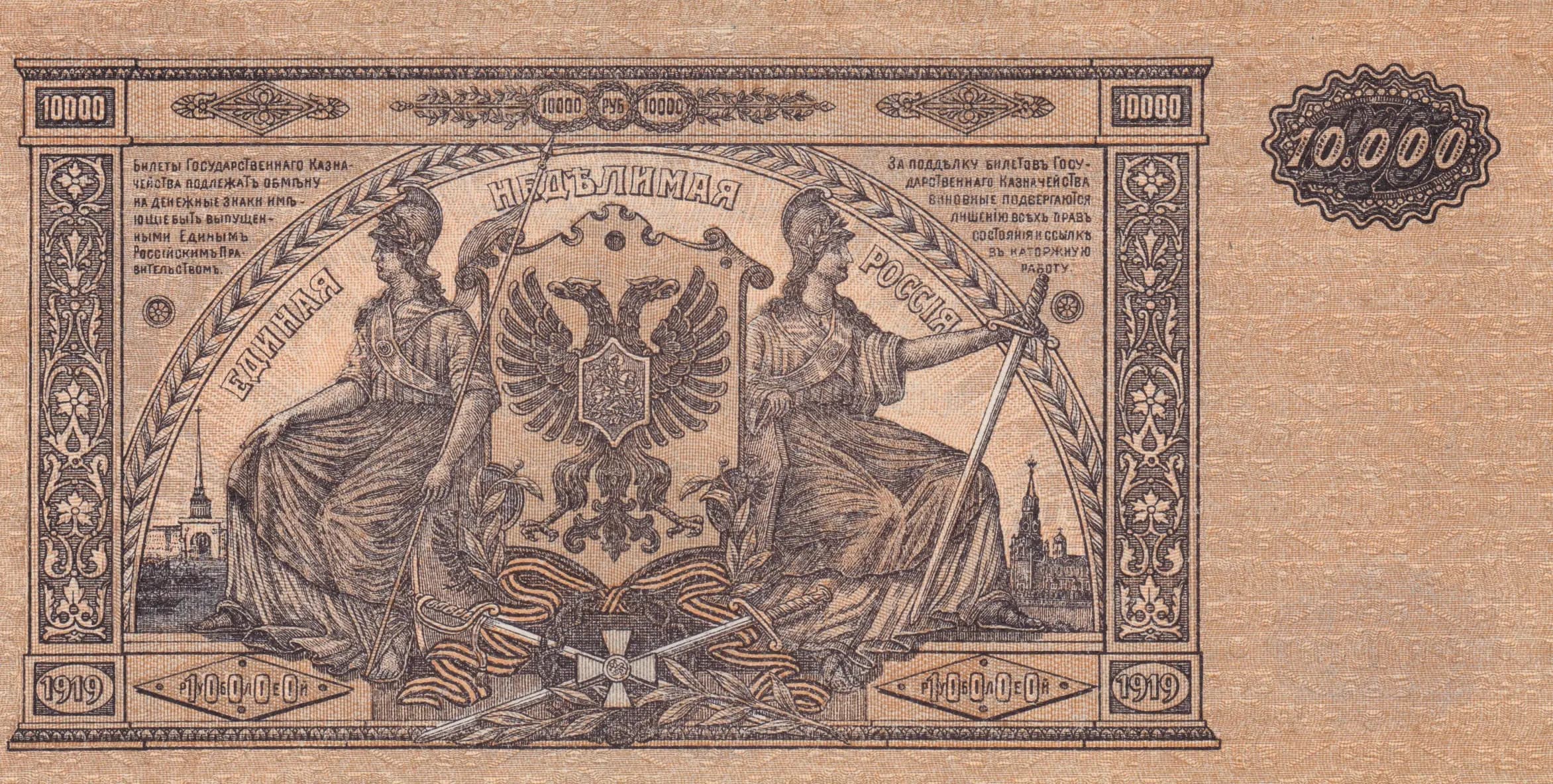
This is an exceptional UNC example of a 10,000 ruble note issued in 1919 by the State Treasury of the High Command of the Armed Forces in South Russia (Denikin's White Army forces). The note features pristine condition with no wear, creases, or stains, displaying the characteristic tan/beige and brown coloration of the period. The obverse showcases an imperial double-headed eagle within an ornate medallion, while the reverse presents an allegorical composition with two winged female figures flanking the state coat of arms, framed by architectural elements representing Russian buildings—a striking design that captures the transitional period of the Russian Civil War.
Uncommon. While these White Army South Russia notes were produced during a specific, limited period (1918-1920) for a geographically and politically restricted territory, they were issued in reasonable quantities for their time and circulating region. The note type itself (P-S425a) was not recalled or suppressed en masse compared to other Civil War-era emergency currencies. UNC examples are less common than circulated pieces due to the chaotic economic conditions and the notes' actual circulation during wartime. However, this Pick number is not considered scarce or rare in absolute terms—the designation reflects moderate availability among collectors, with multiple specimens entering the market periodically. The UNC condition grade is a more significant value determinant than the date or issuer for this particular note.
This banknote was issued during the Russian Civil War (1918-1922) by the White Army forces under General Anton Denikin, who controlled South Russia and attempted to establish alternative monetary authority. The imperial double-headed eagle imagery and formal State Treasury designation reflect the White Army's claim to legitimacy as defenders of the Russian Empire against Bolshevik forces. The 1919 date places this note during the period of maximum White Army territorial control, before their collapse in late 1920, making it a tangible artifact of one of history's pivotal civil conflicts.
The obverse presents a formal, hierarchical composition centered on the Imperial Russian double-headed eagle—symbol of autocratic authority—rendered within an ornate medallion at the top center. The main denomination and issuing authority text occupy a rectangular frame in the center, with denomination markers ('10,000') positioned in the upper corners and lower left. Extensive decorative borders frame the entire composition, featuring geometric patterns, scrollwork, and diamond-shaped ornamental elements characteristic of high-security currency design. The reverse employs a classical allegorical theme common to Imperial Russian monetary designs: two winged female figures (personifications of virtues or national ideals) flank the central imperial coat of arms. Behind these figures, recognizable Russian architectural landmarks—including what appears to be a church or cathedral with spire (left) and a fortification tower or administrative building (right)—reinforce the note's Russian national identity and legitimacy claims. Saint George's ribbon or military decoration elements appear at the bottom, emphasizing the military authority issuing the note. Elaborate ornamental wreaths, laurel branches, and floral motifs in the side borders complete the composition.
OBVERSE: '10,000' (Arabic numerals, top corners and bottom left); 'РУБЛЬ' (Ruble); 'БИЛЕТЬ' (Ticket/Note); 'ГОСУДАРСТВЕННАГО КАЗНАЧЕЙСТВА' (State Treasury); 'ГЛАВНАГО КОМАНДОВАНИЯ' (Main Command/High Command); 'ВООРУЖЕННЫМИ СИЛАМИ НА ЮГЕ РОССИИ' (Armed Forces in South Russia); 'ЯЕ-066' (Serial designation); 'ДЕВЯТЬ ТЫСЯЧ' (Nine Thousand—note discrepancy with 10,000 denomination); '1919' (year); 'Начальник Управления Финансов' (Chief of Financial Administration); 'Начальник Кредитной Части' (Chief of Credit Section). REVERSE: '10000' (Arabic numerals); 'БИЛЕЛЬНАЯ' (Note designation); 'РОССИЯ' (Russia); 'БИЛЕТЫ ГОСУДАРСТВЕННАГО КАЗНАЧЕЙСТВА ПОДЛЕЖАТ ОБМЕНУ НА ДЕНЕЖНЫЕ ЗНАКИ ИМЕЮЩИЕСЯ ВЫПУЩЕНЫ' (State Treasury Notes subject to exchange for previously issued monetary notes); '1919' (year); Additional text regarding acceptance of state treasury notes and full property rights status.
This note was produced using classical engraved intaglio (copperplate) printing, evidenced by the fine line work, intricate cross-hatching, and dimensional quality visible throughout both sides. The complex ornamental borders, detailed architectural rendering, and precise geometric patterns are characteristic of high-security intaglio engraving. The multiple layered decorative frames and fine linework demonstrate the technical sophistication required of legitimate state currency during this period. While specific printer attribution for White Army South Russia notes requires specialized catalog reference, such high-value emergency currency typically employed the most advanced security printing technology available to the issuing authority.
The serial number 'ЯЕ-066' visible on the obverse indicates this is a specific numbered example; variety classification for White Army notes typically focuses on serial number prefixes and signature blocks. The discrepancy between the spelled-out amount 'ДЕВЯТЬ ТЫСЯЧ' (Nine Thousand) and the printed denomination '10,000' is notable and may represent a printing variety or known error state for this issue. No major die or signature varieties are immediately apparent from the visual analysis, though collectors of Russian Civil War currency should verify against specialized catalogs for documented varieties by serial prefix range (ЯЕ designation may be one of several letter combinations used).