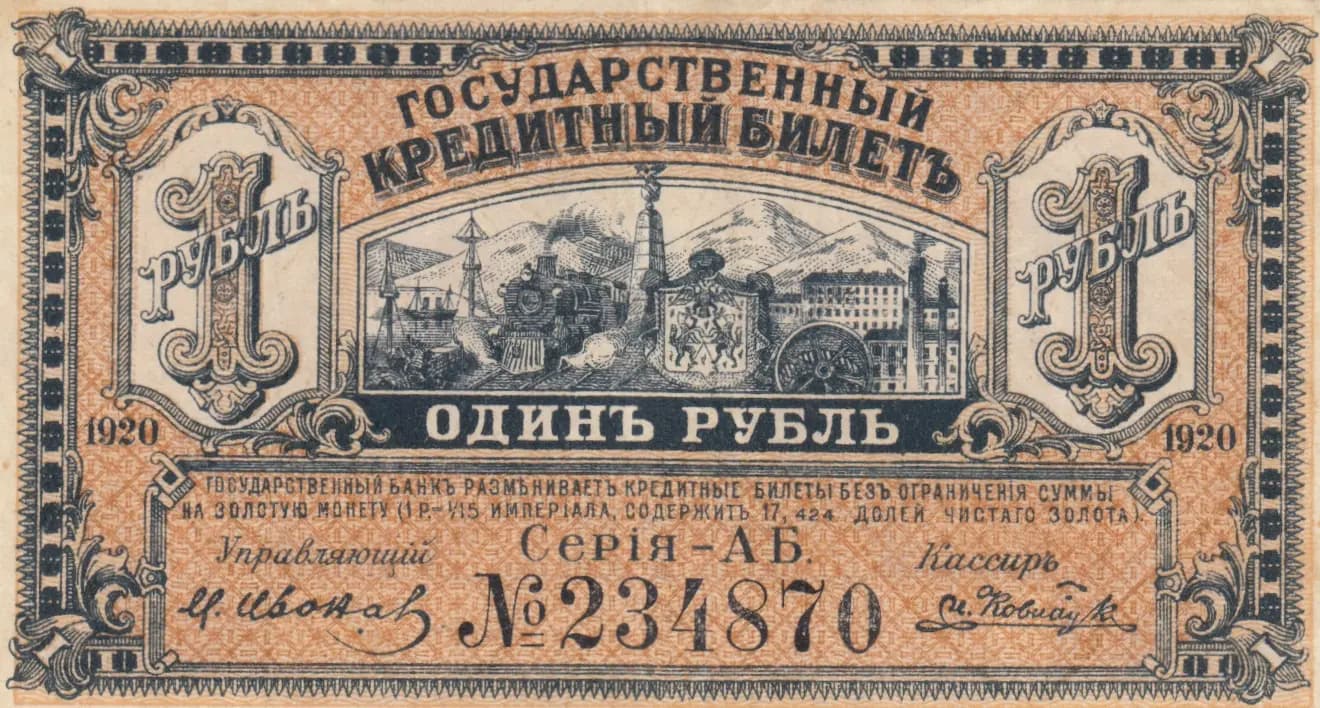
1 rubel 1920
About This Note
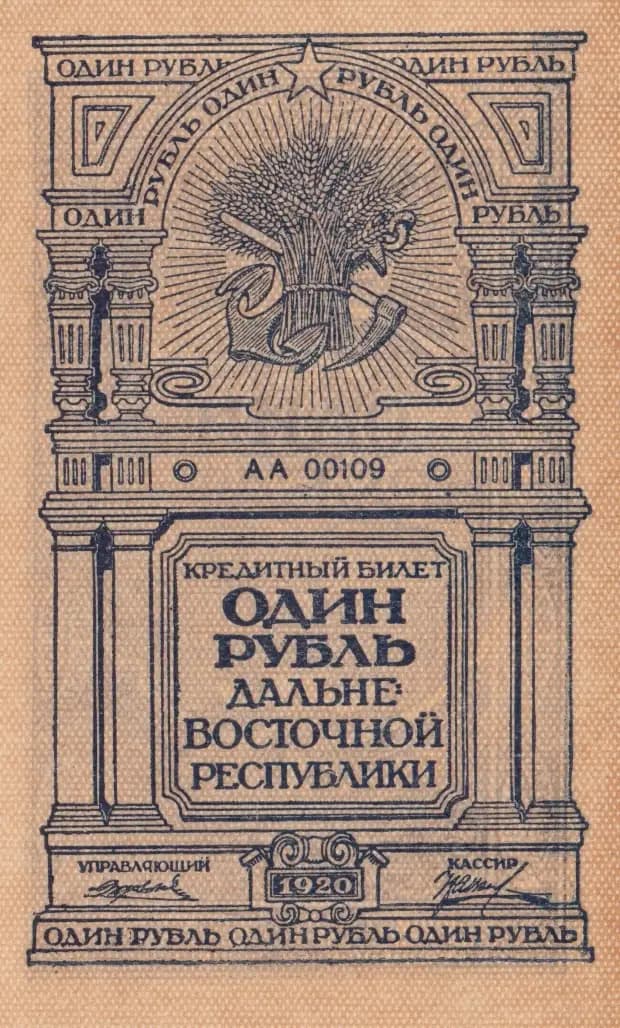
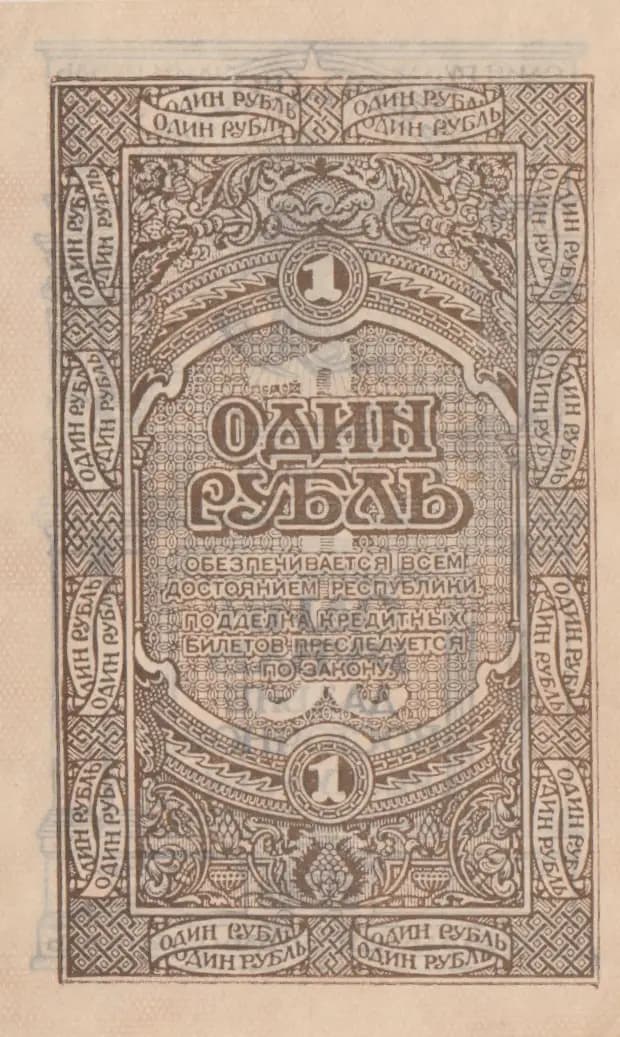
This 1920 Far Eastern Republic 1 Ruble note (Pick S1201) is presented in AU condition, displaying the characteristic design elements of this short-lived Far Eastern Republic currency issue. The obverse features a striking central wheat sheaf with radiating sunburst pattern framed by classical Corinthian columns and ornamental architectural elements, while the reverse displays elaborate baroque-style borders with geometric patterns and a central oval cartouche. The note shows age-appropriate patina and light foxing consistent with early 20th century circulation, with no major tears or creases, making it an attractive example of this historically significant regional Russian currency.
Uncommon. The Far Eastern Republic existed as a monetary authority for only two years (1920-1922), and this 1 Ruble denomination from 1920 represents an early issue from this short-lived entity. While not exceptionally rare, notes from the Far Eastern Republic are scarcer than contemporary Soviet issues due to the limited geographic distribution and the eventual absorption of the republic into the Soviet Union. The AU condition grade enhances desirability relative to more circulated examples. Print run data is limited, but the survival of examples in AU condition suggests moderate scarcity rather than extreme rarity.
The Far Eastern Republic (1920-1922) was a short-lived buffer state between Soviet Russia and Japan during the Russian Civil War period, and this 1 Ruble note represents its monetary sovereignty during this turbulent era. The agricultural symbolism—prominently displayed through the wheat sheaf motif on the obverse—reflects the republic's agrarian economic base and revolutionary ideals emphasizing national productive capacity. The guarantee text on the reverse ('Guaranteed by all property of the Republic') underscores the provisional nature of this authority and its attempt to establish monetary credibility during a period of extreme political and economic instability.
The obverse features a neoclassical design centered on a wheat sheaf or grain bundle with radiating sunburst pattern, symbolizing agricultural productivity and national wealth. This central medallion is framed by two classical Corinthian columns supporting an ornamental pediment, with a star positioned at the apex of the design. The composition is enhanced by decorative architectural moldings and scrollwork typical of early Soviet-era banknote design. The reverse employs an ornate baroque aesthetic with a large oval cartouche as the central focal point, surrounded by elaborate geometric lattice patterns, floral and foliate motifs, and ornamental corner elements. Denomination numerals '1' appear in circular frames at top and bottom center of the reverse. The overall color palette of tan, beige, and dark blue/brown inks on cream paper is characteristic of the period.
OBVERSE: 'ОДИН РУБЛЬ' (One Ruble) - appears three times; 'КРЕДИТНЫЙ БИЛЕТ' (Credit Note/Banknote); 'ДАЛЫЕ ВОСТОЧНОЙ РЕСПУБЛИКИ' (Far Eastern Republic); 'АА 00109' (Serial number); '1920' (Year); 'УПРАВЛЯЮЩИЙ' (Manager/Administrator); 'КАССИР' (Cashier). REVERSE: 'ОДИН РУБЛЬ' (One Ruble) - appears four times; 'ОБЕЗПЕЧИВАЕТСЯ ВСЕМ ДОСТОЯНИЕМ РЕСПУБЛИКИ' (Guaranteed by all property of the Republic); 'ПОДЕЛКА КРЕДИТНЫХ БИЛЕТОВ ПРЕСЛЕДУЕТСЯ ПО ЗАКОНУ' (Counterfeiting of banknotes is prosecuted by law).
This note was produced using intaglio (engraved) printing, evident from the fine line guilloche patterns visible throughout the design, particularly in the background areas and decorative borders. The sharp detail of the architectural elements, the intricate geometric patterns, and the fine ornamental scrollwork are all hallmarks of intaglio engraving, the standard security printing method for banknotes of this era. The Far Eastern Republic's limited resources likely meant this note was printed by a Russian state printing facility, potentially using plates transferred from or produced in coordination with Soviet authorities.
The observed serial number 'АА 00109' indicates this is an early printing from the initial series. Key varieties for Far Eastern Republic 1 Ruble notes typically involve differences in serial number prefixes and signature varieties of the administrative officials ('УПРАВЛЯЮЩИЙ' and 'КАССИР'). The specific combination of serial prefix 'АА' and the low serial number sequence suggests this is from the first printing run. No overprints or date variations are evident on this example. Collectors should note that signature varieties exist across different printings of this issue, making attribution of specific administrative officials a useful cataloging tool.