1 mark 1919
“Mitau”
About This Note
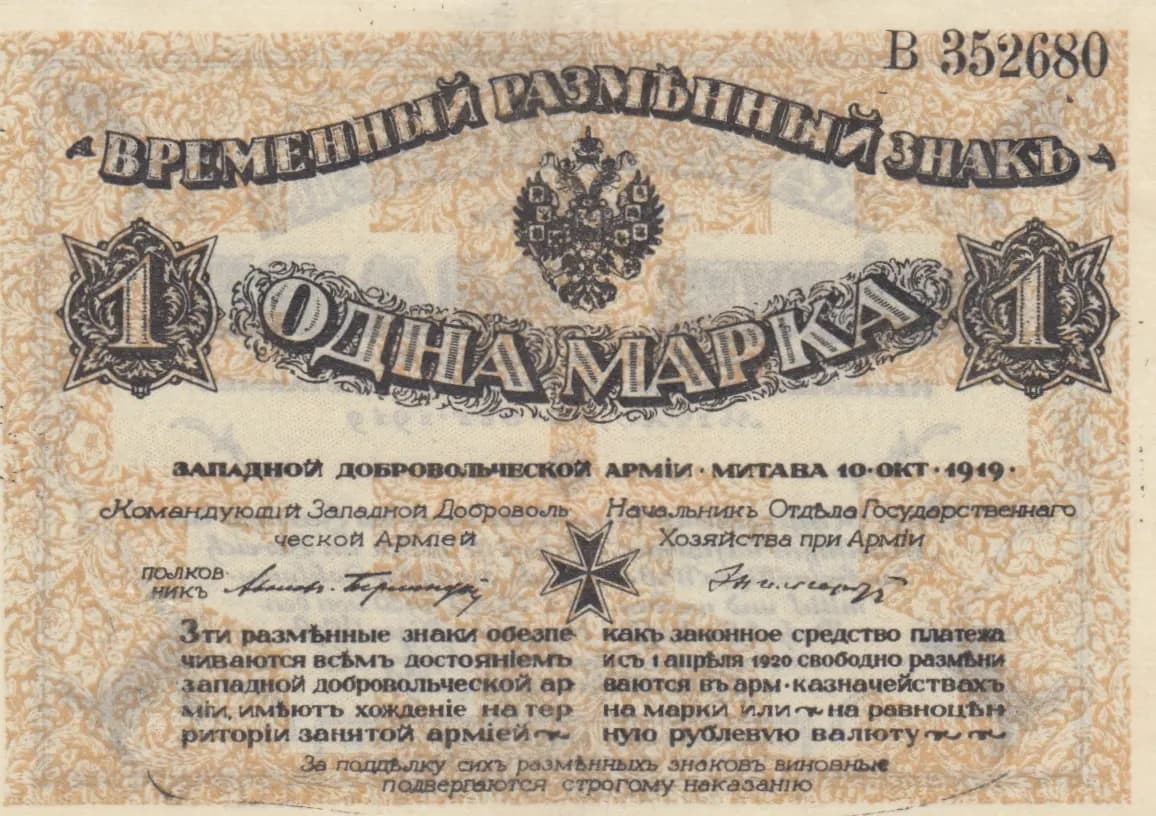
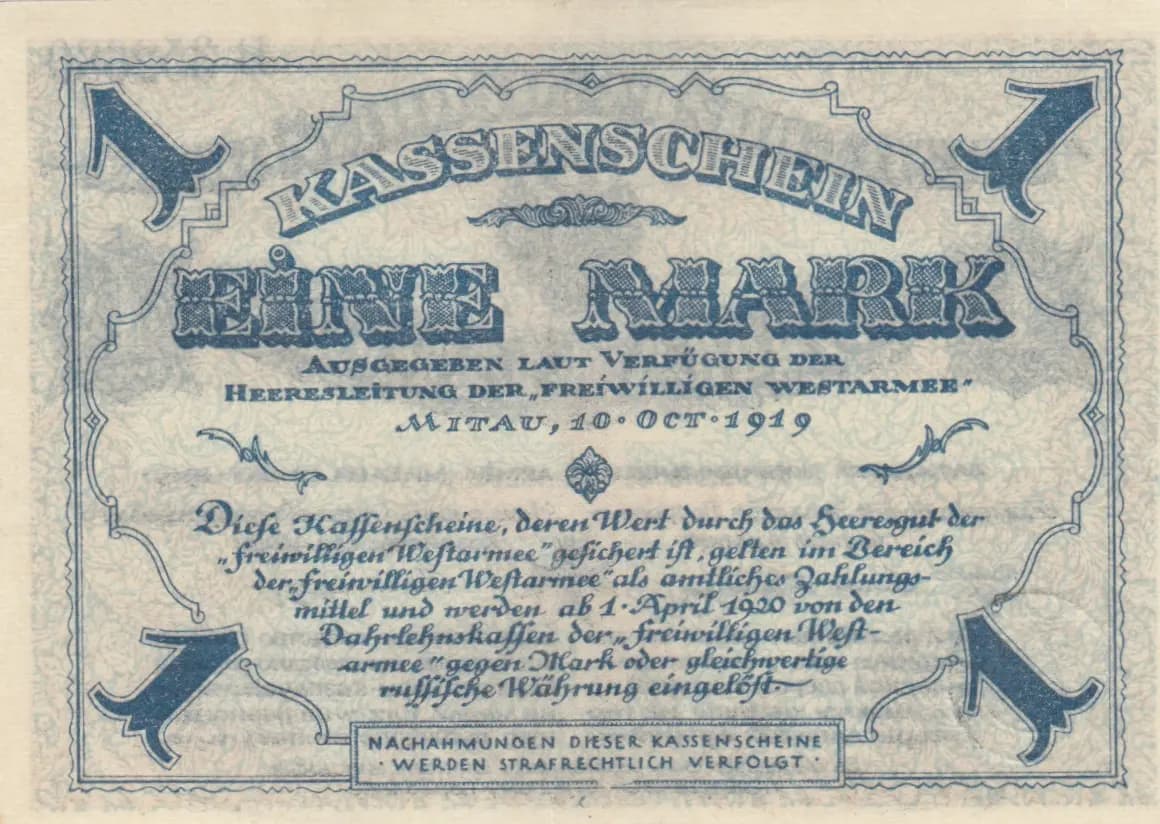
An exceptional UNC example of this 1919 Western Volunteer Army 1 Mark emergency issue from Mitau, Latvia, featuring the Russian Imperial double-headed eagle centered on an ornate Art Nouveau-style beige obverse with black text and fine decorative scrollwork. The reverse displays complementary blue-toned design with bilingual German and Russian text reflecting the complex political situation of the Russian Civil War period. This note preserves crisp printing quality with clear serial number B 352680, making it an important artifact of the White Army's short-lived monetary authority.
Uncommon. While the Western Volunteer Army issued currency for only a brief period (October 1919 to early 1920) before military collapse, these notes circulated in a relatively limited geographic area of the Baltic region and were produced in modest quantities typical of emergency military currency. The UNC condition grade increases value, as most surviving examples show evidence of circulation wear. This is not a major rarity, but significantly less common than mainstream European banknotes of the period. The bilingual design and historical significance to Russian Civil War numismatics sustains collector interest beyond mere scarcity.
This note was issued by the Western Volunteer Army (Западная Добровольческая Армия) on October 10, 1919, during the Russian Civil War when anti-Bolshevik White forces controlled portions of the Baltic region and western Russia. The use of both Russian and German languages, combined with issue from Mitau (now Jelgava, Latvia), reflects the German-Baltic military alliance and the contested territorial claims of the period. The note's validity date of April 1, 1920, and the promise of redemption demonstrate the financial structures these provisional governments attempted to establish despite their ultimately short-lived existence.
The obverse features the Russian Imperial coat of arms—the double-headed eagle—prominently displayed in the upper center, symbolizing the White Army's claim to represent legitimate Russian authority against Bolshevism. The design employs sophisticated Art Nouveau ornamentation with elaborate scrollwork, decorative stars or cross symbols flanking the eagle, and an intricate rectangular border frame in tan and black. The reverse adopts a complementary aesthetic with blue-toned printing on lighter paper, presenting an ornamental rectangular frame with decorative corner flourishes containing the German-language text. The bilingual presentation reflects the multinational composition of the Western Volunteer Army and the German military support provided to anti-Bolshevik forces. Both sides emphasize legitimacy through official signatures, titles of military commanders, and legally-binding redemption language.
FRONT (Russian): 'Temporary Issue Signs' (Временный Раздел Знаки) | 'One Mark' (Одна Марка) | 'Western Volunteer Army · Mitau 10 Oct 1919' (Западной Добровольческой Армией · Митава 10·Окт· 1919) | 'Commander of the Western Volunteer Army' (Командующий Западной Добровольческой Армией) | 'Chief of the State Economic Department at the Army' (Начальник Отдела Государственного Хозяйства при Армии) | 'Colonel' (полков-ник) | Exchange guarantee text promising redemption for marks or equivalent ruble currency from April 1, 1920 | Counterfeiting warning with severe punishment clause | Serial number: B 352680 | BACK (German): 'One Mark' (Eine Mark) | 'Issued by order of the leadership of the Volunteer Western Army' (Ausgegeben laut Verfügung der Herresleitung der 'Freiwilligen Westarmer') | 'Mitau, 10 Oct 1919' | Full redemption and legal tender guarantee matching Russian side | Criminal prosecution warning for counterfeiting
This note employs letterpress printing with fine line engraving techniques, evidenced by the sharp detail visible in the ornamental scrollwork, precise border frames, and clearly defined text. The two-color printing (black and tan on obverse; blue and light gray on reverse) indicates sequential printing passes. The quality of the fine decorative elements and the crisp registration between design elements and text suggest production by a professional security printer, likely operating in the Mitau/Baltic region under White Army authority. The consistency of the ornate border work and detailed eagle imagery across both sides indicates coordinated plate engraving.
Pick catalog number S226 identifies this as the standard 1 Mark denomination. Serial number B 352680 indicates this specific note from an identified batch. The 'B' prefix on the serial number may indicate a specific printing series; surviving examples with different prefix letters (A, C, etc.) would represent distinct varieties. The bilingual reverse (German/Russian) versus any Russian-only or German-only variants would constitute major varieties, though this bilingual version appears to be the standard issued type. The signature blocks show typical officer titles and positions expected for this issuing authority; variations in signatures or title inscriptions would indicate separate printings or revised authorities.