1 kopeika 1915
Market Prices
19 salesAbout This Note
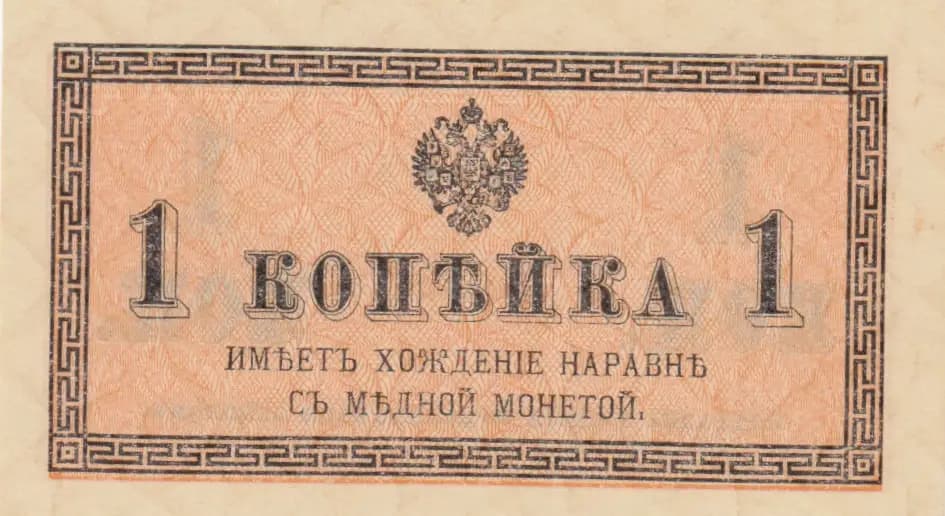
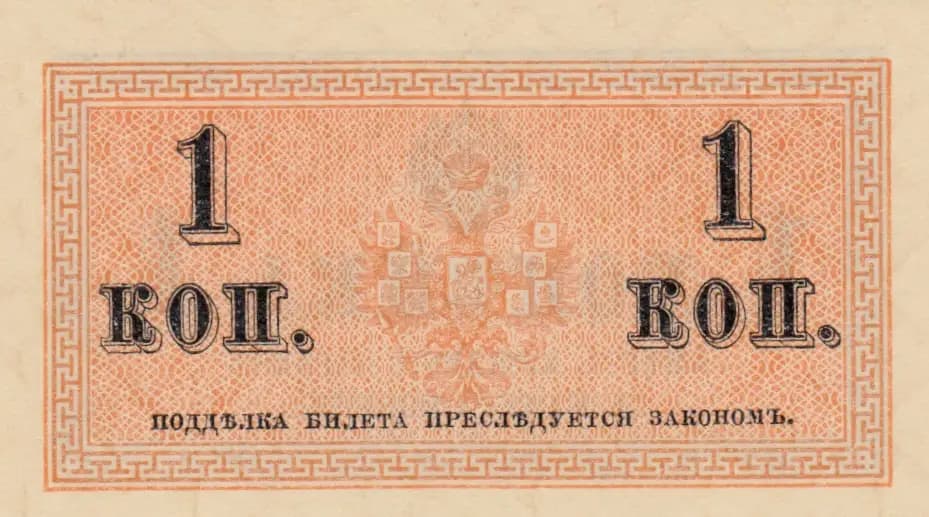
This is a well-preserved example of the 1915 Russian Imperial 1 kopeck banknote (Pick-24), displaying excellent condition with minimal wear consistent with an UNC grade. The note features the characteristic peach/salmon colored paper with the Imperial double-headed eagle centered on the obverse and faint heraldic watermarking on the reverse, both framed by decorative Greek key borders in black. The fine line work and detailed printing remain crisp throughout, making this an attractive specimen of early 20th-century Russian monetary crisis-era small denomination currency.
Common. The eBay market data shows consistent sales of this note across multiple condition grades from 2012-2026, with VF and EF examples regularly selling for $2-$7 and only premium PMG-graded specimens (64) commanding higher prices around $24. The 2016 catalog value of $4 UNC supports common status. The 1915 1 kopeck was issued in large quantities as emergency wartime currency and remains readily available to collectors.
Issued during 1915 in the midst of World War I and the Russian Empire's monetary crisis, this 1 kopeck banknote represents the government's attempt to supplement copper coinage with paper currency of small denominations. The prominent Imperial Russian double-headed eagle with crown and orb symbolizes the authority of Tsar Nicholas II's regime, while the inscriptional guarantee that the note 'has equal circulation with copper coin' underscores the economic pressures forcing the substitution of paper for metal currency during wartime conditions.
The 1915 1 kopeck note is dominated by the Imperial Russian coat of arms—the double-headed eagle with crown and orb—positioned at upper center on the obverse. The design employs a restrained aesthetic typical of emergency wartime currency: a peach/salmon-colored underprint serves as the base, with black ink used for the Greek key border pattern, denomination numerals, and all textual elements. The reverse features a faint but visible watermark or security design with heraldic elements at center, surrounded by the same Greek key decorative border. The paper color and fine line work throughout reflect the engraving techniques of the period. No portraits are depicted, a common feature of Imperial Russian small-denomination notes which typically emphasized state symbols rather than individual representation.
OBVERSE: The numeral '1' appears in large type on both left and right sides. The text 'КОПЕЙКА' (Kopeck) identifies the denomination. Below the eagle is inscribed 'ИМѢТЬ ХОЖДЕНІЕ НАРАВНѢ С МѢДНОЙ МОНЕТОЙ.' which translates to 'Has equal circulation with copper coin.' REVERSE: Corner denominations read '1' and 'КОП.' (Kop./Kopeck) in all four corners. The lower text states 'ПОДДЕЛКА БИЛЕТА ПРЕСЛЕДУЕТСЯ ЗАКОНОМ.' which translates to 'Counterfeiting of banknotes is prosecuted by law.'
This note was produced using intaglio engraving (line engraving) combined with letterpress printing, evident from the crisp, fine line work visible throughout the design, the decorative Greek key patterns, and the sharp denomination numerals. The two-color printing process (black on brown-orange/peach underprint) was typical of Russian Imperial banknote production of this era. The fine crosshatch patterns visible on the reverse and the detailed heraldic watermark suggest skilled engraving work characteristic of the Russian Imperial printing operations.
No specific variety information is readily apparent from the visual analysis provided. The note shows standard obverse and reverse designs consistent with Pick-24. Potential varieties for this issue may exist based on printer marks, serial number ranges, or subtle design differences across printing runs, but these cannot be definitively determined from the images alone. Collectors should consult specialized Russian Imperial banknote catalogs for documented varieties of the 1915 1 kopeck issue.