1- 3 kopeek 1917
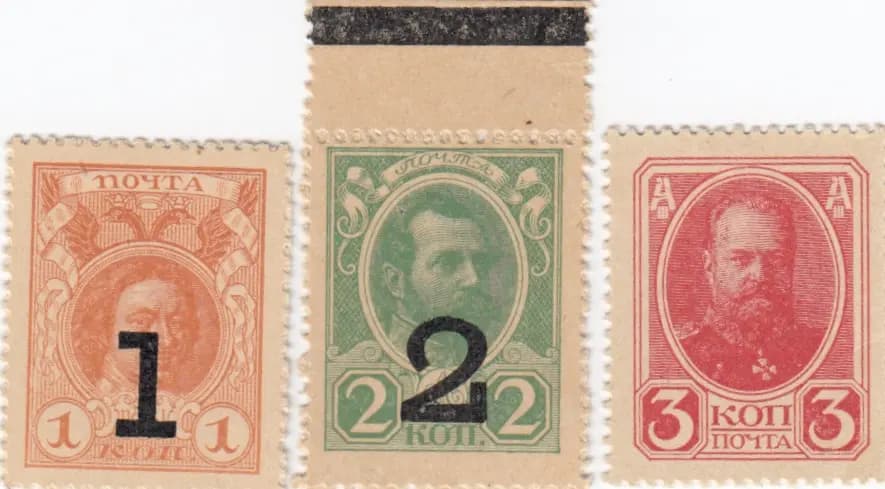
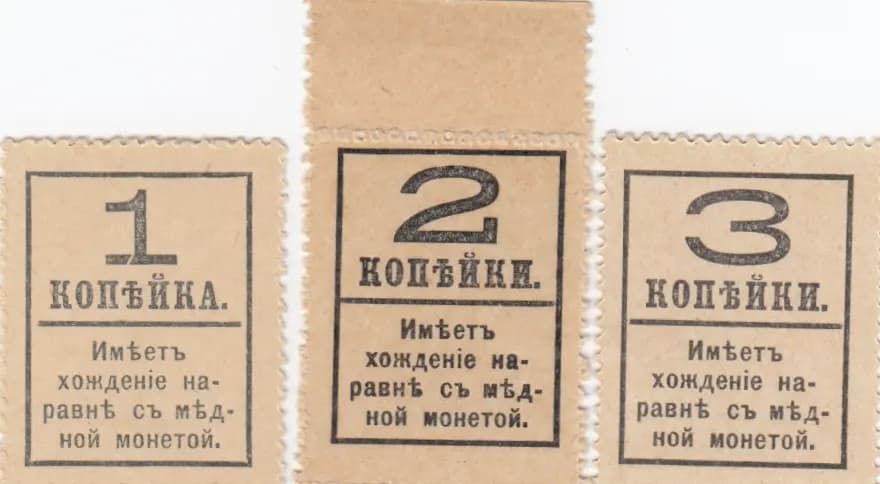
“stamp money”
About This Note
This exceptional UNC example of the 1917 Russian Provisional Government stamp money comprises three denominations (1, 2, and 3 kopecks) presented as a complete set. Each stamp features a bearded male portrait in an oval medallion surrounded by ornamental borders in distinct colors—orange, green, and red respectively—with Cyrillic inscriptions identifying them as postal stamps (ПОЧТА). The reverse displays denomination labels with the critical declaration that these stamps 'have circulation equal to copper coin,' making them emergency fiat currency during the Russian Revolution's chaos.
Common. As official Provisional Government emergency currency issued during 1917, these stamps were produced in substantial quantities to address the currency crisis. The survival of complete, uncut sets in UNC condition is more unusual than individual stamps, but the denomination itself remains common within the collector market. These pieces circulated widely and were preserved in significant numbers by collectors and postal enthusiasts, making them accessible to numismatists at moderate price points.
Issued during the tumultuous 1917 period when Russia's Provisional Government faced severe currency shortages following the February Revolution, this stamp money represents an innovative but desperate monetary solution. The Provisional Government authorized postage stamps to circulate as legal tender alongside regular coinage, as evidenced by the explicit reverse inscription guaranteeing their value parity with copper coins. This emergency measure reflects the institutional breakdown and economic crisis that characterized the Russian Revolution period, ultimately superseded by Soviet currency following the October Revolution.
These stamps represent a uniquely Russian emergency currency solution, utilizing actual postage stamps as the medium. The front displays three stamps in the traditional Russian Imperial postal style, each bearing an identical bearded male portrait—likely representing a symbolic figure of the Russian state or postal service rather than a specific historical personage. The portraits are housed within ornate oval medallion frames featuring decorative scrollwork and floral border elements in the Art Nouveau style typical of Russian Imperial design. The color differentiation (orange/coral for 1 kopeck, green for 2 kopecks, red/crimson for 3 kopecks) follows standard philatelic practice for denomination differentiation. The reverse side presents a more utilitarian design with rectangular framed denomination declarations printed in black on cream-colored stock, emphasizing the legal-tender status through repeated inscription of the monetary parity clause.
FRONT (Stamps): ПОЧТА (Post/Mail) appears at the top of each stamp. Denominations and currency unit are marked as: '1 КОПЕЙКИ' (1 Kopeck), '2 КОПЕЙКИ' (2 Kopecks), '3 КОПЕЙКИ' (3 Kopecks). BACK (Denomination Labels): '1 КОПЕЙКИНА' (1 Kopeck), '2 КОПЕЙКИ' (2 Kopecks), '3 КОПЕЙКИ' (3 Kopecks). Each label includes the critical legal declaration: 'Иметь хождение наравне с мёдной монетой' (To have circulation equal to copper coin).
Typographic (letterpress) printing appears to have been employed for both obverse and reverse, evidenced by the sharp, clean impression of the ornamental borders and the crisp text rendering visible in the reverse denomination labels. The stamps themselves likely utilized traditional postage stamp printing techniques common to Russian Imperial postal authorities. The color differentiation on the front stamps suggests separate printing runs or plates for each denomination, which was standard practice for distinguishing stamp values in this era.
This lot presents the complete three-denomination set (Pick 32, 33, and 34) as a unified piece. The specific variety is identifiable by the Provisional Government's authorization marks and the consistent design elements across all three denominations. No significant varieties are documented for this issue beyond the standard three denominations listed in the Pick catalog. The condition grade of UNC indicates this is an uncut, unused sheet presentation or carefully preserved specimen.