1 & 2 kopeek 1915
“stamp money”
About This Note
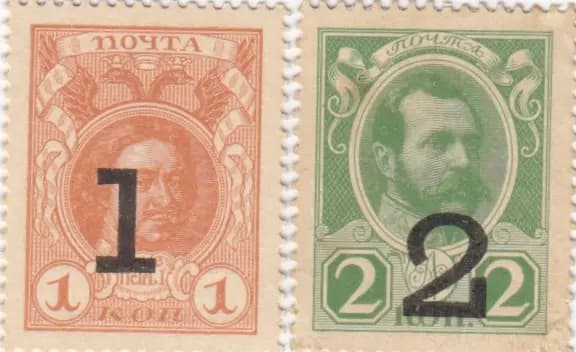
This is a fascinating example of Russian Empire stamp money from 1915, consisting of two postage stamps (1 and 2 kopeeks) that were officially converted to emergency currency. The stamps feature ornamental border designs with male portrait medallions in orange/coral and green respectively, with clear black numerical overprints. Both pieces are in uncirculated condition with crisp impressions, no wear, and the original perforated edges intact—a remarkable survival for emergency currency from the final years of Imperial Russia.
Common. Stamp money of 1915 was issued in substantial quantities to address wartime currency shortages, and survived in considerable numbers due to the paper medium's durability compared to circulated coins. The uncirculated condition makes this example more desirable than average circulated examples, but the denomination and issue type remain fundamentally common in the collector market. These notes typically trade for modest prices reflecting their historical interest rather than rarity.
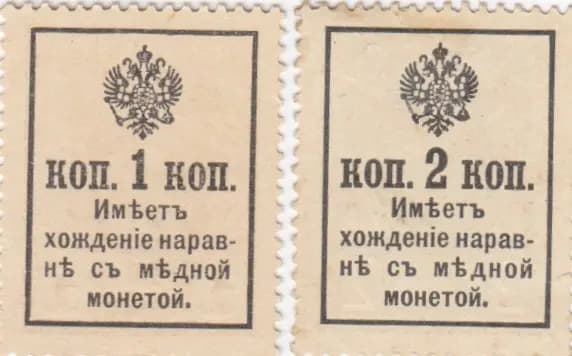
During World War I, Russia experienced severe shortages of small-denomination metal currency due to military demands and economic disruption. The Russian Imperial government authorized the conversion of postage stamps into legal tender by official decree, as evidenced by the reverse side featuring the double-headed Imperial eagle and declaration that these stamps would 'have circulation equal with copper coin.' The stamps shown, dated 1915, represent this desperate but ingenious monetary measure during the closing years of the Romanov dynasty.
The obverse features two Imperial Russian postage stamps of the Alexander III definitive series design. The left stamp (1 kopeck) displays a coral/orange color scheme with an ornamental guilloche border frame and a male portrait medallion in the center, likely representing a member of the Imperial family. The right stamp (2 kopecks) employs a green color scheme with identical ornamental treatment and portrait medallion. Both stamps retain their original perforated edges characteristic of postage stamps. The reverse presents two official control labels, each crowned with the Imperial double-headed eagle emblem, providing the legal authority (an Imperial decree) that grants these stamps monetary status equivalent to copper coinage in denominations of 1 and 2 kopecks respectively.
Front side: 'ПОЧТА' (POST/MAIL); '1' and '2' (overprinted denominations in kopecks on left and right stamps respectively). Back side: Both labels bear identical text reading 'КОП. 1 КОП.' and 'КОП. 2 КОП.' respectively, followed by the declaration: 'Имѣть хождение нарав-нѣ с мѣдной монетой.' (To have circulation equal with copper coin.) The statement officially recognizes these stamps as legal tender at face value in kopecks, equivalent to copper coinage.
The stamps were produced using intaglio (engraved) printing combined with surface-printed overprints for the numerical values. The fine-line guilloche background patterns, ornamental borders, and portrait medallions are characteristic of high-security intaglio work typical of Imperial Russian postage stamp production. The reverse control labels employ letterpress printing with the Imperial eagle emblem. The original stamps were from the Imperial Russian State Printing Works.
The specific variety is identified by the two denominations presented together (1 and 2 kopecks, corresponding to Pick P-16 and P-18). This appears to be a matched pair from the same 1915 series. No mint marks, signature varieties, or serial number prefixes are evident on these stamp money issues, as Imperial stamp currency generally lacked such individuating features. The presence of both denominations in uncirculated condition as a set increases collectible appeal over individual examples.