5 rupias 1945
About This Note
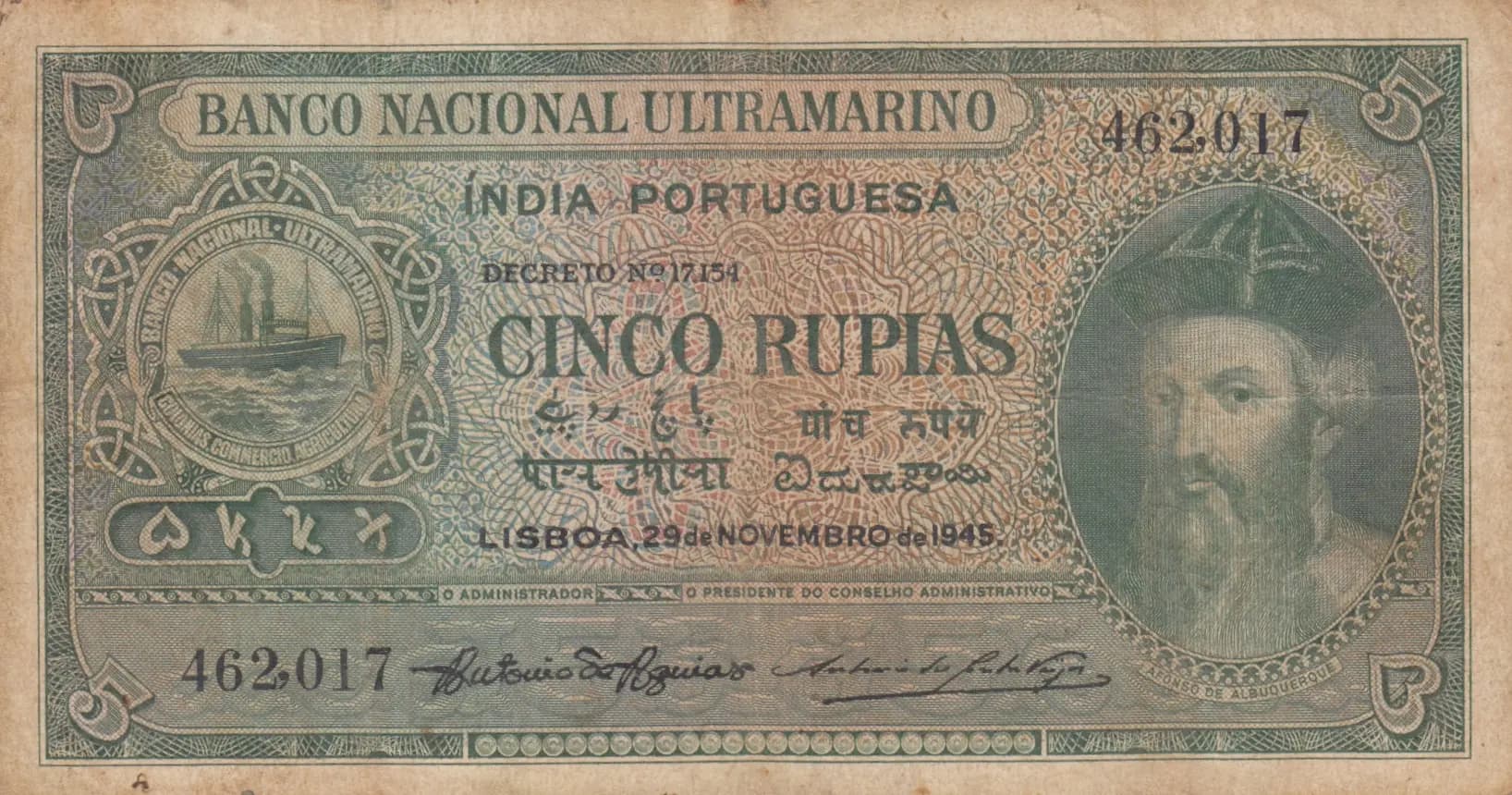
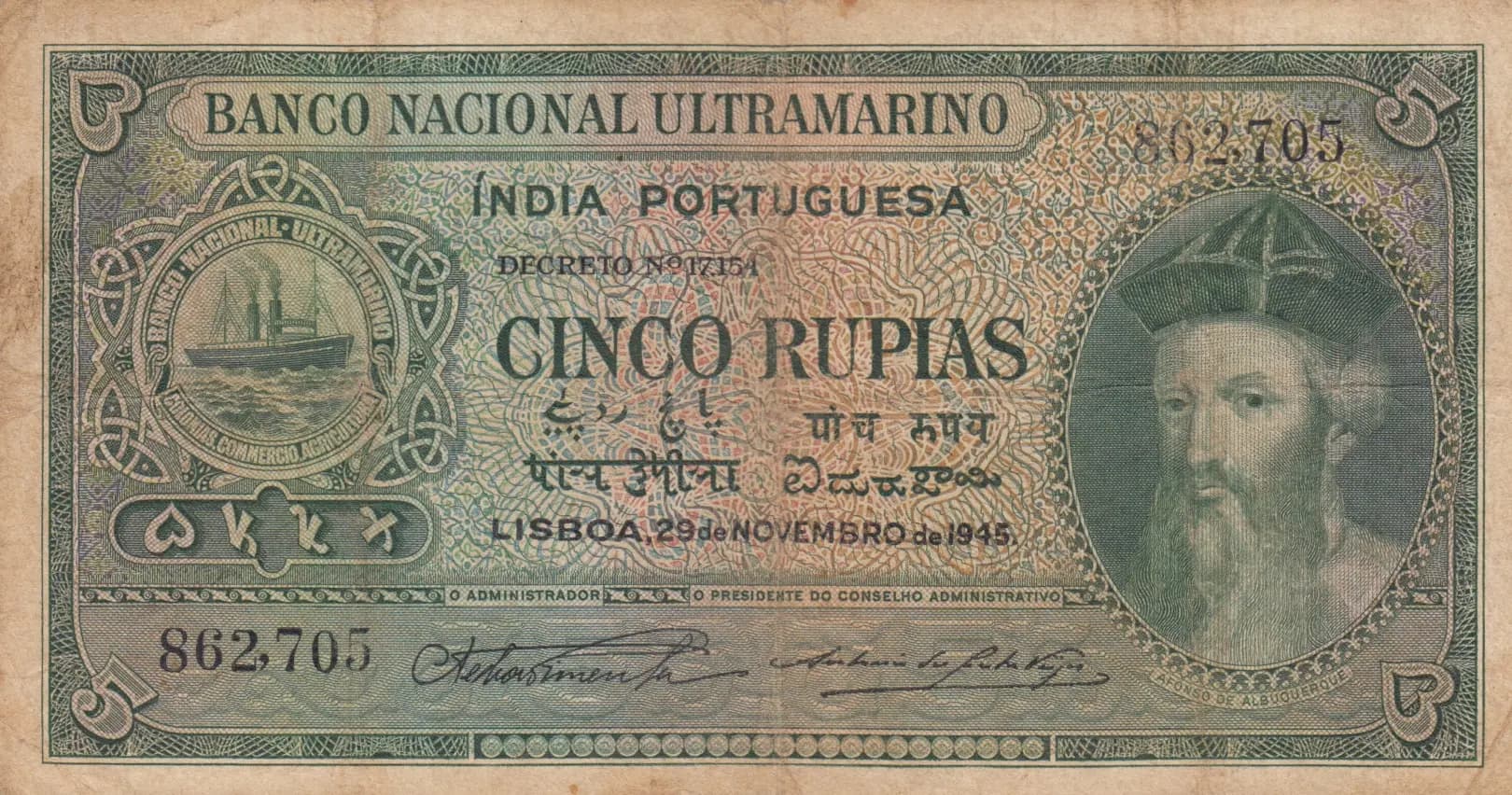
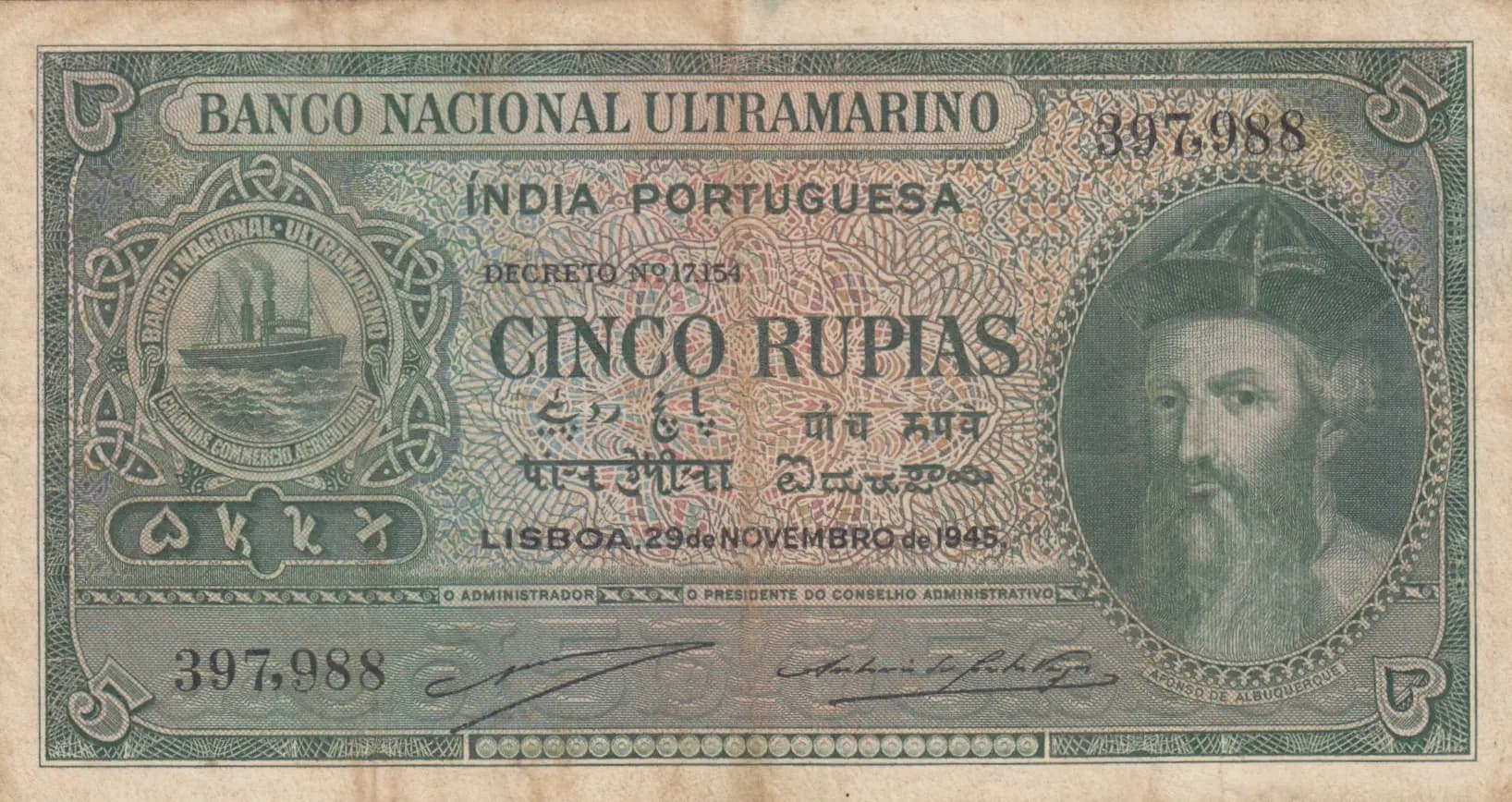
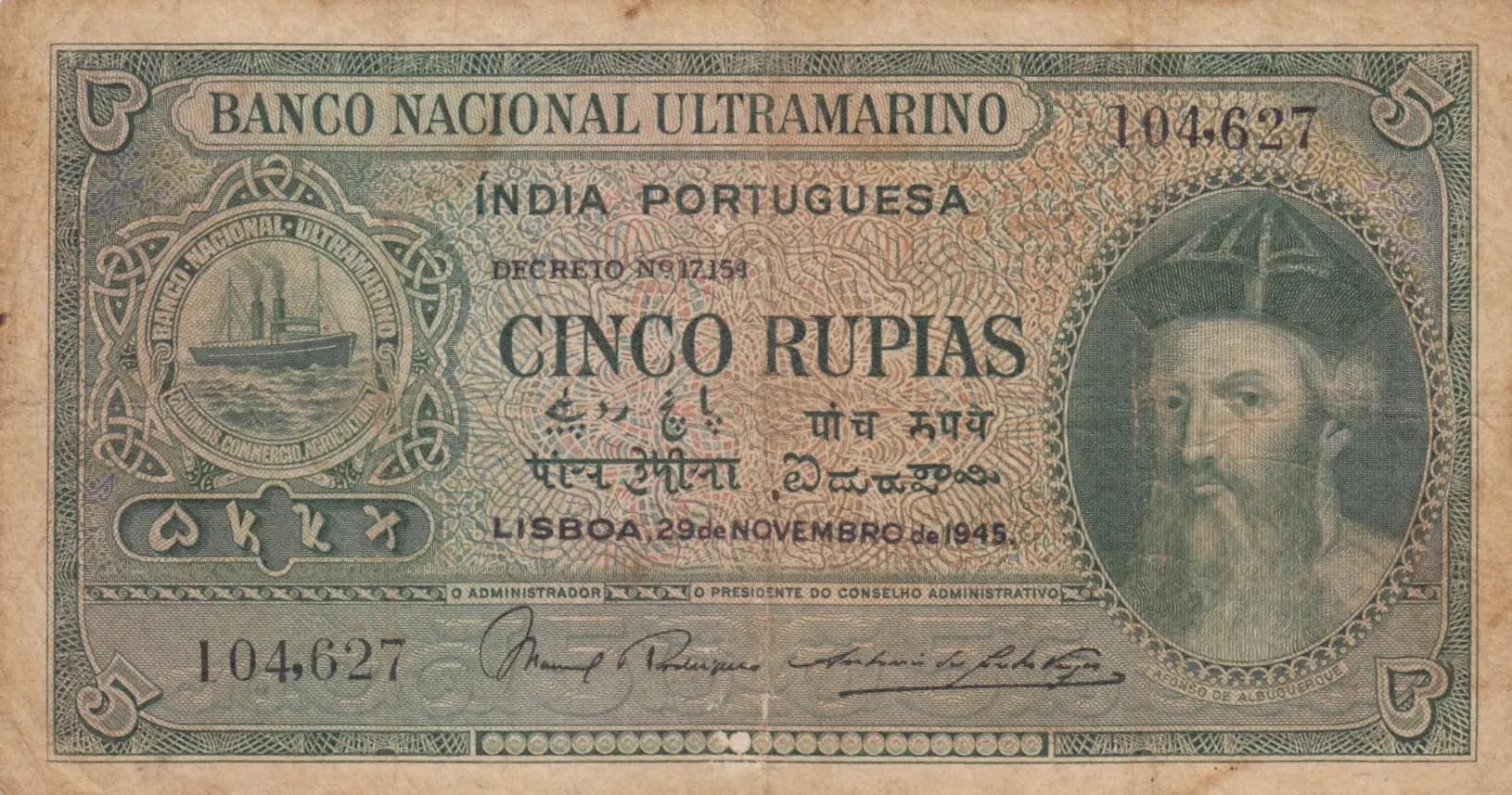
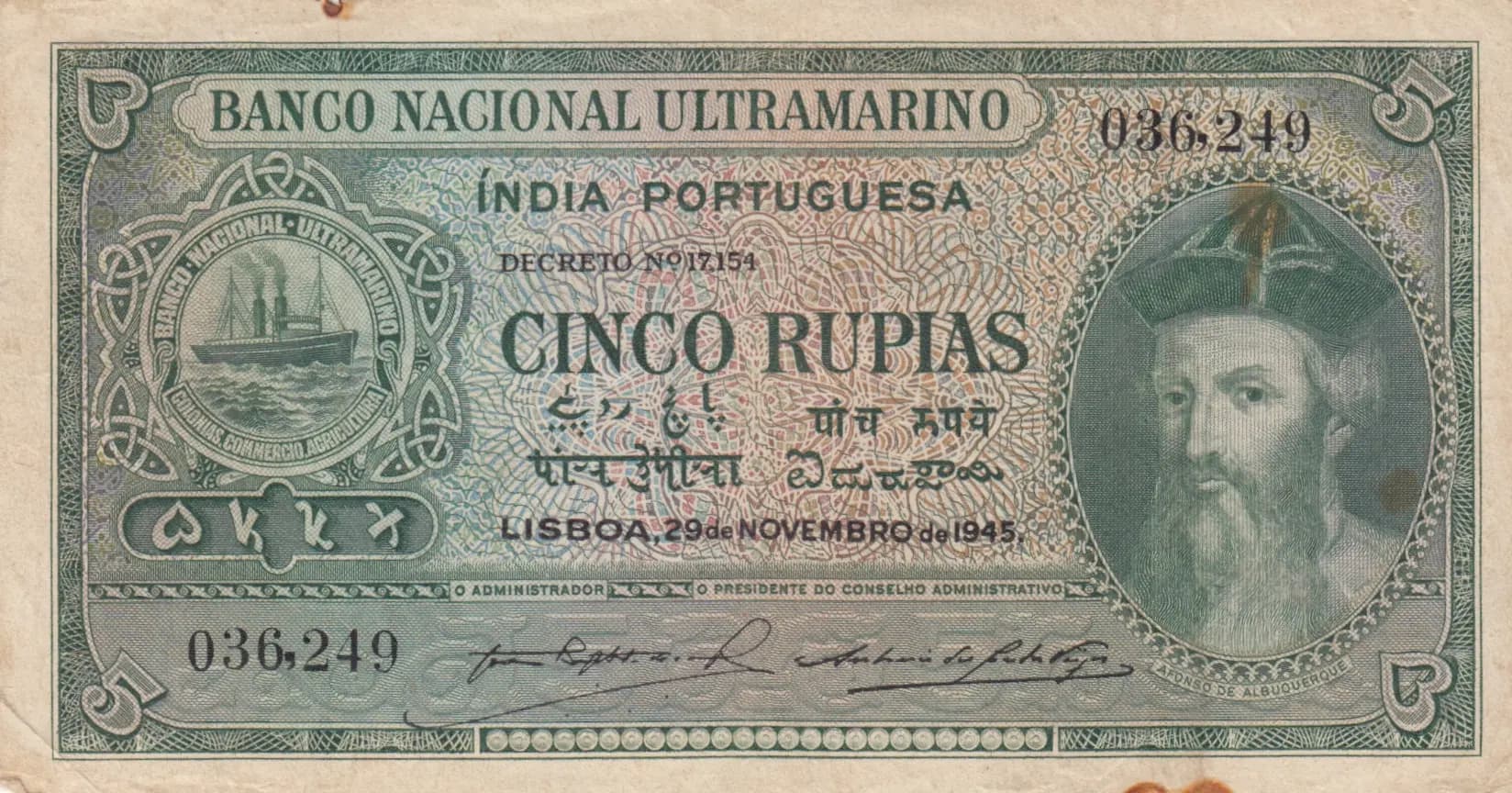
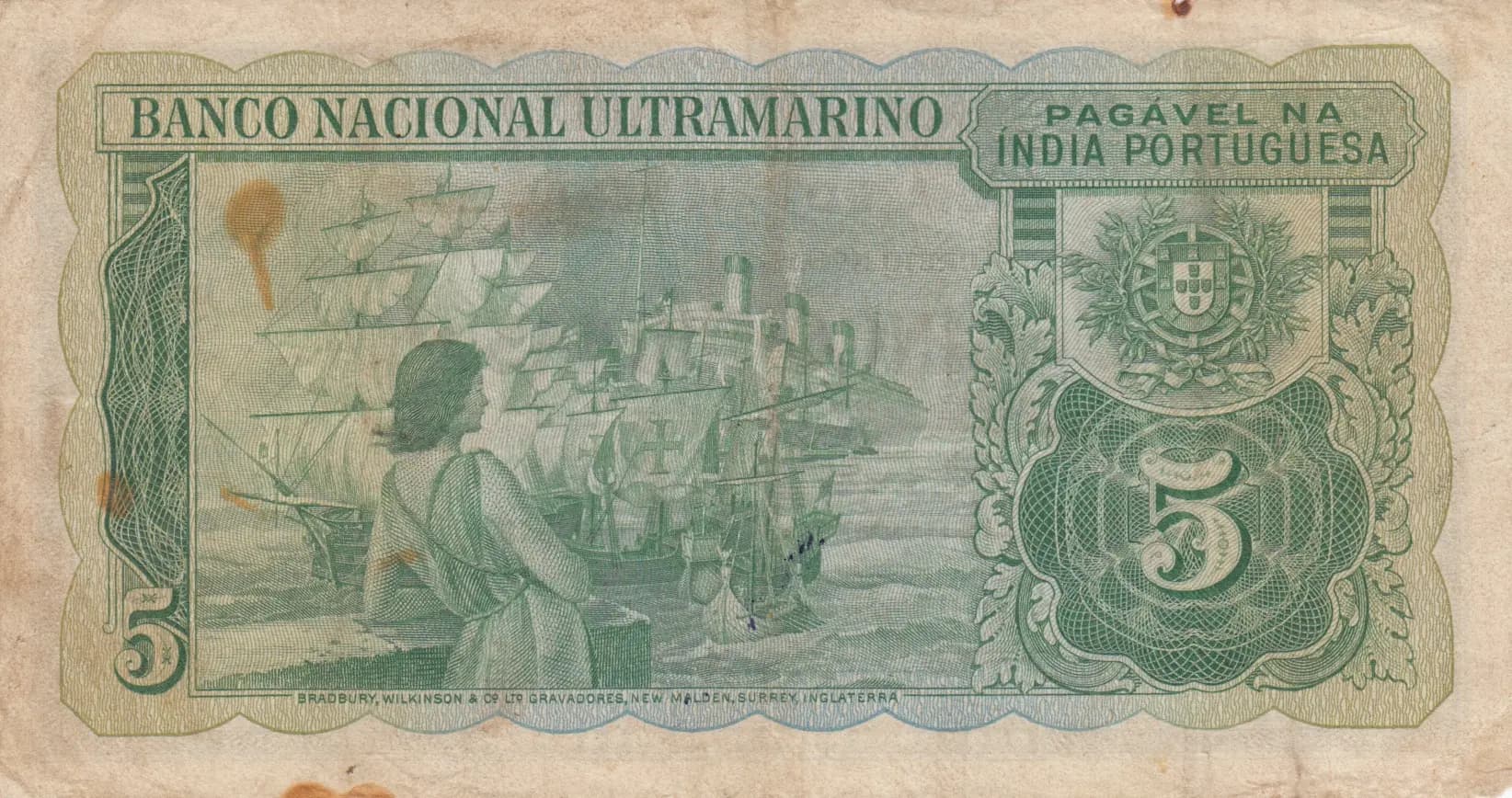
This is a Portuguese India 5 Rupias note from 1945, issued by the Banco Nacional Ultramarino and graded VF. The note features a bearded male portrait in an oval frame on the front, paired with a circular maritime vignette of a sailing ship, while the reverse depicts a Portuguese figure gesturing toward caravels in a coastal scene—imagery reflecting Portugal's naval heritage in India. Despite visible foxing and age-related discoloration consistent with a nearly 80-year-old note, the fine line engraving and distinctive Portuguese colonial design remain clearly legible, making this an interesting example of Portuguese colonial currency.
Common. Portuguese India 5 Rupias notes from 1945 (Pick P-35) are widely available in numismatic markets. As a mainstream denomination issued by a major colonial issuing authority during the final years before the territory's incorporation into India, substantial quantities were printed and many have survived. The VF condition grade is representative of typical surviving examples, and such notes regularly appear in collections and dealer stock at modest valuations, typically under $25.
This 1945 note was issued during the final years of Portuguese colonial rule in India, which would end in 1961 with the Indian annexation of Portuguese territories. The reverse design prominently features Portuguese caravels and a figure gesturing toward them, commemorating Portugal's Age of Discovery maritime legacy that established their presence in India centuries earlier. The Banco Nacional Ultramarino, as the issuing authority, served as the central banking institution for Portuguese colonial territories, and this note represents the currency used in Portuguese India during the twilight of colonial administration.
The front features a bearded male portrait in profile facing right, positioned within an oval frame on the right side, with an elaborate circular maritime medallion on the left depicting a multi-masted sailing ship on water. The entire composition is surrounded by intricate geometric and floral patterns in green and pink/rose tones with ornamental borders and decorative shield elements in the corners. The reverse depicts a Portuguese colonial figure in period dress standing in profile on the left shore, gesturing toward multiple full-rigged Portuguese caravels in the background—a deliberate reference to Portugal's Age of Discovery maritime expeditions to India. A Portuguese coat of arms appears at the top right, with an ornate shield containing the numeral 5 in an elaborate cartouche on the lower right, all rendered in green line engraving against a cream background.
FRONT: 'BANCO NACIONAL ULTRAMARINO' (National Overseas Bank), 'INDIA PORTUGUESA' (Portuguese India), 'DECRETO Nº17154' (Decree No. 17154), 'CINCO RUPIAS' (Five Rupees), 'LISBOA, 23 de NOVEMBRO de 1945' (Lisbon, November 23, 1945), 'O ADMINISTRADOR' (The Administrator), 'O PRESIDENTE DO CONSELHO ADMINISTRATIVO' (The President of the Administrative Board), and Devanagari script text 'शुद्ध रुपया' (Pure Rupee). BACK: 'BANCO NACIONAL ULTRAMARINO' (National Overseas Bank), 'PAGÁVEL NA INDIA PORTUGUESA' (Payable in Portuguese India), 'BRADBURY, WILKINSON & CO LTD, GRAVADORES, NEW MALDEN, SURREY, INGLATERRA' (Bradbury, Wilkinson & Co Ltd, Engravers, New Malden, Surrey, England).
Fine line engraving throughout, executed by Bradbury, Wilkinson & Co Ltd, a renowned London-based security printer. The note exhibits the characteristic detailed geometric patterns, intricate background designs, and multiple decorative borders typical of high-security banknote production from the mid-20th century. The multi-color printing (green and pink/rose primary colors with cream background) was achieved through the sequential layering of engraved plates, a standard technique for colonial banknote production of this era.
The specific variety observed features the serial number 036,249 and is dated November 23, 1945 (Lisbon). This note exhibits the Devanagari script text 'शुद्ध रुपया' (Pure Rupee) on the front, consistent with Pick P-35 standard issue. Bradbury, Wilkinson & Co Ltd engraving credit appears on the reverse. No exceptional overprints, signature variants, or printing anomalies are evident in this specimen.