5 pesos 1944
“Mindanao”
Market Prices
About This Note
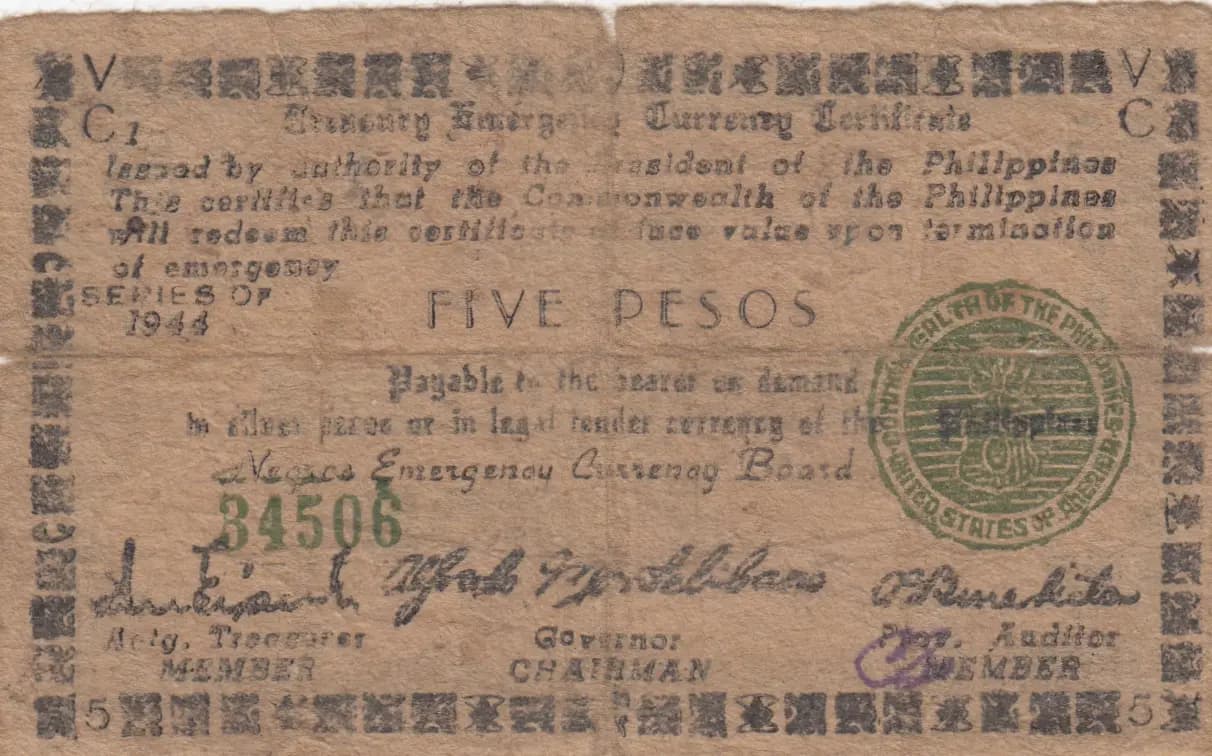
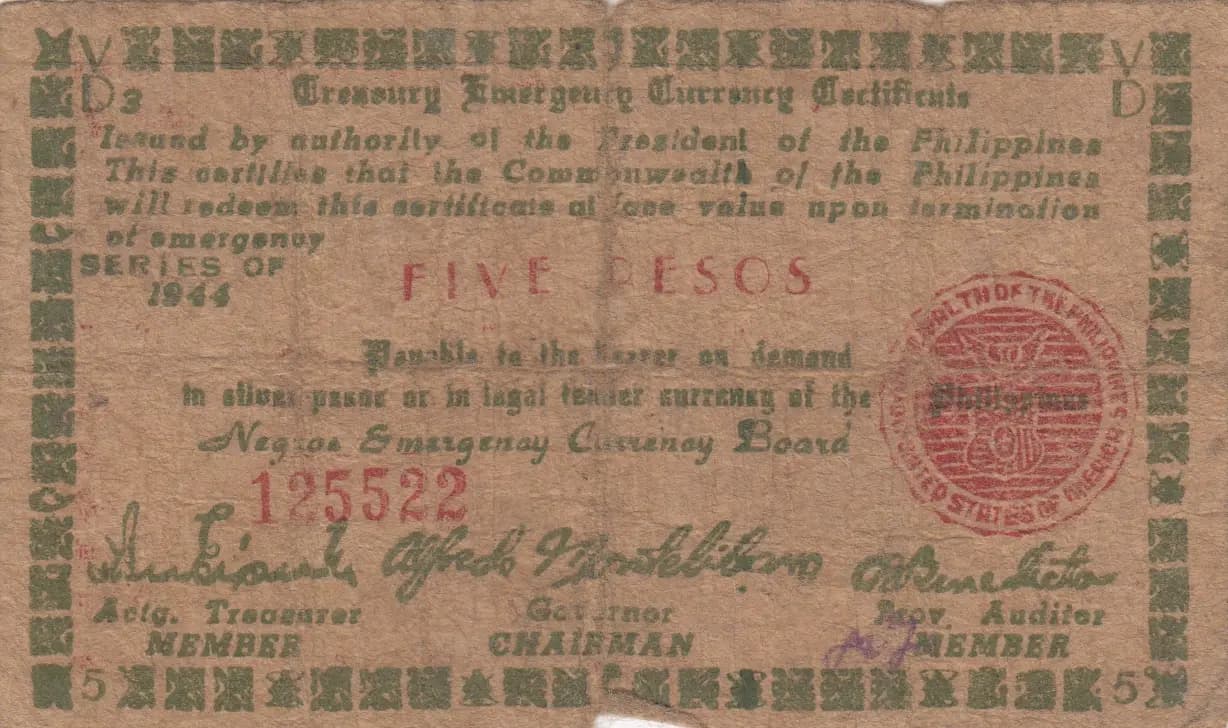
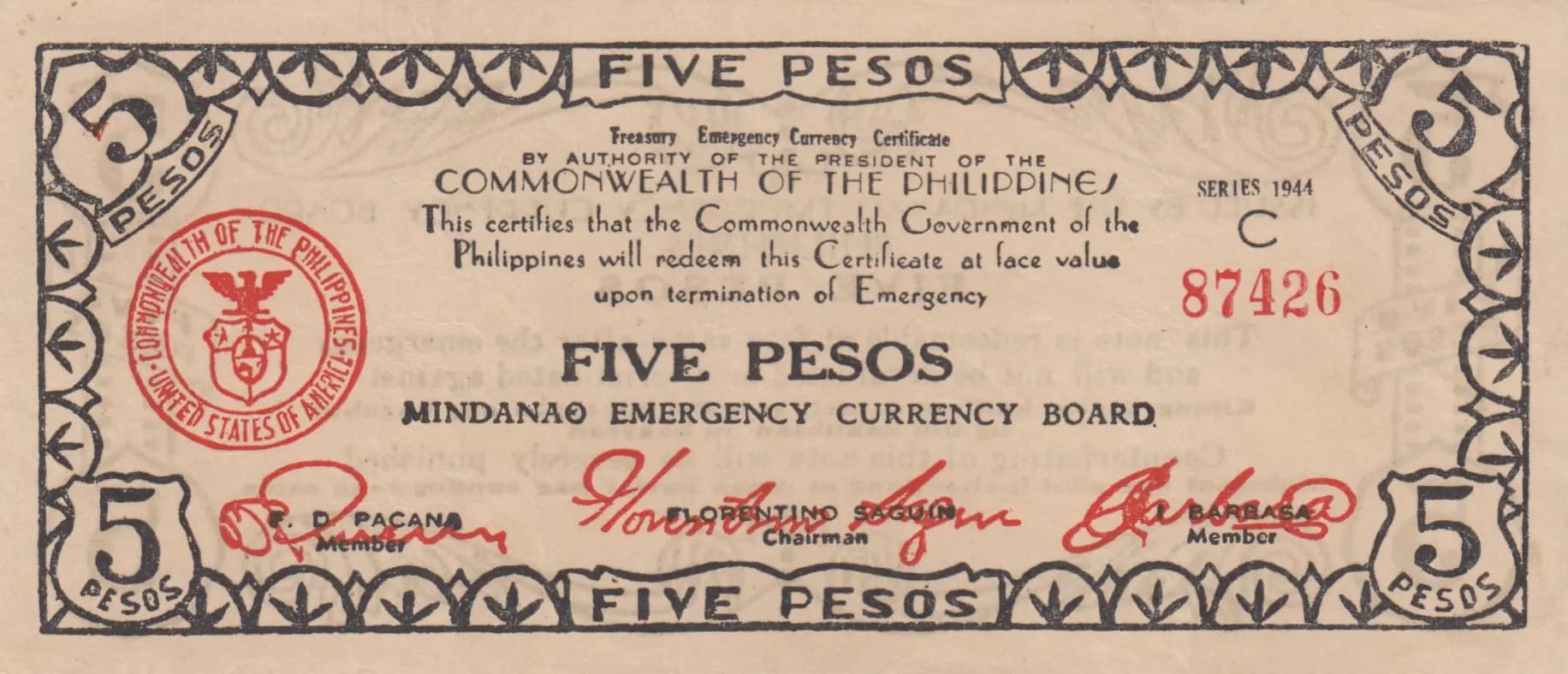
This 1944 Philippine 5 Pesos Treasury Emergency Currency Certificate represents a fascinating wartime issue from the Mindanao Emergency Currency Board, a temporary authority established during WWII. The AU-grade example displays the characteristic tan/beige patina and age-related discoloration typical of notes from this period, with visible creases and handling marks that attest to its circulation history. The note's ornate geometric borders, red Commonwealth seal, and bilingual English/Tagalog inscriptions make it a significant piece of Philippine numismatic history, particularly notable for its emergency currency status and regional issuance.
Common. While this is a wartime emergency issue from a regional board, the market pricing data indicates robust availability: AU specimens are priced at $161.00 USD on eBay, with circulated examples trading in the $3-50 range, suggesting substantial surviving populations. The pick catalog designation P-S517a and the existence of multiple eBay listings across various grades (F, VF, VG, CIRC) confirm this is not a scarce variety. Emergency currency boards typically produced reasonable quantities to meet wartime demand, and Mindanao was a major population center. The AU grade itself commands a modest premium but does not indicate rarity of the date/variety combination.
Issued in 1944 during the final year of Japanese occupation and subsequent Allied liberation of the Philippines, this emergency currency was produced by the Mindanao Emergency Currency Board under the authority of the Commonwealth of the Philippines government. The presence of the U.S. Commonwealth seal reflects the Philippines' status as an American commonwealth territory, while the dual-language text (English and Tagalog) represents the linguistic and political realities of the post-war transitional period. Emergency currency certificates like this were essential as conventional banking and monetary systems were disrupted during the military campaigns to retake Mindanao from Japanese forces.
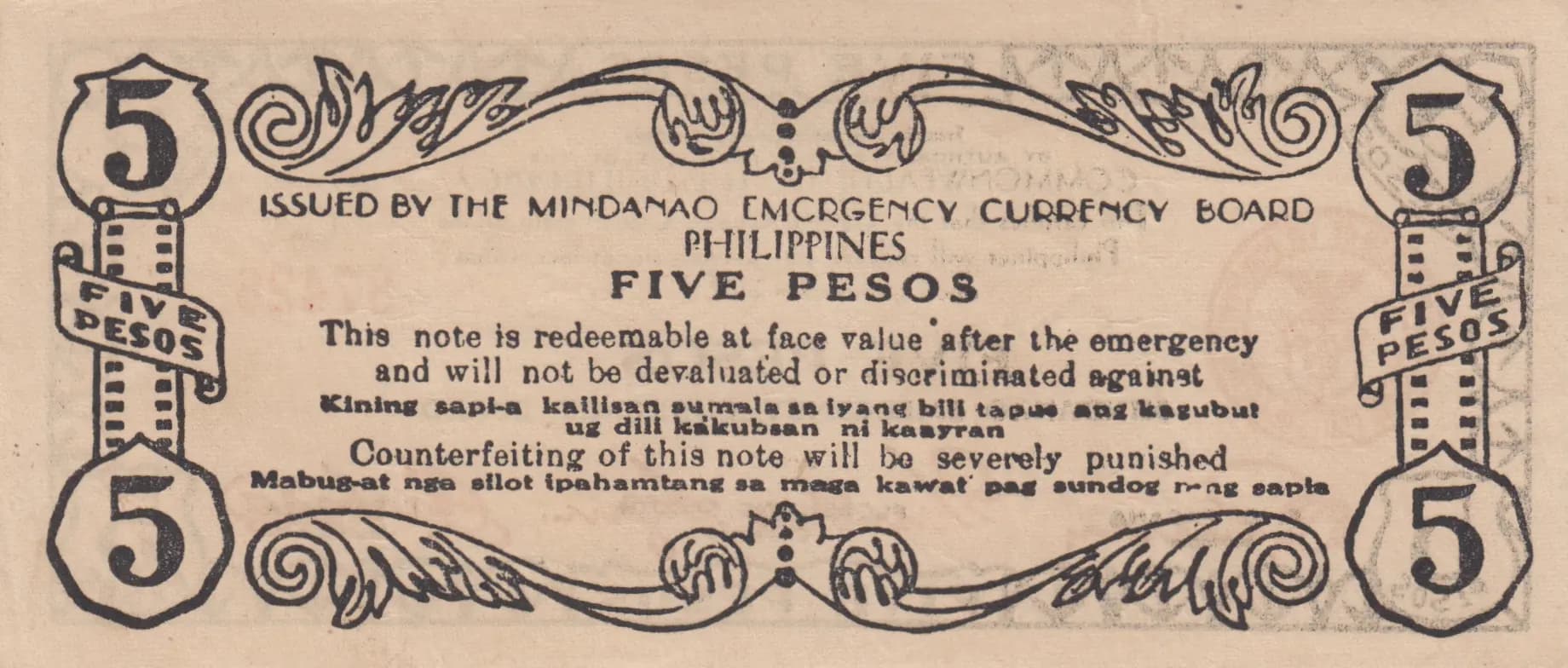
The note features a formal design appropriate to official currency, centered around the concept of temporary emergency currency backed by government authority. The obverse displays the circular seal of the Commonwealth of the United States of America with an eagle emblem on the left side, serving as the primary symbolic element affirming official status. The design employs an ornate geometric border pattern characteristic of 1940s currency printing, with the denomination clearly marked in multiple locations. The reverse side continues the decorative motif with elaborate scrollwork flourishes and shield-shaped frames in the four corners, each containing the numeral '5'. The bilingual text reflects the post-war Philippine context, with English and Tagalog versions of redemption promises and counterfeiting penalties. No portraits of individuals are depicted on the note; instead, it relies on governmental symbols and formal typography for authority. The color scheme consists of beige/tan paper with black and red printing, typical of wartime emergency currency production.
FRONT: 'FIVE PESOS' (denomination, top and bottom); 'Treasury Emergency Currency Certificate'; 'BY AUTHORITY OF THE PRESIDENT OF THE COMMONWEALTH OF THE PHILIPPINES'; 'This certifies that the Commonwealth Government of the Philippines will redeem this Certificate at face value upon termination of Emergency'; 'MINDANAO EMERGENCY CURRENCY BOARD'; 'SERIES 1944'; Serial number '87426'; Signatures of 'PACANA' (Member), 'FLORENTINO SAGUIN' (Chairman), and one additional member. BACK: 'FIVE PESOS' (repeated in four shield-shaped corners); 'ISSUED BY THE MINDANAO EMERGENCY CURRENCY BOARD'; 'PHILIPPINES'; 'This note is redeemable at face value after the emergency and will not be devaluated or discriminated against' (English); 'Kining sapta-kailisan pumala an iyang bill tapus ang kagubut ug dili kalususan ni kaayran' (Tagalog equivalent); 'Counterfeiting of this note will be severely punished' (English); 'Mabug-at nga silot ipahamtang sa mga kawat pag sundog n'ng saple' (Tagalog equivalent).
The note was produced using letterpress printing, evidenced by the crisp relief impressions visible in the geometric borders, shield frames, and ornate scrollwork. The consistent density and alignment of the printed elements, combined with the distinct impression of the red-ink signatures and seal, are characteristic of high-quality letterpress work typical of government currency production. The bilingual text arrangement and multiple denomination markers suggest careful plate preparation. The specific printer for Pick S517a is not definitively documented in standard references, though Philippine emergency currency of this period was often produced by local or regional facilities under military administration.
This specific example is identified as Pick S517a, the 'a' variety designation indicating a specific plate or signature combination within the 1944 Mindanao Emergency Currency Board 5 Pesos issue. The serial number 87426 with prefix 'C' and the signature block including Chairman Florentino Saguin and member Pacana represent identifying characteristics of this particular variety. Collectors should note that multiple signature combinations exist for this series, with variations in the three authorized signatories being a primary basis for cataloging varieties. The 'S' prefix in the Pick number denotes this as a special or supplementary issue rather than a standard regular-issue currency note.