1 peso 1944
“Mindanao”
Market Prices
About This Note
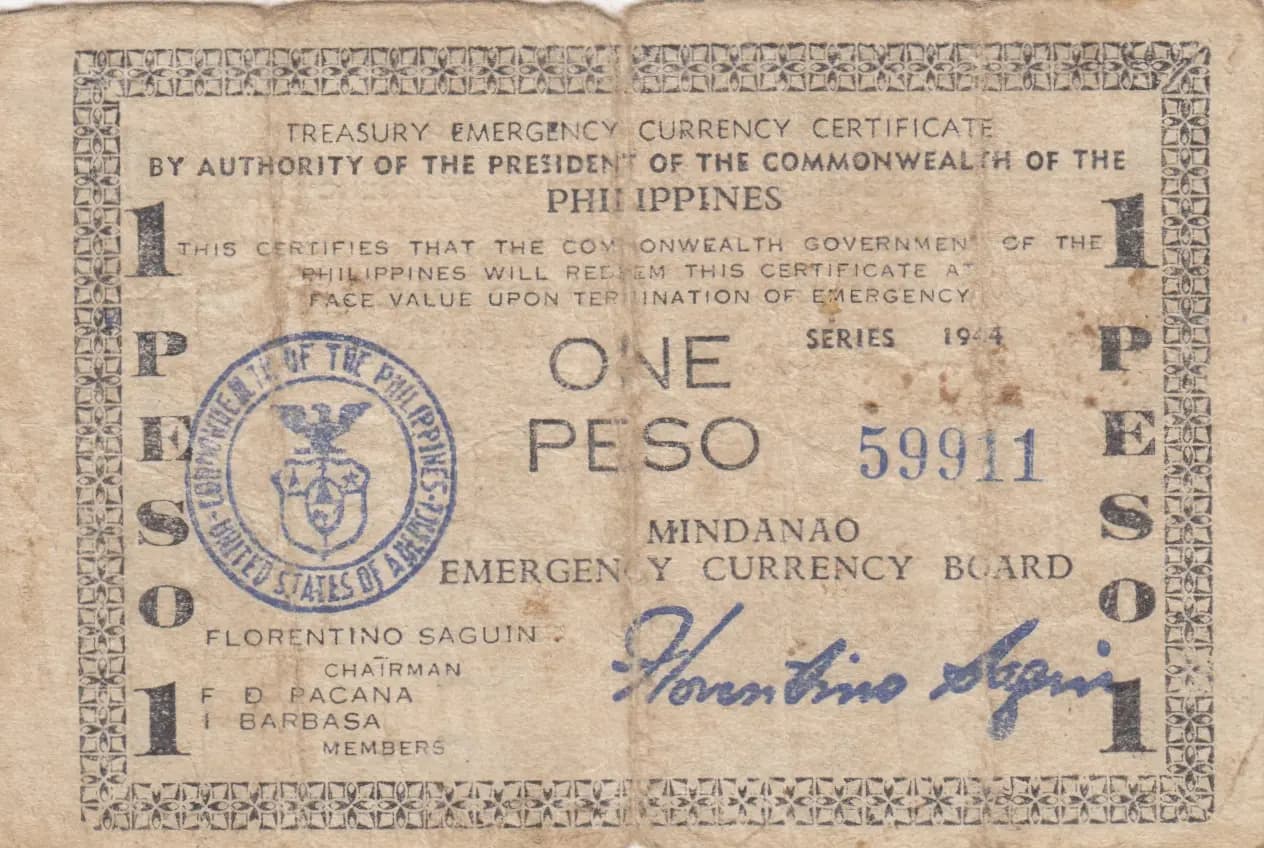
This is a 1 Peso Treasury Emergency Currency Certificate from the Commonwealth of the Philippines, Series 1944, issued by the Mindanao Emergency Currency Board during World War II. The note displays extensive aging with significant foxing, creasing, and discoloration throughout, consistent with VG condition grade. The intricate ornate border and bilingual English/Tagalog inscriptions make this a historically important example of Philippine wartime emergency currency, with the serial number 59911 and signatures of board officials Florentino Saguin, F.D. Pacana, and F. Barbasa clearly visible.
Common. eBay market pricing data shows these notes consistently trading in the $9.99-$20.00 range for circulated examples, with even AU-condition specimens reaching only $20-$161.00, suggesting moderate collector demand but substantial existing supply. The Mindanao Emergency Currency Board issued multiple denominations in 1944, and surviving examples of the 1 Peso denomination appear in sufficient quantity to maintain affordable pricing. The VG condition grade of this specific example places it at the lower end of collector interest, consistent with the $10-15 range typical for similar worn examples. Wartime emergency currency from the Philippines, while historically significant, was issued in substantial quantities to support the regional economy during occupation, making individual notes relatively common in the secondary market.
This emergency currency was issued under the authority of the Commonwealth of the Philippines government during the Japanese occupation of World War II (1942-1945), when normal monetary circulation was disrupted. The Mindanao Emergency Currency Board was established as a localized response to currency shortages in the Mindanao region, with redemption guarantees printed in both English and Tagalog to reassure the populace. The note's certification that it would be redeemed at face value 'upon termination of emergency' reflects the provisional nature of wartime currencies and the Commonwealth government's commitment to honoring these certificates post-war.
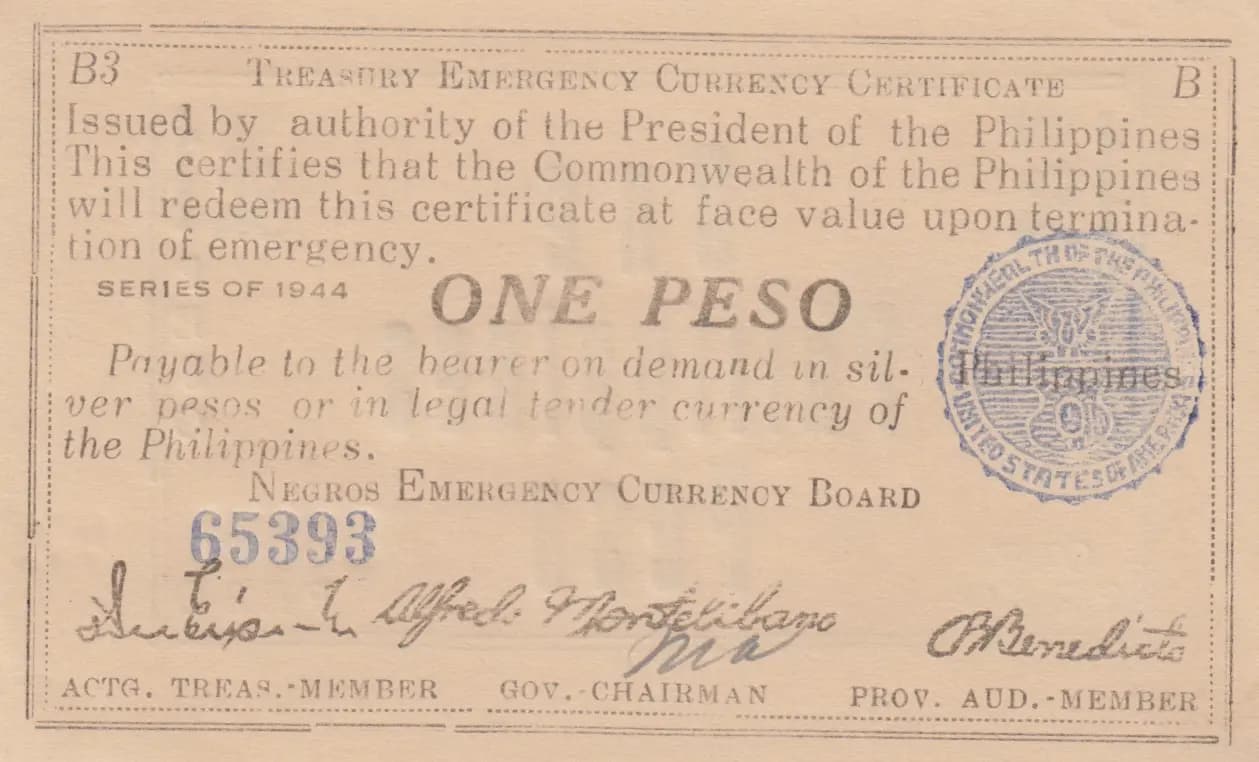
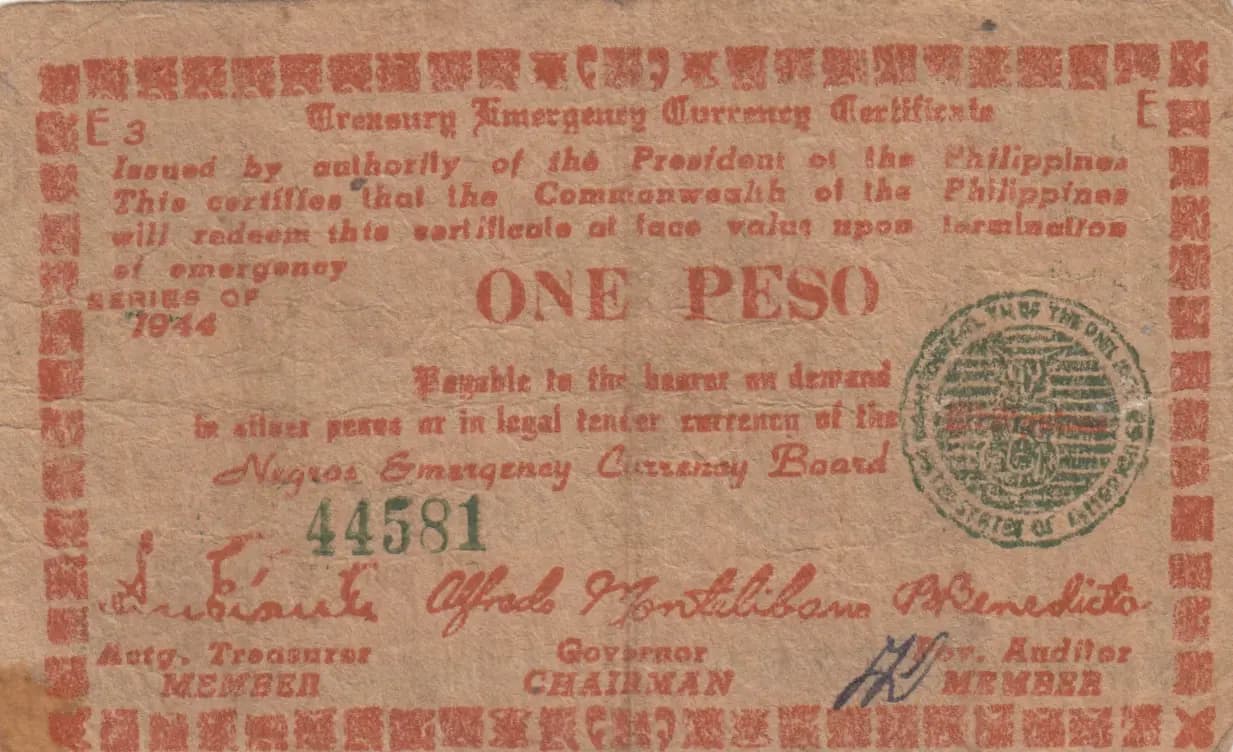
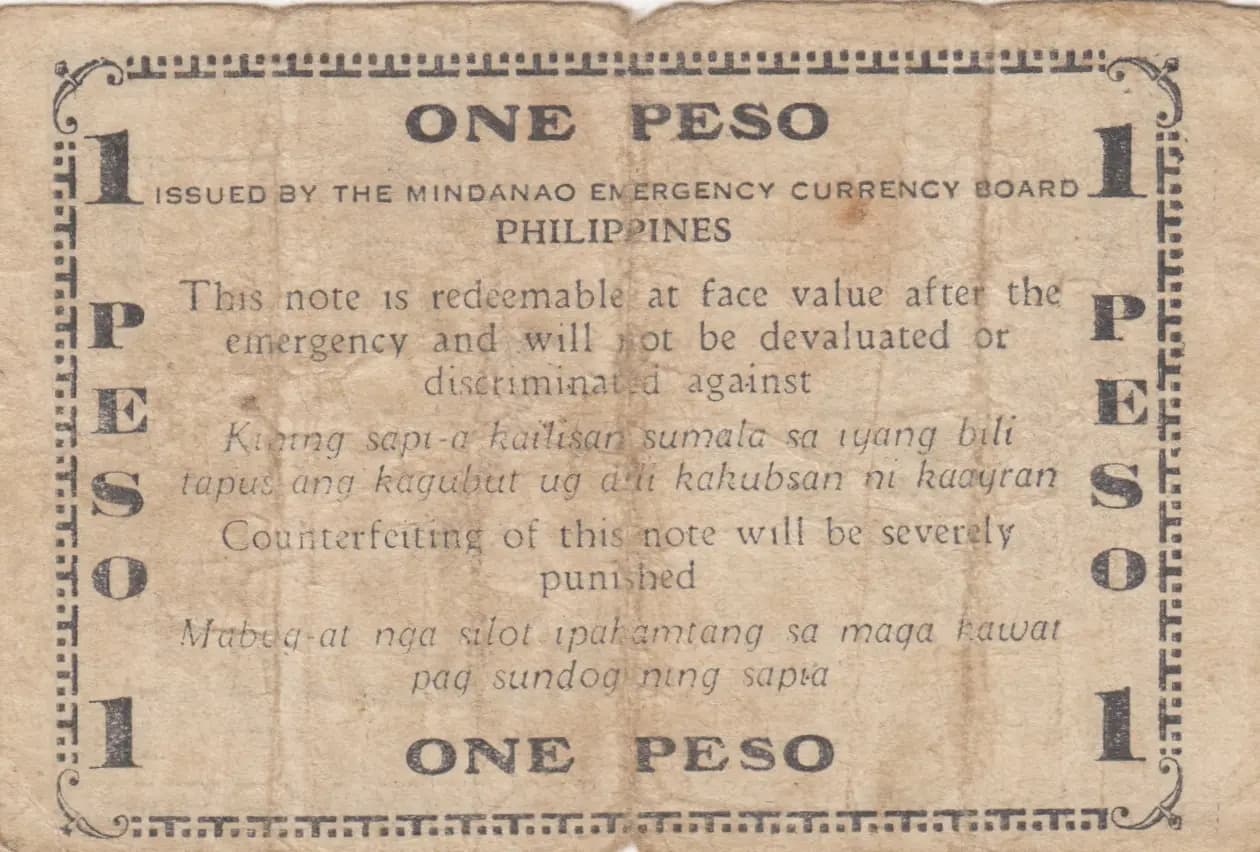
The note features a formal, austere design appropriate to its emergency currency status, with an ornate rectangular border containing geometric patterns on both sides. The front displays the Seal of the Commonwealth of the Philippines (a circular seal featuring an eagle and shield design) positioned center-left, serving as the primary security element and symbol of governmental authority. The denomination 'ONE PESO' is presented prominently with the series year '1944' clearly marked. The central text area is densely arranged with both vertical and horizontal inscriptions in English, establishing the legal basis for redemption and naming the issuing authority. The back reiterates the denomination and redemption terms, with parallel text in both English and Tagalog to ensure accessibility to the local population. The overall design eschews portraiture in favor of textual authority and the Commonwealth seal, reflecting the utilitarian emergency nature of the certificate. The paper stock shows the characteristic tan/beige coloration of aged currency paper.
FRONT: 'TREASURY EMERGENCY CURRENCY CERTIFICATE' / 'BY AUTHORITY OF THE PRESIDENT OF THE COMMONWEALTH OF THE PHILIPPINES' / 'THIS CERTIFIES THAT THE COMMONWEALTH GOVERNMENT OF THE PHILIPPINES WILL REDEEM THIS CERTIFICATE AT FACE VALUE UPON TERMINATION OF EMERGENCY' / 'ONE PESO' / 'SERIES 1944' / Serial number '59911' / 'MINDANAO EMERGENCY CURRENCY BOARD' / 'FLORENTINO SAGUIN - CHAIRMAN' / 'F.D. PACANA' / 'F. BARBASA' / 'MEMBERS' [with signature]. BACK: 'ONE PESO' (top and bottom) / 'ISSUED BY THE MINDANAO EMERGENCY CURRENCY BOARD' / 'PHILIPPINES' / 'This note is redeemable at face value after the emergency and will not be devalued or discriminated against' / Tagalog: 'Kung sapi-a katilsan sumala sa iyung bili tapus ang kagubat ug adi kakubsan ni kaagyan' [approximately: 'This note shall be accepted in all purchases after the war and shall not be subject to discrimination'] / 'Counterfeiting of this note will be severely punished' / Tagalog: 'Mabig-at nga silot ipatamiang sa mga kawai pag sundog ning sapya' [approximately: 'Severe punishment shall be imposed on those who counterfeit this note'].
This note was produced using letterpress printing, the standard security printing method for banknotes and emergency currency of the 1940s era. The crisp, defined impression of the text and border elements visible in the images, along with the depth of the black ink, is characteristic of letterpress production. The bilateral design with mirrored border patterns and consistent ink density suggests professional security printing facilities, likely operated under Commonwealth authority or contracted by the Philippine government. The registration and alignment of text across both sides indicates careful plating and press work typical of government currency production of this period.
This note is cataloged as Pick S523a (the 'a' variety designation). The specific variety can be identified by the serial number format (59911), the signature of Florentino Saguin as Chairman, and the names of board members F.D. Pacana and F. Barbasa. Variations in this series are primarily distinguished by serial number ranges and potential differences in printing runs; the bilingual text (English/Tagalog) appears consistent with the primary issue type for Mindanao Emergency Currency Board notes. No overprints, date variations, or color varieties are apparent on this example. The Pick catalog S523a designation indicates this is a recognized standard variety within the established typology of Philippine emergency currency from 1944.