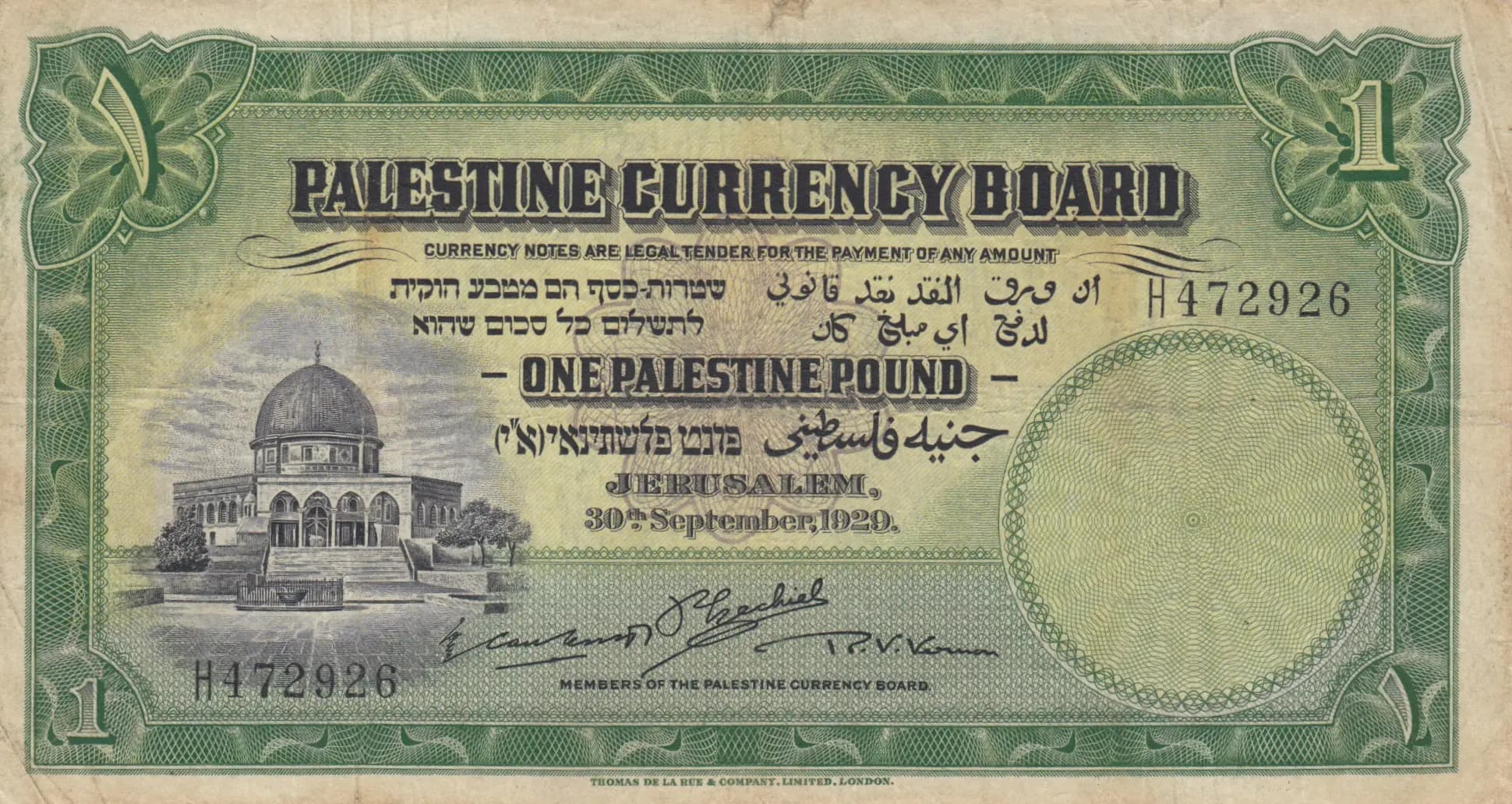
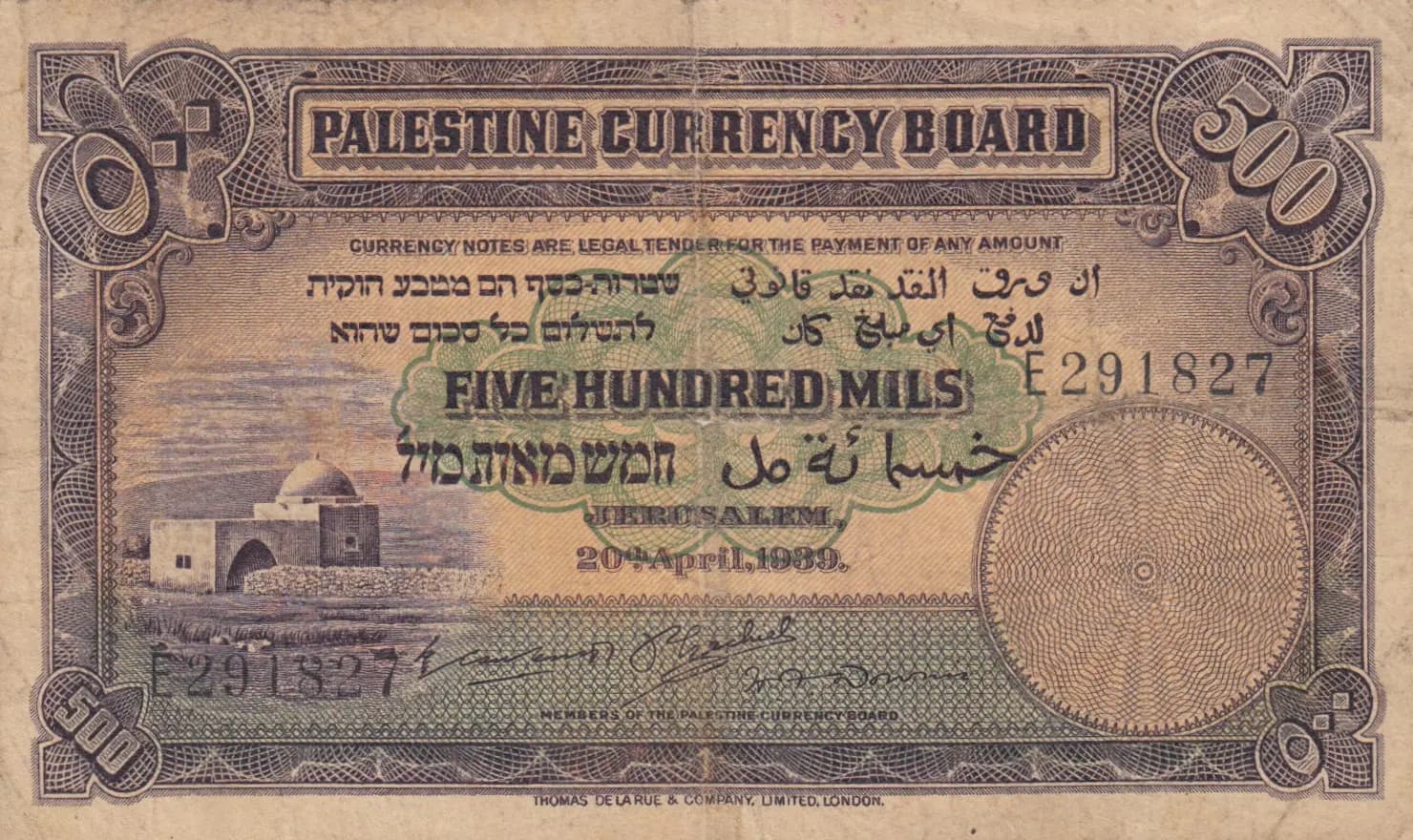
1 pound 1939
Market Prices
14 salesAbout This Note
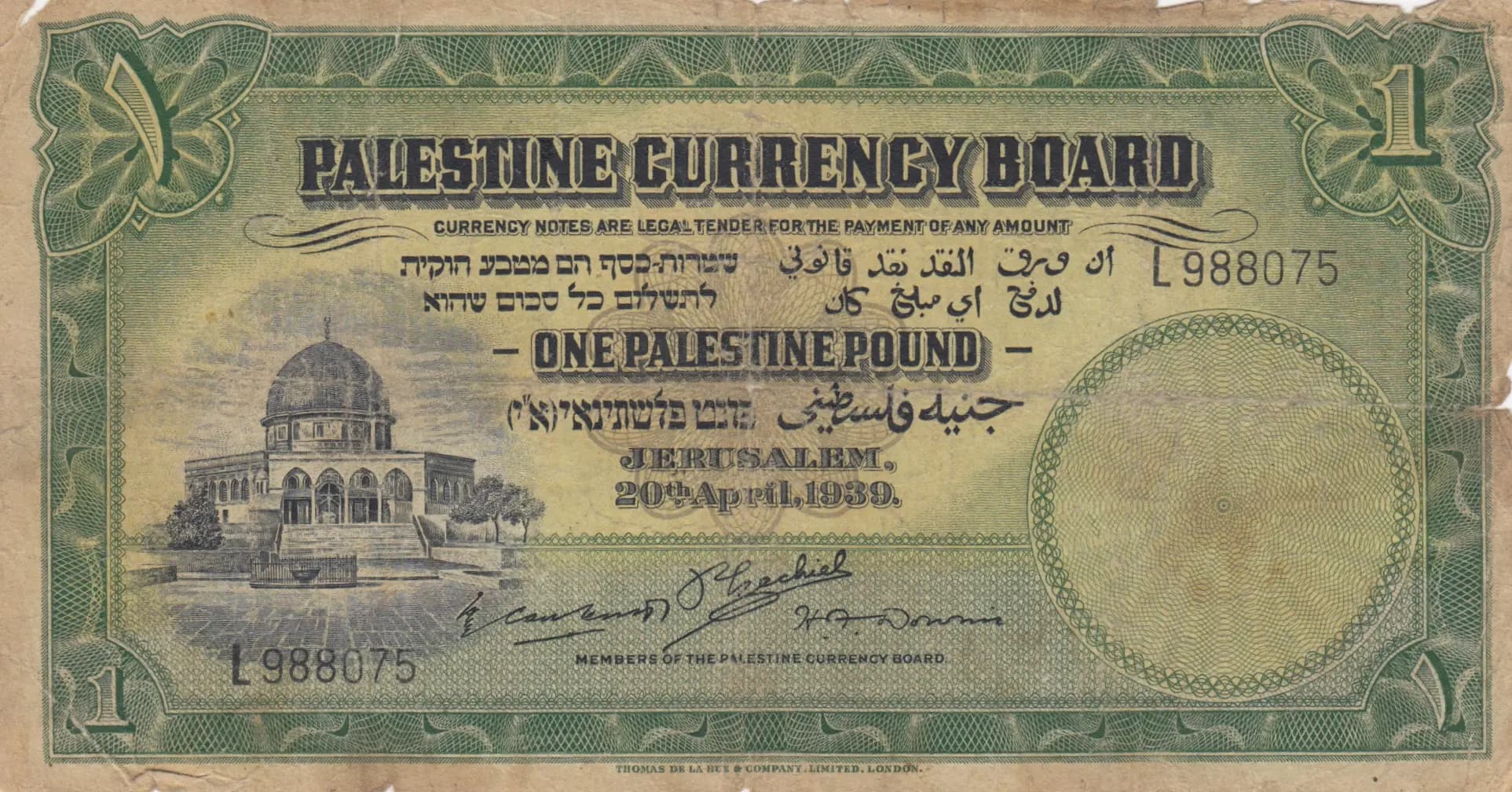
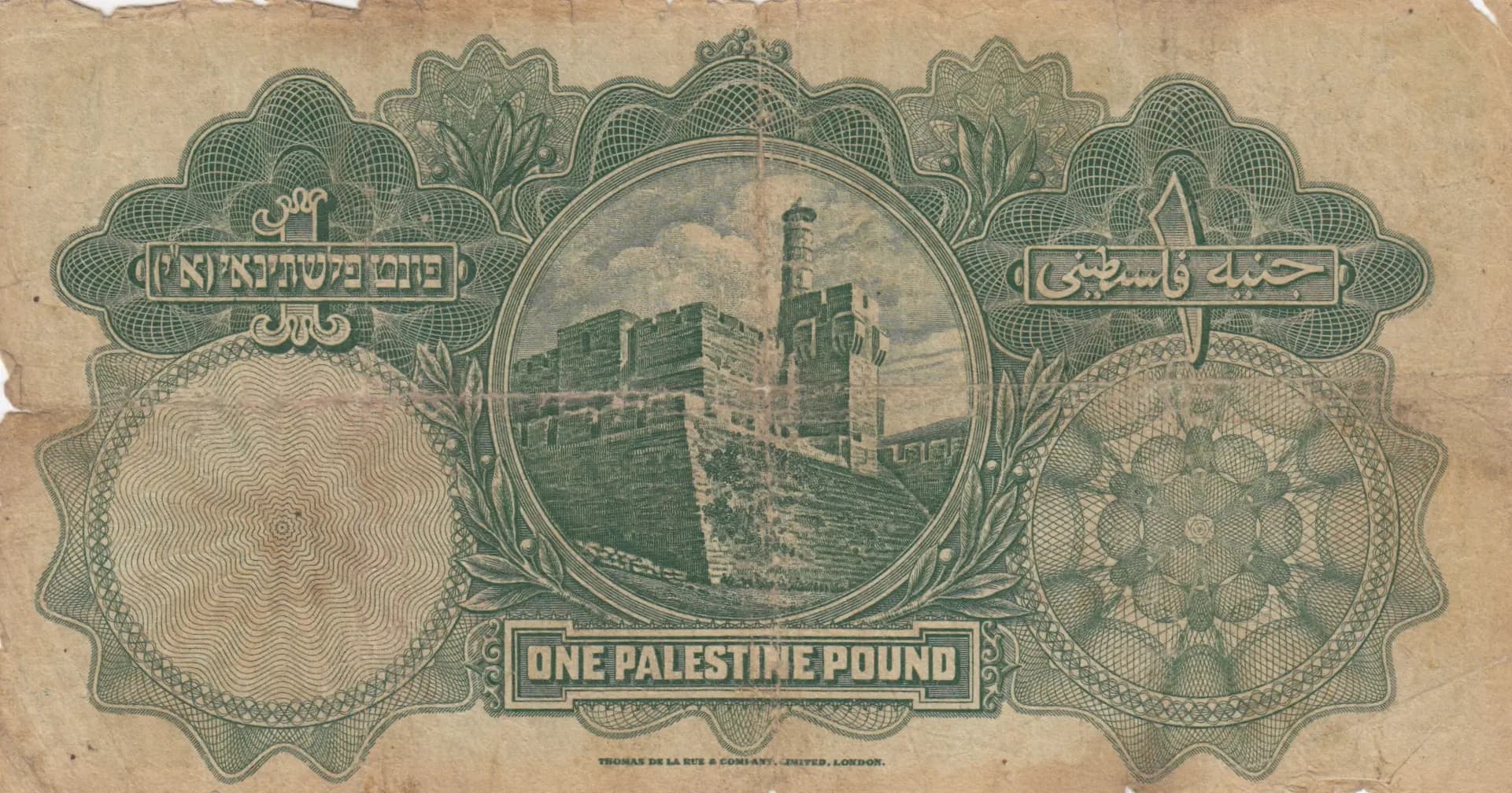
This is a 1939 Palestine Currency Board 1 Pound note (Pick P-7c) in Very Good condition, displaying the characteristic design elements of this historically significant issue. The obverse features an engraved Dome of the Rock in Jerusalem on the left, while the reverse depicts the Citadel of Jerusalem (David's Tower) in a circular vignette, both rendered in fine line engraving by Thomas de la Rue. The note shows expected aging with foxing, creasing, and tan patina throughout, consistent with an 85-year-old circulated example, yet remains fully legible with all design elements clearly visible.
Common. Despite the historical interest in Palestine Currency Board notes, the 1 Pound denomination from 1939 is a relatively common issue within the context of world banknotes. eBay auction data shows consistent sales activity across multiple condition grades, with VF examples selling in the $275–$700 range and F examples in the $345–$510 range over the past 15 years. A VG-graded example like this specimen would typically realizing $250–$400 at auction. The note's circulation period (1939-1948) was relatively brief, but print runs were substantial enough to ensure reasonable availability in the collector market today. Notes are not scarce or difficult to locate.
Issued during the final years of the British Mandate for Palestine (1920-1948), this 1939 note represents a period of increasing tension and political complexity in the region. The tripartite inscriptions in English, Arabic, and Hebrew reflect the multicultural administration of Palestine under British mandate. The iconic landmarks depicted—the Dome of the Rock and the Citadel of Jerusalem—symbolize the historical and religious significance of Jerusalem to multiple populations, making this currency both a medium of exchange and a statement of administrative presence in the territory.
This note exemplifies the classical British Commonwealth banknote design of the interwar period. The obverse features the Dome of the Rock—the golden-domed Islamic shrine located on the Temple Mount in Jerusalem—rendered as a detailed architectural engraving on the left portion of the note, serving as a recognizable landmark and symbol of Jerusalem's religious significance. The reverse displays the Citadel of Jerusalem (also known as David's Tower or the Tower of David), depicted within a circular vignette surrounded by ornamental scalloped frames. Both sides employ an elaborate ornamental border design with geometric mesh patterns and floral elements in green and tan/cream, typical of Thomas de la Rue's security printing style. The design employs tripartite text—English, Arabic, and Hebrew—arranged symmetrically to reflect the mandate's multicultural administration. A distinctive circular guilloche (security pattern) occupies the right side of the obverse, a hallmark of high-security banknote design. Serial numbers appear in multiple locations (top right and bottom left on the obverse), and the note carries the date of issue: 20 April 1939.
FRONT SIDE: 'PALESTINE CURRENCY BOARD' (English); 'CURRENCY NOTES ARE LEGAL TENDER FOR THE PAYMENT OF ANY AMOUNT' (English legal declaration); 'ONE PALESTINE POUND' (English denomination); 'Palestine currency' (Arabic: حينية فلسطينى); 'Palestine pound' (Hebrew: לינק פלסטינאית); 'JERUSALEM' (English, location); '20th April, 1939' (English, issue date); Serial number 'L 988075'; 'MEMBERS OF THE PALESTINE CURRENCY BOARD' and 'THOMAS DE LA RUE & COMPANY, LIMITED, LONDON' (printer attribution). BACK SIDE: 'Palestine currency/pound' (Hebrew: חינית פלסטינאית and Arabic: حينية فلسطينى); 'ONE PALESTINE POUND' (English denomination); 'THOMAS DE LA RUE & COMPANY, LIMITED, LONDON' (printer attribution).
Intaglio engraving (line engraving) on banknote paper, executed by Thomas de la Rue & Company, Limited, London, the world's foremost security printer of the period. The visual characteristics—fine parallel lines, intricate guilloche patterns, detailed architectural vignettes, and mesh border designs—are diagnostic of high-quality intaglio plate printing. The multi-color effect (green ink on tan/cream paper) was achieved through carefully designed plate work where different areas received different ink densities during the engraving process, a sophisticated technique requiring multiple passes or carefully controlled inking of a single plate.
This example is identified as Pick P-7c, indicating it is a specific variety within the 1939 Palestine Pound issue. The serial number prefix 'L' and the specific serial number 'L 988075' are consistent with the 1939 date of issue (20 April 1939 as printed on the note). The Palestine Currency Board issued notes in multiple denominations and with different date printings during the 1927-1944 period. This particular example, dated 1939, represents the later period of the board's operations. No overprints or unusual variations are observed on this specimen. The note carries standard signatures or authorization marks for the Palestine Currency Board, though specific signatory details are not clearly legible in the provided images due to the note's aged condition.