1 shilling 1942
About This Note
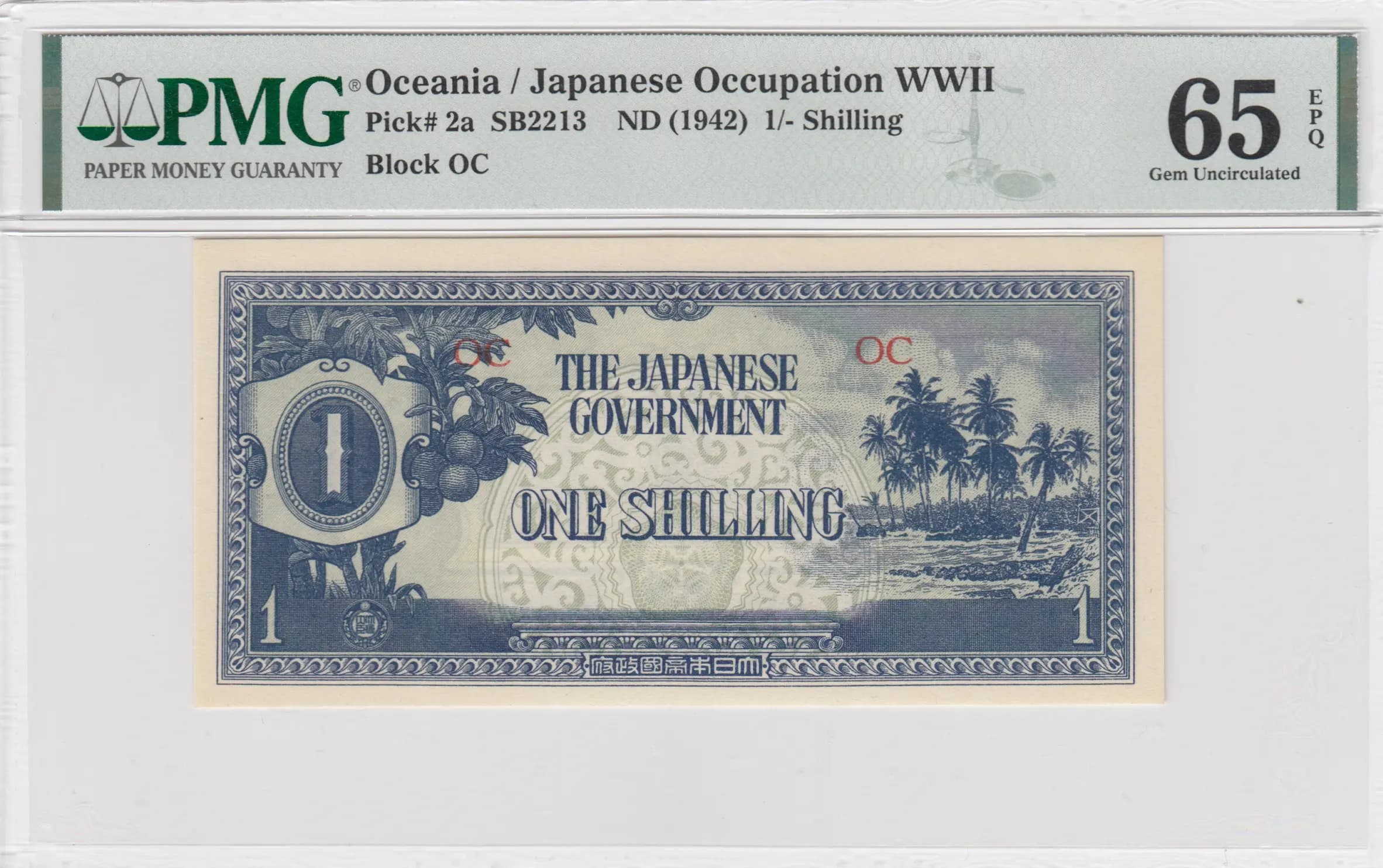
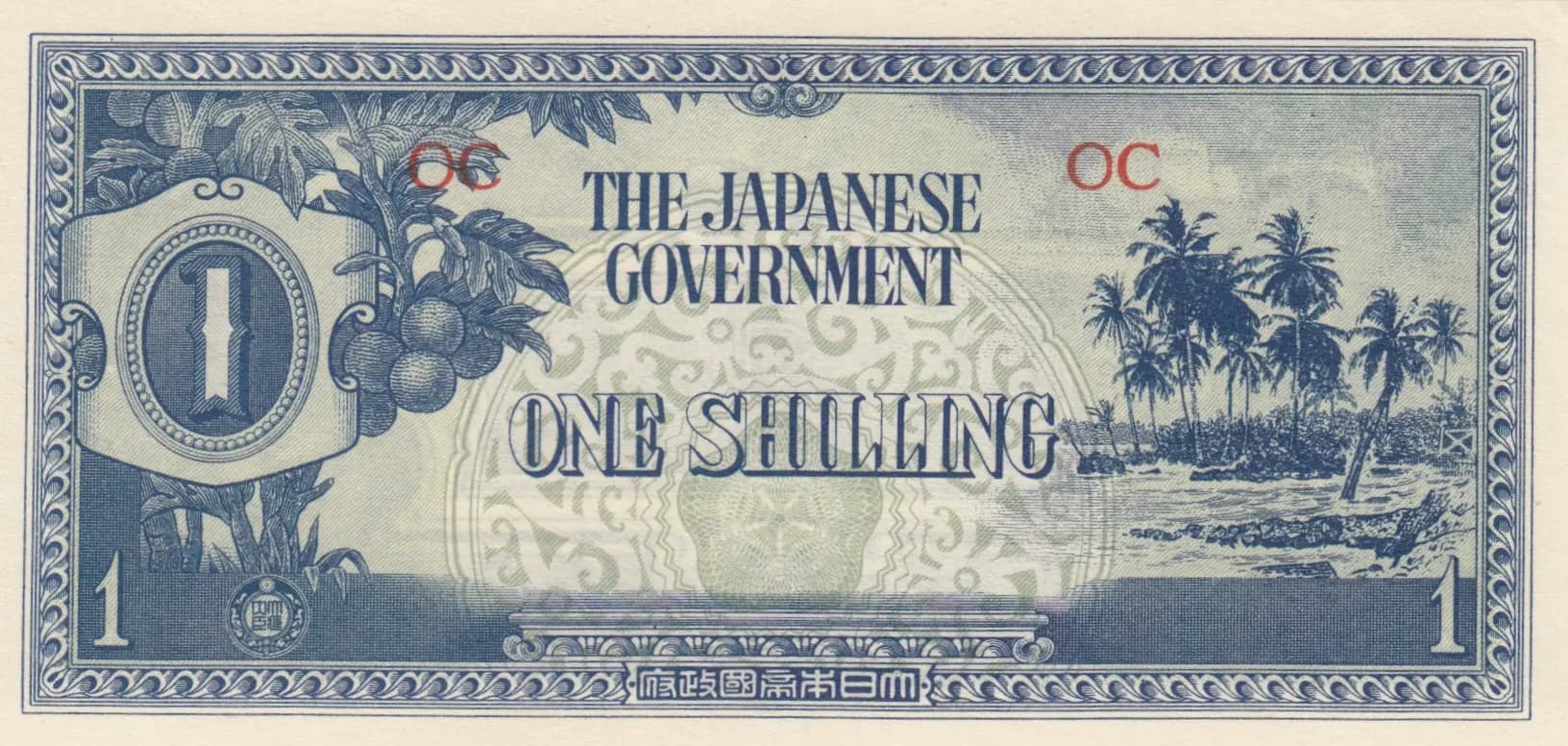
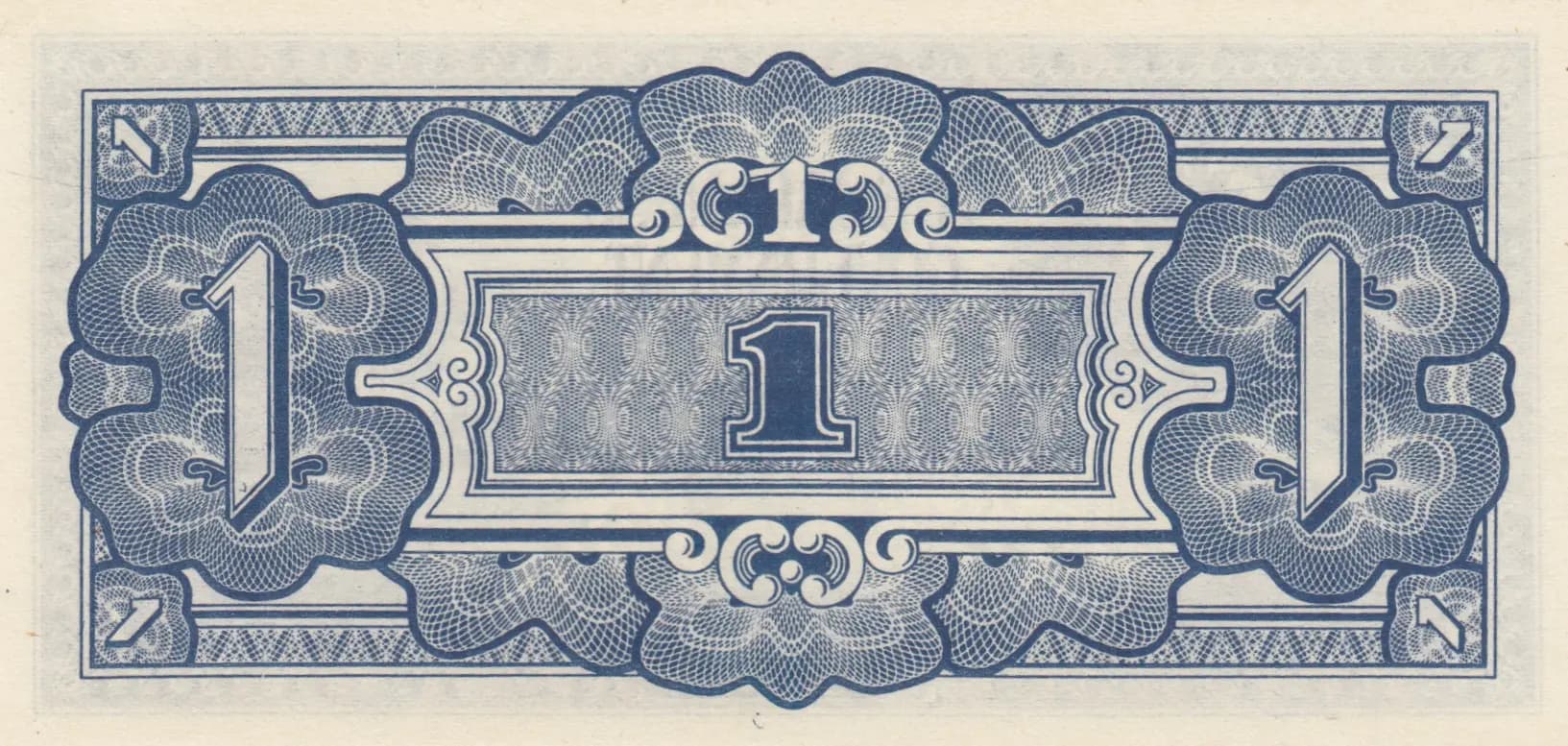
This 1942 Japanese Government 1 Shilling note from Oceania (Pick P-2) is presented in AU (About Uncirculated) condition with sharp printing and minimal wear. The obverse features an elegant coastal landscape with palm trees, ornamental borders with wave patterns, and a large numeral '1' in a decorative oval frame with loquat fruit and leaf motifs. The reverse displays a highly symmetrical design with multiple denomination numerals in scalloped frames and fine geometric engraving patterns, characteristic of high-security currency production during the Japanese occupation period.
Common. Japanese occupation currency from 1942 was produced in substantial quantities to support administrative and commercial functions across occupied Pacific territories. Pick catalog listing as P-2 indicates this is a standard, widely-documented issue rather than a specialized or limited printing. Notes from this occupation period regularly appear in the numismatic market, and AU condition examples are neither exceptionally scarce nor particularly valuable, suggesting healthy surviving populations.
This note was issued during Japan's occupation and administration of Oceanian territories in 1942, as reflected by the 'OC' markings (likely denoting Oceania) and bilingual English-Japanese inscriptions. The coastal palm tree imagery on the obverse represents the tropical island geography of the occupied Pacific territories under Japanese military administration. The use of English text alongside Japanese reflects the transitional currency system imposed during the occupation of formerly British-administered territories.
The obverse depicts a sophisticated classical currency design centered on a tropical coastal scene with multiple coconut or palm trees arranged along a waterway or shoreline, symbolizing the Pacific island territories under Japanese control. A prominent numeral '1' occupies the left portion within an oval cartouche decorated with loquat fruits and botanical leaves—a deliberate cultural reference to Japanese flora. Ornamental borders throughout feature wave patterns and scrollwork typical of official currency engraving. The reverse adopts a high-security anti-counterfeiting approach with a symmetrical layout featuring four corner panels containing stylized numerals '1' within elaborate scalloped frames, with the center containing an additional decorative numeral panel, all rendered in intricate geometric line work and cross-hatching. The color scheme of blue and cream/white provides clear contrast and security differentiation.
FRONT SIDE: 'THE JAPANESE GOVERNMENT' (English) and 'ONE SHILLING' (English) indicate the issuing authority and denomination. 'OC' markings in red appear in both upper corners. Japanese text at bottom center reads '日本国政府' (Nippon-koku Seifu, 'Japanese Government'). BACK SIDE: Multiple numeral '1' markings appear in decorative frames, representing the denomination throughout the design.
Intaglio engraving (steel plate engraving), the standard security printing method for currency production in 1942. The fine geometric patterns, precise line work, cross-hatching, and deeply engraved borders observed in the visual analysis are characteristic of high-quality intaglio printing. The sharp clarity and definition of both ornamental elements and security features indicate professional security printer production, likely executed by the Japanese Government Printing Bureau or an affiliated official printer during wartime currency production.
Based on PMG population data, this Pick number encompasses at least two catalogued variants: P-2a (standard 1/- Shilling) and P-2s1 (specimen note). The visual analysis appears consistent with P-2a characteristics. The observed 'OC' territorial markings and absence of specimen overprints suggest this is a regular circulation issue rather than a specimen variant. Serial numbers, if visible on the obverse, would further clarify the specific printing batch and potential sub-varieties within the P-2a classification.