5 pounds 1972
Market Prices
4 salesAbout This Note
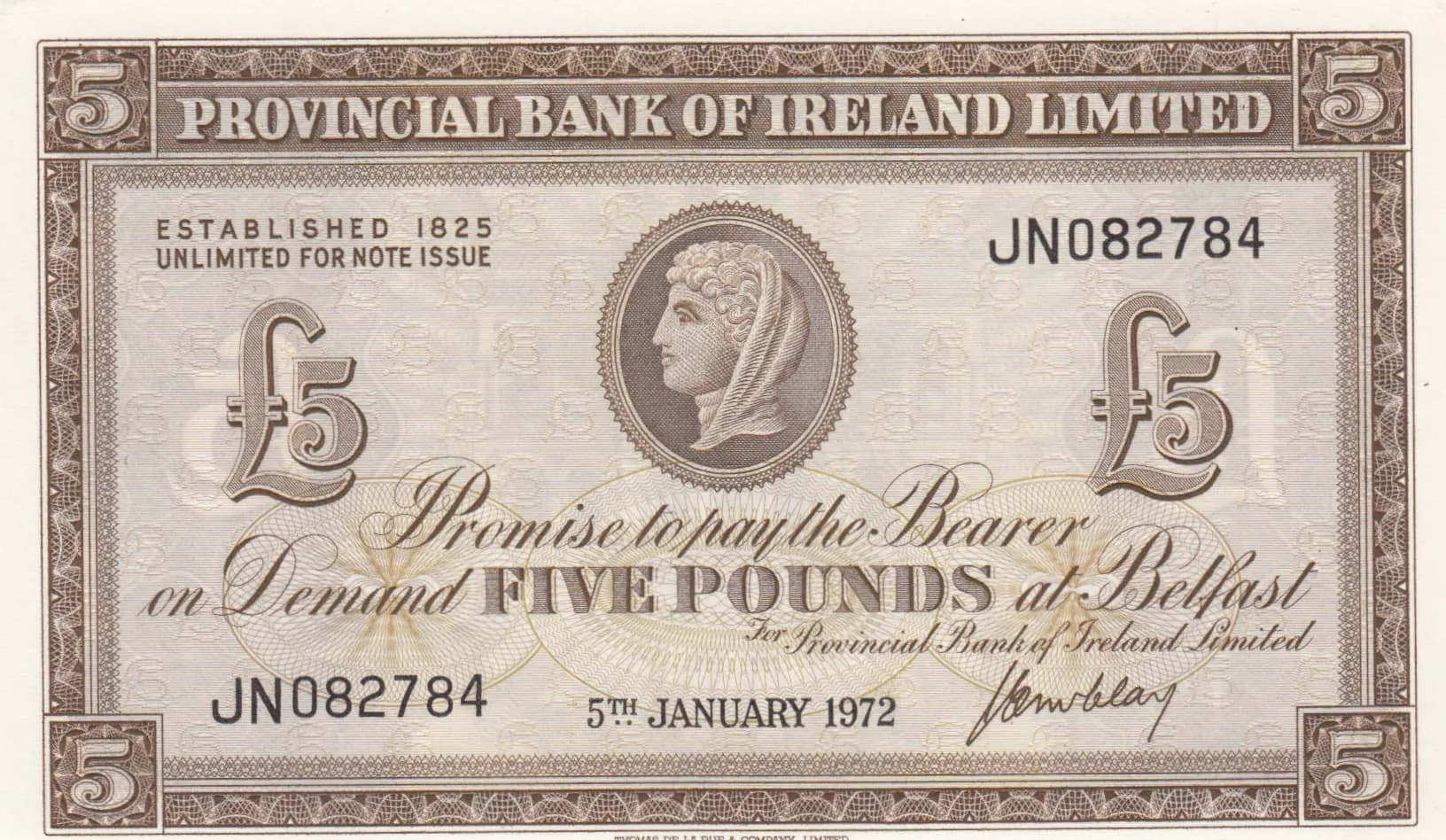
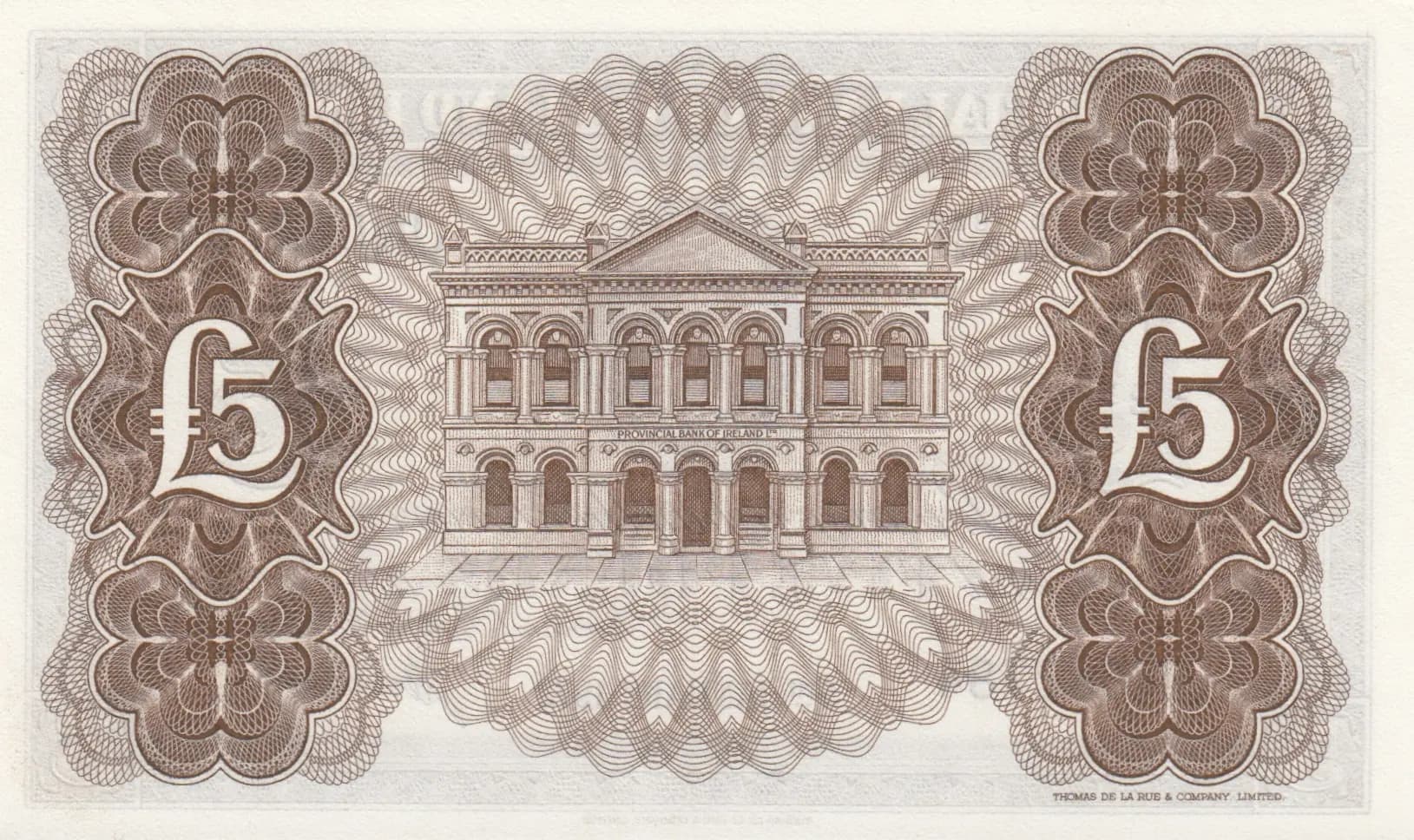
This is an exceptional example of the Provincial Bank of Ireland Limited's 5 pound note from 1972, presented in uncirculated condition. The note features a striking portrait of a classical woman in profile within an ornate oval frame on the obverse, while the reverse displays a detailed neoclassical architectural rendering of the Provincial Bank of Ireland building in Belfast. The brown color scheme and fine engraving work are characteristic of this series, with the note showing no signs of circulation, creasing, or wear.
Common. While the Provincial Bank of Ireland's note issues are modest in modern collecting terms and the bank itself is historically significant, this 1972 issue remains relatively common in the market. eBay price tracking data from 2018-2021 shows PMG 64-65 examples trading in the $80-$126 range, with catalog values (2019) listing UNC examples at approximately $90. These modest prices and consistent market availability indicate this is a standard circulation-period note with reasonable print runs. It is not scarce or rare despite its interesting historical context.
This note was issued during a transitional period for Irish currency, with the Provincial Bank of Ireland Limited having operated since 1825. The classical imagery—including the archaic female portrait and the neoclassical bank building depicted on the reverse—reflects the institution's heritage and prominence in Northern Ireland's financial landscape. The date of 5th January 1972 marks this note within the final years of the Provincial Bank's independent note-issuing authority before consolidation within the Irish banking system.
The obverse features a classical portrait of a woman in left-facing profile, depicted wearing a head covering or veil, centered within an ornate oval protective frame. This cameo-style portrait is surrounded by intricate decorative border patterns and fine line engraving typical of high-security currency design. The reverse presents a meticulously engraved neoclassical building—the Provincial Bank of Ireland's headquarters in Belfast—featuring multiple stories, symmetrical columned facade, regularly spaced arched windows, and a pediment roof. Ornamental rosette patterns occupy all four corners, and elaborate decorative wave and line patterns fill the background, creating a protective barrier against counterfeiting. The brown and tan color palette dominates throughout both sides.
FRONT: 'PROVINCIAL BANK OF IRELAND LIMITED' (institution name); 'ESTABLISHED 1825' (founding year); 'UNLIMITED FOR NOTE ISSUE' (authorization); 'Promise to pay the Bearer on Demand' (legal tender clause); 'FIVE POUNDS' (denomination); 'at Belfast' (location); 'for Provincial Bank of Ireland Limited' (issuing authority); '5TH JANUARY 1972' (issue date); Serial number 'JUN082784'; Multiple '£5' denomination markers. BACK: 'PROVINCIAL BANK OF IRELAND' (institution name); '£5' (denomination markers on left and right); 'THOMAS DE LA RUE & COMPANY LIMITED' (printer attribution).
This note was produced using intaglio engraving (also called line engraving or recess printing), the primary security printing method employed by Thomas de la Rue & Company Limited, the noted London security printer responsible for this issue. The fine line engraving patterns visible throughout both obverse and reverse, the detailed portraiture, the intricate wave and geometric patterns, and the precise architectural rendering are all characteristic signatures of intaglio printing. The printer's mark 'THOMAS DE LA RUE & COMPANY LIMITED' appears on the reverse, confirming their role as security printer.
The specific variety is identified by the issue date of 5th JANUARY 1972 and serial number prefix 'JUN' visible on this example. The Provincial Bank series spanning 1968-1972 contains multiple dated varieties. The serial number JUN082784 suggests this note is from the June printing sequence of the 1972 issue period. No overprints, significant signature variations, or other notable varieties are apparent on this example beyond standard production variations expected within the regular 1972 issue run.