100 pounds 1990 specimen
Market Prices
About This Note
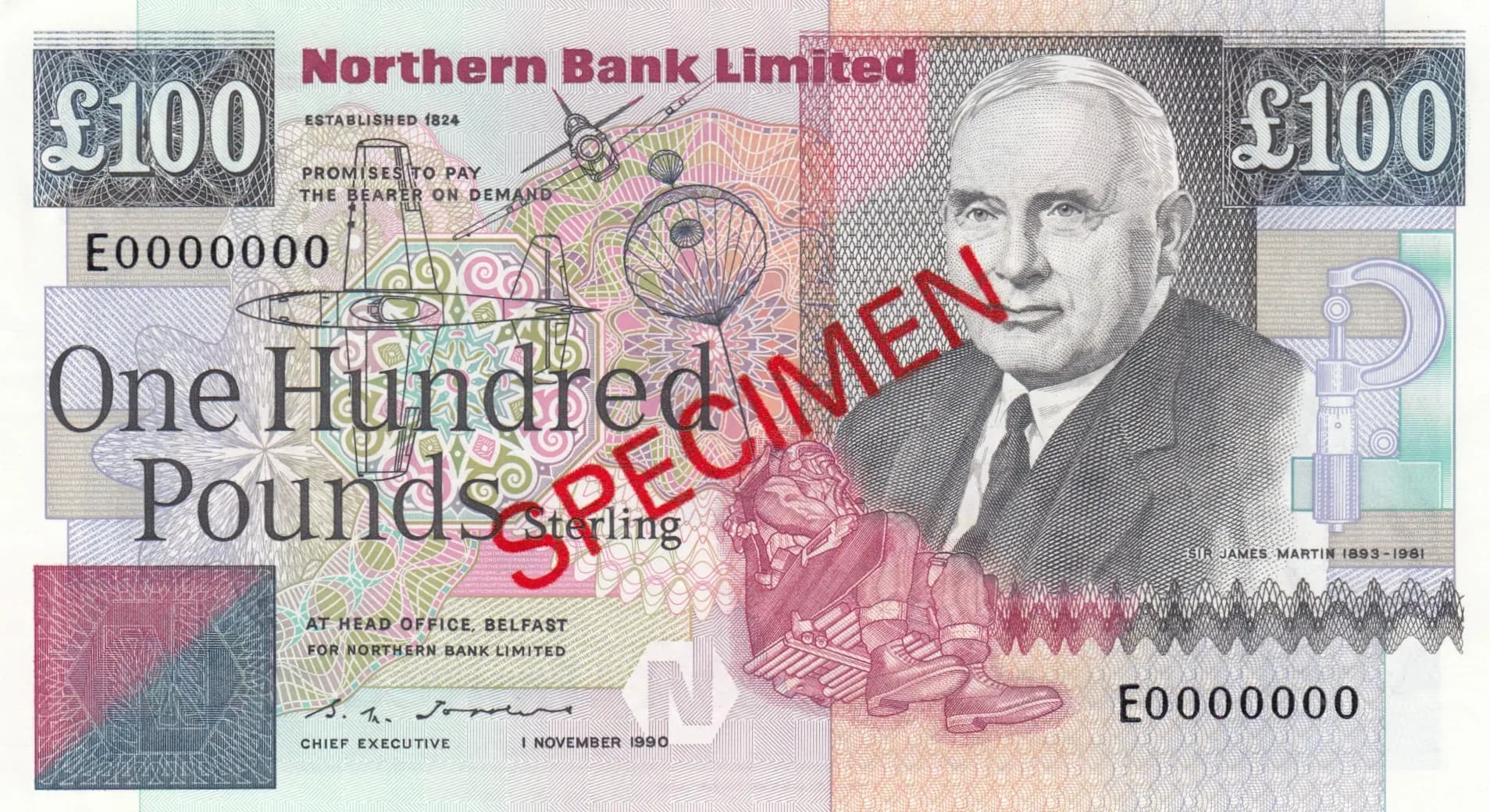
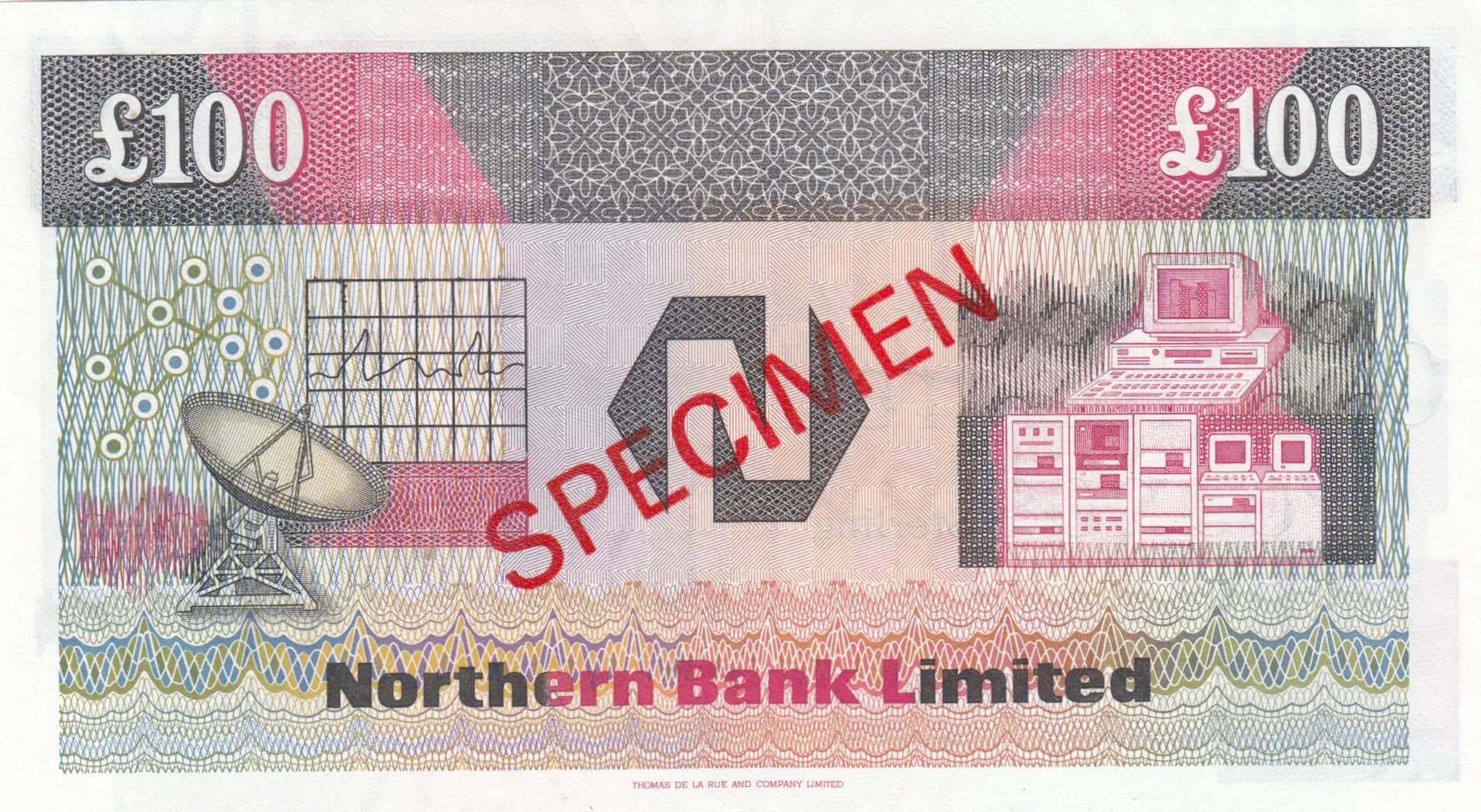
This is a pristine uncirculated specimen of the Northern Bank Limited £100 note from 1 November 1990, featuring Sir James Martin, the pioneering inventor of the ejection seat. The note displays the full diagonal red 'SPECIMEN' overprint characteristic of specimen issues, with exceptional printing quality throughout and sharp, well-defined corners. The vibrant multi-color design emphasizing technological imagery (satellite dishes, computer terminals) reflects the note's theme of modern communications and innovation.
Uncommon. While specimen notes are inherently less common than circulated issues due to their restricted distribution (typically retained by the issuing bank, regulators, and museums), this particular note is not extremely scarce. eBay market data shows a wide range of asking prices ($19.99 to $799.99 USD), with 2019 catalog value at $450 USD and multiple UNC specimens sold in the $279-$589 range, suggesting moderate collector demand but adequate supply. The note is from a major regional UK bank with legitimate currency-issuing authority, not a rare or recalled issue. Specimen status and the collectibility of Sir James Martin as a notable figure maintain above-average value, but supply appears sufficient to avoid true rarity designation.
Issued in 1990, this Northern Bank note commemorated Sir James Martin (1893-1981), a legendary Irish engineer whose ejection seat technology revolutionized aviation safety. The reverse design's emphasis on satellite dishes and computer terminals reflects the technological optimism of the early 1990s, a period of rapid communications advancement. Northern Bank, established in 1824, exercised its legal authority as a note-issuing bank in Northern Ireland, one of the few UK regional banks permitted to print their own currency.
The obverse features a formal portrait of Sir James Martin positioned on the right side, rendered in classical intaglio style with fine line work characteristic of high-security currency printing. The left side contains an intricate geometric composition in pink, green, yellow, gray, and light blue, incorporating a satellite dish illustration and abstract technological patterns. The reverse maintains the multi-color palette with a more pronounced technology theme: a prominent satellite dish on the left, a central grid/lattice structure suggesting computer networks or electronic circuits, and computer terminals and modern office equipment on the right. The entire design emphasizes mid-20th century communications infrastructure and the technological revolution, with ornate border designs and fine microprint patterns providing security depth throughout both sides.
FRONT: '£100' and 'One Hundred Pounds Sterling' (denomination); 'Northern Bank Limited' and 'ESTABLISHED 1824' (issuer); 'PROMISES TO PAY THE BEARER ON DEMAND' (legal tender clause); 'AT HEAD OFFICE, BELFAST FOR NORTHERN BANK LIMITED' (location); 'I NOVEMBER 1990' (issue date); 'SIR JAMES MARTIN 1893-1981' (portrait identification); 'CHIEF EXECUTIVE' (signature line designation); 'E00000000' (specimen serial number); 'SPECIMEN' in red diagonal overprint. BACK: '£100' (denomination); 'Northern Bank Limited' (issuer); 'THOMAS DE LA RUE AND COMPANY LIMITED' (printer); 'SPECIMEN' in red diagonal overprint.
Intaglio printing (recess printing) combined with multi-color lithography, executed by Thomas de la Rue and Company Limited of London, the world's premier security printer. The visual analysis confirms evidence of classical intaglio work in the portrait rendering and fine line micropattern backgrounds. Multiple color separation layers are evident, with complex geometric security patterns integrated throughout. The specimen overprint in red appears to be applied via offset lithography after primary printing.
This is identified as Pick 197s (the 's' suffix denoting specimen status). The specimen overprint in red diagonal text is the primary distinguishing feature of this variety. The serial number visible on the note (E00000000) is characteristic of specimen issues, which typically feature zero serial numbers or replacement series designations rather than standard circulation numbering. The date of issue is specifically 1 November 1990, with no noted varieties for alternative dates reported in standard catalogs. The signature line marked 'CHIEF EXECUTIVE' is standard for this issue, with variations only occurring in the actual signatures of different executives (not visible or legible in specimen format).