10 pounds 1977 specimen
Market Prices
About This Note
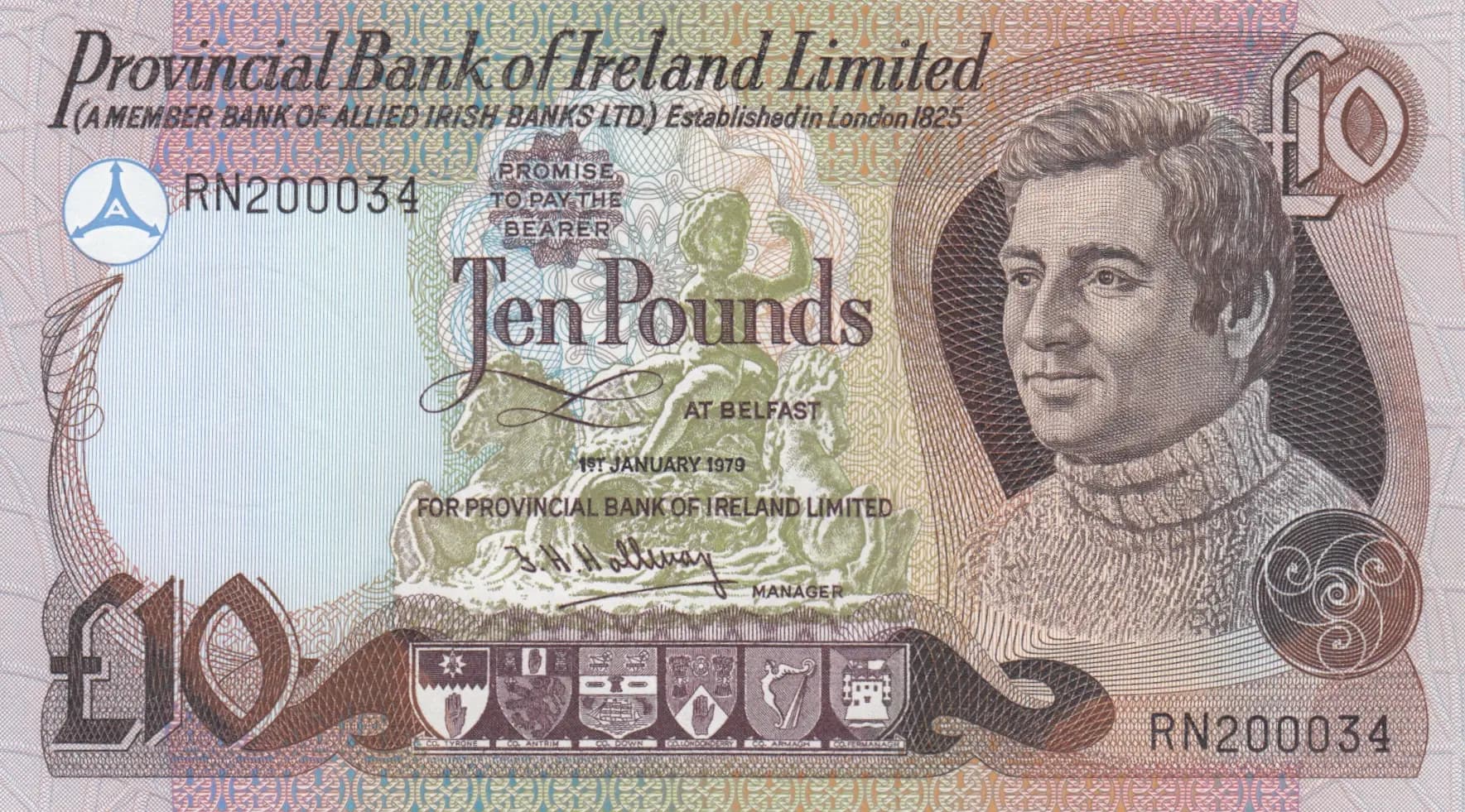
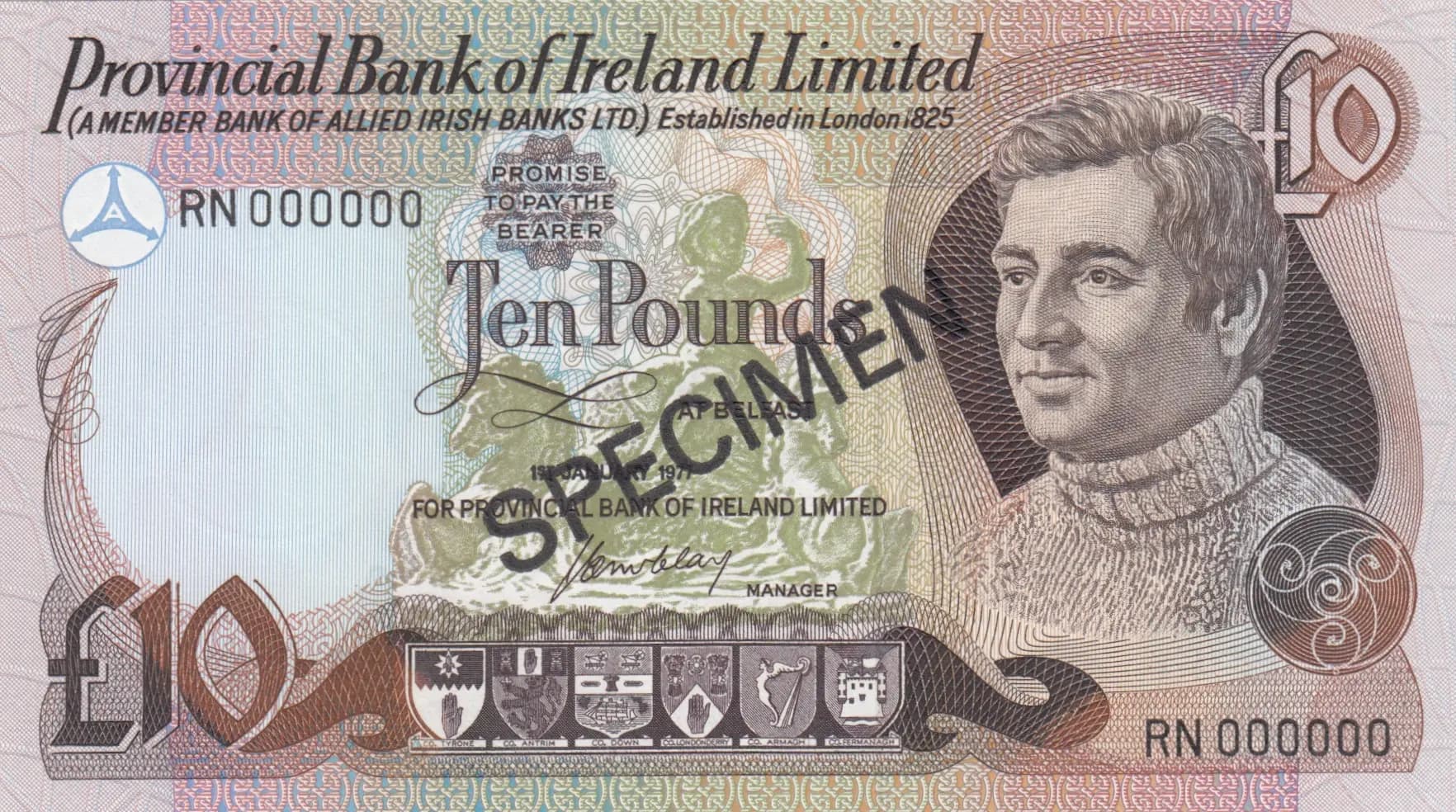
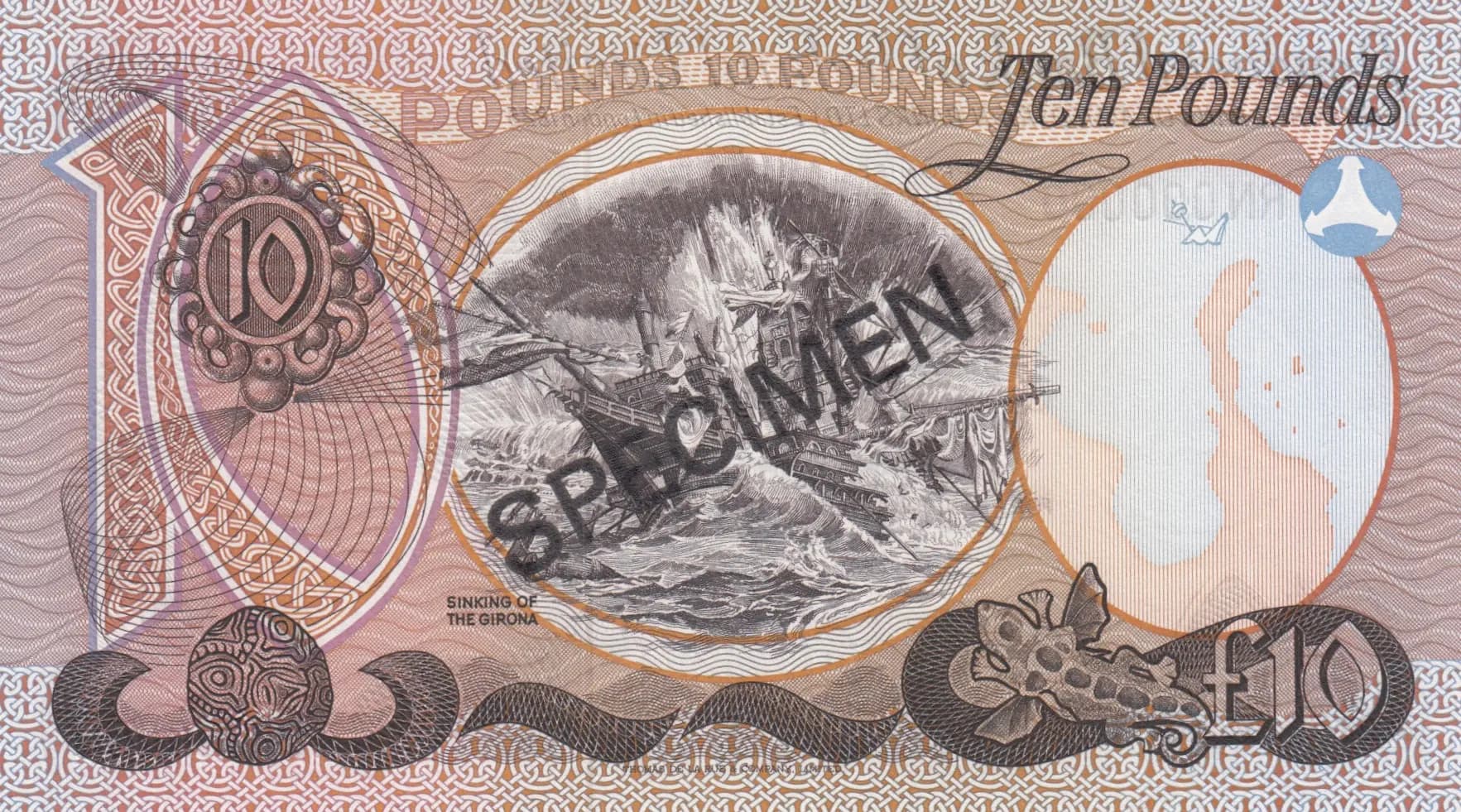
This is a 1977 specimen note from the Provincial Bank of Ireland Limited, a member of Allied Irish Banks, in uncirculated condition. The note features an ornately engraved design with a portrait of a man with curled hair on the obverse and a dramatic maritime scene depicting the Sinking of the Girona on the reverse, both rendered in brown, tan, green, and blue tones. As a specimen note with diagonal overprint and zero serial numbers, this represents an important numismatic artifact from Northern Ireland's banking history, showcasing the high-quality engraving standards of Thomas de la Rue, London.
Common. While this is a specimen note, which typically have smaller print runs than circulation notes, the eBay market data shows UNC examples ranging from $30 to $349.99 USD with most clustered between $30–$135, and 2019 catalogue value at $175 UNC. The wide range of listings and relatively modest pricing indicate this specimen is readily available in the collector market. Specimen notes from major issuers like Provincial Bank of Ireland are regularly produced for distribution to central banks and collectors, and this particular issue does not appear to have exceptional scarcity. The designation as 'specimen' and the zero serial numbers (RN 000000) are standard for this type rather than indicators of extreme rarity.
The Provincial Bank of Ireland Limited was established in London in 1825 and operated as a member bank of Allied Irish Banks, reflecting the complex banking structures in Ireland during the post-partition era. The Girona, depicted on the reverse, was a Spanish Armada vessel wrecked off the coast of County Antrim in 1588, making it a historically significant Irish maritime symbol chosen to represent Ulster's heritage. This 1977 issue marks a period when Northern Irish banks maintained their own note-issuing authority, a practice that continued through the late 20th century.
The obverse features a formal portrait of a young man positioned on the right side, depicted with curled hair and wearing period clothing with a ruffled collar, rendered in classical engraving style. The left side displays large ornamental numerals indicating the ten pound denomination, framed in decorative cartouches. The center contains the bank's promise to pay and institutional details, with the Provincial Bank of Ireland Limited logo/circular emblem positioned on the upper left. Multiple heraldic shields are arranged in a row at the bottom center, representing Irish heraldic tradition. The reverse showcases an elaborate engraved maritime scene within an ornate oval frame depicting the historical wreck of the Girona, a Spanish Armada ship, with dramatic waves and atmospheric detail. The reverse also features large ornamental numerals and Celtic-style geometric patterns throughout both sides. Guilloche patterns, microprint-style fine line work, and ornamental spirals in the corners provide both aesthetic richness and security features characteristic of Thomas de la Rue's premium banknote production.
FRONT SIDE: 'Provincial Bank of Ireland Limited' (institution name), '(A MEMBER BANK OF ALLIED IRISH BANKS LTD) Established in London 1825' (corporate affiliation and founding date), 'PROMISE TO PAY THE BEARER Ten Pounds' (legal promise to pay, standard on banknotes), 'FOR PROVINCIAL BANK OF IRELAND LIMITED' and 'MANAGER' (authorization), 'RN 000000' (specimen serial number, repeated twice), 'SPECIMEN' (specimen overprint). BACK SIDE: 'Ten Pounds' (denomination), 'SINKING OF THE GIRONA' (identification of depicted maritime scene), '10' (denomination numeral), 'SPECIMEN' (specimen overprint). All inscriptions are in English.
Intaglio/engraving, the standard high-security printing method used by Thomas de la Rue, London. The visual analysis confirms characteristic features of intaglio production: fine line guilloche patterns, intricate border work, detailed portrait engraving, and the elaborate maritime scene all executed with the precision typical of steel engraving. The microprint-style fine line work and ornamental details visible in the security features confirm multi-plate engraved production, a hallmark of De la Rue's security printing methodology.
This is catalogued as Pick P-249as, the 's' suffix indicating 'specimen' status. As a specimen note from 1977, it bears the diagonal SPECIMEN overprint and zero serial numbers (RN 000000) in place of regular issue serial numbers. The specific variety would be identified by the presence of the specimen overprint and stamp. No signature varieties are typically noted for specimen issues, as these utilize standard authorization blocks rather than individual manager signatures. The note represents the standard specimen printing for this 1977 Provincial Bank of Ireland Limited ten pound note issue.