1 pound 1978
Market Prices
7 salesAbout This Note
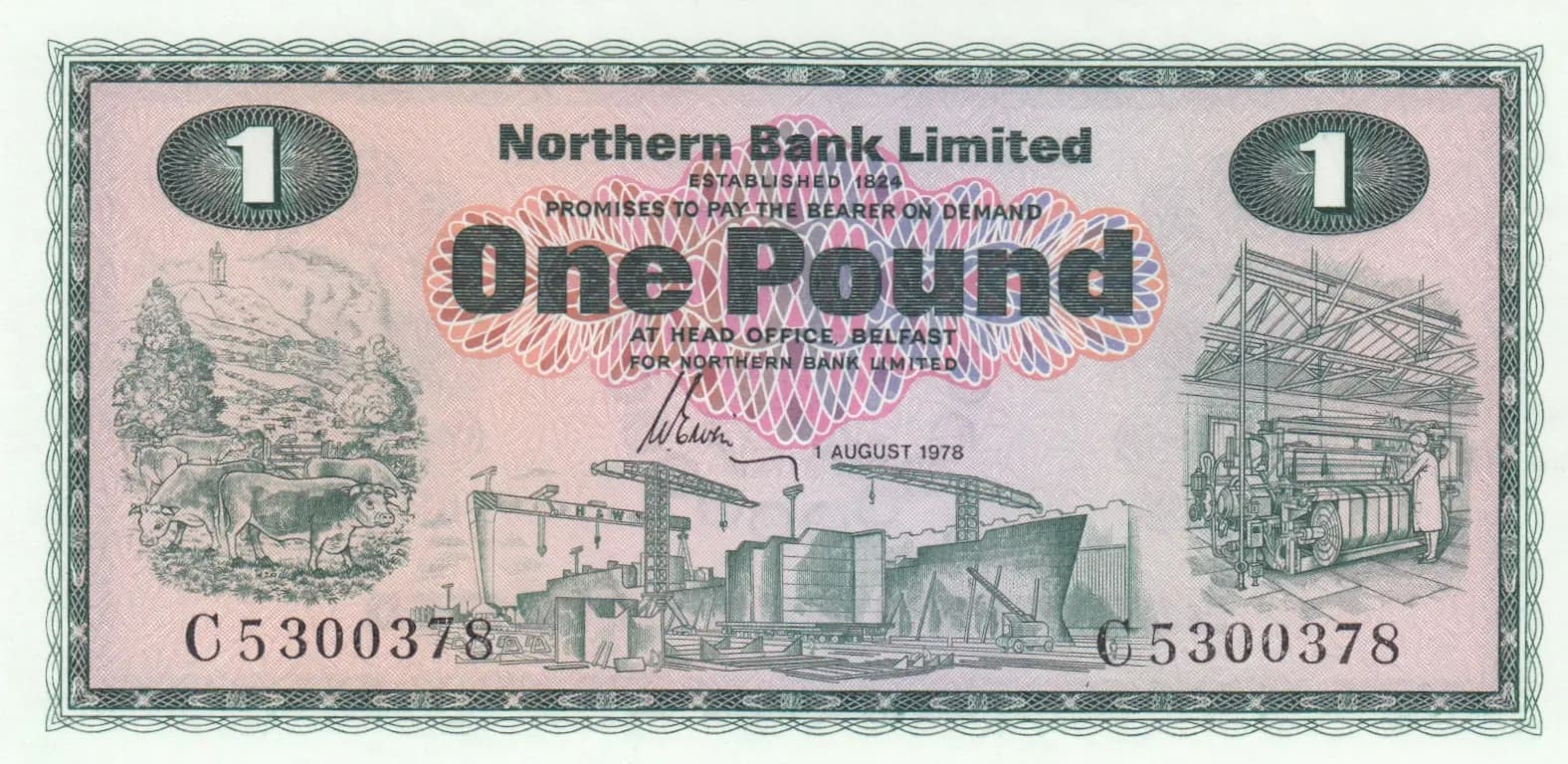
This is an uncirculated 1978 Northern Bank Limited 1 pound note (Pick 187c), featuring exceptional intaglio printing quality with crisp, well-defined details throughout. The note showcases vibrant pink and green coloration with distinctive industrial and pastoral imagery—Harland & Wolff shipyard facilities, cattle herding scenes, and manufacturing equipment—reflecting Northern Ireland's economic heritage. In this pristine condition with no visible wear or handling marks, it represents a desirable example of Northern Irish currency from the final decade of the 1970s.
Common. This note represents a regular issue from a 13-year production period (1970-1982) with substantial circulation throughout Northern Ireland. Catalog values as of 2019 were modest (UNC: $40), and recent eBay market data shows typical UNC examples selling in the $25-$61 range with single-digit to moderate bidding activity. The absence of scarcity indicators—no small print run, recall, or limited issuer lifespan—combined with straightforward market pricing confirms this as a common issue despite its regional significance.
Issued during the period 1970-1982, this Northern Bank Limited note reflects Northern Ireland's industrial economy of the late 1970s, prominently featuring the famous Harland & Wolff shipyard in Belfast—one of the world's largest shipbuilders. The imagery balances industrial prowess with rural agricultural tradition, depicting both the shipyard's construction cranes and vessels alongside pastoral cattle scenes, symbolizing the region's dual economic foundations. The note's establishment in 1978 falls within a period of significant economic and social change in Northern Ireland during the Troubles.
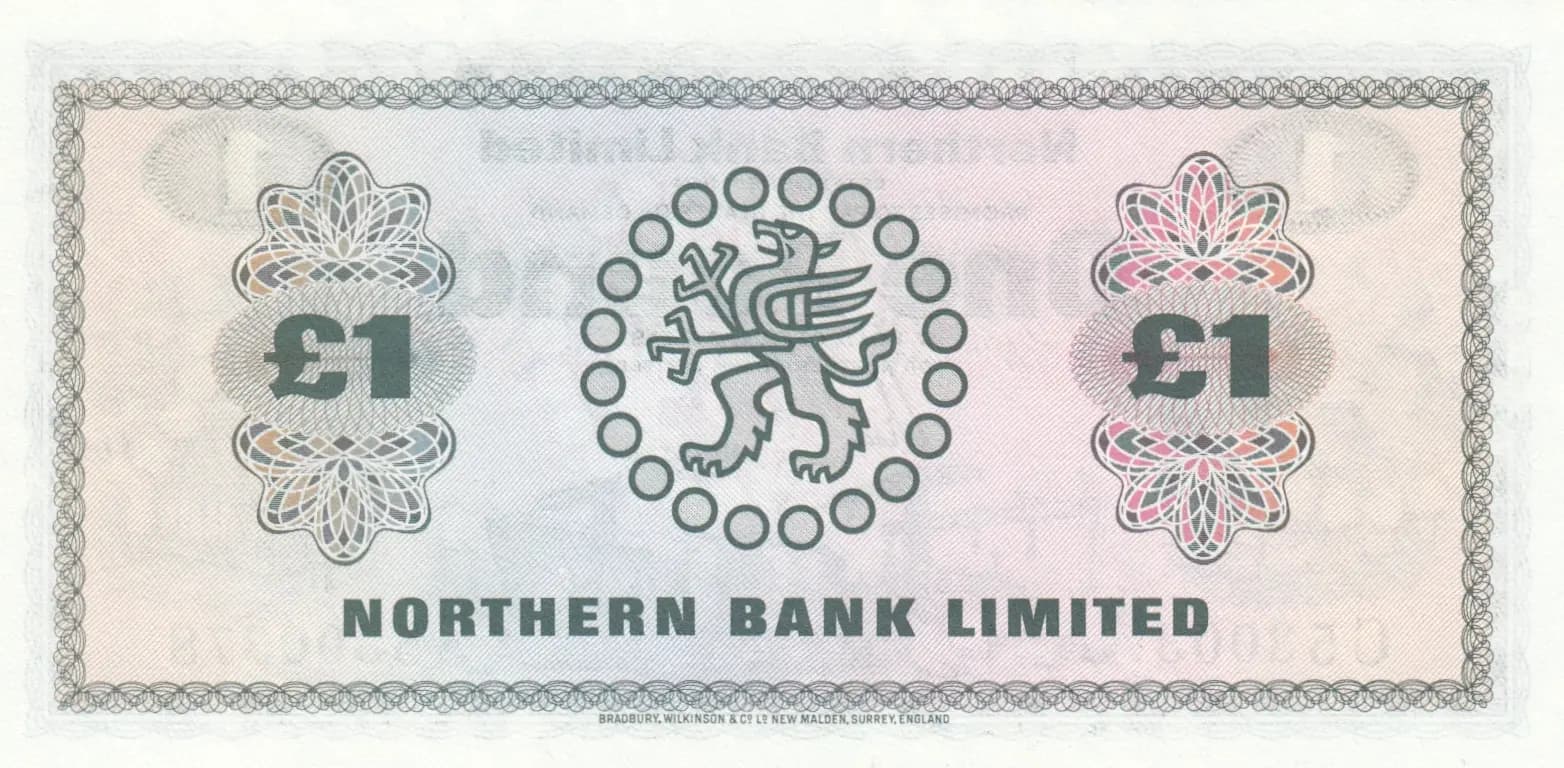
The obverse features a horizontally-oriented composition with the denomination '1' in oval frames at top left and right corners. The central motif displays 'One Pound' in large ornate text surrounded by elaborate decorative rosette work. The lower portion depicts the Harland & Wolff shipyard at bottom center, identifiable by construction cranes and a vessel under assembly, flanked by pastoral imagery of cattle and rural landscape on the left and factory/manufacturing facility interior on the right, representing Belfast's maritime and industrial heritage. The reverse displays a Scottish lion rampant (heraldic lion) as the central emblem, enclosed within a circular beaded border, with corner ornaments integrating the £1 denomination. The entire composition is rendered in pink, green, blue, and cream tones with intricate border patterns throughout.
FRONT: 'Northern Bank Limited' (issuing bank name), 'Established 1824' (founding year), 'Promises to Pay the Bearer on Demand' (legal tender declaration), 'One Pound' (denomination in words), 'Head Office, Belfast' (headquarters location), 'For Northern Bank Limited' (authorization), '1 August 1978' (issue date), 'C5300378' (serial number). BACK: '£1' (denomination symbol, appears twice in corner ornaments), 'Northern Bank Limited' (issuing bank name), 'Bradbury, Wilkinson & Co Lt New Malden, Surrey, England' (printer identification).
Intaglio printing (engraved banknote production) executed by Bradbury, Wilkinson & Co Ltd, New Malden, Surrey—a premier British security printer. The visual analysis confirms characteristic intaglio features including fine line work, complex ornamental patterns, and crisp detail reproduction. Multiple color printing was achieved through sequential intaglio passes, evident in the layered pink, green, blue, and cream tones. The fine-line border ornamentation and beaded circular border around the heraldic lion are hallmarks of high-security intaglio engraving techniques.
This specific example is dated 1 August 1978 with serial number C5300378, identifying it as from the third year of the 1970-1982 issue period. The 'C' prefix on the serial number represents the note sequence for this particular issue date. No major varieties (different signatures, overprints, or design modifications) are indicated for the 1978 date within the standard 1970-1982 series. The note represents the standard variety for its date of issue.