1 pound 1937
Market Prices
1 saleAbout This Note
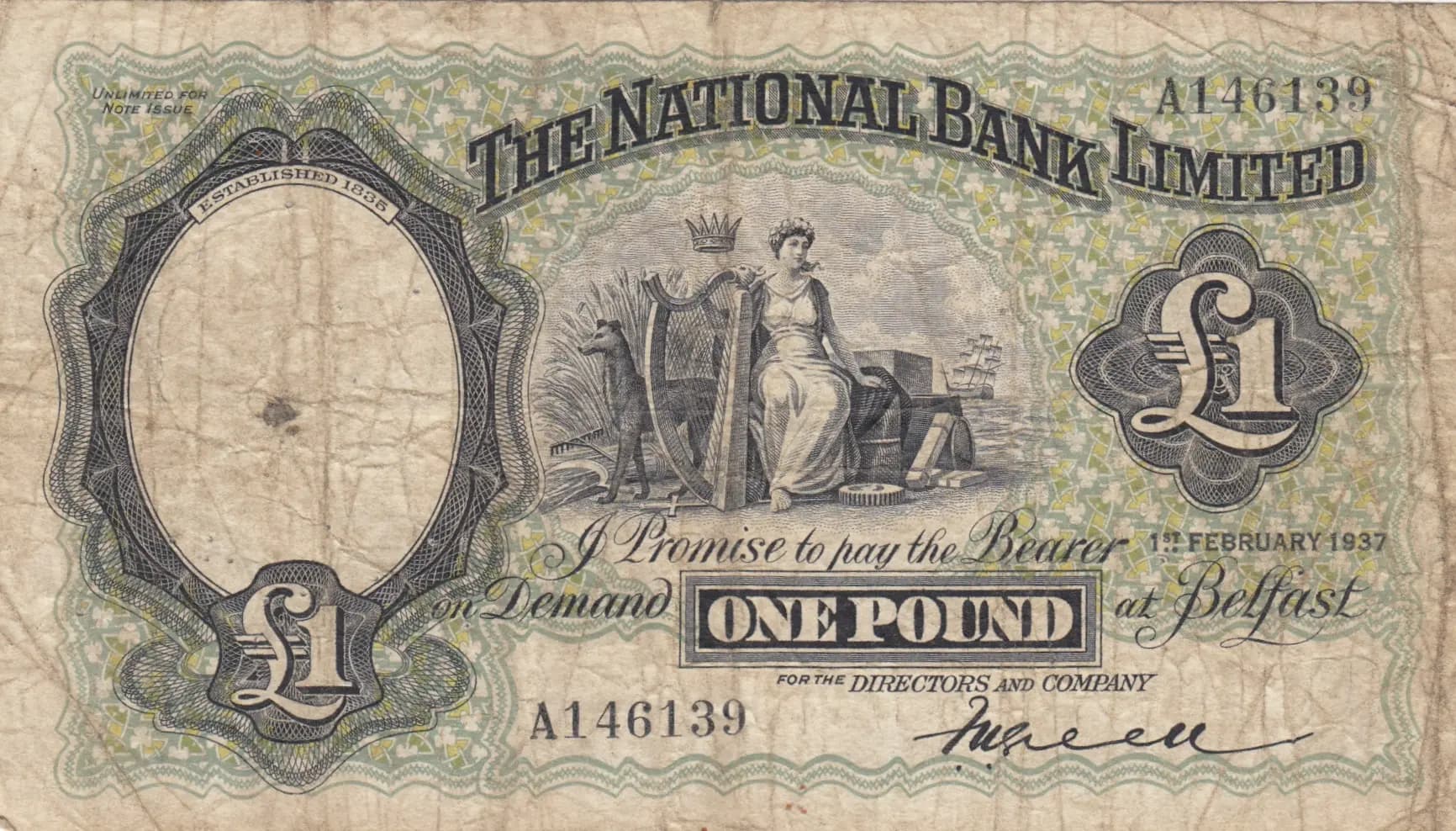
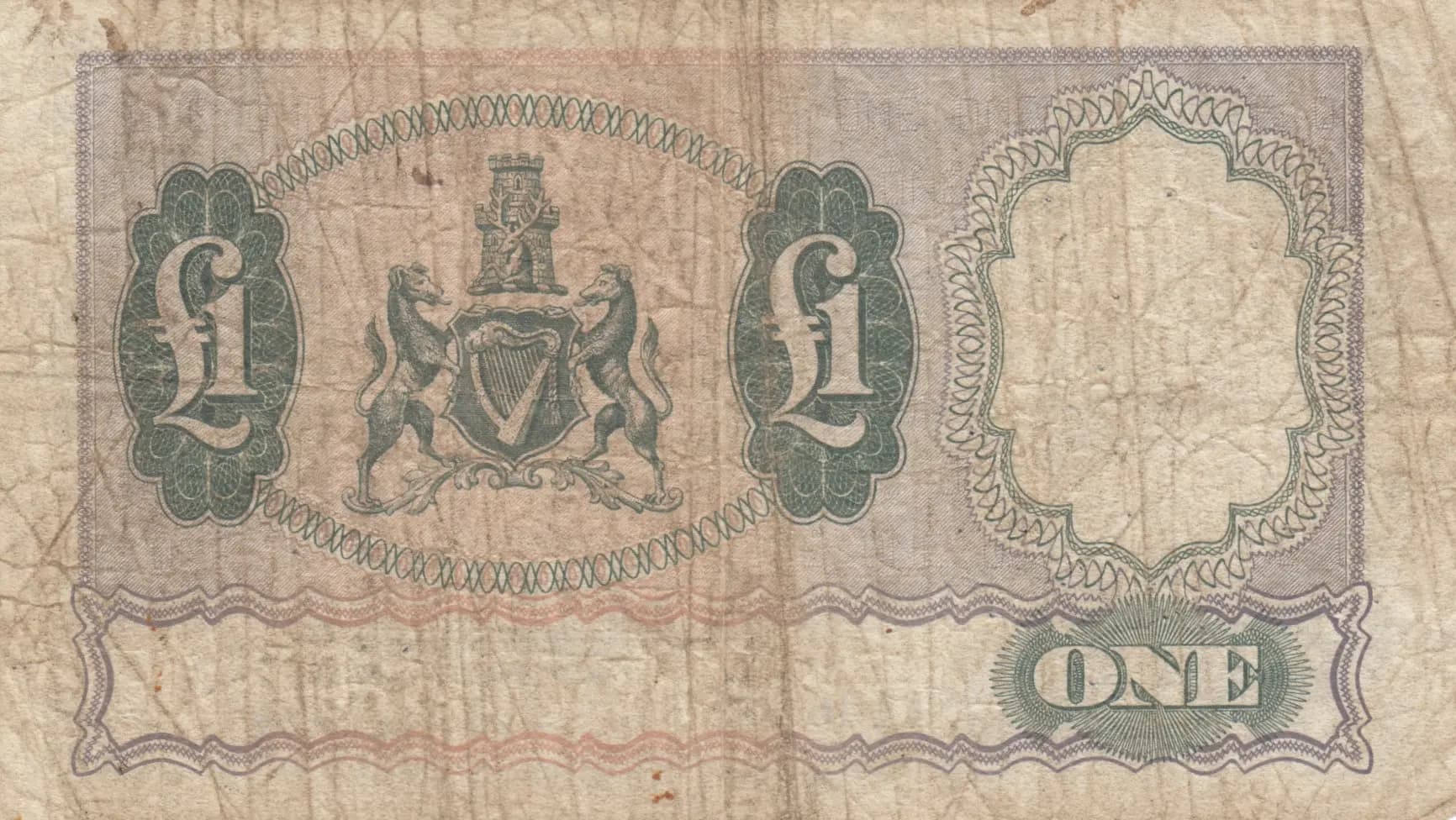
A 1937 one pound note from The National Bank Limited of Belfast, displaying the classic allegorical design of Hibernia with shield and trident on the obverse, paired with an ornate heraldic coat of arms on the reverse. The note exhibits significant wear consistent with VG condition, showing multiple creases, fold lines, foxing, and age-related discoloration typical of an 85+ year old circulated banknote. This is an iconic Irish banknote from the interwar period, representing the National Bank's currency authority during the early Free State era.
Common. The 1937 National Bank Limited one pound note (Pick P-155) is readily available to collectors. Catalog values from 2016 show VG examples at $40, with UNC specimens reaching only $250, and market data indicates steady but modest pricing. The note was part of a regular issue with substantial circulation, and surviving examples in various conditions are not difficult to locate. No evidence suggests limited print runs, short-lived issuance, or recall status that would elevate rarity.
Issued in 1937, this note reflects The National Bank Limited's role as one of Ireland's major private note issuers during the interwar period, prior to the establishment of the Central Bank of Ireland. The allegorical figure of Hibernia (Ireland personified) seated with shield and maritime symbols reflects Irish national identity during this period. The heraldic design on the reverse, featuring the castle tower and supporting lions, represents Irish heraldic traditions and sovereignty during the early years of the Irish Free State.
The obverse features Hibernia, the classical allegorical personification of Ireland, depicted as a crowned female figure seated with a shield bearing heraldic designs and holding or accompanied by a trident, flanked by a male figure, with a sailing vessel visible in the background—representing Ireland's maritime heritage. An empty ornate oval frame with scalloped edges occupies the left side, a common feature in banknote design of this era. The denomination '£1' appears in an ornate quadfoil cartouche on the right. The reverse displays a symmetrical heraldic composition centered on a coat of arms topped with a castle tower or fortified structure, flanked by two rampant lions in the heraldic tradition, with matching '£1' denominations in quadfoil frames on both sides. The overall color scheme combines cream/pinkish backgrounds with green and black engraved details, creating a formal, dignified appearance characteristic of interwar Irish currency.
Front Side: 'THE NATIONAL BANK LIMITED' (issuing bank); 'ESTABLISHED 1858' (founding year); 'Unlimited for Note Issue' (note-issuing authority); 'I Promise to pay the Bearer on Demand' (standard currency promise); 'ONE POUND' (denomination in words); 'at Belfast' (location of redemption); '1st FEBRUARY 1937' (issue date); 'FOR THE DIRECTORS AND COMPANY' (authorization); Serial number 'A146139' (appears twice); Signature of authorized officer. Back Side: '£1' (denomination symbol, appears left and right); 'ONE' (denomination in words, center bottom). All inscriptions are in English.
Intaglio (copperplate) engraving, the standard security printing method for banknotes of this era. The fine line work, intricate decorative borders, ornamental frames, and detailed heraldic designs visible throughout are hallmarks of classical intaglio printing. The printer for National Bank Limited notes of this period was typically British banknote security printers such as De La Rue or Bradbury, Wilkinson & Co., though specific attribution would require additional documentation. The engraved vignettes and security features are consistent with 1930s British Commonwealth currency production standards.
This specific example is dated '1st FEBRUARY 1937' with serial number 'A146139' and bears a signature reading 'J. Lee'. The Pick catalog notes this design was issued in both 1937 and 1939, indicating at least two distinct printing runs. Varieties for this Pick number would include different issue dates (1937 vs. 1939), different signature combinations representing various authorized officers, and serial number prefix variations. The 'A' prefix observed on this note's serial number may indicate part of an early series, though without comprehensive records of all serial ranges, specific variety classification would require comparison with other documented examples.