1 cordoba 1958
Market Prices
6 salesAbout This Note
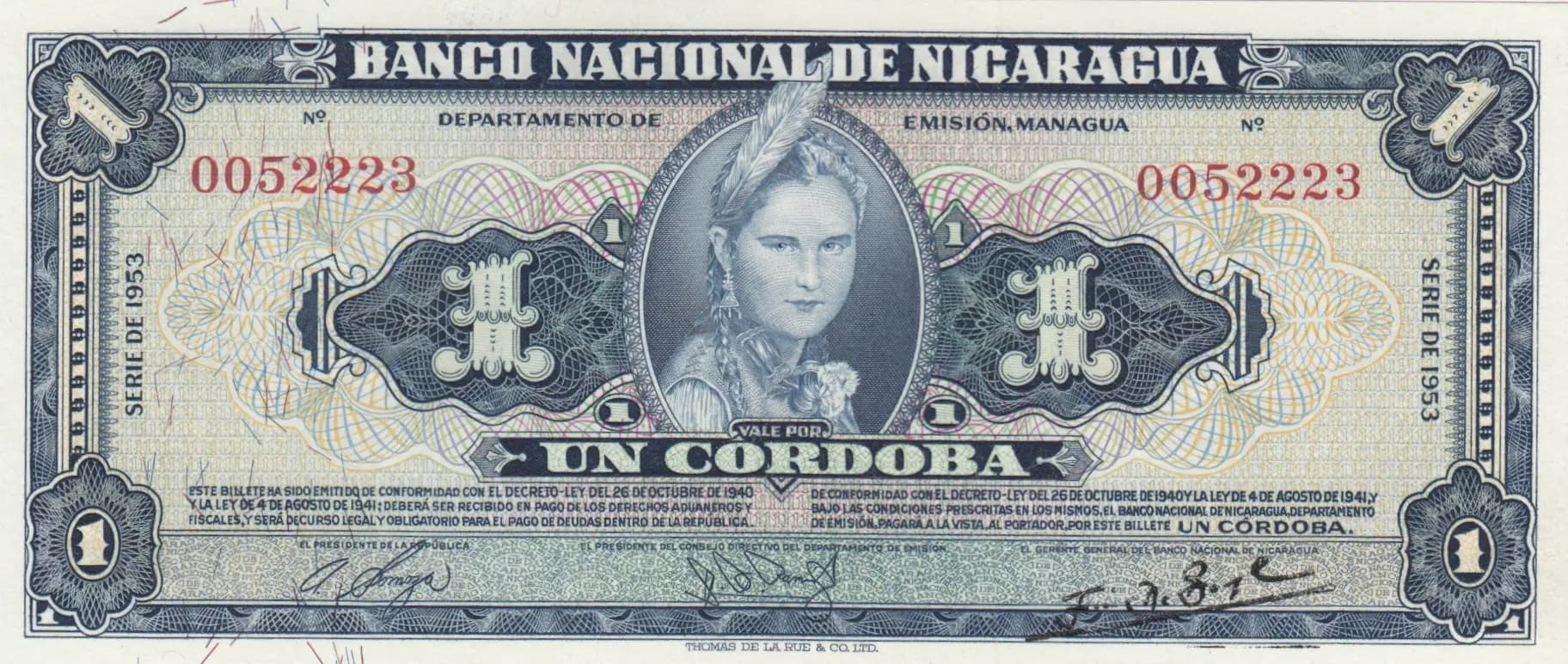
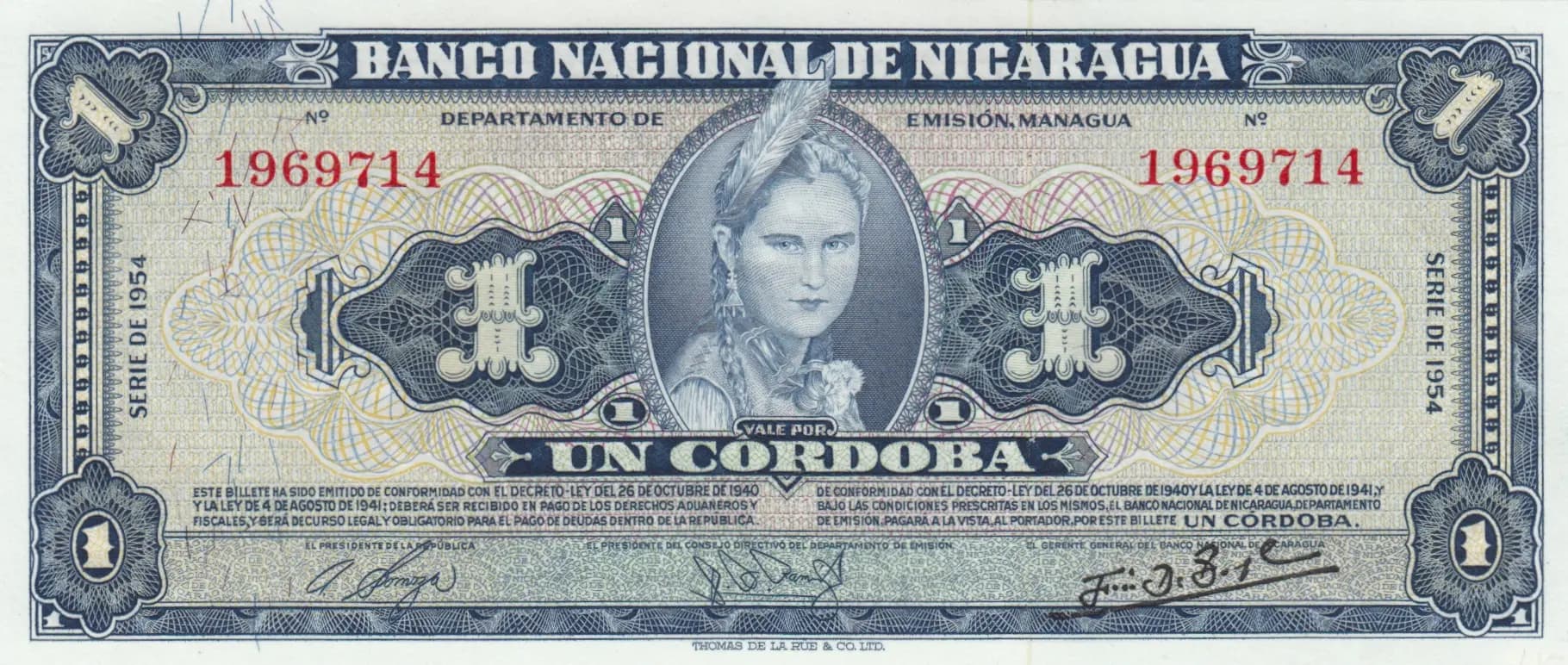
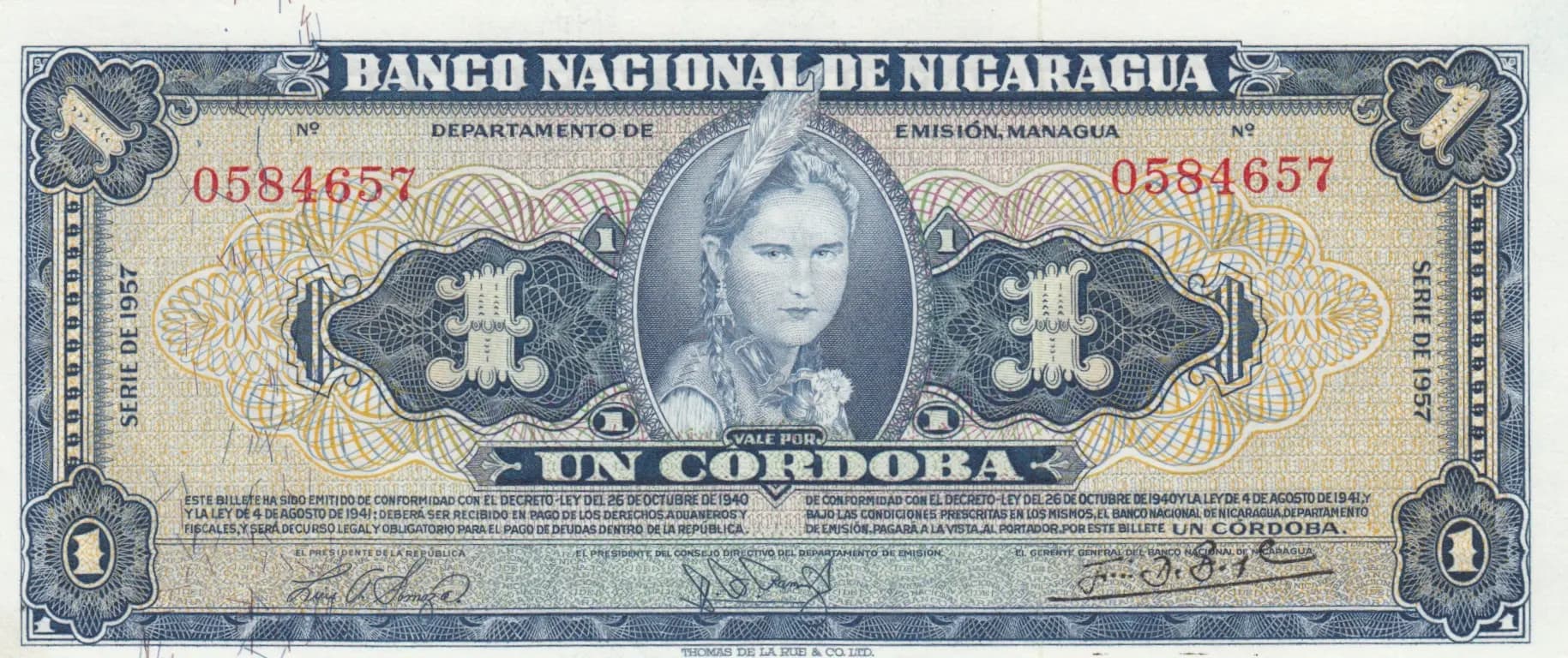
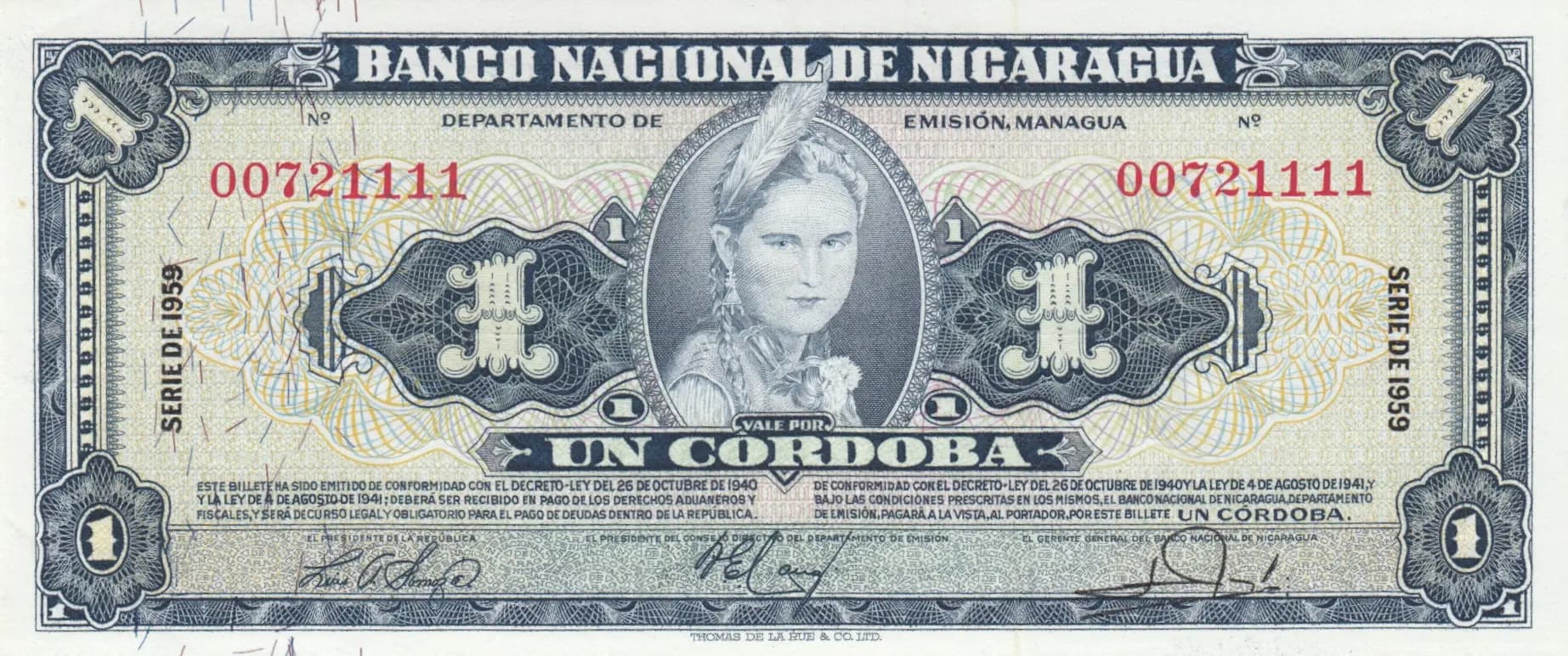
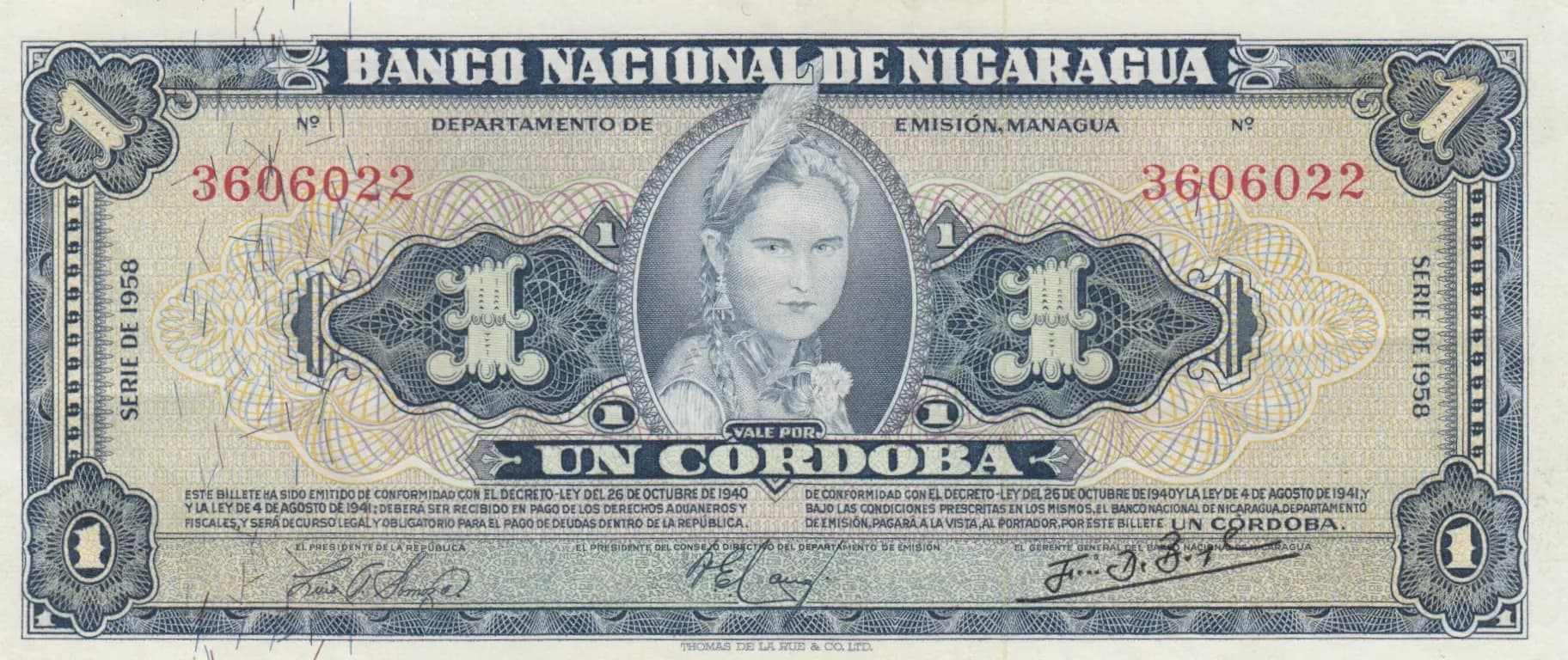
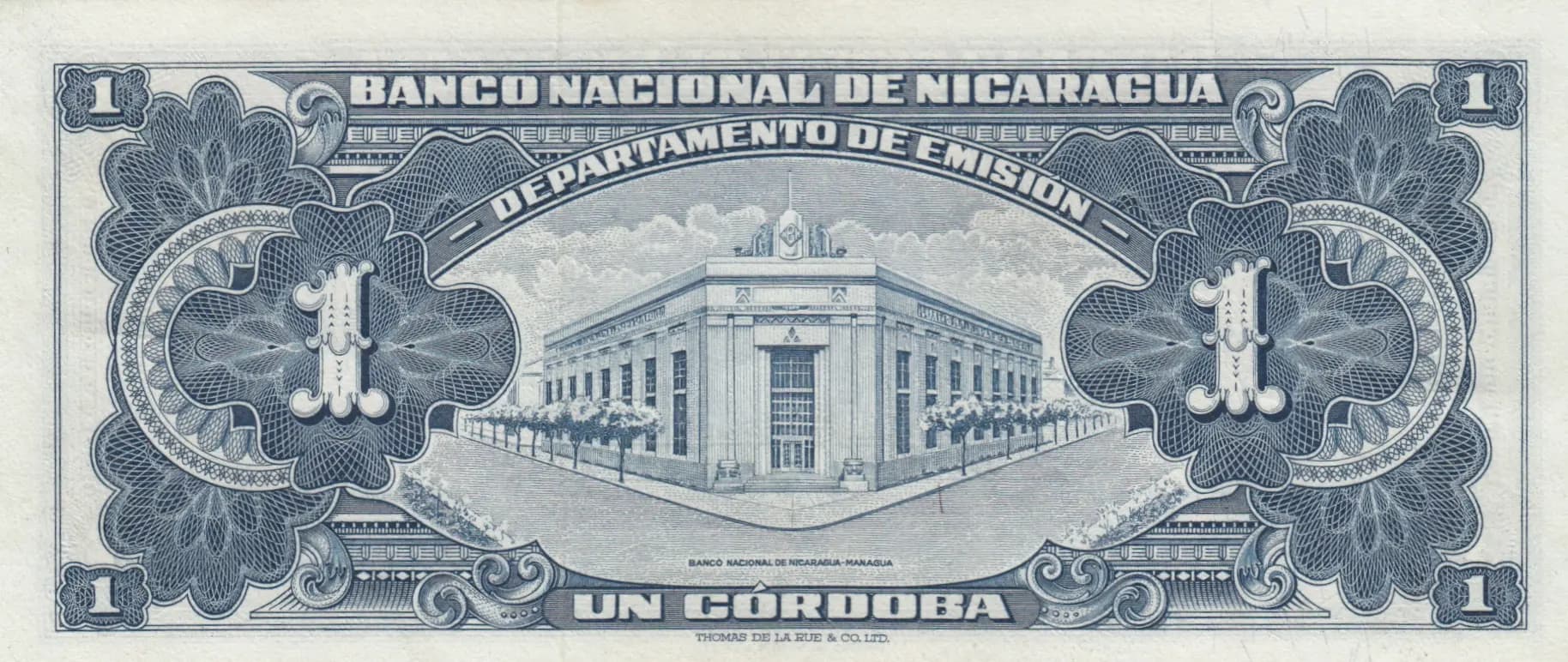
This is a 1958 series 1 Córdoba note from Nicaragua's Banco Nacional, printed by the prestigious Thomas de la Rue of London. The note features an elegantly engraved portrait of an indigenous girl with braided hair on the obverse and a classical institutional building on the reverse, both surrounded by ornate guilloche patterns in blue, tan, and gold tones. The visual analysis confirms this is circulated but presents the characteristic fine-line engraving and decorative security patterns typical of mid-20th century De la Rue work.
Common. This note represents a regular issue from a multi-year production period (1953–1960 according to external catalog data), and eBay price tracking shows consistent sales in the $8–$18 range for VF grades, with UNC catalog values of $50. These modest valuations, combined with regular market availability evidenced by numerous documented sales transactions, indicate wide circulation and substantial print runs. No evidence of scarcity or collector premium applies to this Pick number.
This 1958 note was issued during Nicaragua's post-1940 period under the Banco Nacional de Nicaragua's Emission Department, as referenced in the decree-law inscriptions visible on the obverse. The indigenous girl portrait reflects Central American cultural identity of the mid-twentieth century, while the institutional building on the reverse (the Banco Nacional de Nicaragua building in Managua) symbolizes the nation's financial authority during a period of relative economic development. The note's design and De la Rue printing represent Nicaragua's engagement with international banking standards in the post-war era.
The obverse features a central oval portrait of an indigenous Nicaraguan girl, shown in three-quarter profile with elaborately braided hair and period clothing with a decorative brooch or pin. She is flanked by lyre or musical instrument symbols within ornamental frames, representing cultural refinement. The design is bounded by intricate guilloche patterns and floral rosette motifs in the corners, executed in blue, tan, yellow, and black. The reverse depicts the Banco Nacional de Nicaragua's institutional headquarters building in Managua—a multi-story neo-classical structure with columned facade and classical architectural details. This building is similarly surrounded by ornamental borders, corner rosettes, and lyre symbols, maintaining design symmetry. Large numeral '1' denominators appear in all four corners of the reverse. Both sides employ fine-line engraved security elements that resist simple reproduction.
FRONT: 'BANCO NACIONAL DE NICARAGUA' (National Bank of Nicaragua); 'DEPARTAMENTO DE EMISIÓN, MANAGUA' (Department of Emission, Managua); 'SERIE DE 1958' (Series of 1958); 'UN CORDOBA' (One Córdoba); 'VALE POR' (Valid for); 'ESTE BILLETE HA SIDO EMITIDO DE CONFORMIDAD CON EL DECRETO-LEY DEL 26 DE OCTUBRE DE 1940' (This banknote has been issued in accordance with the Decree-Law of October 26, 1940); Full legal tender clause regarding customs, fiscal rights, and debt payment within the Republic; signature lines for 'EL PRESIDENTE DE LA REPUBLICA' (The President of the Republic), 'EL PRESIDENTE DEL CONSEJO DIRECTIVO DEL DEPARTAMENTO DE EMISIÓN' (President of the Board of Directors of the Emission Department), and 'EL GERENTE GENERAL DEL BANCO NACIONAL DE NICARAGUA' (General Manager of the National Bank of Nicaragua); Serial number 3606022 in red. BACK: 'BANCO NACIONAL DE NICARAGUA' (National Bank of Nicaragua); 'DEPARTAMENTO DE EMISIÓN' (Department of Emission); 'UN CORDOBA' (One Córdoba); 'BANCO NACIONAL DE NICARAGUA - MANAGUA' (National Bank of Nicaragua - Managua); Printer credit 'THOMAS DE LA RUE & CO LTD.'
Steel plate intaglio engraving (recess printing), executed by Thomas de la Rue & Co Ltd., London. The fine-line guilloche patterns, detailed portraiture, and complex geometric borders visible in the visual analysis are characteristic of De la Rue's signature security printing methods from this period. The intricate floral and geometric patterns throughout would have been produced from hand-engraved steel plates, providing multiple layers of anti-counterfeiting security through detail complexity and precision.
This note is cataloged as Pick-99b, with Pick-99c noted as an existing variant in the PMG population report. The observed specimen carries the series date '1958' on the obverse and serial number 3606022. The specific variety (99b vs. 99c) would be determined by signature combinations, date variations, or printing characteristics; further comparison with other documented examples would be required to distinguish the exact variety beyond the Pick-99b designation provided in the catalog data. No overprints or notable date variations are evident in the visual analysis.