3 tögrög 1955
Market Prices
13 salesAbout This Note
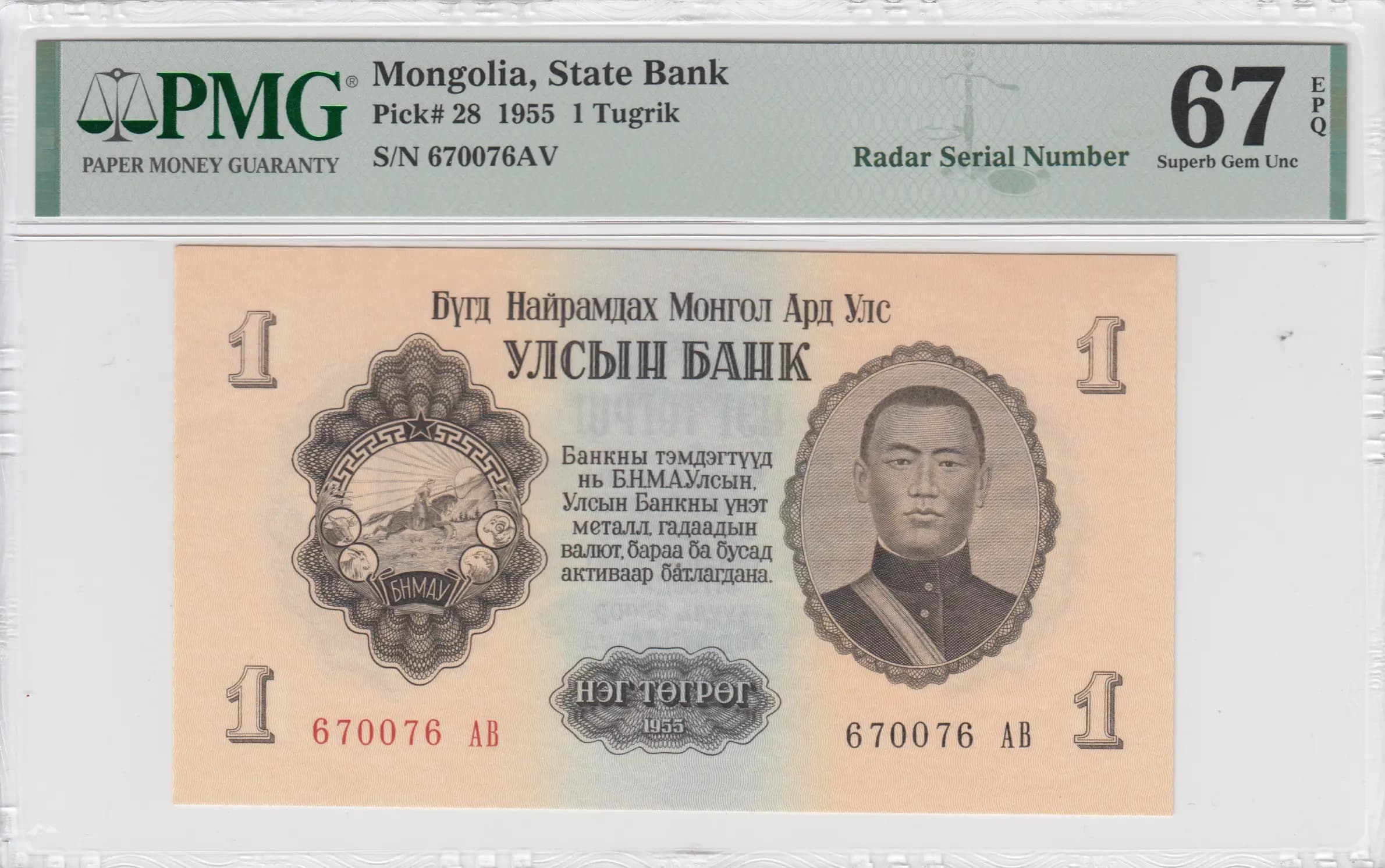
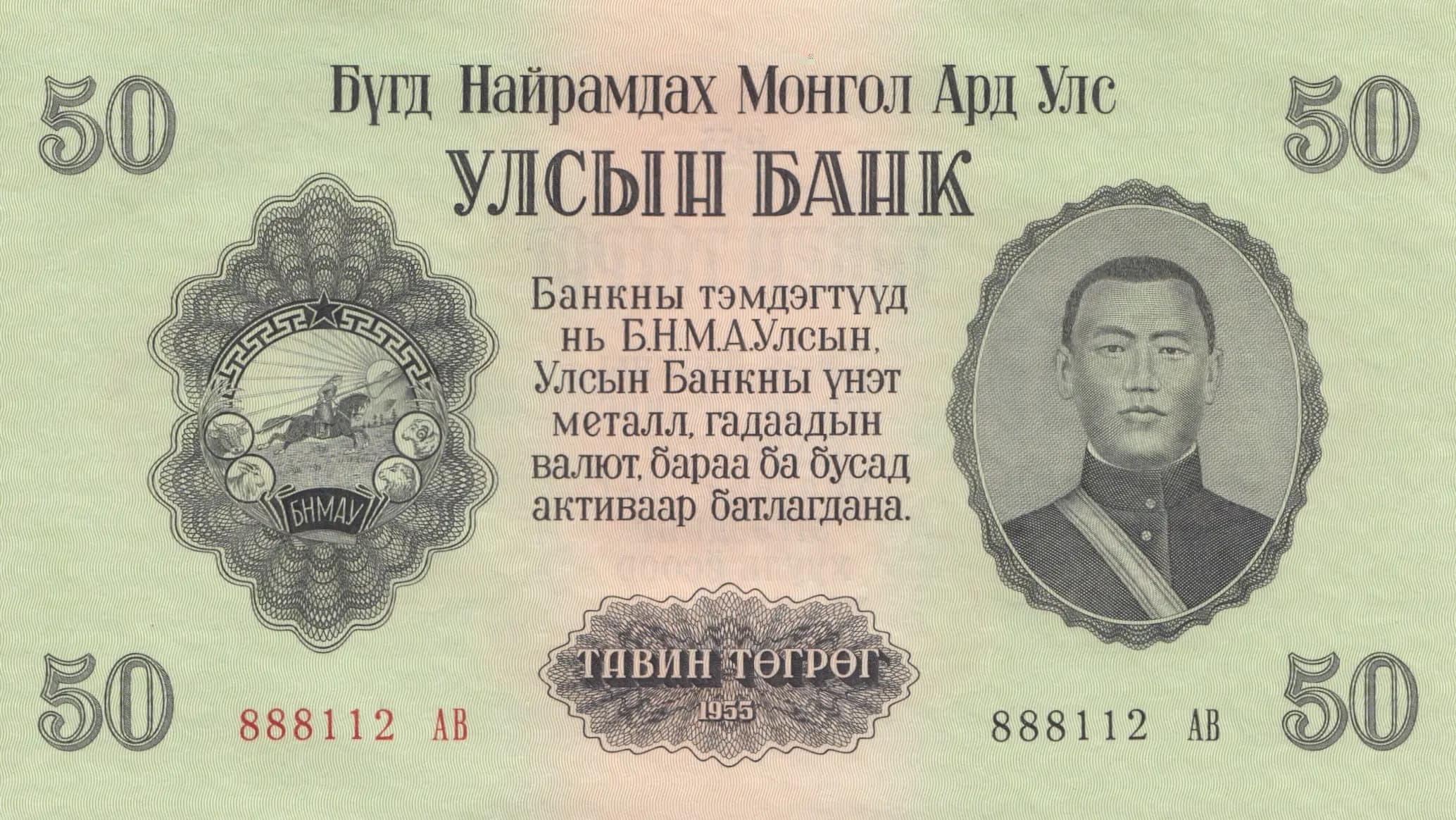
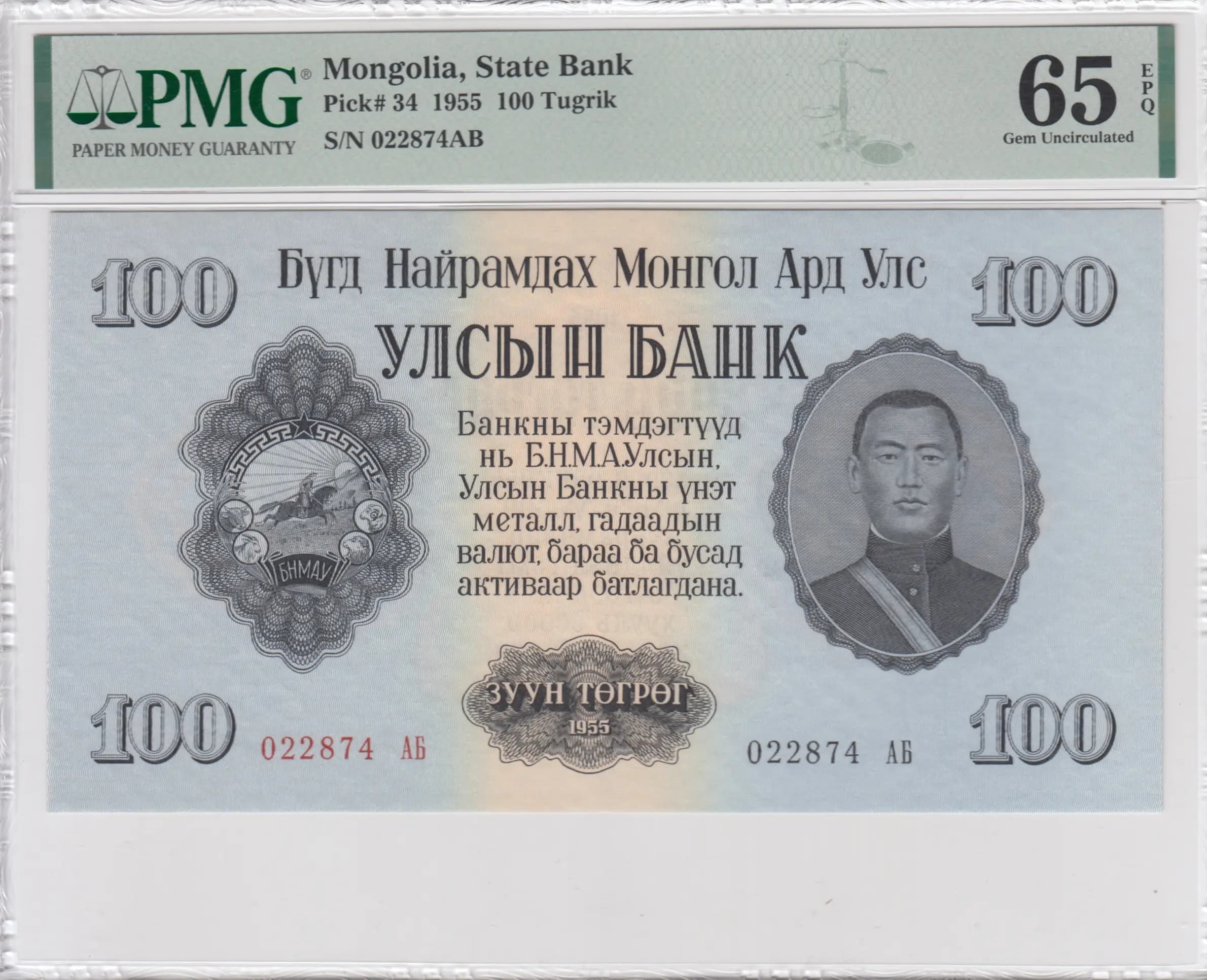
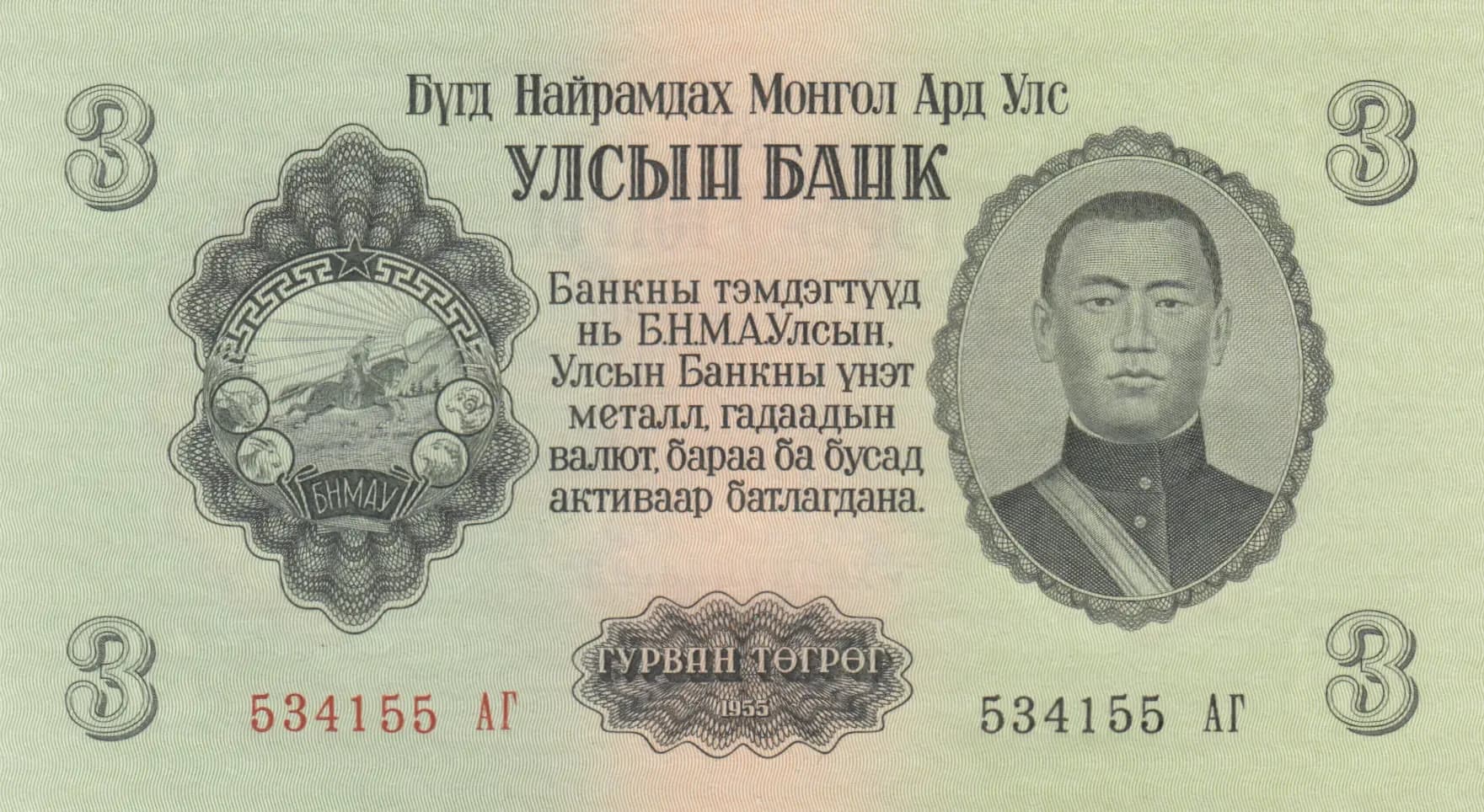
This is an uncirculated example of Mongolia's 1955 3 tögrög note (Pick-29), issued by the Ulsiyn Bank (State Bank) during the early post-war period of the Mongolian People's Republic. The note displays pristine condition with sharp printing, clean margins, and no signs of wear or handling. The design features a portrait of Sukhe-Bataar in military dress on the obverse, paired with the state emblem of the BNMAU on the reverse, making this an important transitional currency note from Mongolia's socialist era.
Common. eBay transaction data shows regular sales across multiple grades with UNC examples trading between $4.76 and $9.98 in recent years (with 2016 catalog value of $8 for UNC condition). The consistent availability of multiple graded examples in the PMG population report and frequent market activity indicate a reasonable print run and sustained collector interest without significant scarcity. Notes trading consistently below $15 are standard indicators of common status.
This 1955 issue represents an early post-World War II currency of the Mongolian People's Republic, a Soviet-aligned state. The prominence of Sukhe-Bataar, the legendary military leader and founder of modern Mongolia, reflects the nation's emphasis on revolutionary and nationalist heritage during the Cold War period. The inclusion of the state emblem (featuring horses and traditional Mongolian motifs) alongside Soviet-style socialist imagery demonstrates Mongolia's dual identity as a traditional nation integrated into the Soviet sphere of influence.
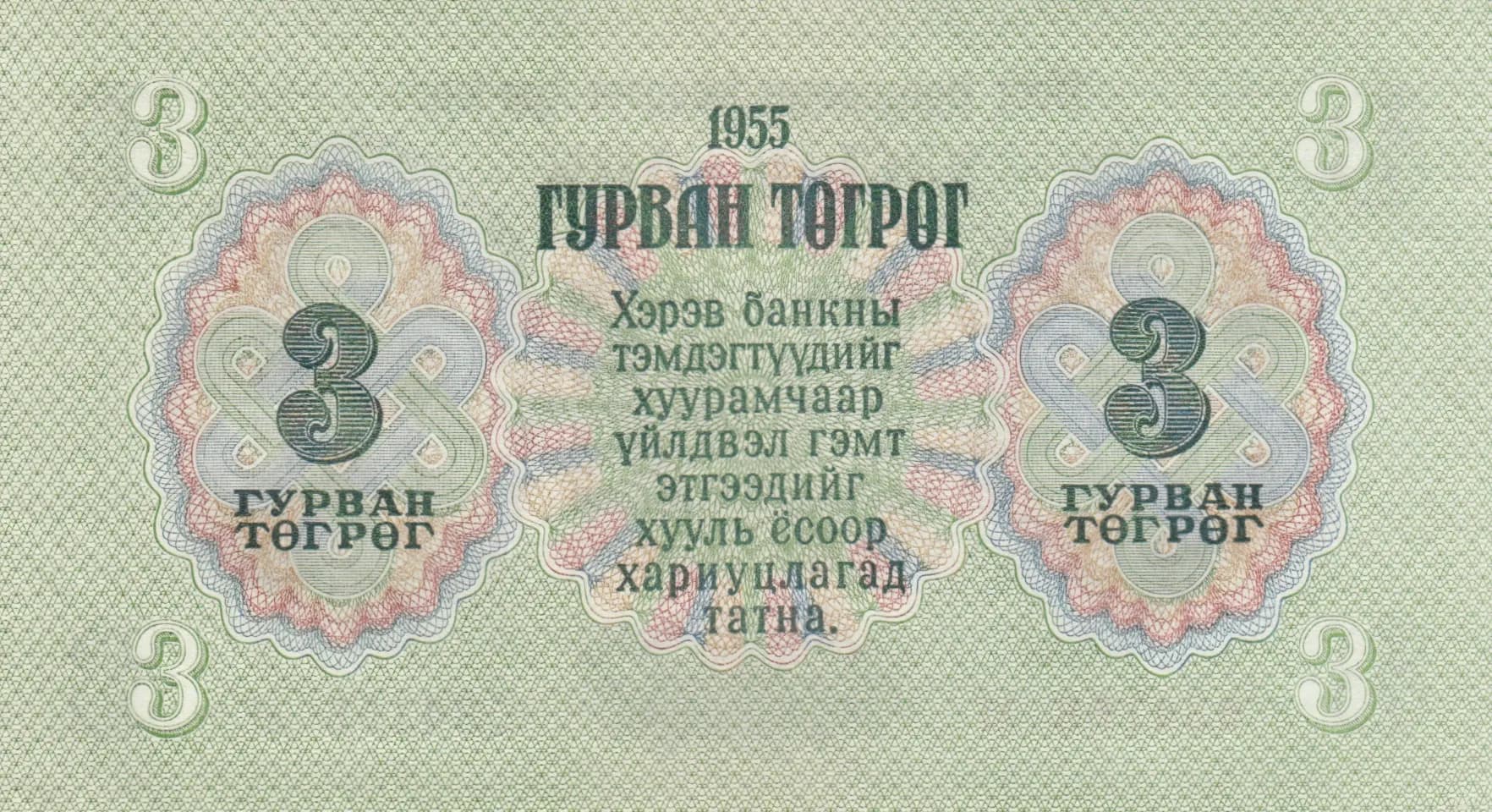
The obverse features a right-facing oval portrait of Sukhe-Bataar (1893-1923), Mongolia's revolutionary military leader, depicted in military-style uniform within an ornately scalloped frame. The portrait is positioned on the right side with the state emblem of the Mongolian People's Republic prominently displayed on the left, incorporating traditional Mongolian motifs including horses and mountainous landscape elements within a circular design. Large denomination numerals '3' appear in both upper corners. The reverse displays two identical decorative circular medallions with the numeral '3' in ornamental frames, featuring geometric and floral patterns with red and blue accents. The overall design employs fine line pattern backgrounds throughout, characteristic of mid-20th century socialist currency design. The color scheme is predominantly pale green and beige with gray printing, enhanced by red and blue tinting in decorative elements.
FRONT: 'Буцл Найрамдах Монгол Арл Улс' (Mongolian People's Republic); 'УЛСЫН БАНК' (State Bank); 'ГУРВАН ТӨГРӨГ' (Three Tögrög); 'Банкны төмдөгтүүд ь БНМАУлсын Улсын Банкны унөт металл гадаадын валют бараа ба бүсад активаар батлагдана' (The banknotes are backed by the precious metals and foreign currency reserves of the State Bank of the Mongolian People's Republic); Serial number '534155 АГ'; Denomination numeral '3'. BACK: 'ГУРВАН ТӨГРӨГ' (Three Tögrög); '1955' (Year of issue); 'Харьв банкны төмдөгтүүлийг хүүрамчаар үйлдвэл гэмт әггәдийг хүүль өсөөр харциулагад тагна' (Counterfeiting banknotes will be punished according to the law); Denomination numerals '3' in all four corners.
Intaglio engraving (copperplate printing), evidenced by the fine line patterns, intricate portrait details, complex geometric ornamental borders, and sharp, crisp printing visible throughout both sides. The high quality of the engraved work and the precise rendering of security elements such as fine line backgrounds and detailed medallion designs are consistent with high-security banknote production standards of the Soviet-era socialist states. The printer for this issue was likely a Soviet security printer or state-controlled Mongolian printing facility, typical for satellite state currencies of this era.
This note exhibits serial number '534155 АГ' with the Cyrillic prefix 'АГ'. The PMG population report indicates two cataloged variants for Pick-29: the standard P-29 and a starred variety P-29* (likely representing a printer's variety or signature variant). The visual analysis does not reveal obvious overprints or signature variations that would definitively identify this as the starred variety. Further research into the significance of the 'АГ' prefix and comparison with known P-29* examples would be needed to confirm exact variety classification.