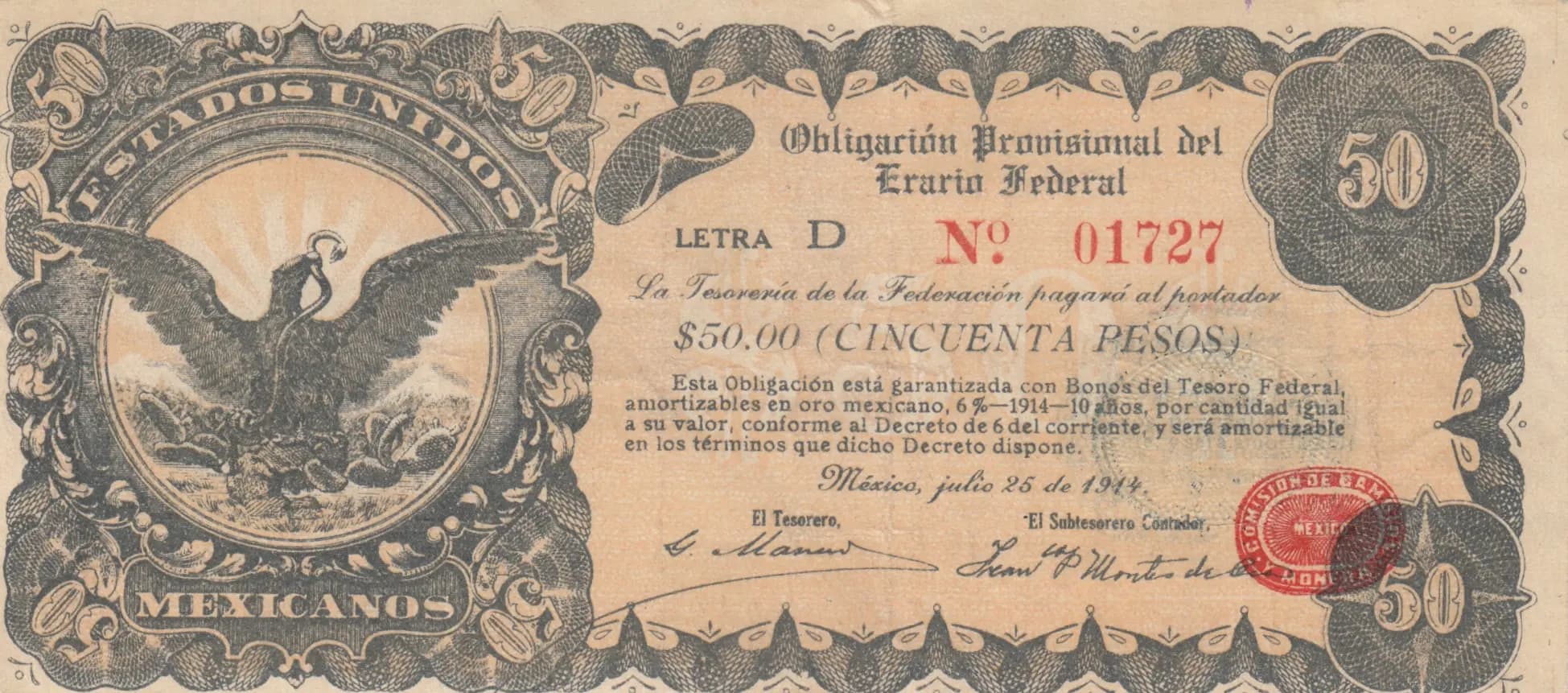
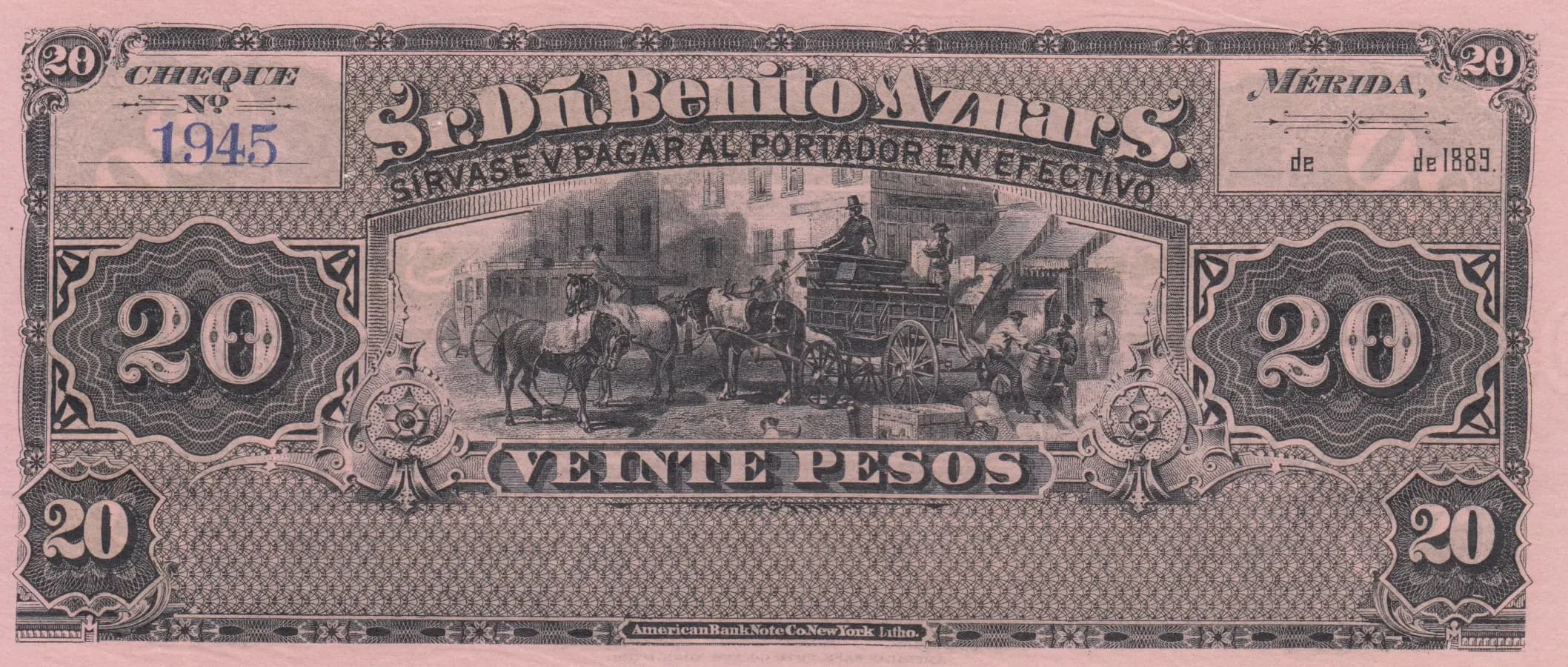
50 pesos 1914


About This Note
This is a 50 pesos banknote issued by the Estado de Chihuahua in 1914 during the Mexican Revolution, displaying the characteristic green and black color scheme of revolutionary-era Mexican state currency. The note features two formal portrait medallions flanking the central text, ornate decorative borders, and denomination circles marked 'CINCUENTA' in each corner of the front. While the note shows significant circulation wear with visible creases, fold marks, foxing, and age-related discoloration, it retains good legibility of the printed elements and handwritten signatures, representing an important artifact of Mexico's tumultuous revolutionary period.
Common. State notes issued during the Mexican Revolution by Chihuahua and other northern states were produced in significant quantities for practical currency needs, and this denomination represents a middle-value note likely issued in substantial numbers. While revolutionary-era Mexican state currency is historically significant and sought by collectors, the Estado de Chihuahua 50 pesos issue is not cataloged as a scarce variety, and examples appear regularly in the numismatic market. The observed condition (UNC despite visible wear) may represent a later grading assessment, but even fine examples of this note type are typically moderately priced rather than commanding rare-note premiums.
This banknote was issued under the authority of the Estado de Chihuahua in accordance with a military decree dated February 10, 1914, during the height of the Mexican Revolution when various regional authorities issued their own currency to finance military operations and government functions. The classical government building depicted on the reverse, identified as the Tesorería General (General Treasury) of Chihuahua, symbolizes the state's attempt to maintain institutional legitimacy during the conflict. The note's promise to pay 'al portador en efectivo' (to bearer in cash) reflects the currency's role as emergency government scrip during a period of extreme political and economic instability in northern Mexico.
The front side presents a formal state document design characteristic of 1914 Mexican revolutionary currency, with two bearded male portraits in formal attire positioned symmetrically on either side of the central text area. The left portrait depicts a bearded gentleman in formal dress, while the right portrait shows a man with a prominent mustache, both rendered in classical engraving style within circular medallions. The design incorporates three signature lines for key officials: the Governor (Gobernador), General Treasurer (Tesorero General), and Interventor (Inspector), reflecting the multiple-authority approval structure of revolutionary state governments. The reverse features an impressive neoclassical government building with columns and a domed roof, representing the Tesorería General del Territorio de Chihuahua, enclosed within an ornamental frame with decorative scalloped borders. The denomination '50' and 'CINCUENTA' appear in four corner positions, a standard security and clarity feature of the period.
FRONT SIDE: 'EL ESTADO DE CHIHUAHUA' (The State of Chihuahua); 'PAGARA AL PORTADOR EN EFECTIVO' (Will pay to bearer in cash); 'CINCUENTA PESOS' (Fifty Pesos); 'CONFORME AL DECRETO MILITAR DE FECHA 10 DE FEBRERO DE 1914' (In accordance with the military decree dated February 10, 1914); 'CHIHUAHUA, CHIHUAHUA, MEXICO' (Chihuahua, Chihuahua, Mexico); 'SERIE F' (Series F); Serial number '135918'; 'TESORERO GENERAL' (General Treasurer); 'GOBERNADOR' (Governor); 'INTERVENTOR' (Interventor/Inspector). BACK SIDE: 'CINCUENTA' (Fifty) appears twice in corner denomination circles; 'TESORERIA GENERAL DEL TERRITORIO CHIHUAHUA' (General Treasury of the Territory of Chihuahua); 'I-UMO' (unclear designation, possibly a control mark).
This note was produced using traditional intaglio (engraved steel plate) printing, as evidenced by the intricate line work, fine detail in the portraits and architectural rendering, and the crisp decorative scrollwork visible throughout. Multiple color printing was employed, with the front utilizing green, black, red, and cream inks, while the reverse employed cream, beige, yellow, purple/violet, and brown inks. The serial number '135918' was printed in red, suggesting separate press runs for different color elements. The printer for this specific Chihuahua issue is not definitively identified in standard catalogs, but the sophisticated engraving quality suggests work by a capable regional or national Mexican security printer of the revolutionary period.
This note is cataloged as Pick S538b, indicating it is the second listed variety of this denomination and issuer. The visual inspection confirms this as Series F (SERIE F), with serial number 135918 printed in red. The variety designation suggests there may be differences in this issue from other printings of the same denomination—potentially differing in signature combinations, series letters, or minor design elements. The presence of handwritten signatures indicates this note retains original period signatures, which may vary by individual notes depending on who held the relevant offices at the time of issue.