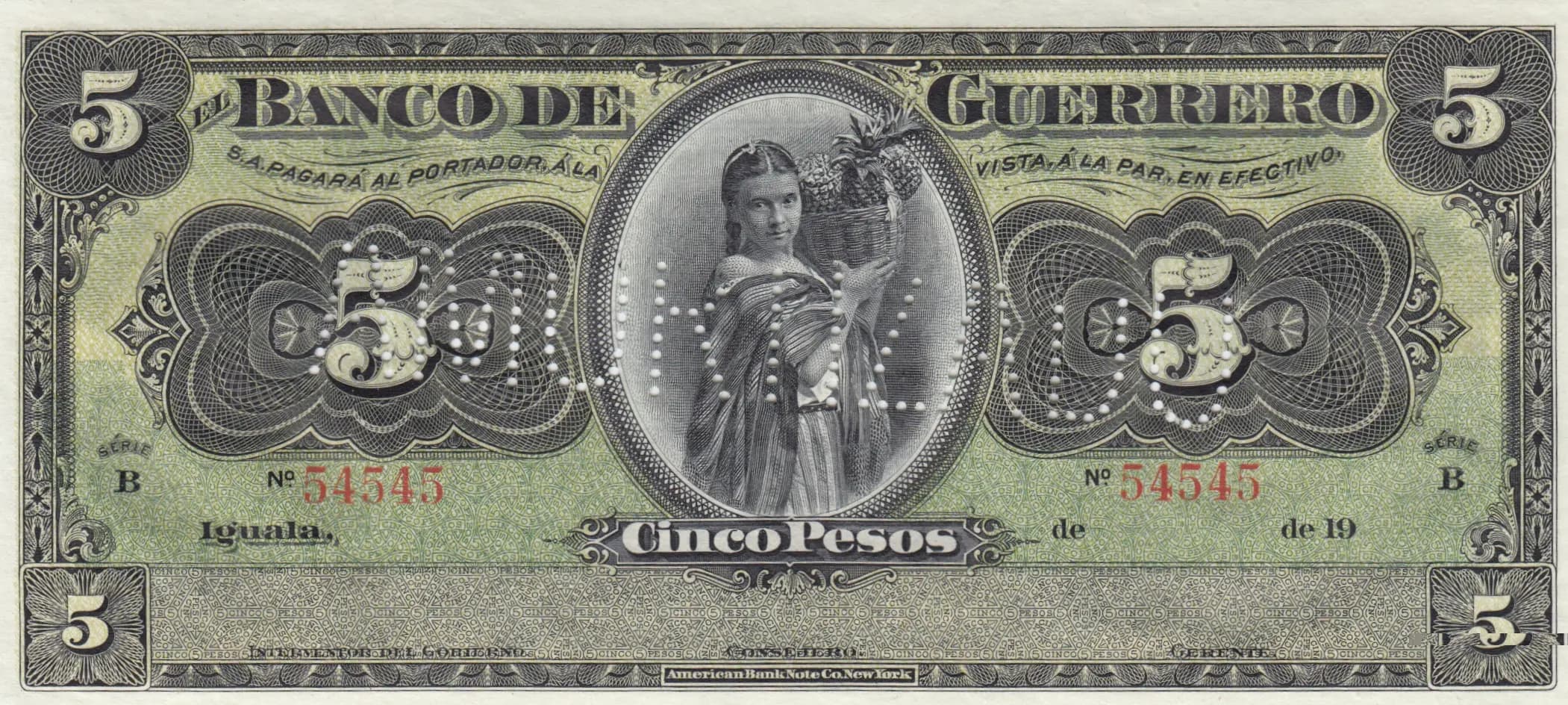
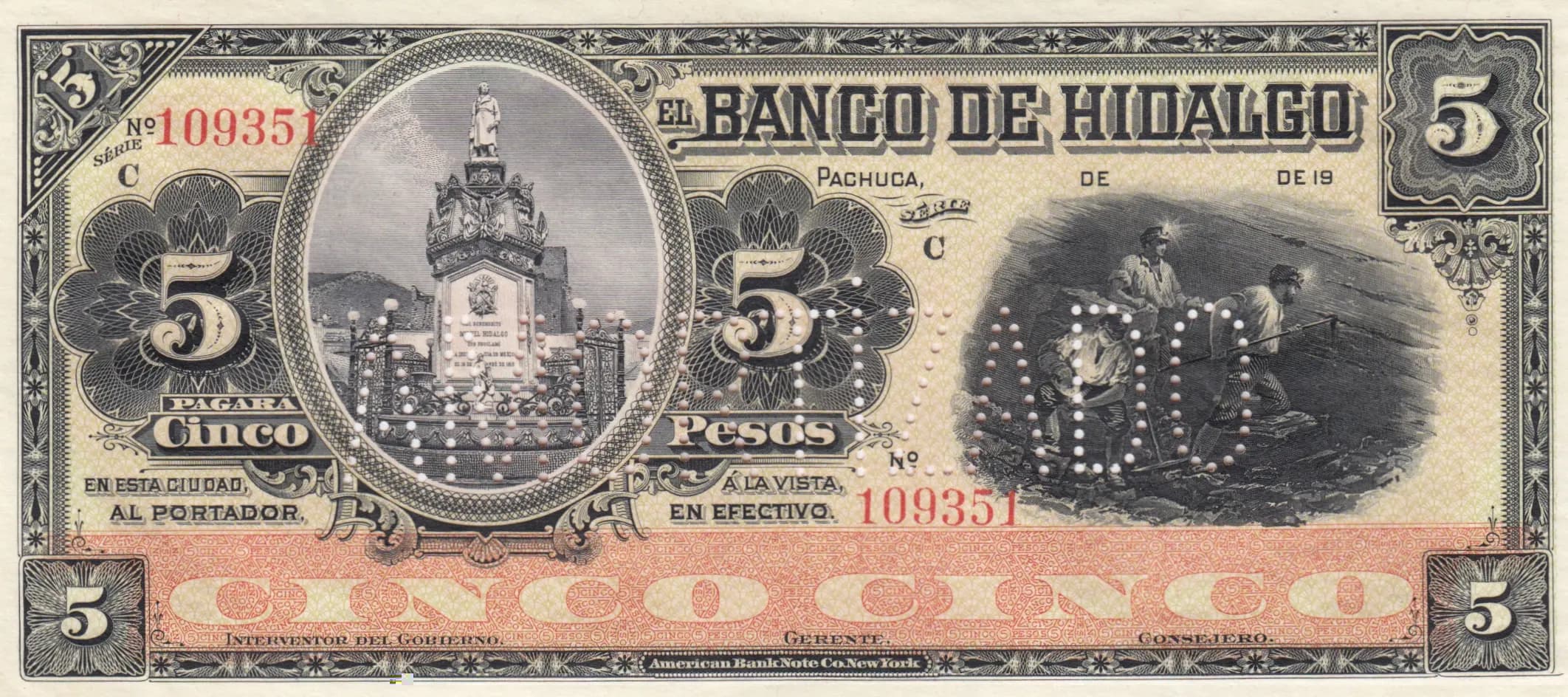
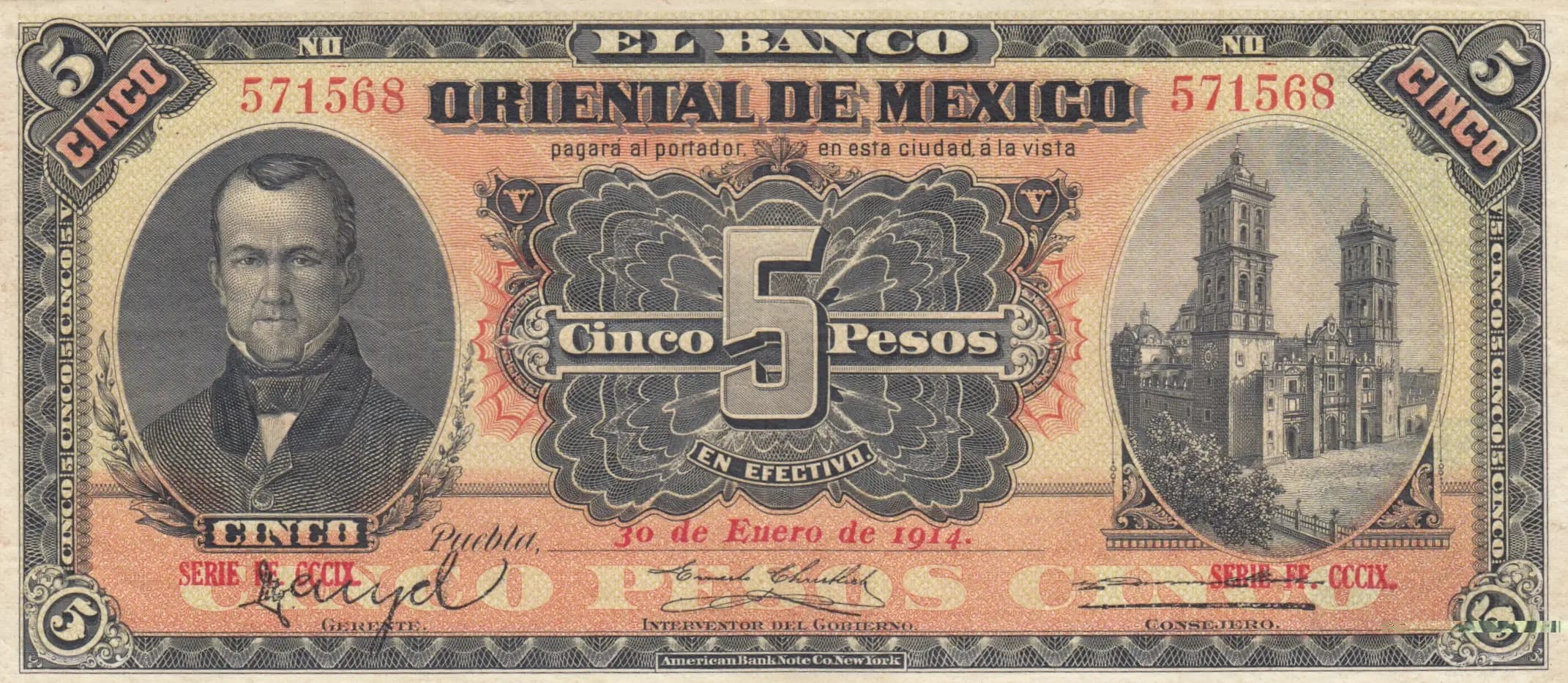
5 pesos 1914
Market Prices
3 salesAbout This Note
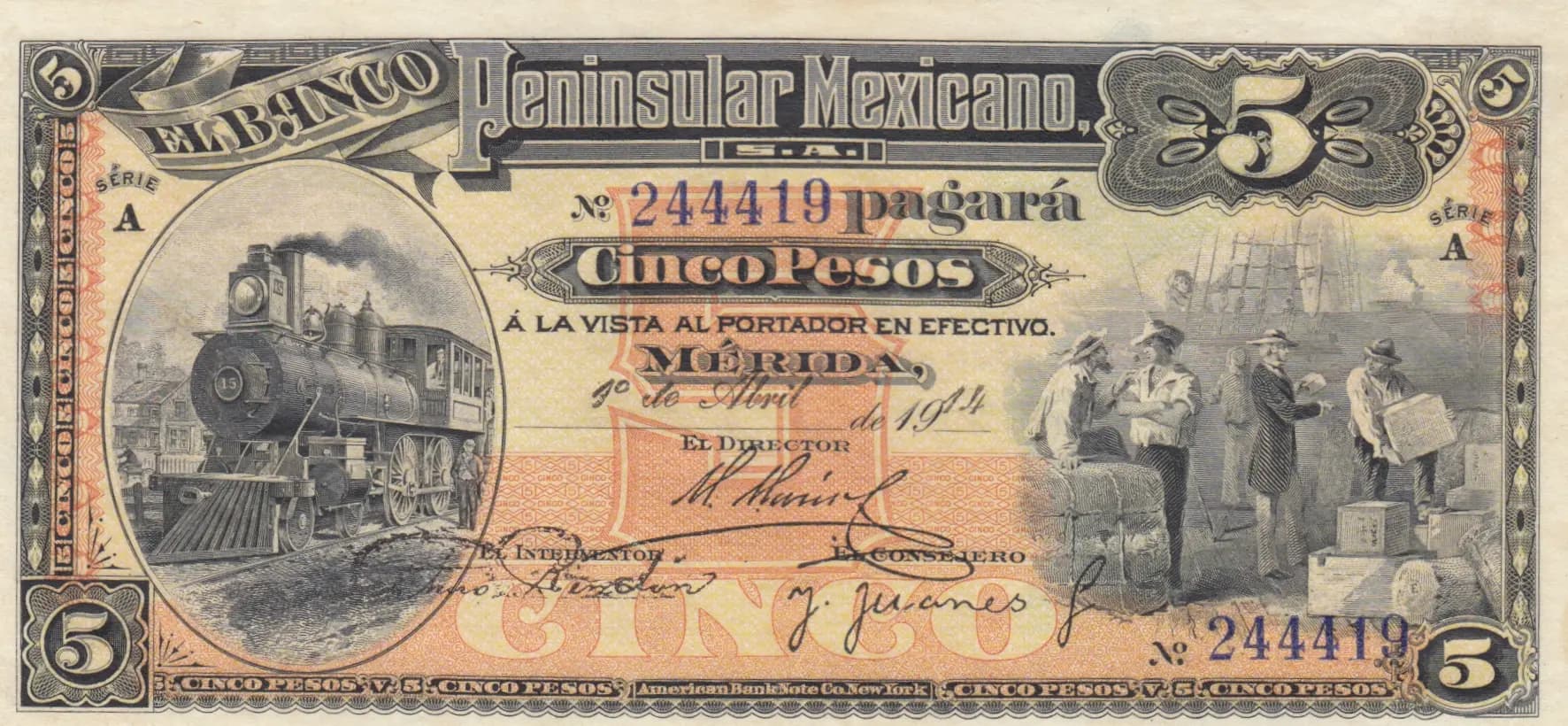
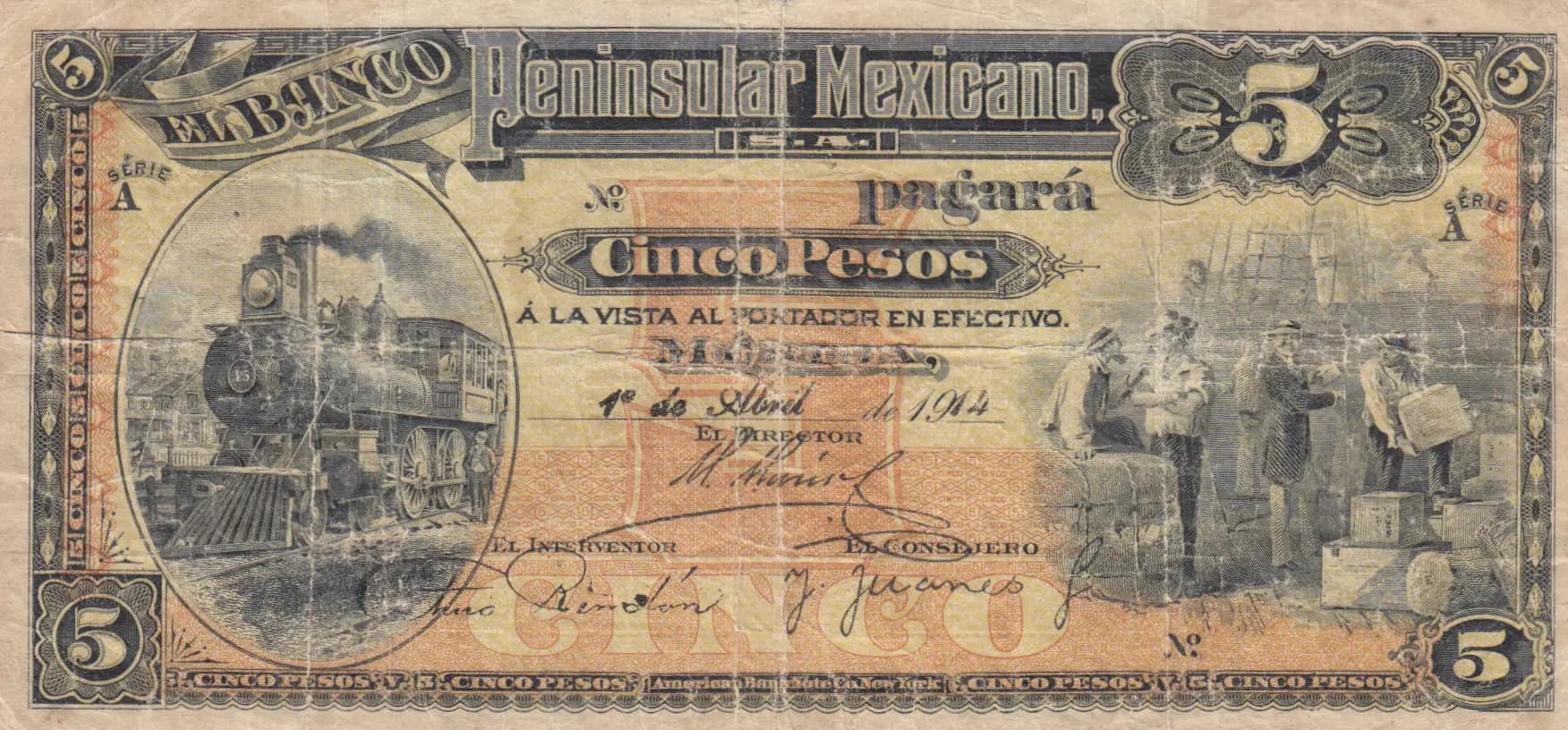
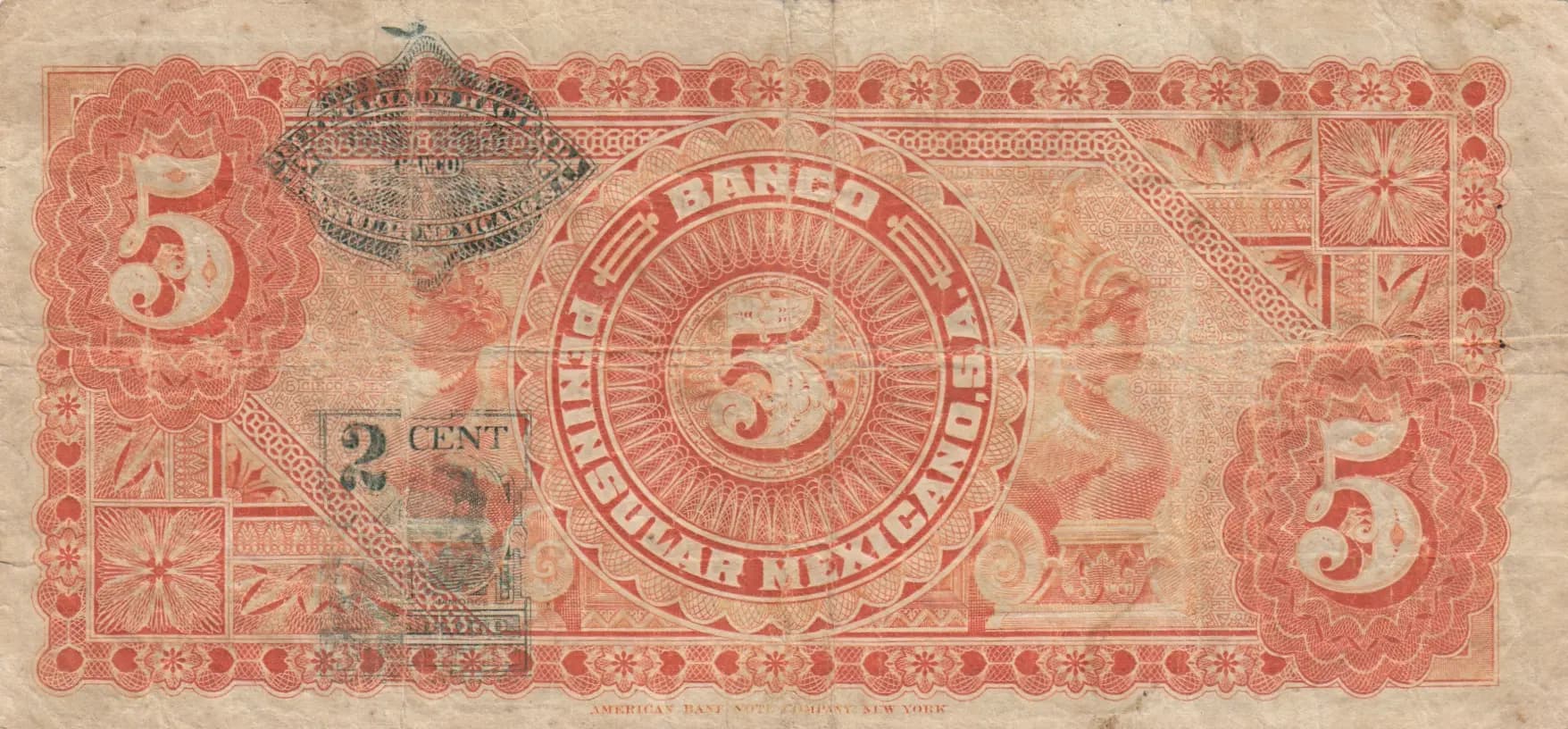
A well-circulated 1914 Banco Peninsular Mexicano 5 pesos note (Pick S465r) in Fair condition, featuring a striking steam locomotive vignette on the obverse and ornate allegorical design on the reverse. The note exhibits heavy aging characteristics including multiple creases, fold lines, water stains, and foxing throughout, consistent with active circulation during the Mexican Revolution era. This Series A issue from April 1, 1914, represents an interesting example of regional Mexican banking currency produced by the American Bank Note Company.
Common. While regional Mexican banknote issues from the Revolution era can attract numismatic interest, the eBay transaction data demonstrates active market circulation with multiple recent sales ranging from approximately $61–$112 depending on condition. The Fair grade specimen observed here would typically sell in the $50–$100 range, consistent with common pricing for this type. No evidence of a particularly small print run, recall, or short-lived issuance exists for Pick S465r. The note's accessibility in the secondary market and modest price points indicate routine availability.
The Banco Peninsular Mexicano issued this note during one of Mexico's most turbulent periods—the Mexican Revolution of 1910-1920. The prominent steam locomotive imagery reflects Mexico's late 19th and early 20th-century modernization efforts and the strategic importance of railroads to the nation's economy and political stability. Regional banks like Peninsular Mexicano maintained relative autonomy during this period, issuing their own currency until the consolidation of Mexican banking under the Central Bank in subsequent decades.
The obverse features a classical industrial vignette composition typical of early 20th-century currency design. The primary image on the left depicts a steam locomotive within an oval frame, symbolizing Mexico's railroad expansion and industrial progress. The right side shows dock workers or commercial figures engaged in labor, representing commerce and trade. The note employs baroque-style cartouches with ornamental '5' denominations in the corners. The reverse displays a symmetrical allegorical design centered on a large circular medallion containing the numeral '5' with radiating lines suggesting light or enlightenment, flanked by repeating geometric and floral patterns. The black overprint on yellow and orange underprint (obverse) and red/coral pink on cream background (reverse) are typical of American Bank Note Company's color lithography techniques of this era.
FRONT: 'Banco Peninsular Mexicano' (Peninsular Mexican Bank); 'Pagará' (Will pay); 'Cinco Pesos' (Five Pesos); 'Á LA VISTA AL PORTADOR EN EFECTIVO' (At sight to bearer in cash); '1º de Abril de 1914' (April 1, 1914); 'FERROCARRILO' (Railroad); 'SERIE A' (Series A); 'EL DIRECTOR' (The Director); 'EL INTERVENTOR' (The Comptroller); 'EL CONSEJERO' (The Counselor); 'CINCO PESOS Y CINCO PESOS' (Five Pesos and Five Pesos); 'American Bank Note Co New York' (American Bank Note Company, New York). BACK: 'BANCO CENTRAL MEXICANO' (Mexican Central Bank—likely a printer's plate notation); '2 CENT' (2 Cent—printer's marking); 'AMERICAN BANK NOTE COMPANY NEW YORK' (American Bank Note Company, New York).
Steel plate engraving with color lithography, executed by the American Bank Note Company (ABNC) of New York, one of the world's premier currency printers. The note exhibits characteristic fine line work, intricate vignette details, and ornamental borders typical of high-security intaglio printing. The multi-color design utilized separate lithographic stones or plates for the colored underprints, with black engraved details overprinted for the vignettes and text.
This specimen is identified as Series A (SERIE A), issued April 1, 1914. The visual analysis confirms this is an issued note (not a specimen or proof). No overprints, signatures of specific officers, or unusual serial number prefixes were distinctly identified in the images, though the presence of signature blanks for 'El Director,' 'El Interventor,' and 'El Consejero' is typical of the issue. Collectors should note that Series A designation and the specific April 1, 1914 date are key identifiers; later series or date variations may exist but were not evident in this example.