5 pesos 1910
Market Prices
About This Note
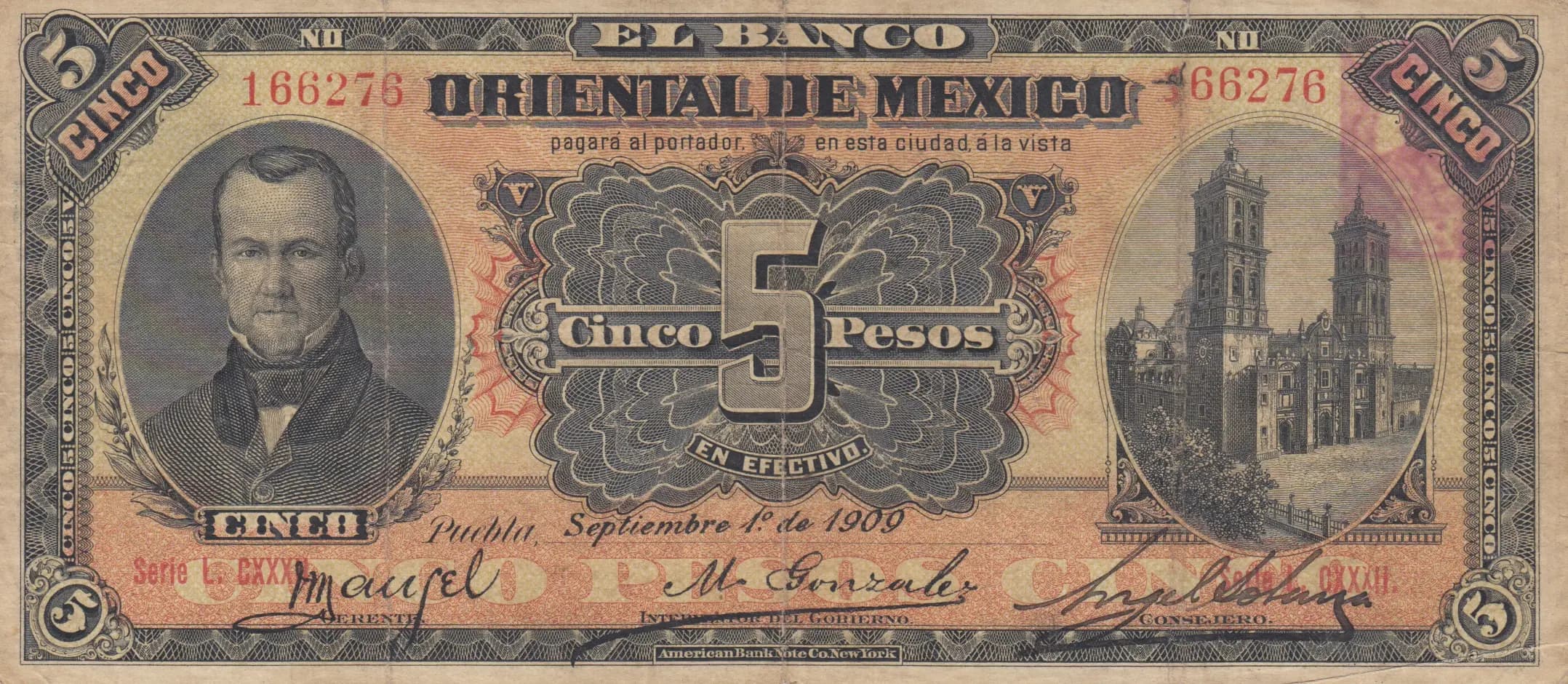
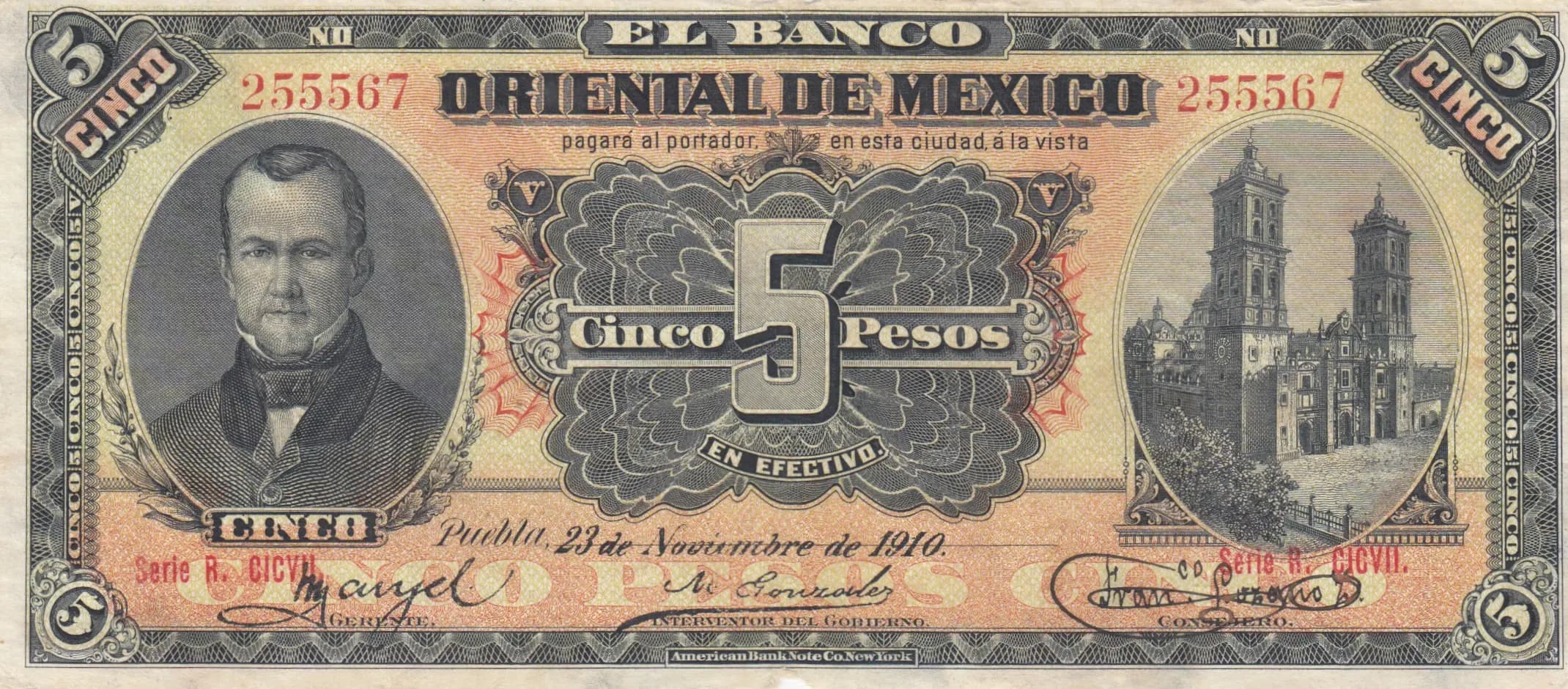
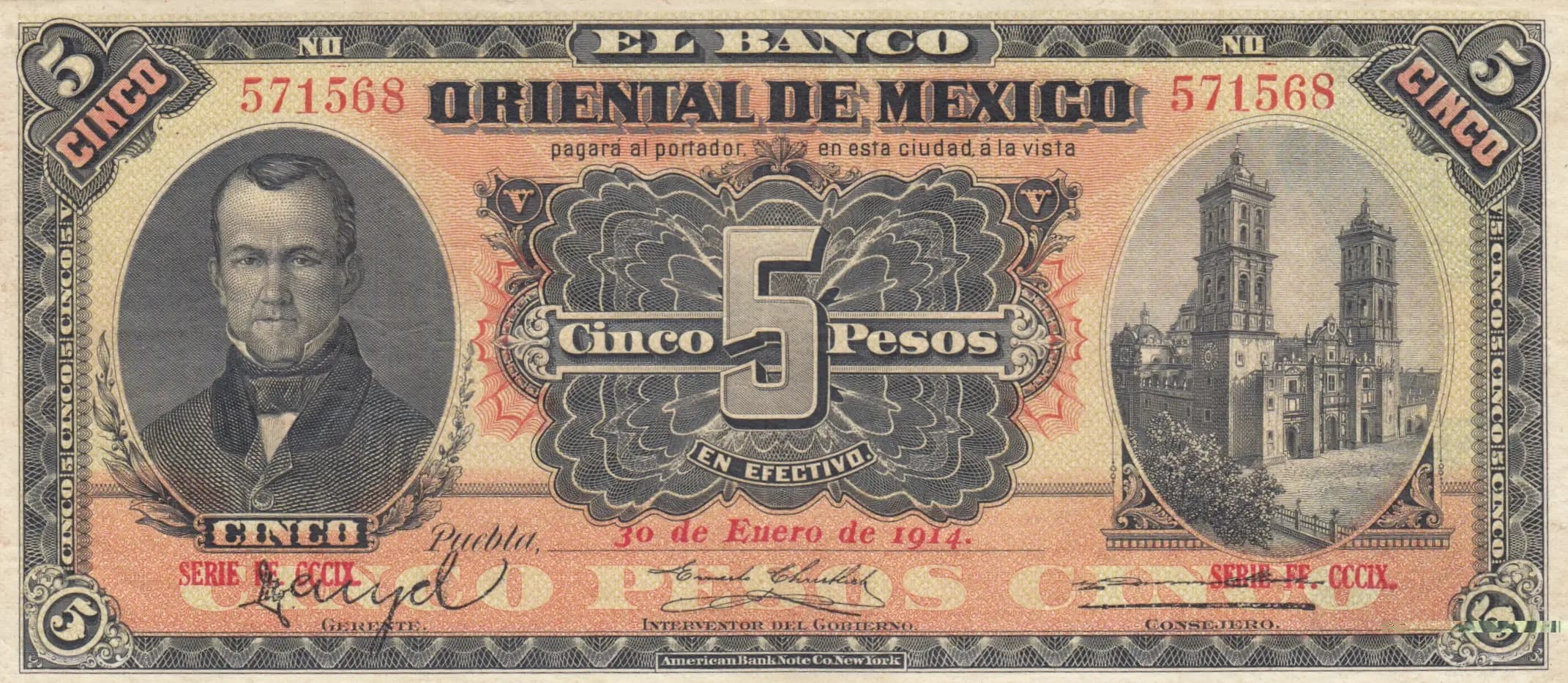
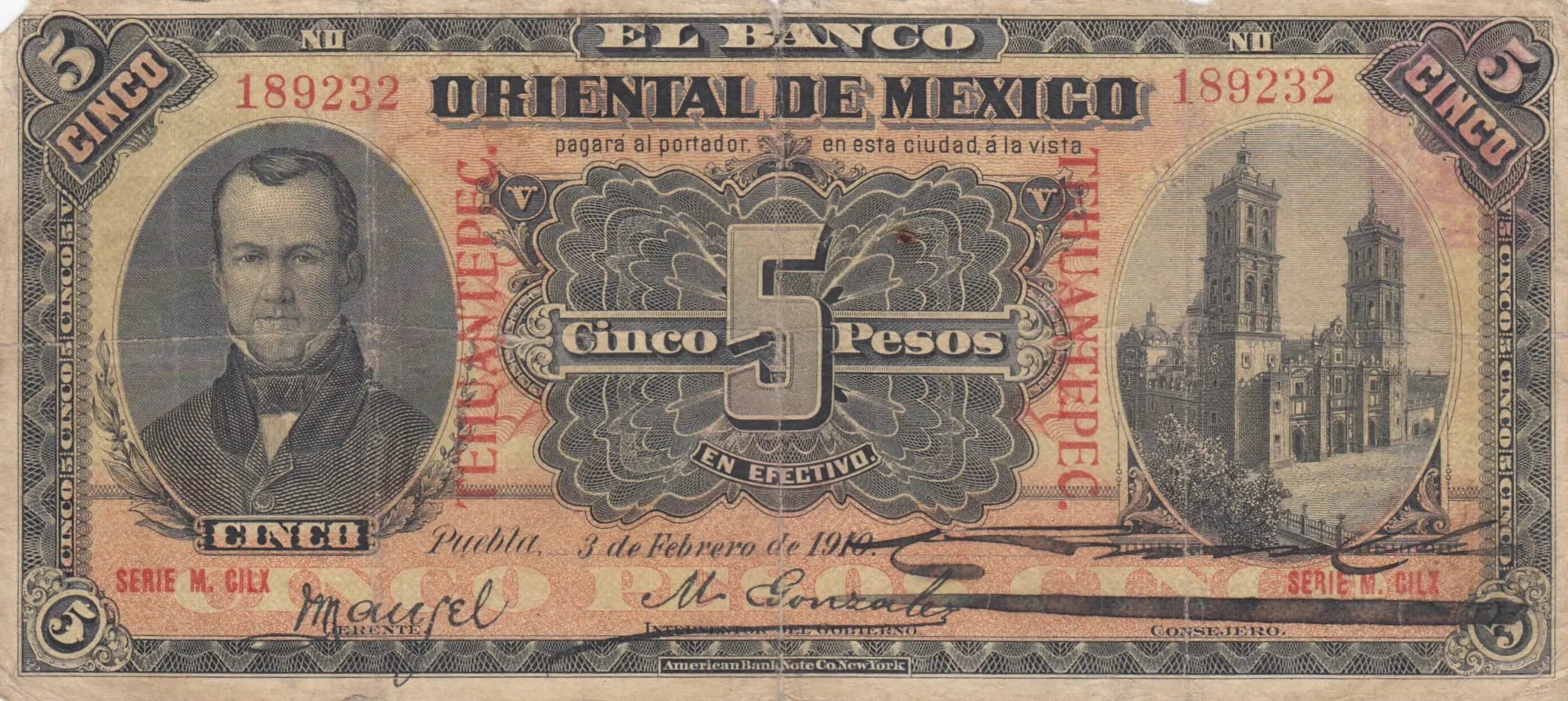
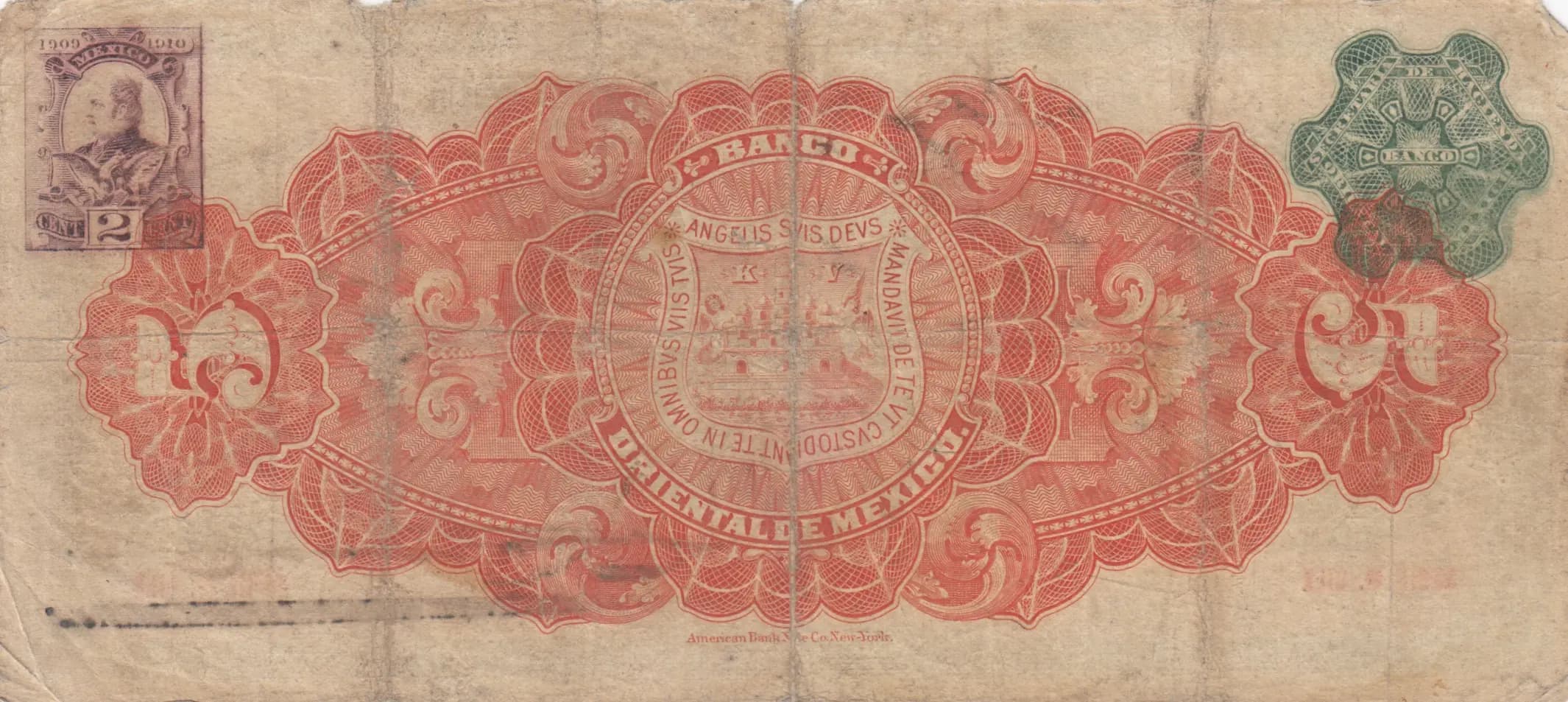
A 5 Pesos banknote from Banco Oriental de Mexico dated 1909-1910, printed by American Bank Note Company in their characteristic baroque engraving style. The note features a portrait of Estebán de Antunano on the obverse and the Cathedral of Puebla on the reverse, with ornate red and black printing on a beige base. In VG condition, the note displays significant age-related wear including creases, foxing, and discoloration consistent with over a century of circulation—typical characteristics that make early 20th-century Mexican regional bank notes valued by collectors of Latin American currency.
Common. While regional Mexican bank notes from this period are collected, eBay market data shows notes in similar condition ranging from $29.99 to $145.00 USD, with most sales clustered below $50 and numerous examples available. The Banco Oriental de Mexico issued this 5 Pesos denomination in significant quantities (evidenced by varying serial numbers and series marks observed), and surviving examples remain readily obtainable for collectors. VG condition specimens like this example, showing expected circulation wear, are not scarce in the numismatic market.
This Banco Oriental de Mexico note was issued during a turbulent period in Mexican history, just prior to the Mexican Revolution (1910-1920). The cathedral depicted on the obverse is the Cathedral of Puebla, one of Mexico's most significant colonial-era religious structures, reflecting the bank's Puebla connection. The Latin motto 'CONSILIO ET VIRTUTE' (With counsel and virtue) and heraldic imagery on the reverse emphasize institutional legitimacy during an era when regional banks competed for credibility and trust in pre-federal currency systems.
The obverse features a formal portrait of Estebán de Antunano, a 19th-century Mexican businessman and industrialist, positioned at the left in three-quarter profile facing left, dressed in formal 19th-century attire with bow tie. The central design showcases an ornate baroque-style decorative frame containing the denomination 'Cinco Pesos,' flanked by laurel wreaths symbolizing achievement and honor. The right side depicts the Cathedral of Puebla with its distinctive twin colonial towers, a prominent architectural landmark of Puebla. The reverse displays the State arms of Puebla at center within an ornate heraldic shield, surrounded by baroque decorative flourishes in red and black with green accents. The entire design reflects the bank's regional prestige and institutional authority through classical iconography and fine engraving work.
OBVERSE: 'BANCO ORIENTAL DE MEXICO' (Oriental Bank of Mexico) / 'Cinco Pesos' (Five Pesos) / 'EN EFECTIVO' (In Cash/Legal Tender) / 'pagará al portador, en esta ciudad, á la vista' (Will pay to bearer, in this city, on sight) / 'SERIE M. GILX' (Series M. GILX) / 'Puebla. 3 de Febrero de 1909' (Puebla. February 3, 1909) / 'DIRECTOR' and 'CONSEJERO' (Director and Councilor) with signatures of Manuel and M. Gonzales / 'American Bank Note Co. New York' (printer attribution). REVERSE: 'BANCO ORIENTAL DE MEXICO' (Oriental Bank of Mexico) / 'ANGELI SVIS DEVS' (God is with us) / 'CONSILIO ET VIRTUTE' (With counsel and virtue) / '1909-1910' (years of issue) / 'American Bank Note Co. New York' (printer attribution).
Intaglio engraving (steel plate engraving), executed by American Bank Note Company of New York, one of the world's premier security printers of the era. The note demonstrates characteristic ABNC quality with fine line work, complex baroque ornamental patterns, and multi-color printing achieved through successive plate passes (black, red, and gray inks applied to a beige base stock). The intricate engraved patterns and fine detail work served as anti-counterfeiting security measures standard for high-value banknote production of this period.
This note is specifically identified as Pick S381k with Series M. GILX, Serial Number 189232, and dated 3 Febrero 1909 (February 3, 1909). The overprint marking 'TEHUÁNTEPEC' and date '3.2.1910' referenced in the catalog indicates this is a variant with regional overprint applied in 1910, distinguishing it from base issue variants. The presence of signatures by Manuel (Director) and M. Gonzales (Councilor) is consistent with the official authorization marks found on this series. The 1909 printing date on the note itself versus the 1910 overprint date reflects the bank's practice of pre-printing before applying location-specific overprints for regional distribution.