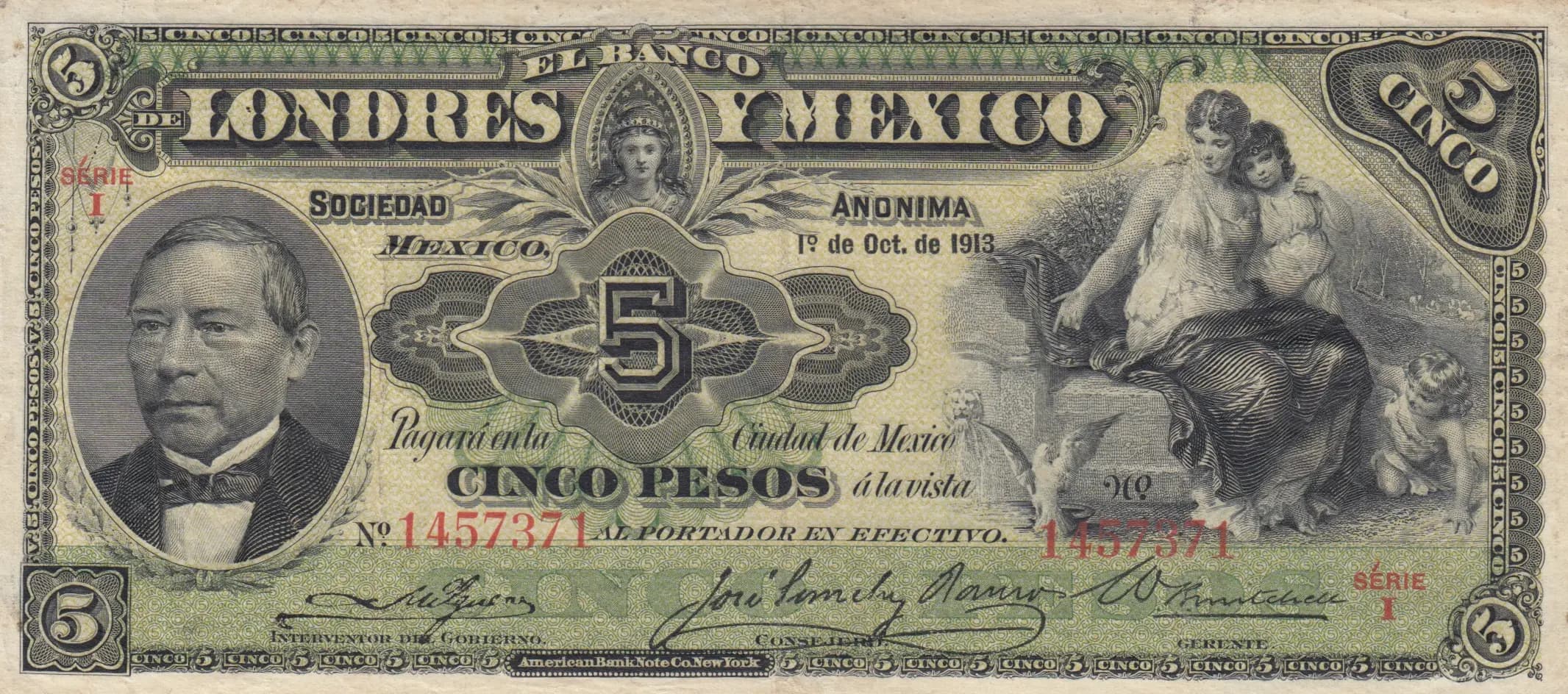
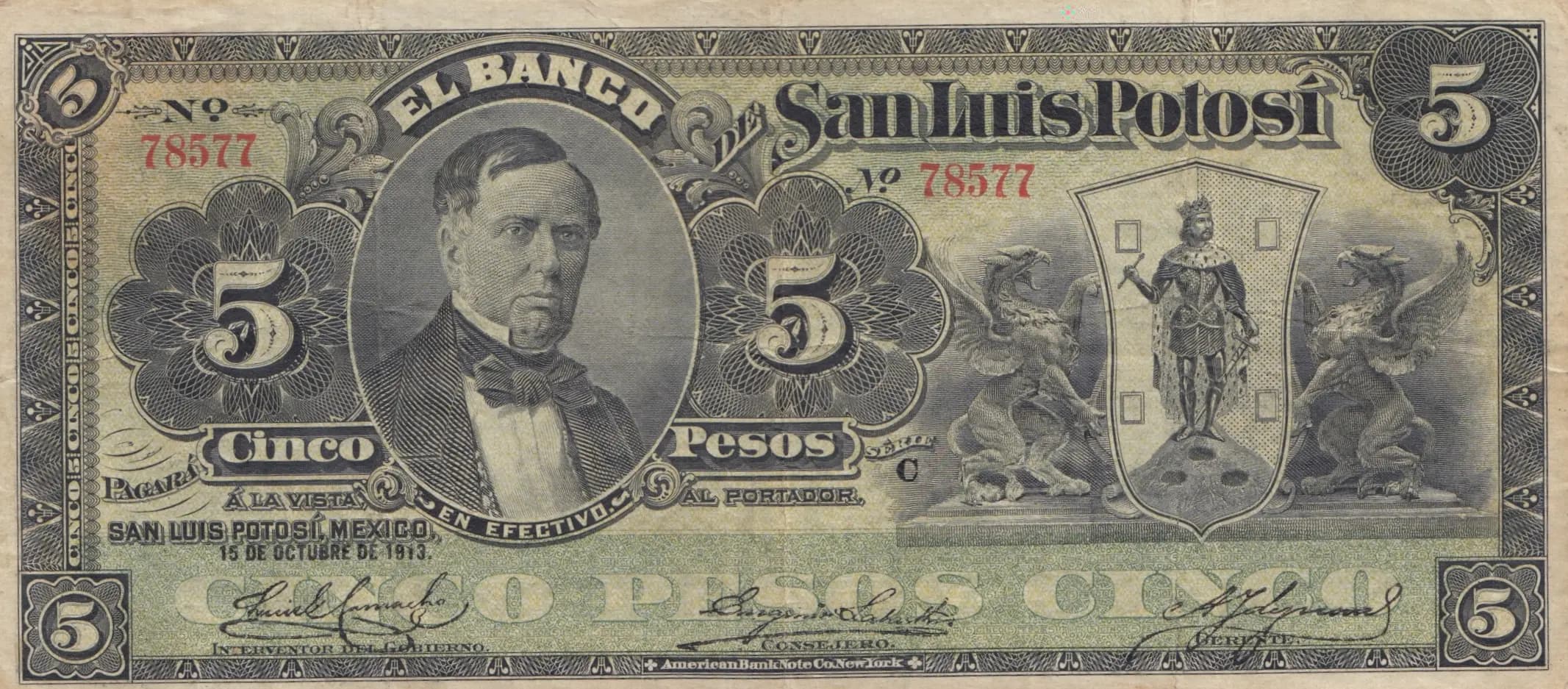
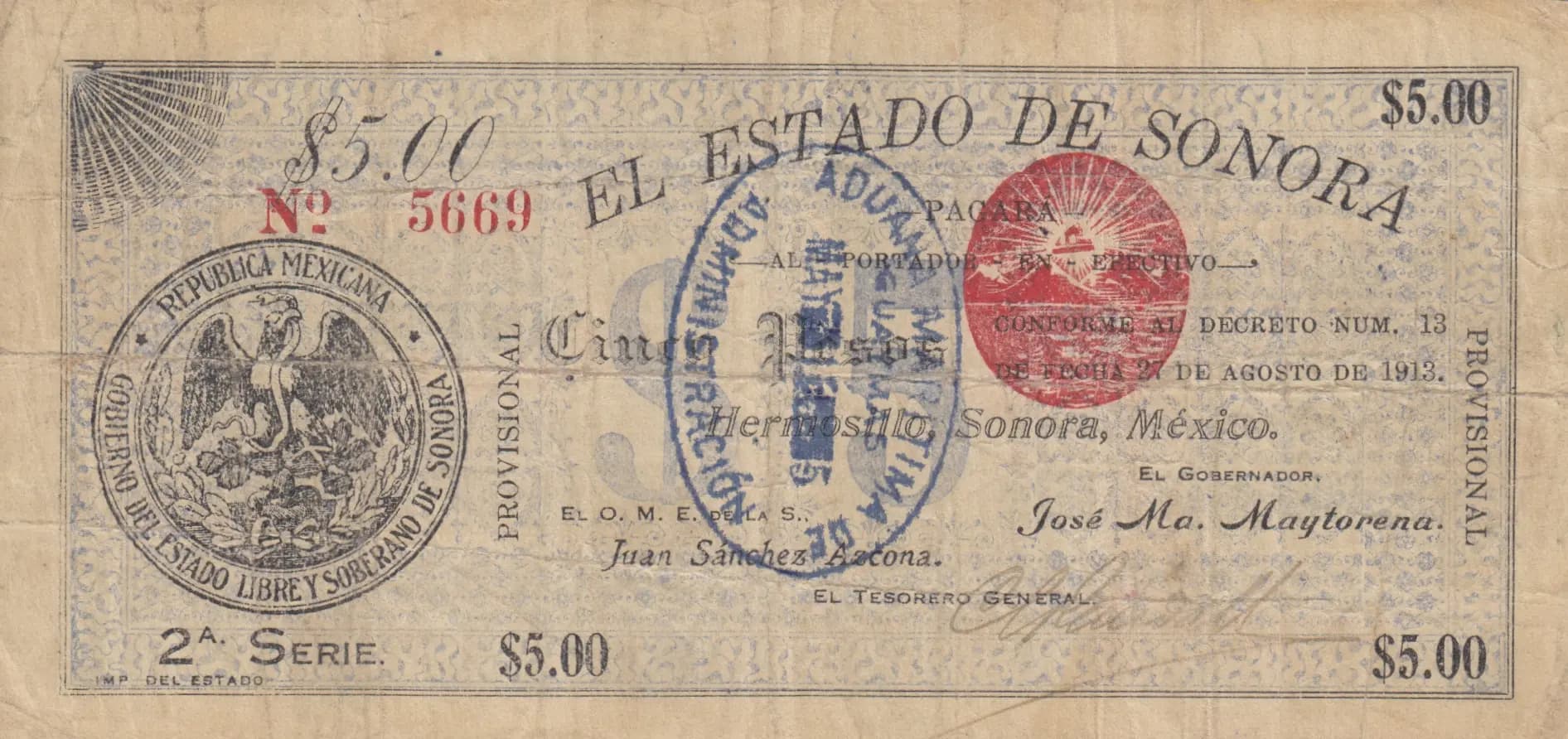
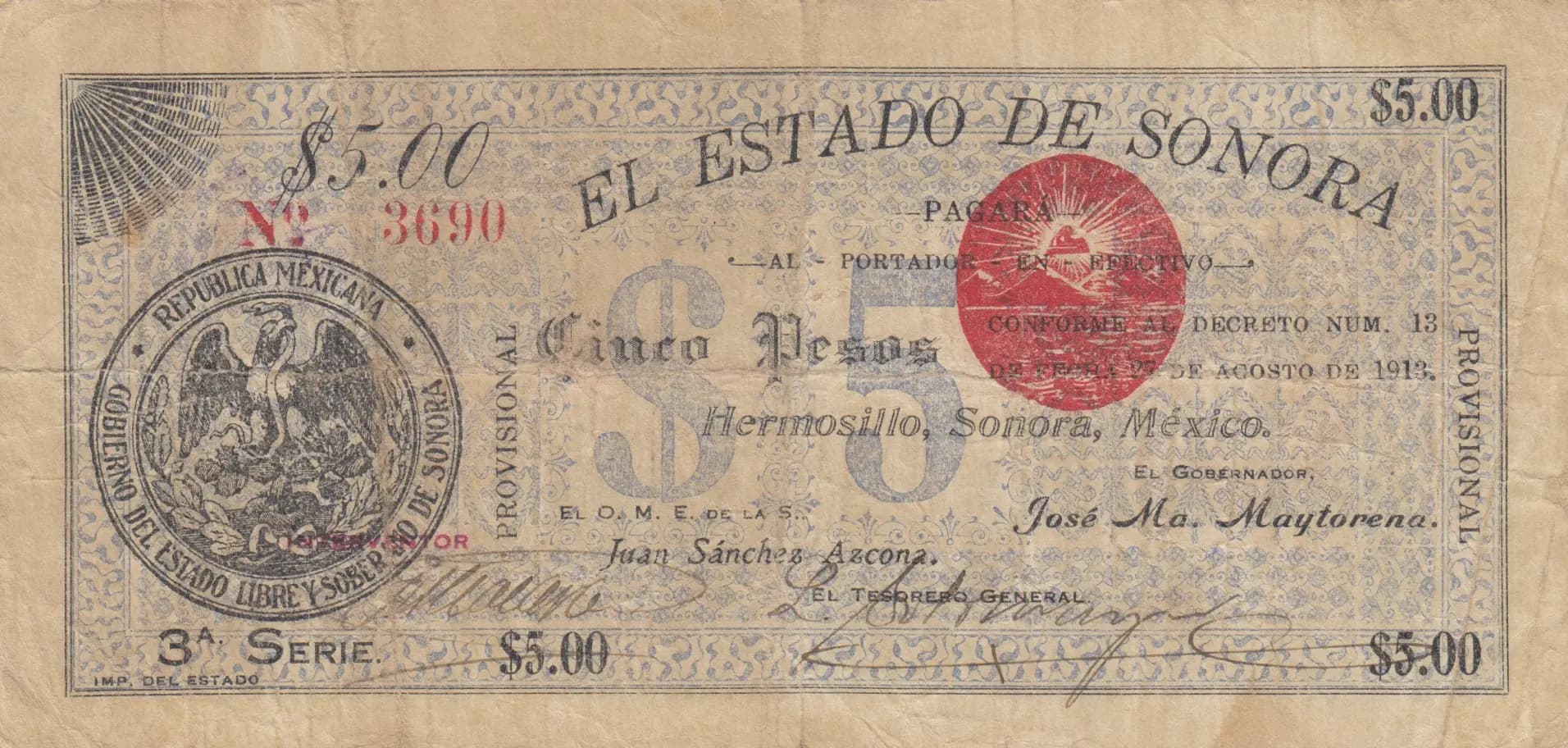
5 pesos 1913
Market Prices
4 salesAbout This Note
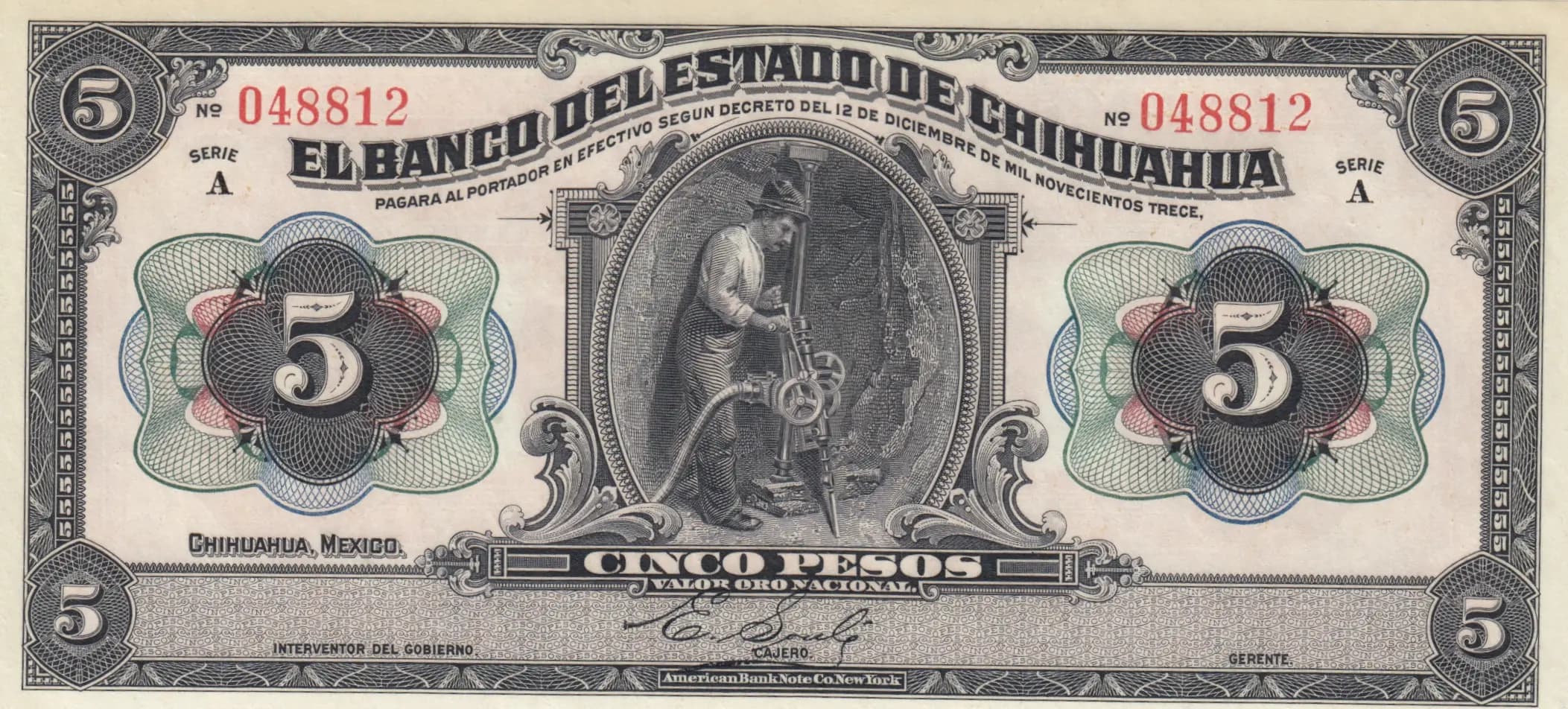
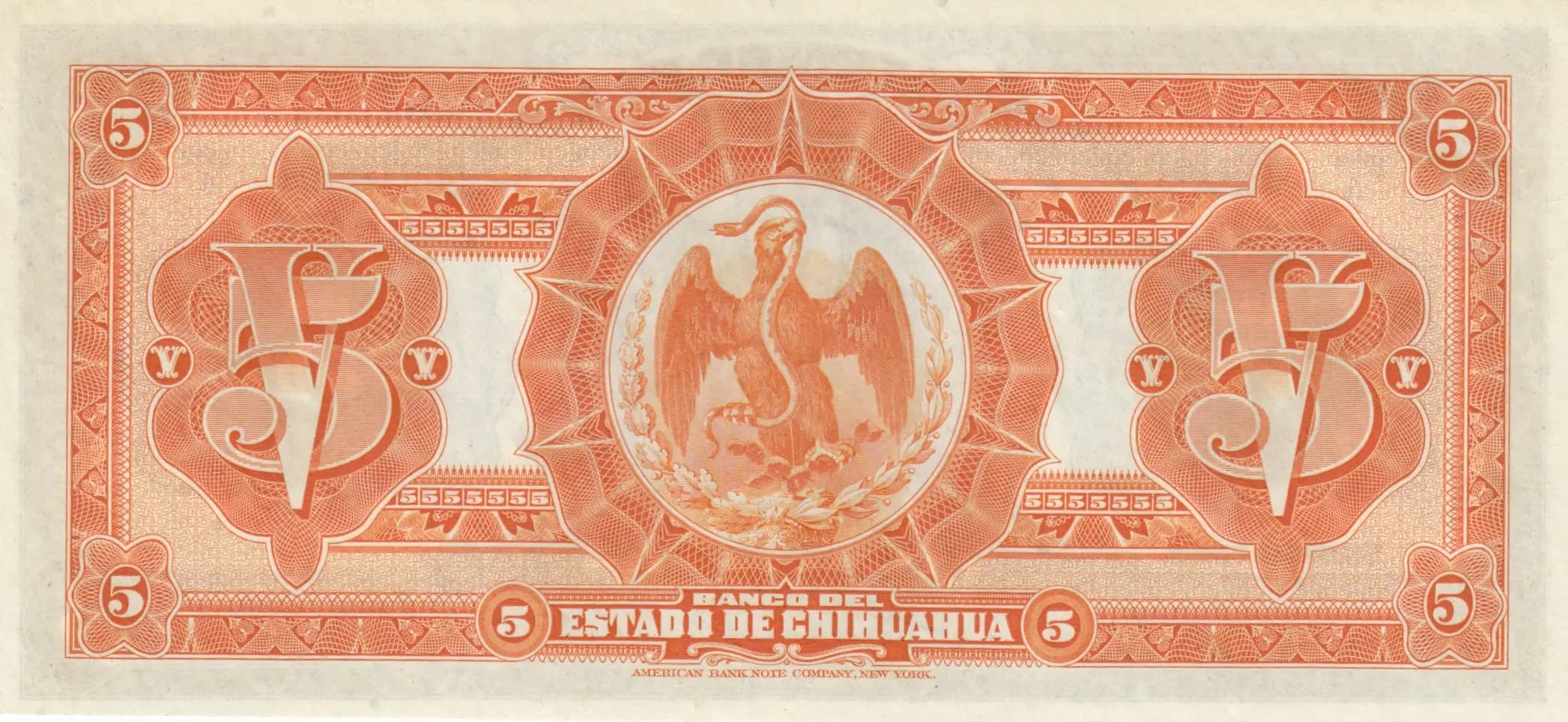
This is an exceptional uncirculated example of the 1913 Banco del Estado de Chihuahua 5 pesos note (Pick S132), one of the most visually striking Mexican regional banknotes of the early 20th century. The obverse features a skilled miner operating industrial drilling equipment at center, rendered in black and green on cream stock with elaborate decorative borders, while the reverse displays the Mexican national arms (eagle with spread wings) in striking orange-red. The note exhibits pristine condition with no visible wear, creases, or damage, making it highly desirable to both Mexican numismatists and collectors of industrial-themed currency.
Common. While this is a regional Mexican banknote from 1913, the eBay market data demonstrates steady availability and consistent modest pricing across multiple condition grades (VF examples selling for $16.50–$24.50, with even a PMG 65 specimen reaching only $78). The relatively consistent presence of examples in the market, combined with the production run by a major international security printer (ABNC), indicates this note was produced in sufficient quantities to remain accessible to collectors. No evidence suggests a restricted print run or historical recall that would elevate rarity.
Issued during the tumultuous Mexican Revolution period, this note represents the Banco del Estado de Chihuahua's assertion of financial authority in northern Mexico. The prominent depiction of mining equipment reflects Chihuahua's economic importance as a center of mineral extraction and industrial development during the early 1900s. The decree date of December 12, 1913, places this issue during a critical transition period when regional banks competed for legitimacy amid revolutionary upheaval.
The obverse features an industrial-themed central vignette depicting a male worker operating a pneumatic mining drill or similar industrial machinery, symbolizing the extractive industries that drove Chihuahua's economy. The composition is framed by ornate decorative borders incorporating geometric mesh patterns and intricate scrollwork characteristic of American Bank Note Company's engraving style. Large decorative rosette designs containing the numeral '5' anchor both left and right margins. The reverse displays Mexico's national coat of arms—an eagle with outstretched wings perched within a circular medallion—surrounded by an ornamental wreath, accompanied by stylized '5' numerals in heraldic frames and complex geometric and floral border patterns. Both sides employ fine-line engraving throughout, creating a sophisticated aesthetic typical of high-quality regional banknote production.
FRONT: 'EL BANCO DEL ESTADO DE CHIHUAHUA' (The Bank of the State of Chihuahua); 'PAGARA AL PORTADOR EN EFECTIVO SEGÚN DECRETO DEL 12 DE DICIEMBRE DE MIL NOVECIENTOS TRECE' (Will pay the bearer in cash according to decree of December 12, nineteen hundred thirteen); 'SERIE A' (Series A); 'CINCO PESOS' (Five Pesos); 'CHIHUAHUA, MEXICO'; 'INTERVENTOR DEL GOBIERNO' (Government Comptroller); 'CAJERO' (Cashier); 'GERENTE' (Manager); Serial number 'No 048812'; 'American Bank Note Co. New York'. BACK: 'BANCO DEL ESTADO DE CHIHUAHUA' (Bank of the State of Chihuahua); 'AMERICAN BANK NOTE COMPANY, NEW YORK'.
Intaglio engraving (traditional banknote line engraving method) executed by American Bank Note Company (ABNC), New York, as credited on both obverse and reverse. The fine geometric mesh patterns, intricate scrollwork, and sharp linear details visible throughout are characteristic of ABNC's premium engraving work. The multi-color printing (black and green on obverse; orange-red on reverse) indicates sequential color application typical of early 20th-century intaglio production.
Series A example with serial number 048812, featuring the single signature characteristic noted in catalog references. The Pick S132 designation encompasses notes issued under the December 12, 1913 decree; varieties within this Pick number are primarily distinguished by series (A noted here), signature combinations, and serial number ranges. No overprints or unusual variants are evident in this example.