20 pesos 1915
About This Note
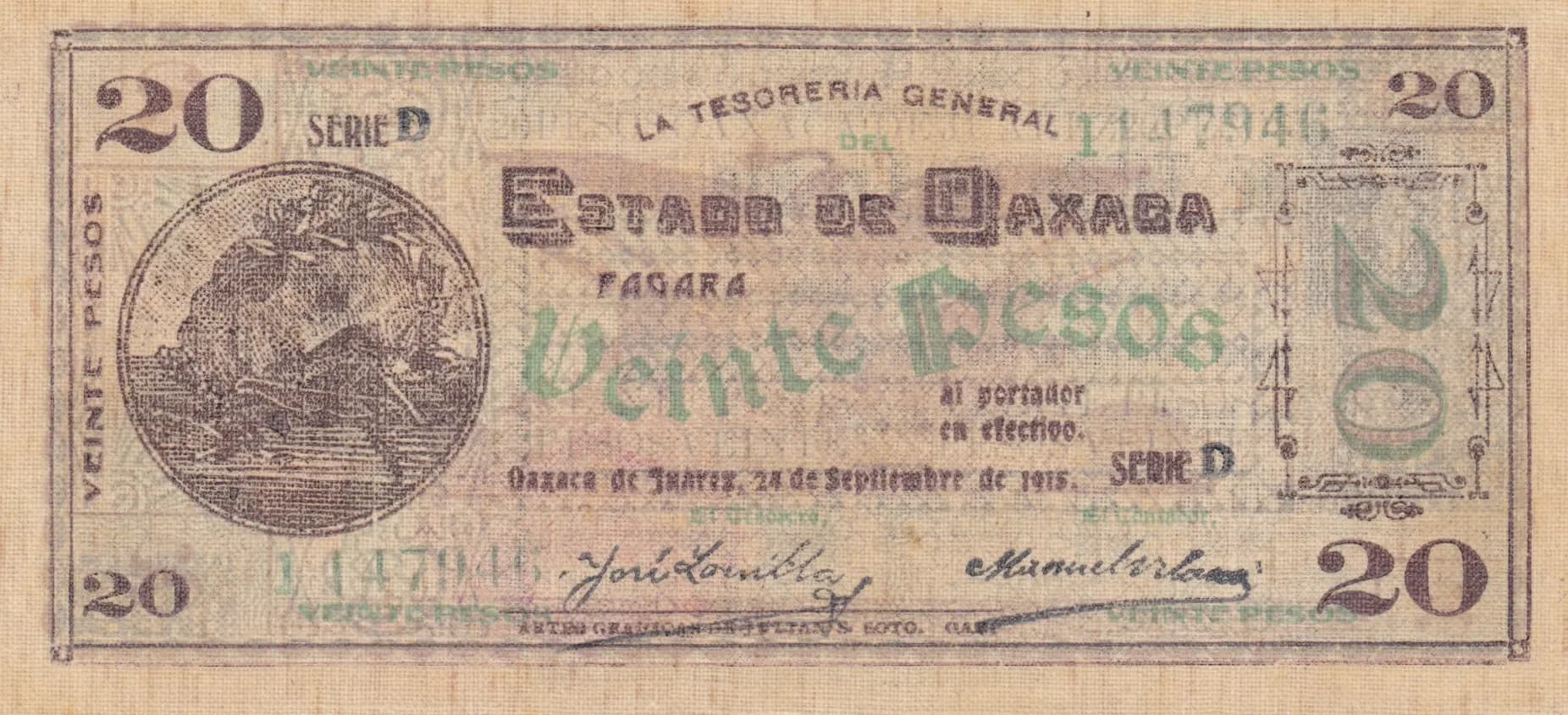
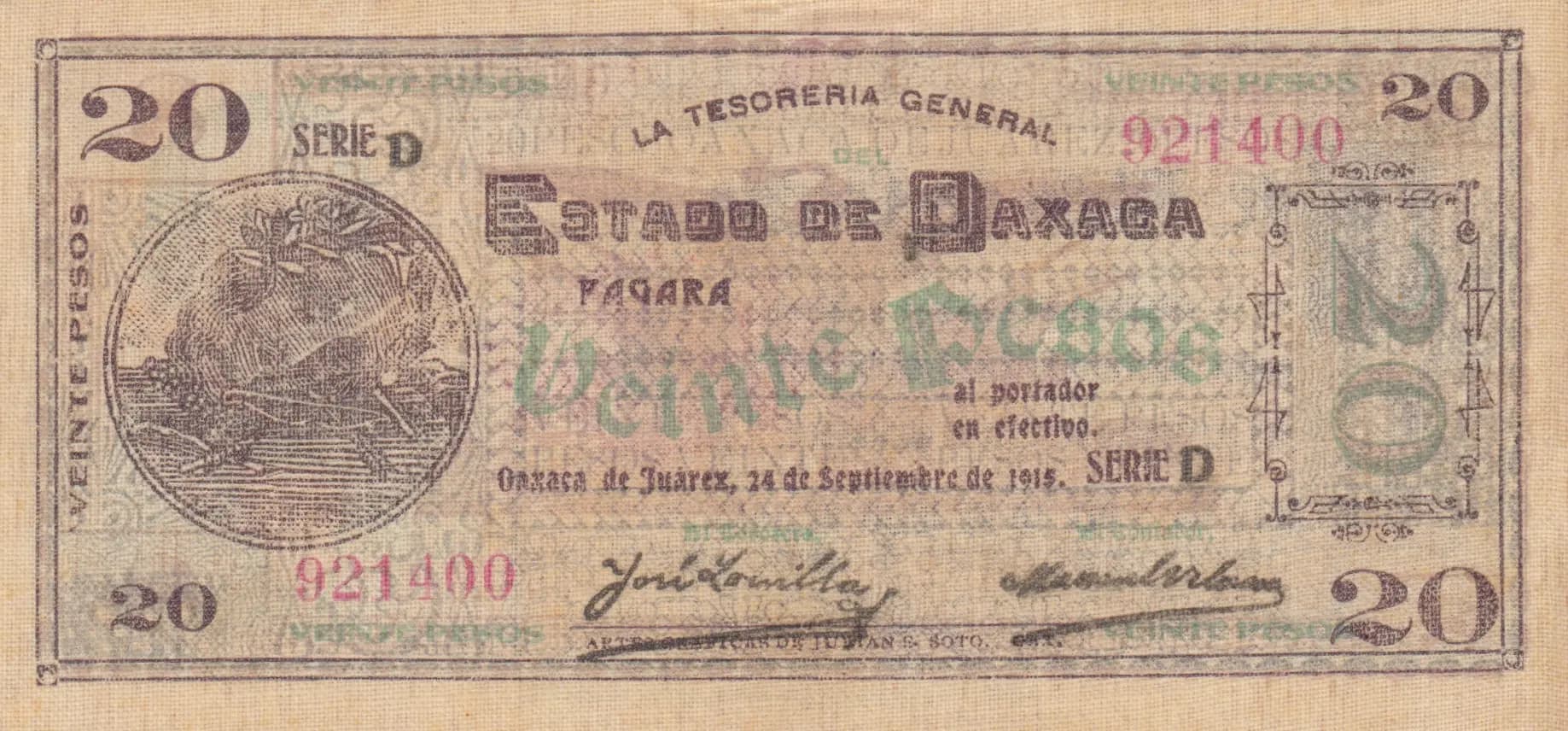
This 20 pesos note from the Tesoreira General del Estado de Oaxaca, dated September 24, 1915, is a scarce example of Mexican revolutionary-era state currency issued during a period of significant political upheaval. The note displays the characteristic features of early 20th-century Mexican emergency currency with its heraldic Mexican eagle vignette, multiple denomination markings, and overprinted security elements in green and red. In AU condition, this piece shows expected age-related foxing and wear consistent with historical circulation, making it an attractive example for collectors of Mexican regional currency and revolutionary-period numismatics.
Uncommon. While Mexican revolutionary-era state notes are collected, this specific Pick number (P-S959a) from the State of Oaxaca in AU condition represents a localized emission with limited surviving examples. The state of Oaxaca issued several denominations during this brief period, but print runs were necessarily modest and many notes were destroyed or lost to time. The AU grade elevates its desirability above circulated examples. These notes are not commonly encountered in the international numismatic market, particularly in higher grades, making this a meaningful acquisition for specialists in Mexican regional currency.
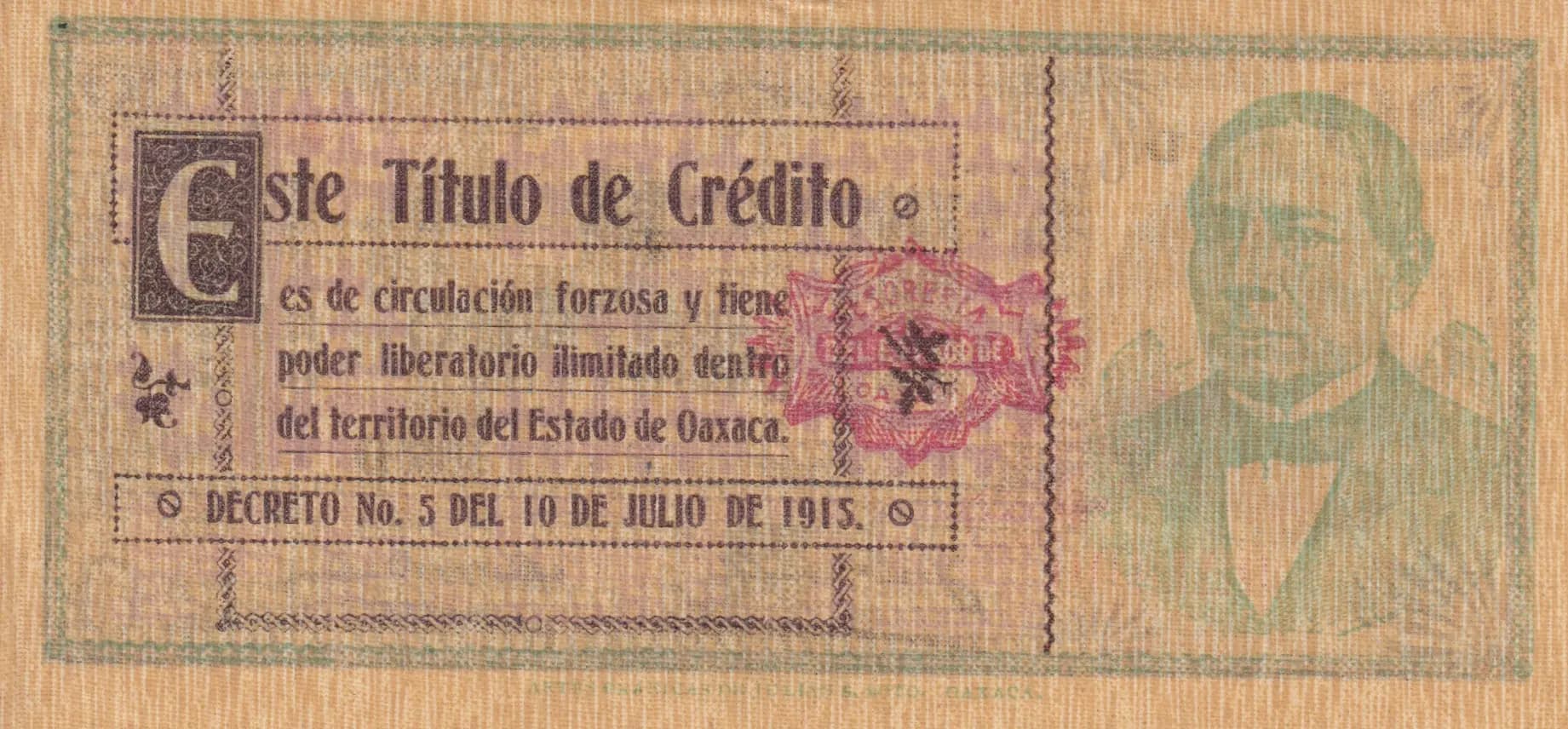
This note was issued by the State of Oaxaca's General Treasury on September 24, 1915, during the height of the Mexican Revolution when central government authority was fragmented and individual states issued their own emergency currency. The mandatory circulation decree (Decree No. 5 of July 10, 1915) referenced on the reverse reflects the legal mechanisms states employed to establish forced tender status for their credit notes when specie and federal currency were scarce. The Mexican national eagle on cactus symbol, prominent on the obverse, reinforced state legitimacy and connection to Mexican sovereignty despite the federal government's temporary weakness.
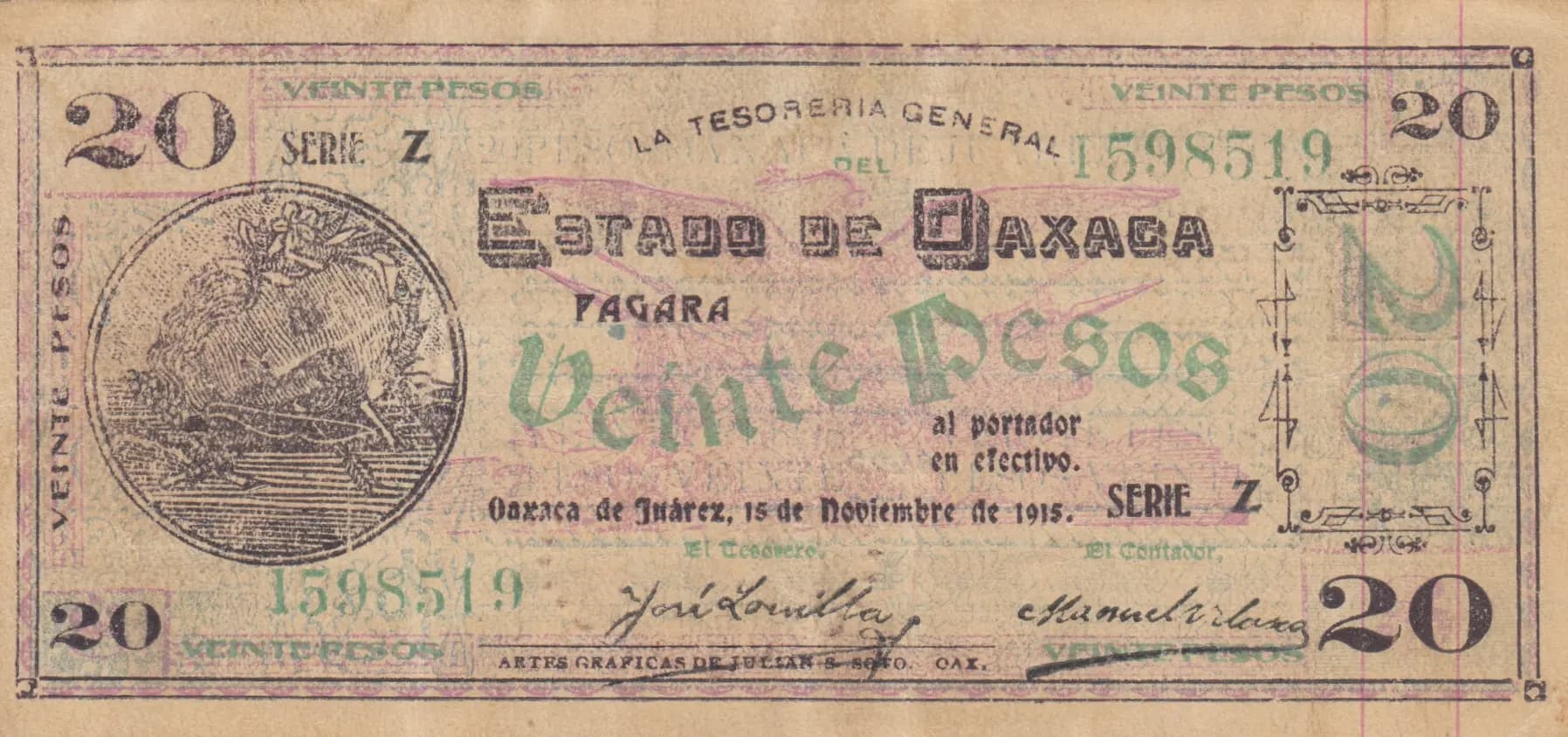
The obverse features a circular heraldic vignette of the Mexican national eagle with spread wings perched on a cactus (the Aztec symbol that appears on the Mexican flag), positioned on the left side of the note. Large denomination numerals '20' appear in all four corners. The center carries the issuing authority text: 'La Tesorería General del Estado de Oaxaca Pagará al portador en efectivo' (The General Treasury of the State of Oaxaca will pay to the bearer in cash), with the specific issue location and date prominently displayed. An ornamental border frame encases the design. The reverse contains a large decorative letter 'E' on the left, with a centered text box explaining the legal status of the credit note under Decree No. 5. A watermark portrait (male face in profile) appears on the right side of the reverse, serving as an anti-counterfeiting measure. Security elements include green overprinted text and red/pink overprinted serial numbers and official stamps.
FRONT: '20' (denomination in numerals); 'SERIE D' (Series D); 'LA TESORERIA GENERAL' (The General Treasury); 'ESTADO DE OAXACA' (State of Oaxaca); 'PAGARA al portador en efectivo' (Will pay to the bearer in cash); 'Oaxaca de Juarez, 24 de Septiembre de 1915' (Oaxaca de Juarez, September 24, 1915); 'VEINTE PESOS' (Twenty Pesos); '921400' (serial number). BACK: 'Este Título de Crédito es de circulación forzosa y tiene poder liberatorio limitado dentro del territorio del Estado de Oaxaca.' (This Credit Note is of forced circulation and has limited legal tender power within the territory of the State of Oaxaca.); 'DECRETO No. 5 DEL 10 DE JULIO DE 1915' (Decree No. 5 of July 10, 1915).
This note was produced using traditional letterpress printing combined with lithographic techniques, typical for Mexican state currency of the 1915 period. The base design was likely lithographed, with the denomination numerals, text, and borders added via letterpress. The overprinted security elements—green text on the obverse and red/pink serial numbers and official stamps visible on both sides—were applied in separate passes, a common practice for emergency currency to prevent counterfeiting. The watermark portrait on the reverse suggests either a watermarked paper stock or an engraved vignette, adding to the note's security features.
This note is identified as Pick P-S959a, indicating it is Series D as denoted by the 'SERIE D' inscription visible on the obverse. The serial number 921400 is visible on this specific example. Known varieties for this denomination from Oaxaca include different series designations and potentially different date variants. The overprint colors (green and red/pink) are consistent with the Pick catalog notation for this issue. Collectors should note that state notes from this era sometimes appear with minor variations in overprint application and positioning due to manual application methods during the emergency period.