2 pesos 1916
About This Note
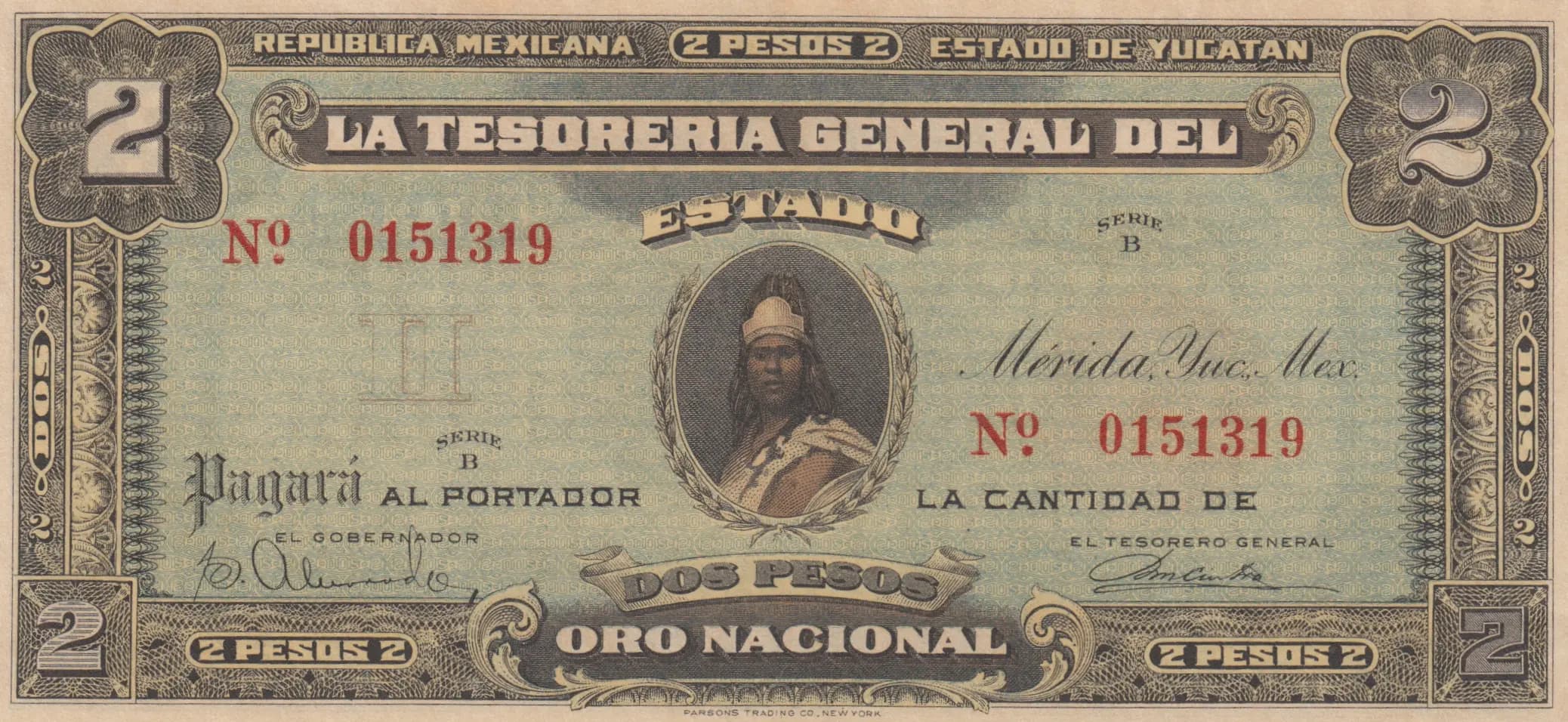
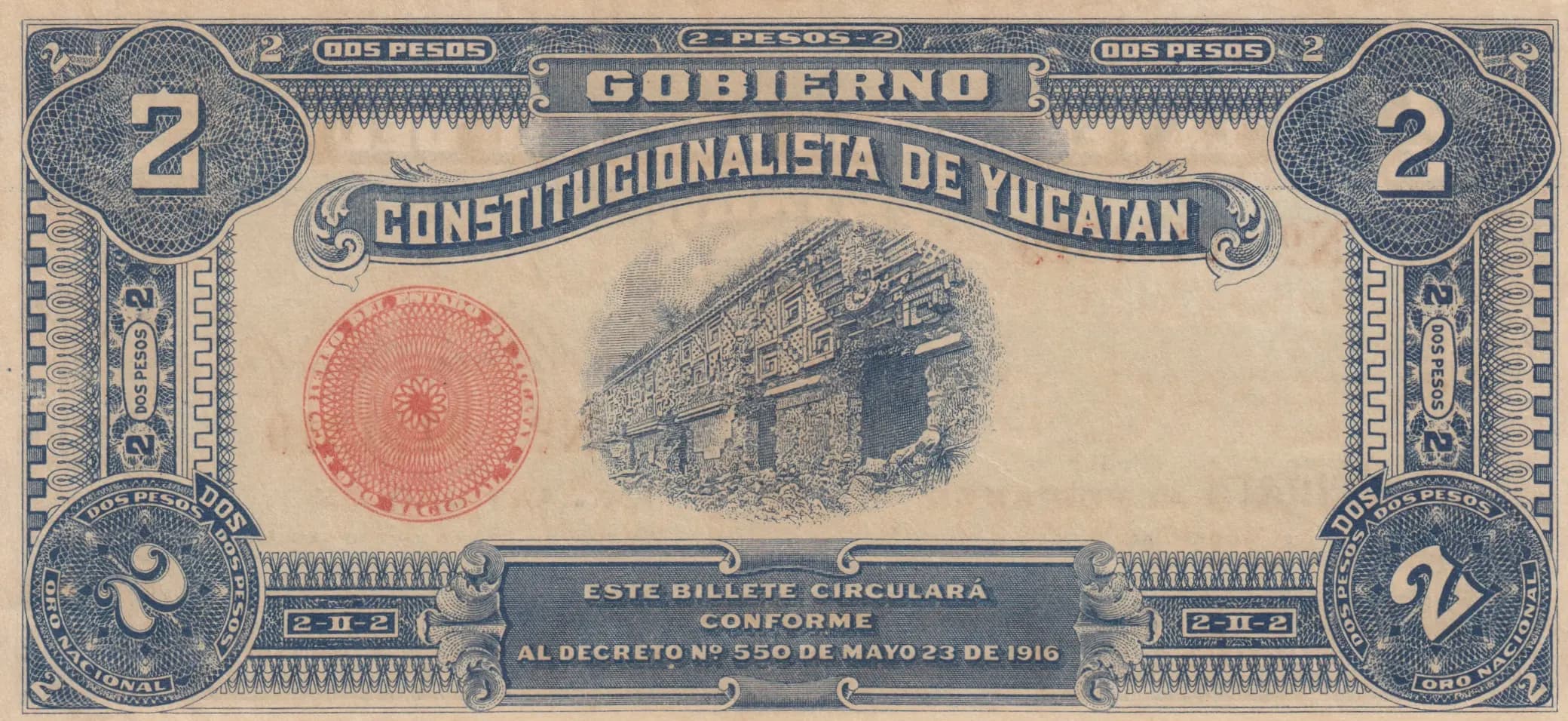
This is a 2 Pesos note from 1916 issued by the Tesorería General del Estado of Yucatan during Mexico's Constitutional period, graded UNC. The front features an ornately engraved portrait of a bearded man in profile within an elaborate oval frame, while the reverse depicts a Pre-Columbian or Mayan architectural structure, both rendered in fine line engraving typical of the era. The note displays excellent preservation with only minor age-related foxing and discoloration, making it a well-preserved example of this state-issued emergency currency from a tumultuous period in Mexican history.
Common. While this is a state-issued emergency currency from a specific historical period, the 1916 Yucatan 2 Pesos notes were issued in quantities sufficient to make them readily available to collectors today. There is no evidence of an exceptionally small print run or subsequent recall that would classify this as scarce or rare. The UNC condition grade is desirable but not exceptionally rare for this issue, as multiple examples in high grades appear in the numismatic market regularly.
This note was issued under Decree No. 550 of May 23, 1916, by the Constitutional Government of Yucatan (Gobierno Constitucionalista de Yucatan), reflecting the political fragmentation during Mexico's Revolutionary period when various regional authorities issued their own currency. The reverse's depiction of Pre-Columbian or Mayan ruins represents Yucatan's cultural heritage and archaeological significance, while the inscription 'Oro Nacional' (National Gold) indicates the note's theoretical backing or basis in national currency standards. The 'Parsons Trading Co. New York' imprint on the front suggests use of an American security printer, typical of Mexican state issues during this era.
The front features a classical engraved portrait in profile of a bearded gentleman wearing a cap, centered within an ornamental oval frame with decorative scrollwork emanating into all four corners of the note. The symmetrical composition employs fine line engraving with elaborate floral and geometric flourishes characteristic of high-quality security printing of the period. The reverse depicts what is believed to be a Mayan architectural ruin or Pre-Columbian structure rendered in the central cartouche, surrounded by ornate geometric border patterns and flanked by a prominent circular red seal or rosette design on the left side. Both sides employ a color palette of beige/tan, brown/sepia, and gray on the front, with blue/navy, cream, and red accents on the reverse, typical of period banknote production.
FRONT: 'República Mexicana' (Mexican Republic) / '2 Pesos 2' (denomination) / 'Estado de Yucatan' (State of Yucatan) / 'La Tesorería General del Estado de Yucatan Pagará al Portador la Cantidad de Dos Pesos Oro Nacional' (The General Treasury of the State of Yucatan Will Pay to the Bearer the Amount of Two Pesos in National Gold) / 'El Gobernador' (The Governor) / 'El Tesorero General' (The General Treasurer) / Serial number 'No 0151319' / 'Merida, Yuc. Mex.' (Mérida, Yucatan, Mexico) / 'Serie B' (Series B) / 'Parsons Trading Co. New York' (printer attribution). BACK: 'Dos Pesos' and '2-Pesos-2' (denomination) / 'Gobierno Constitucionalista de Yucatan' (Constitutional Government of Yucatan) / 'Este Billete Circulará Conforme al Decreto Nº 550 de Mayo 23 de 1916' (This Banknote Will Circulate in Accordance with Decree No. 550 of May 23, 1916) / 'Oro Nacional' (National Gold) / '2-II-2' (denomination marker).
This note was produced using intaglio (engraved) printing, the standard security printing method for banknotes of this era. The fine line work, intricate scrollwork, and detailed portrait are characteristic of hand-engraved intaglio plates. The printer attribution to 'Parsons Trading Co. New York' suggests production by or under the supervision of this American security printer, which was active in producing Mexican state currency during the Revolutionary period. The red serial number and seal were likely added through letterpress or additional color printing passes.
This example is identified as Series B (Serie B) based on the front inscription. The serial number 0151319 is specific to this individual note. Known varieties of this issue may include different series designations and signature varieties corresponding to different governors and treasurers during the 1916 issuance period, though without additional comparative examples, specific variety classification beyond 'Series B' cannot be definitively established from this single note.