100 pesos 1914
Market Prices
About This Note
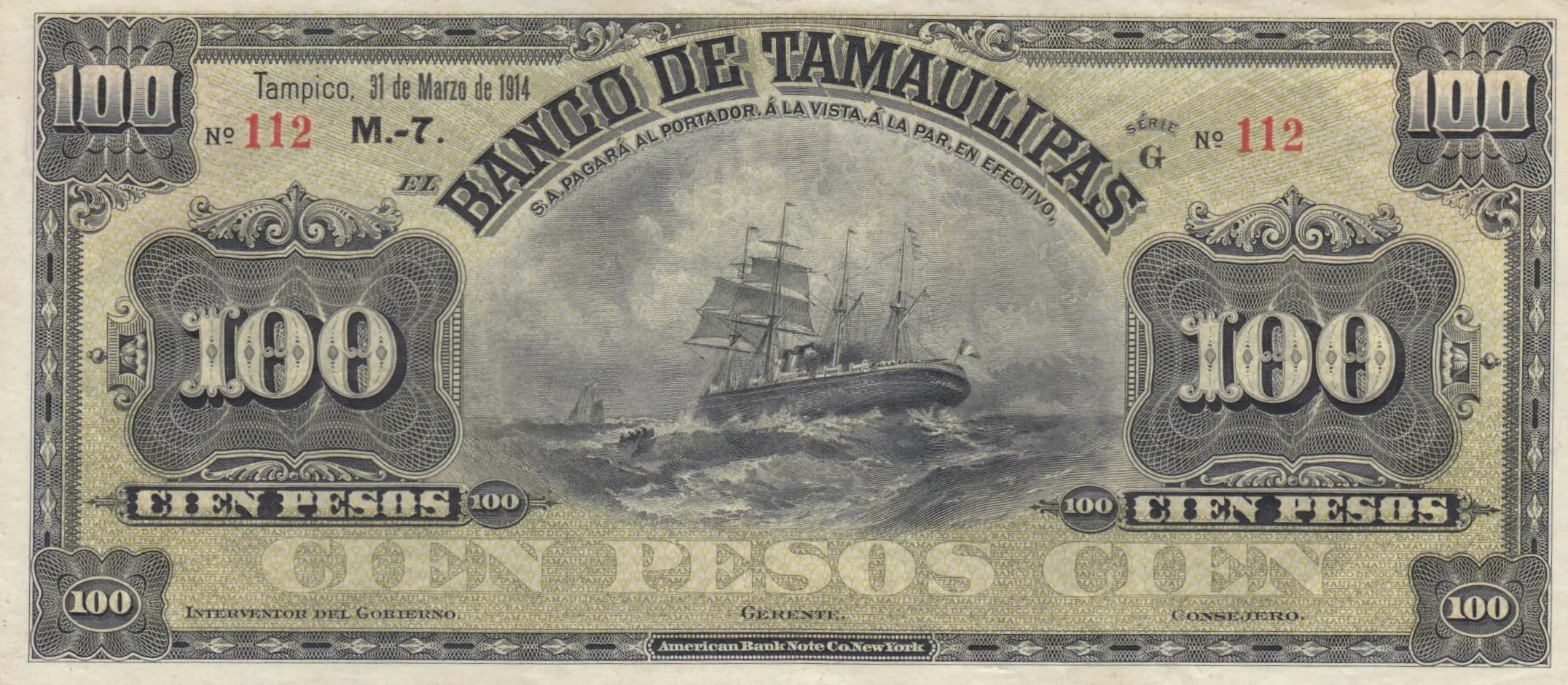
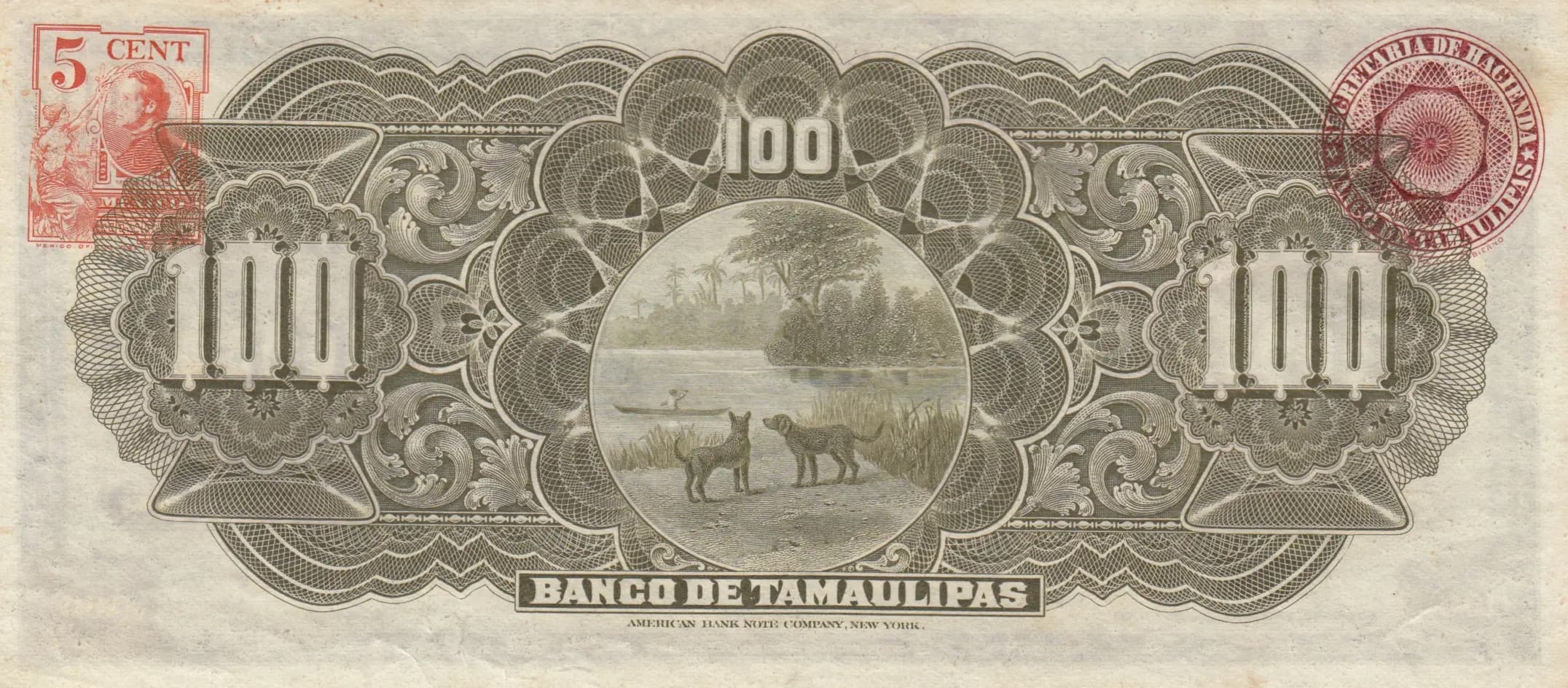
This is a VF-graded 100 pesos note from the Banco de Tamaulipas dated March 31, 1914, featuring striking central vignettes of maritime and naturalistic scenes. The obverse displays an intricately engraved steam-powered sailing ship navigating rough seas, while the reverse presents a pastoral landscape with dogs and water scenes, both rendered in fine detail by the American Bank Note Company. The note exhibits characteristic age-related toning and foxing consistent with its 110-year history, with well-preserved engraving and visible red security stamps on the reverse.
Common. The eBay market data shows multiple sales across various condition grades (UNC, VF, CIRC, AU) with VF examples trading in the $54.99–$300.00 range, indicating consistent collector demand and regular supply. The Banco de Tamaulipas, while a state-level issuer, produced sufficient quantities of this denomination and series to remain readily available in today's market. The note is not from a recalled or extremely short-lived series.
Issued during Mexico's turbulent Revolutionary period, this Banco de Tamaulipas note reflects the state bank's attempt to maintain financial stability and currency circulation in Tampico, a critical port city. The maritime imagery—featuring ships and coastal scenes—directly references Tamaulipas's geographic importance as a Gulf of Mexico shipping hub and economic center. The note's bilingual printer attribution (American Bank Note Company, New York) and Spanish-language payee promises demonstrate the international commercial networks and confidence mechanisms relied upon during this period of Mexican institutional upheaval.
The obverse features a classical baroque-style ornamental border with elaborate scrollwork and corner decorative flourishes framing the primary vignette of a multi-masted steam-powered merchant or naval vessel heeling dramatically against turbulent ocean waves—a powerful symbol of Tamaulipas's maritime commerce and Gulf trade dominance. Large '100' denominations are positioned symmetrically in the left and right margins. The reverse presents a contrasting pastoral composition: a scenic landscape vignette depicting dogs or similar canines in a shoreline setting with trees and natural vegetation, accompanied by a man in a canoe on the water, creating a narrative of regional economic activities beyond maritime trade. Both sides employ intricate fine-line engraving with ornamental frames and large decorative numeral work. Red circular and rectangular security stamps or validation marks appear on the reverse, indicating official government oversight and authentication.
FRONT: 'BANCO DE TAMAULIPAS' (Bank of Tamaulipas); '100' / 'CIEN PESOS' (One Hundred Pesos); 'Tampico, 31 de Marzo de 1914' (Tampico, March 31, 1914); 'Nº 112' (Number 112); 'SERIE G' (Series G); 'M.-7.' (Matrix reference); 'SE PAGARA AL PORTADOR, A LA VISTA, A LA PAR, EN EFECTIVO' (It will be paid to the bearer, on sight, at par, in cash); 'INTERVENTOR DEL GOBIERNO' (Government Comptroller); 'GERENTE' (Manager); 'CONSEJERO' (Counselor); 'American Bank Note Co. New York' (printer attribution). BACK: '100' / 'BANCO DE TAMAULIPAS' (Bank of Tamaulipas); '5 CENT' (5 Cents, likely a watermark or security reference); 'AMERICAN BANK NOTE COMPANY, NEW YORK' (printer attribution).
Steel engraving via intaglio process, executed by the American Bank Note Company of New York—the premier security printer of the era. The fine line work, detailed vignettes, complex ornamental borders, and security stamp capability are all characteristic of high-security intaglio banknote production. The note demonstrates the sophisticated multi-plate engraving techniques standard for ABNC work during the early 20th century.
This example is identified as Series G, with serial number 112 and matrix reference M.-7., issued from Tampico on March 31, 1914. The catalog reference BK-TAM-23 indicates this corresponds to the post-1902 issue period. Known catalog series include B (dated 15.10.1902) and C (dated 15.7.1903) per reference sources, with this 1914 example representing a later printing under Series G designation. The specific date of March 31, 1914 may represent a later production run or reissue variant.