1 peso 1915
About This Note
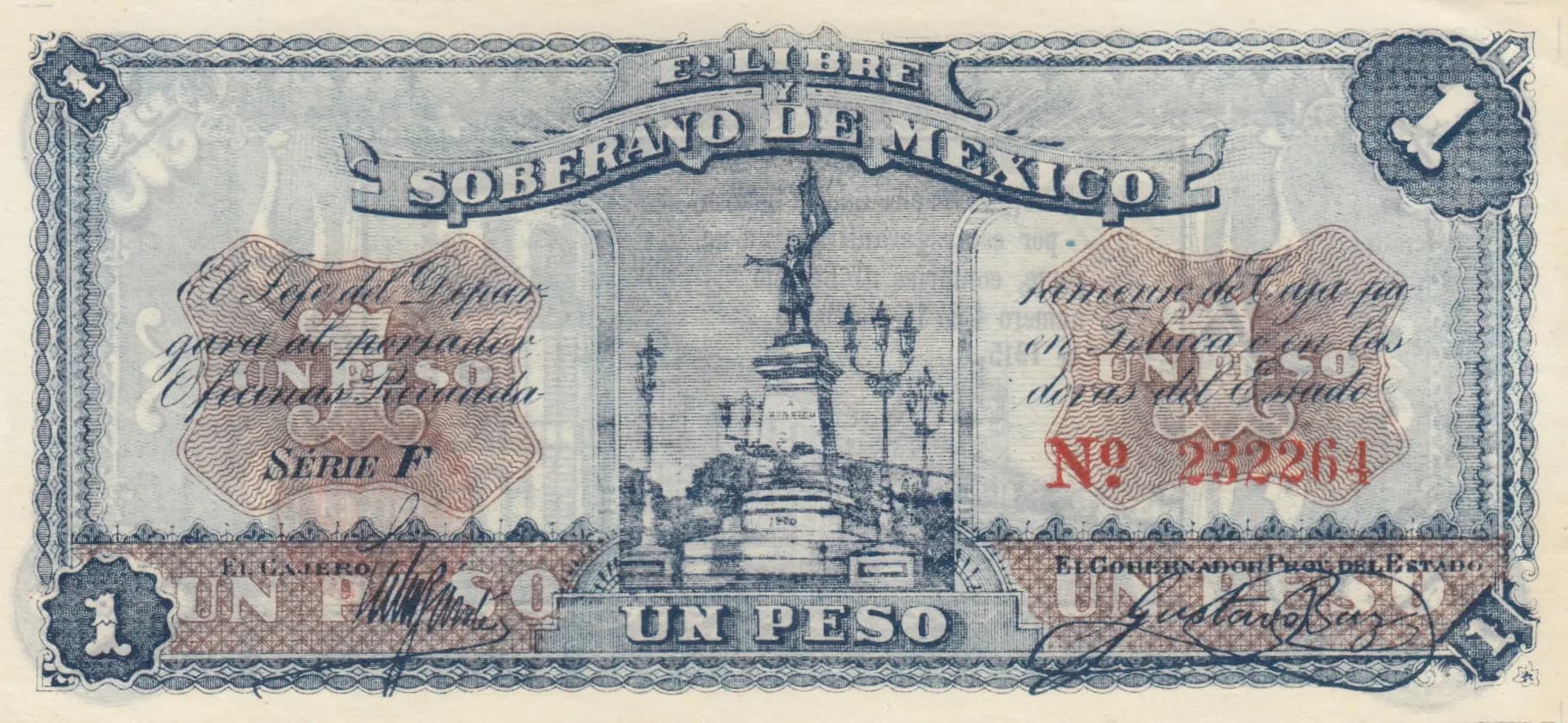
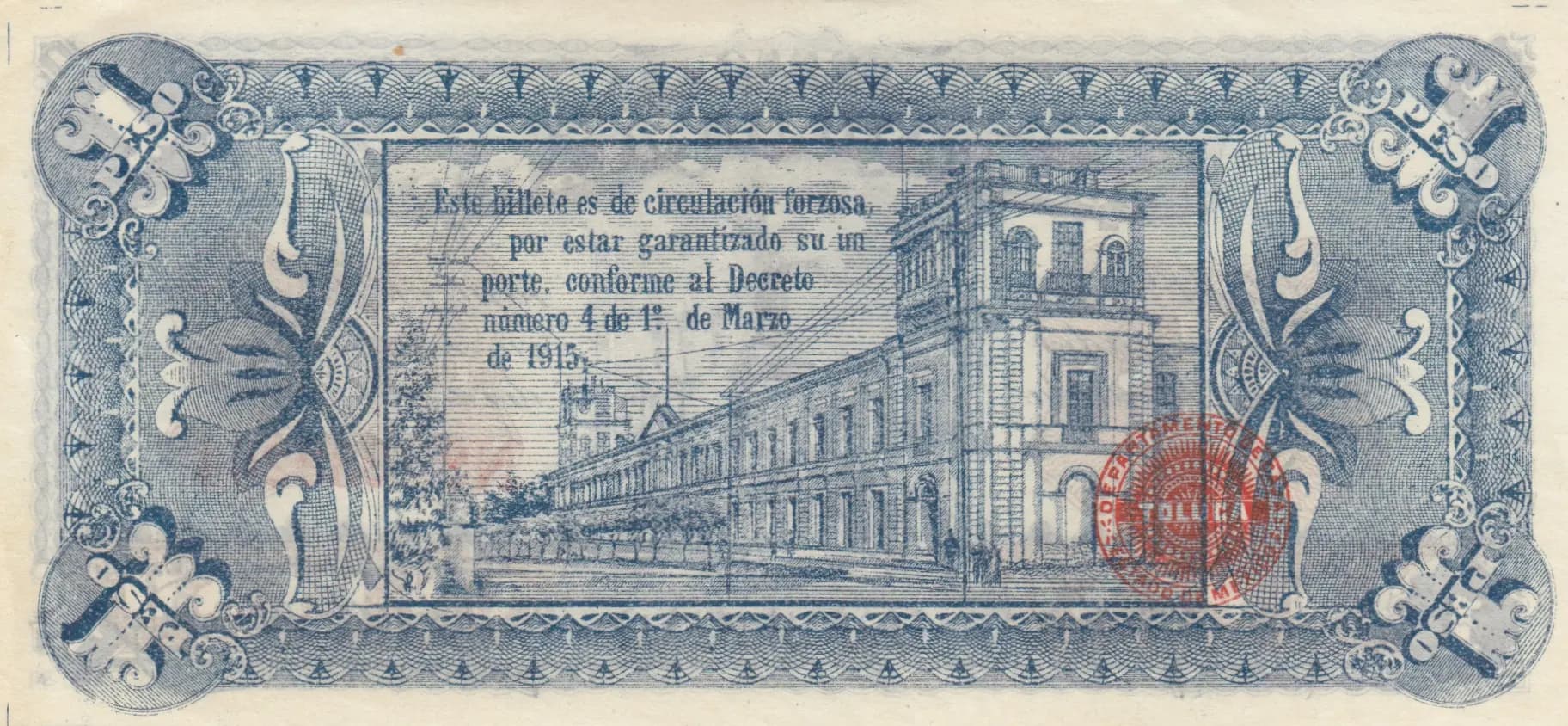
This is an AU-graded 1 peso banknote issued by the Estado Libre y Soberano de Mexico in Toluca de Lerdo during 1915, a critical year of the Mexican Revolution. The note features an elegant monument with a winged figure and a neoclassical government building on the reverse, rendered in blue, gray, and tan tones with complex engraved borders. Despite moderate circulation wear evidenced by creasing and aging patina, the note retains excellent detail and clarity, making it a desirable example of Mexican revolutionary-era currency with strong historical significance.
common. This note, while historically significant as a Mexican revolutionary-era issue, was produced in sufficient quantity for general circulation in Toluca de Lerdo. The Pick catalog listing (P-S881) indicates it was a standard denominational issue rather than an emergency or emergency limited run. Serial number 232264 and Series F suggest substantial production numbers. Revolutionary-period Mexican notes of this type typically appear in the collector market with moderate frequency and at modest price points, consistent with common classification despite their historical interest.
This 1915 peso represents the tumultuous period of the Mexican Revolution, issued under Decree No. 4 of March 1st, 1915, by the State of Mexico authorities in Toluca de Lerdo. The monument depicted on the obverse likely commemorates a significant civic or patriotic figure, while the neoclassical building on the reverse exemplifies Mexico's institutional architecture during the pre-revolutionary era. The 'forced circulation' guarantee stamped on the reverse underscores the economic chaos of the period, when numerous regional authorities issued currency to maintain commerce amid national upheaval.
The obverse features a tall commemorative monument as its central focal point, topped with a winged allegorical figure symbolizing victory or liberty, flanked by ornamental lamp posts and a distant landscape with architectural elements. The monument is framed by ornate decorative borders and side panels with leaf and vine motifs in tan and brown. The reverse displays a grand neoclassical government building with multiple stories, prominent columns, and detailed architectural facade, characteristic of 19th-century Mexican civic architecture. An official red circular seal or stamp is applied to the building image, serving as an authentication mark. Both sides employ complex ornamental corner medallions with scrollwork and floral designs, contributing to the note's security and aesthetic appeal.
Front Side: 'SOBERANO DE MEXICO' (Sovereign of Mexico); 'UN PESO' (One Peso); Series designation 'SERIE F'; 'EL CAJERO' (The Cashier); 'EL GOBERNADOR' (The Governor); Serial number 'Nº 232264'. Back Side: 'Este billete es de circulación forzosa, por estar garantizado su importe, conforme al Decreto número 4 de 1ª de Marzo de 1915.' (This note is of forced circulation, being guaranteed its value, in accordance with Decree number 4 of March 1st, 1915.)
This note was produced using multi-color engraved intaglio printing, a standard security technique of the period. The complex line engraving patterns visible throughout both sides—particularly in the decorative borders, corner medallions, and architectural details—are characteristic of intaglio production. The precise registration of multiple colors (blue, gray, tan, brown, and red) indicates sophisticated printing equipment. The official red seal appears to have been applied as a separate stamp or overprint after initial printing, a common practice for government validation during the Mexican Revolution.
This example is identified as Series F with serial number 232264, representing a specific printing within the 1915 emission. The presence of handwritten signatures for both 'EL CAJERO' (The Cashier) and 'EL GOBERNADOR' (The Governor) is notable; variations in these authorized signatures constitute recognized varieties within this issue. The red circular official stamp/seal appears to be a standard authentication mark applied during the printing process rather than a post-issue overprint. No known major varieties (such as color variations or text errors) are evident from the visual analysis, though the signature combinations should be documented for comprehensive variety cataloging.