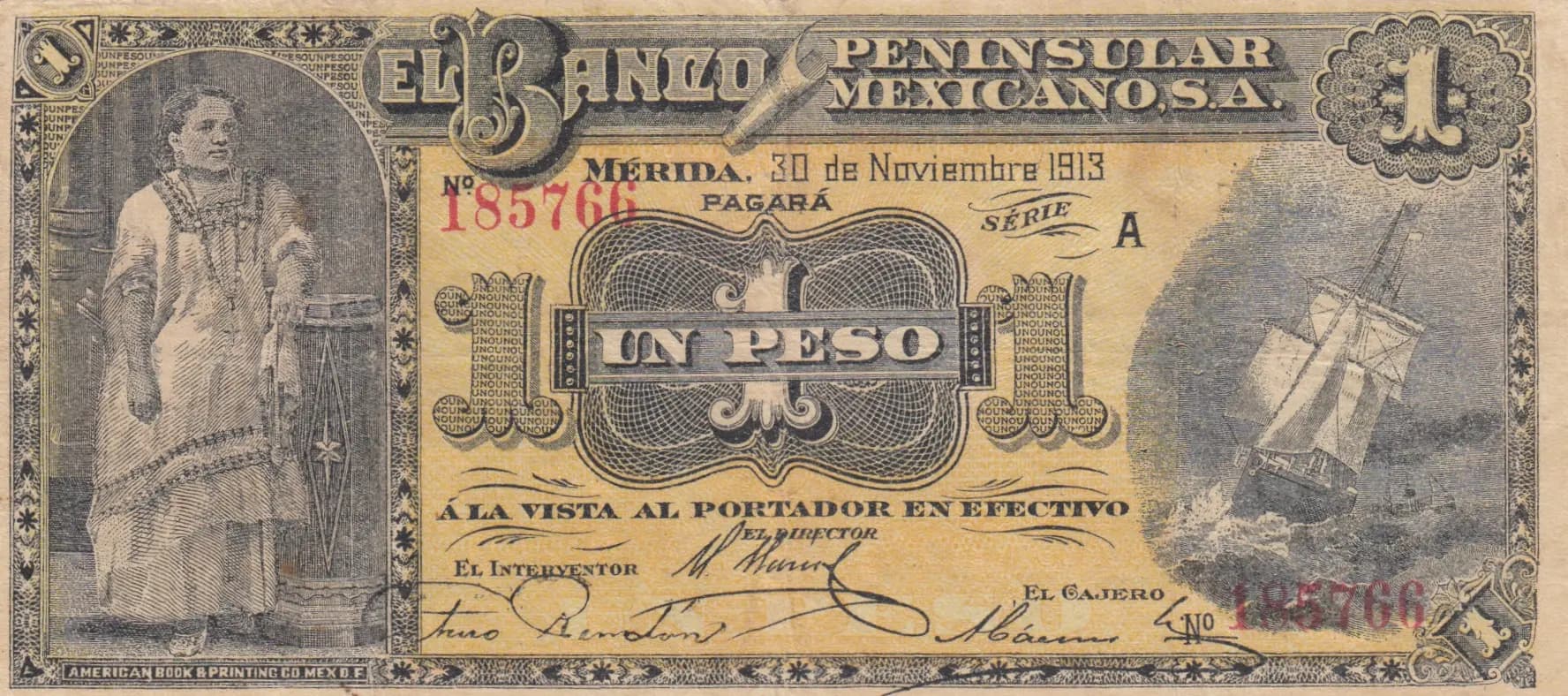
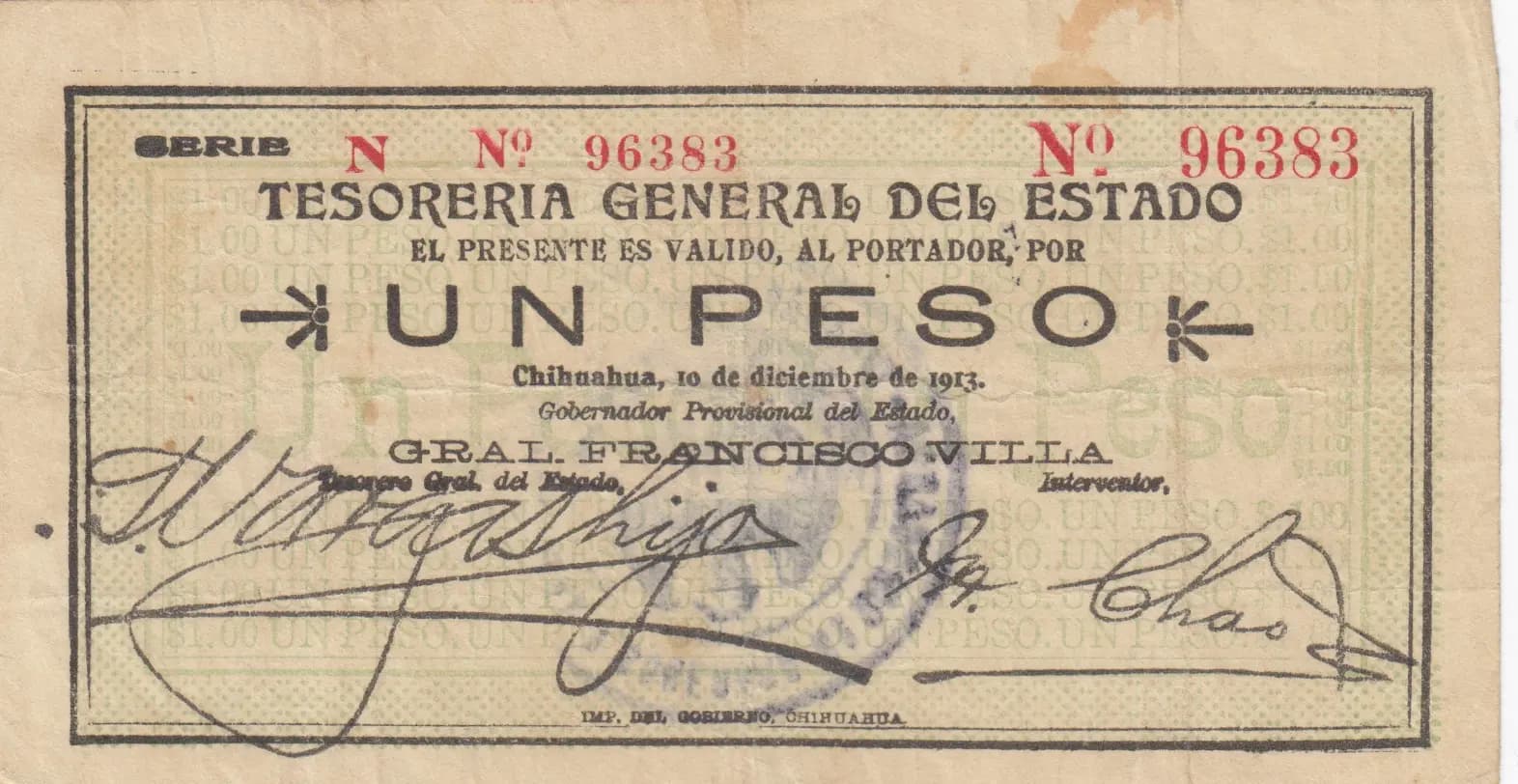
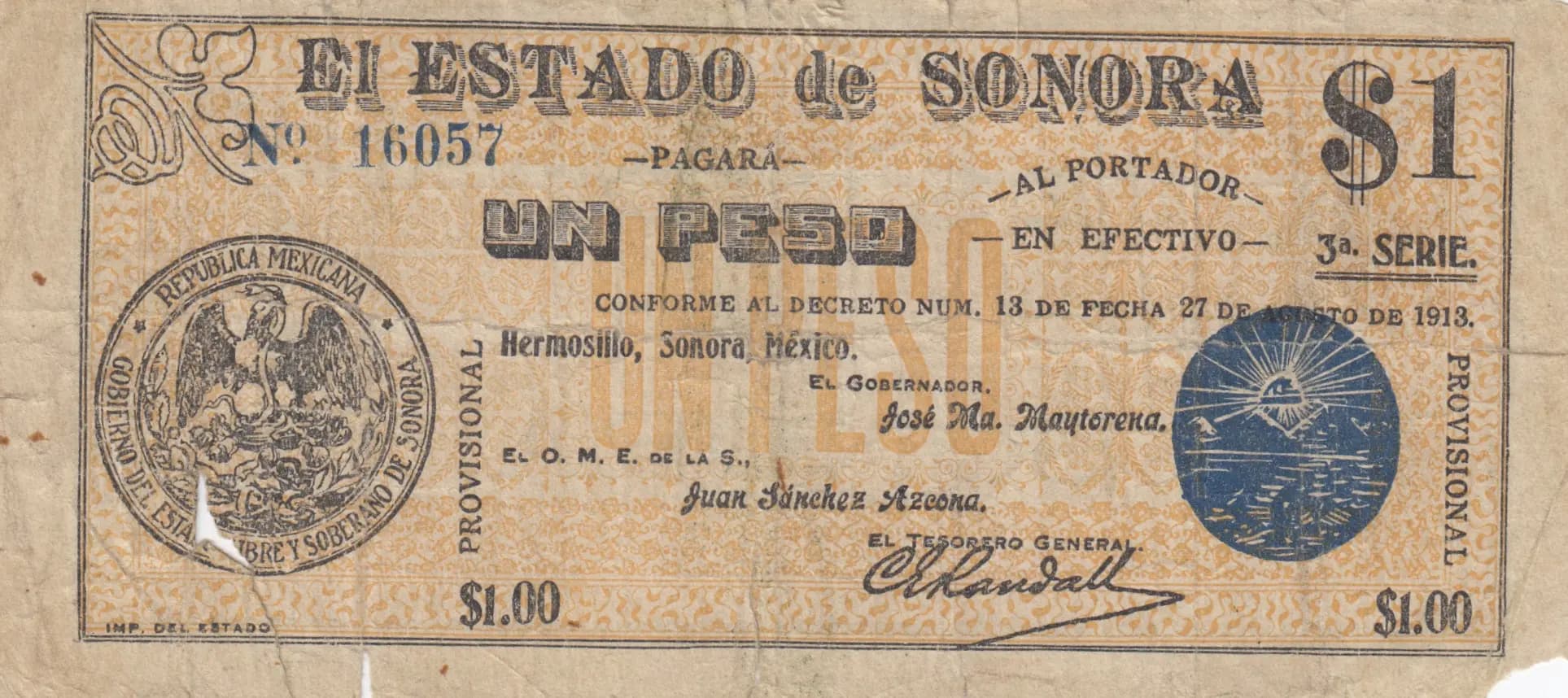
1 peso 1913
About This Note
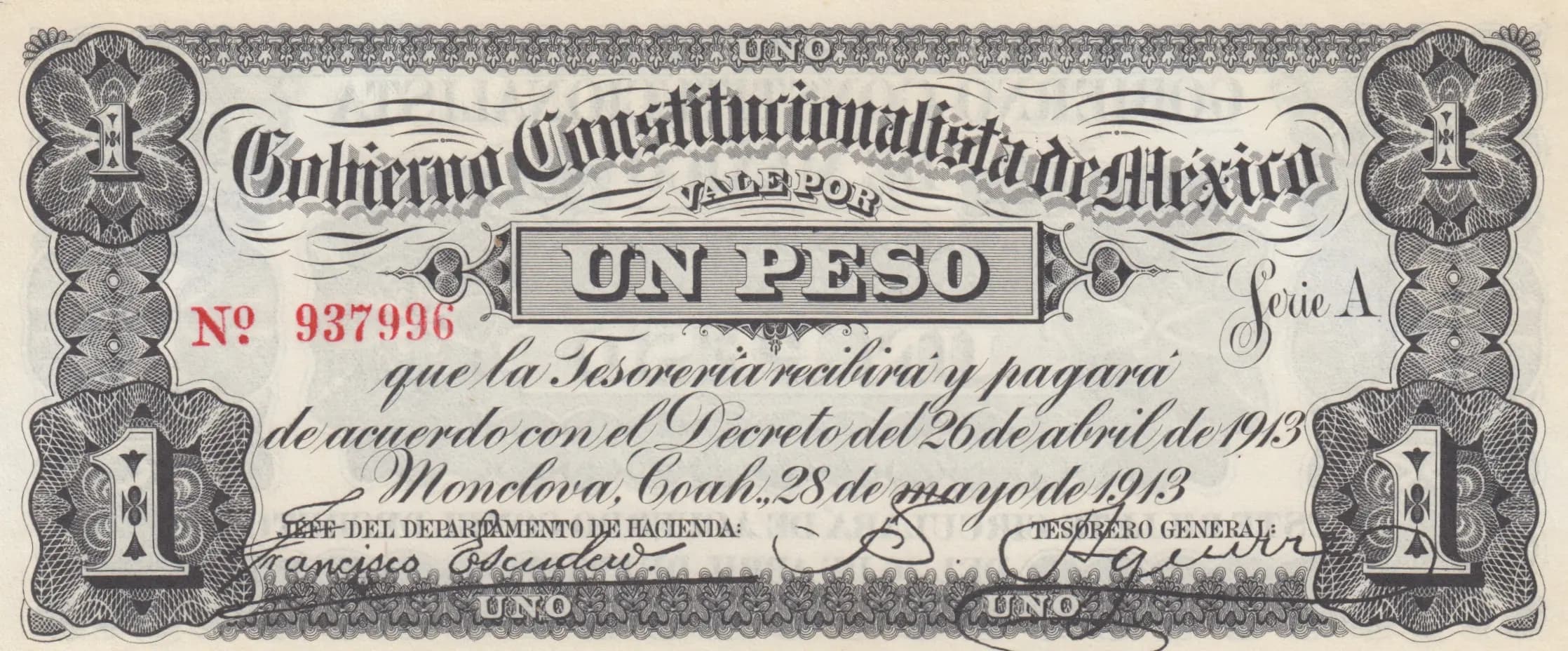
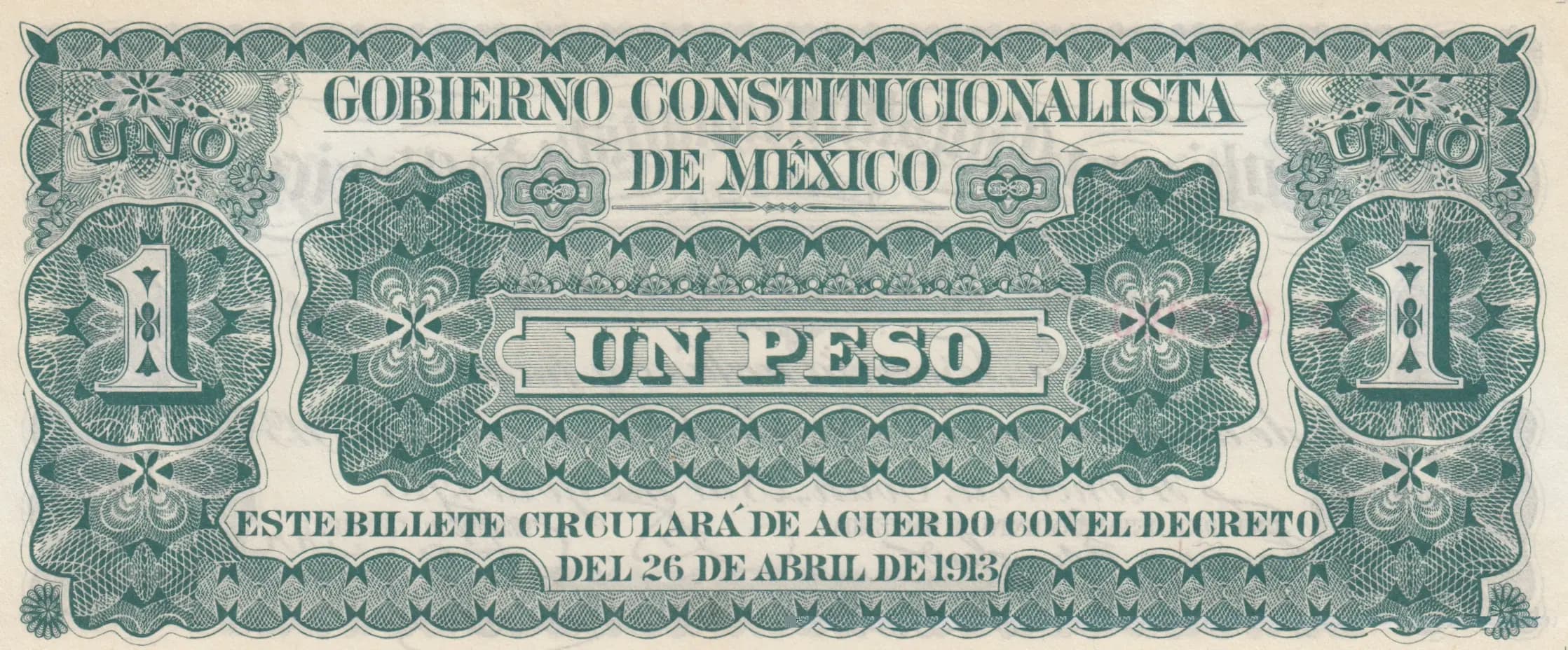
This 1913 Constitutional Government one peso banknote from Monclova, Coahuila represents a significant piece of Mexican revolutionary-era currency. The note exhibits an AU condition grade with age-appropriate creasing and foxing on the obverse, while the reverse remains remarkably well-preserved with crisp teal-green printing. The ornate engraved design with decorative corner medallions and fine geometric borders exemplifies early 20th-century Mexican banknote artistry, making it a desirable specimen for collectors of Mexican revolutionary currency.
Common. While this note represents an important historical period in Mexican numismatics, Constitutional Government issues from 1913 were produced in substantial quantities for regional circulation, and multiple examples survive in collectors' hands. The AU condition grade is above average but not exceptionally rare for this issue. No specific scarcity indicators (such as small print runs, immediate recalls, or documented rarity flags) apply to this Pick number variant.
This note was issued during Mexico's Constitutional Revolution under the Gobierno Constitucionalista, representing the reformist faction's monetary authority centered in Coahuila. Dated May 28, 1913, it was authorized by decree on April 26, 1913, marking a transitional period when multiple factions issued competing currencies during the Mexican Revolution. The Monclova issue represents the regional financial authority attempting to establish legitimacy and economic stability during this turbulent period of national transformation.
This banknote features a symmetrical design centered on denomination cartouches rendered in black ink on the obverse and teal-green ink on the reverse. The design employs no portrait figures, focusing instead on allegorical and decorative elements: ornamental corner medallions with floral and botanical motifs frame the note on all sides, while elaborate geometric border patterns with cross-hatching provide additional security detail. The central cartouche design prominently displays 'UN PESO' and 'UNO' in various positions, with text arranged horizontally across both sides. The cream/beige paper stock serves as a neutral ground for the intricate engraved line work, which includes fine details and flourishes characteristic of late 19th/early 20th-century banknote production. Handwritten signatures authenticate the document in the capacity of Finance Department head and General Treasurer.
FRONT SIDE: 'Gobierno Constitucionalista de México' (Constitutional Government of Mexico); 'UN PESO' (One Peso); 'Serie A' (Series A); Serial number 'Nº 937996'; 'que la Tesorería recibirá y pagará de acuerdo con el Decreto del 26 de abril de 1913' (which the Treasury will receive and pay according to the Decree of April 26, 1913); 'Monclova, Coahuila, 28 de mayo de 1913' (Monclova, Coahuila, May 28, 1913); 'JEFE DEL DEPARTAMENTO DE HACIENDA:' (Head of the Finance Department); 'TESORERO GENERAL:' (General Treasurer); 'UNO' (One). REVERSE SIDE: 'GOBIERNO CONSTITUCIONALISTA' (Constitutional Government); 'DE MÉXICO' (Of Mexico); 'UN PESO' (One Peso); 'ESTE BILLETE CIRCULARÁ DE ACUERDO CON EL DECRETO' (This banknote will circulate according to the Decree); 'DEL 26 DE ABRIL DE 1913' (Of April 26, 1913); 'UNO' (One).
This note was produced using traditional intaglio engraving, evidenced by the fine line work, detailed cross-hatching in the corner medallions, and the crisp impression of the geometric border patterns visible throughout both sides. The two-color printing (black obverse, teal-green reverse) was achieved through separate engraved plates, a standard security practice of the era. The printer for this specific Monclova Constitutional Government issue is not definitively documented in readily available catalogs, though the quality of engraving suggests a reputable Mexican or potentially international security printer engaged by the provisional government.
This specimen is identified as Series A (Serie A) with serial number 937996. The specific variety is defined by the Monclova, Coahuila issue date of May 28, 1913. Known varieties of this Pick S626 note include different series designations and serial number ranges. The handwritten signatures visible on this example are characteristic of the regional authority's authentication method, and variations in signature placement and individual signatories may exist across surviving examples. No overprints or significant printing varieties have been definitively documented for this note.