5 shillings 1939
Market Prices
7 salesAbout This Note
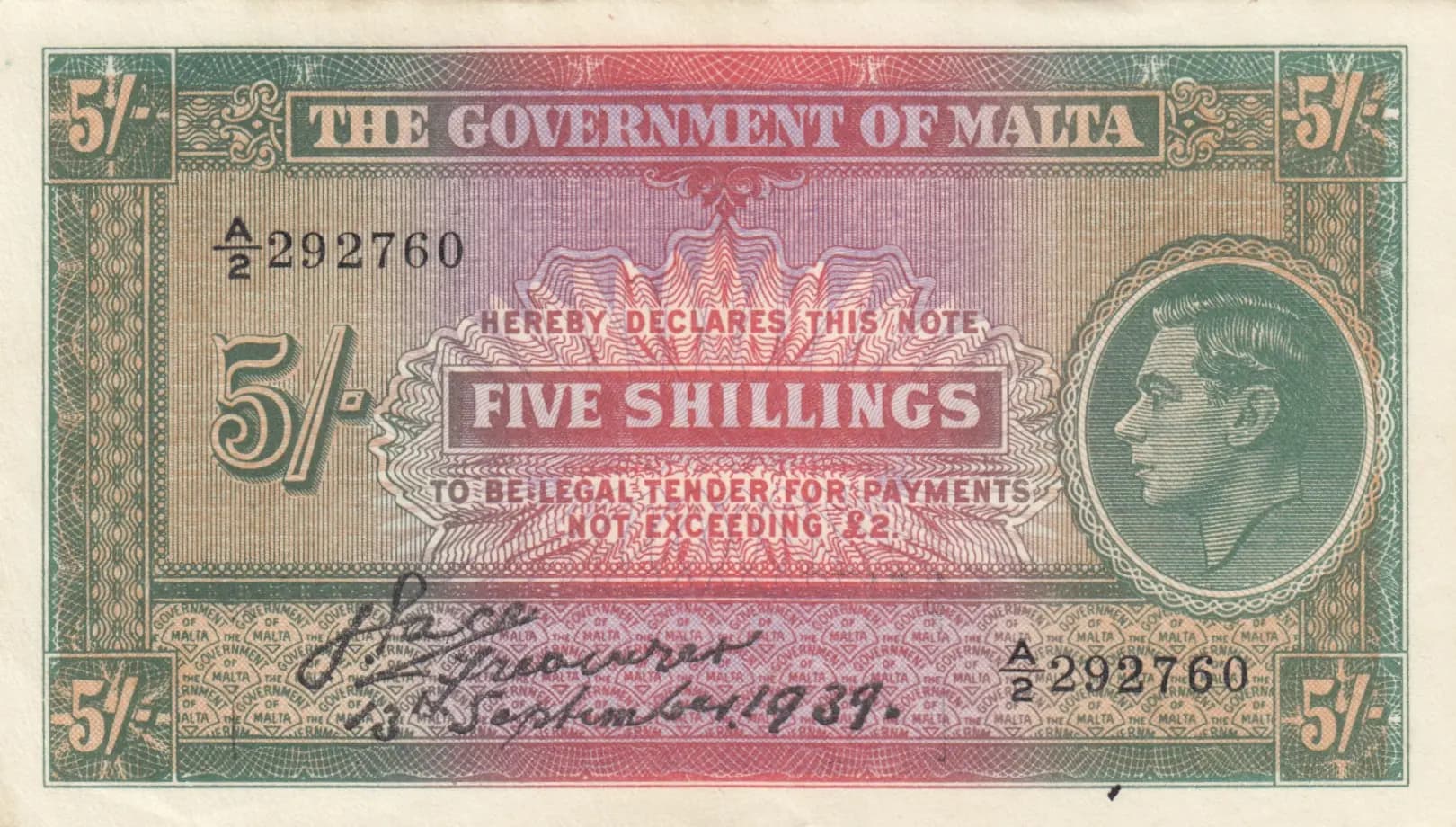
A Malta Government 5 Shillings note from 1939 in Extremely Fine condition, featuring King George VI in profile on the right side within an ornate oval frame. The note displays vibrant green and red/pink decorative borders with intricate geometric and floral patterns throughout, characteristic of the pre-decimal era British Commonwealth currency design. Though circulation wear and aging are evident, the serial number A/2 292760 remains clearly legible, and the note retains strong color saturation and structural integrity befitting its EF grade.
Common. This is a regular issue government note with an estimated circulation in the tens of thousands during a nine-year period (1939-1948). eBay market data confirms common status: recent comparable sales range from $13-$26 for F-VF grades, with 2016 catalog valuations placing EF examples at approximately $37.50. The 1939 issue date and straightforward design (without variants or special overprints) indicate standard production rather than limited release. Wartime currency was printed in substantial quantities to meet circulation demands.
Issued on September 13, 1939—coinciding with Britain's entry into World War II—this note represents Malta's Government-backed currency during a critical period of the island's history. The portrait of King George VI emphasizes Malta's status as a British Crown possession and Commonwealth territory during the war years. The legal tender declaration limiting payments to £2 reflects the monetary control systems in place during wartime Britain and its territories.
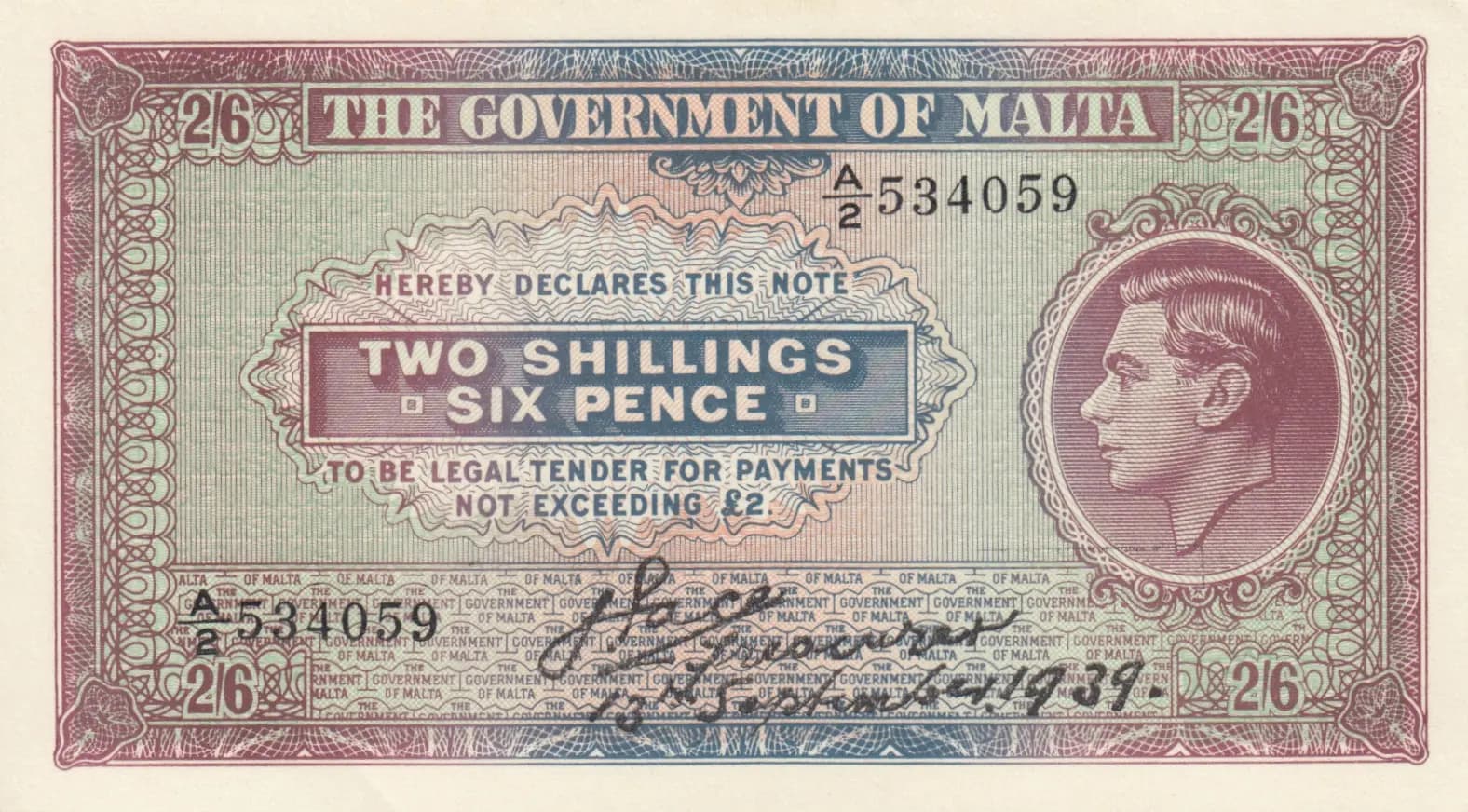
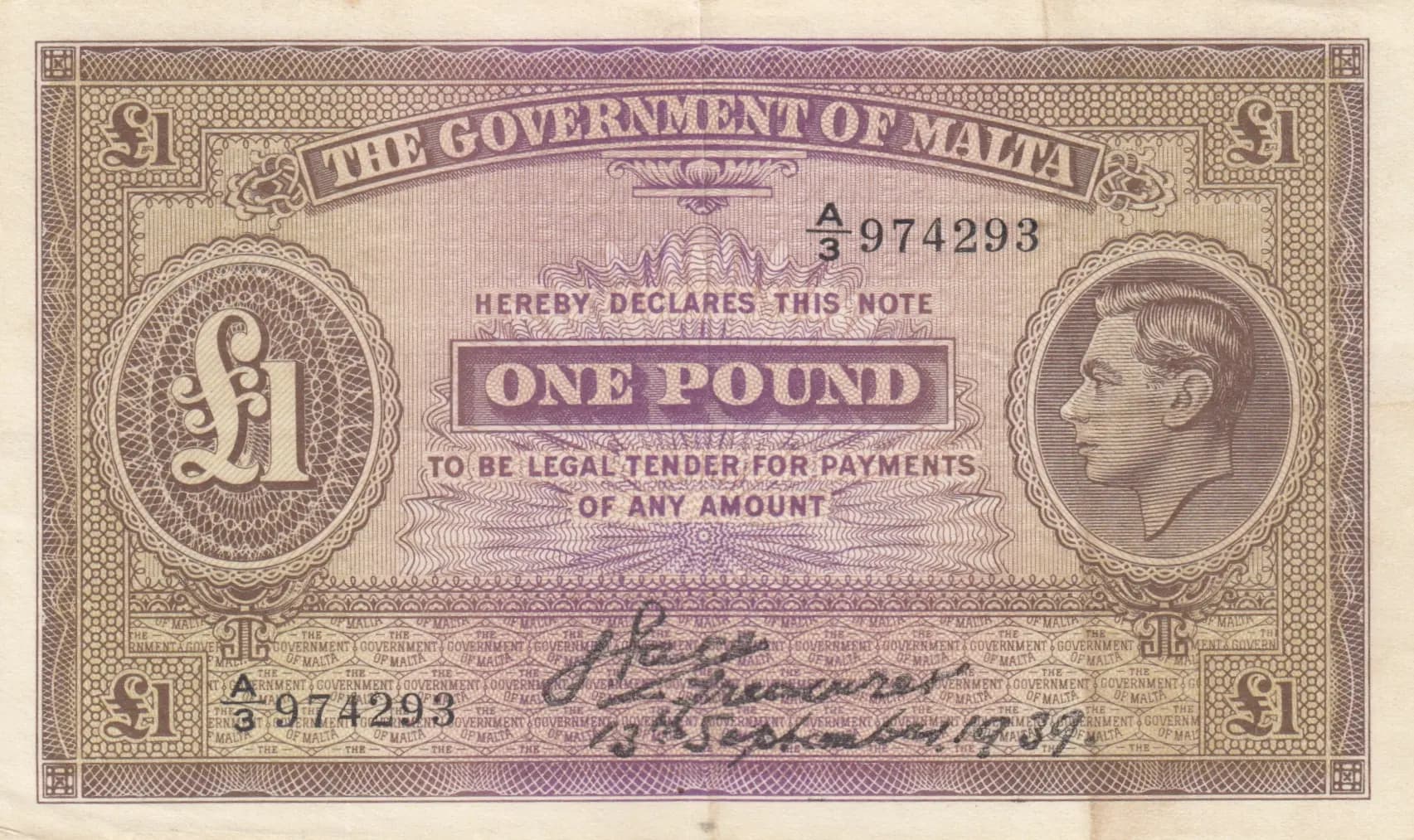
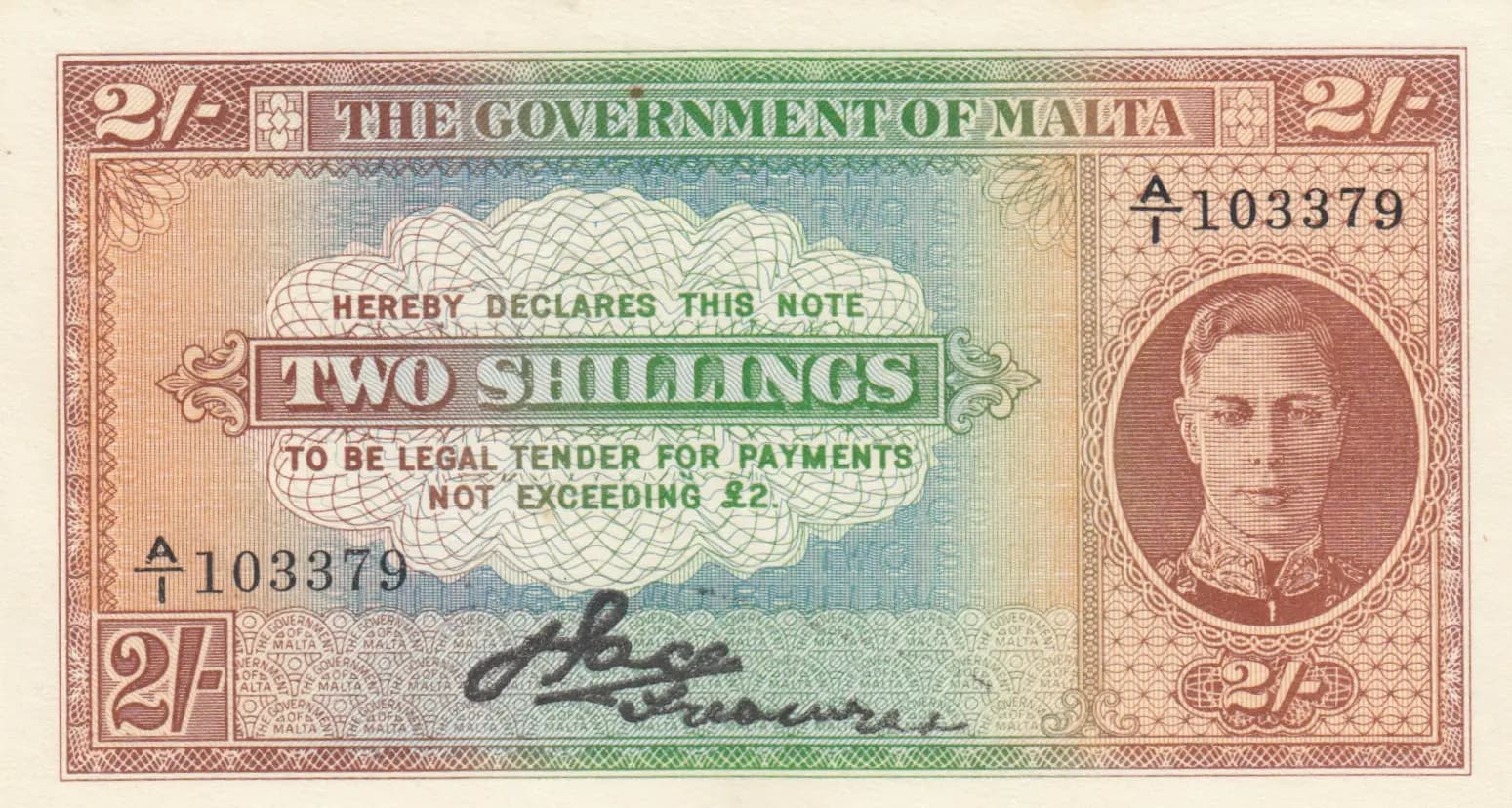
The obverse features a formal portrait of King George VI in right-facing profile, rendered in classical numismatic style and set within an elaborate decorative oval cartouche. The portrait is positioned on the right side of the note, a standard placement for Commonwealth currency of this era. The design employs rich Art Deco-influenced ornamentation with symmetrical geometric patterns, cross-hatch security work, and repeating 'MALTA' text elements in the background. The color scheme of green and red/pink creates visual zones that organize the legal text and denomination declarations. The uniface design (printing only on the obverse) was economical for wartime government-backed notes. All typography is formal, uppercase serif lettering typical of Government of Malta issue currency.
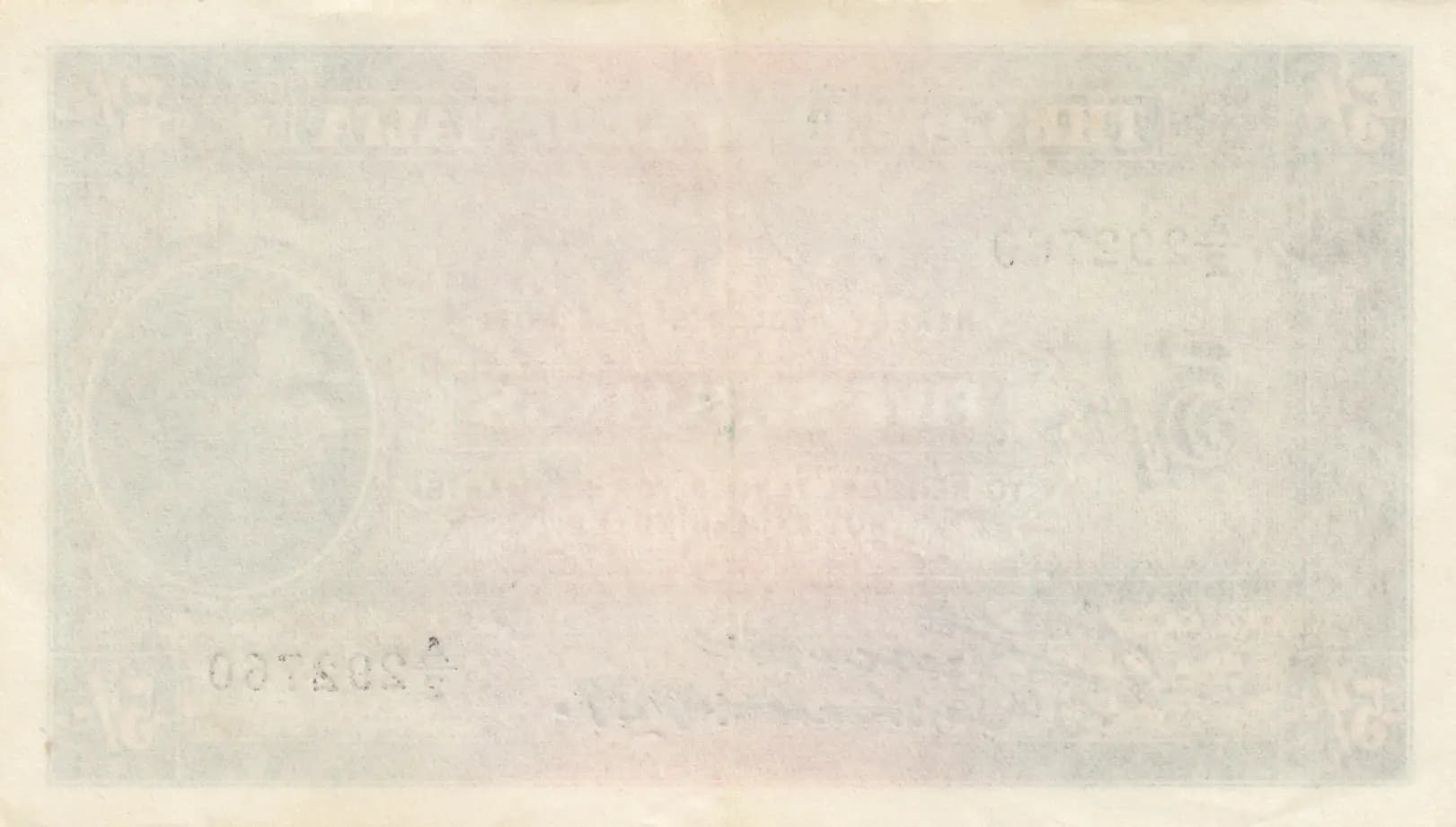
Front side: 'THE GOVERNMENT OF MALTA' / 'HEREBY DECLARES THIS NOTE' / 'FIVE SHILLINGS' / 'TO BE LEGAL TENDER FOR PAYMENTS NOT EXCEEDING £2' / Denomination: '5/-' (Five Shillings) / Serial number: 'A/2 292760' (appears twice, top left and bottom right). Back side: 'OCTOBER' (month designation, likely part of date or series marking).
This note was produced using intaglio (recess) printing by BWC (Bradbury, Wilkinson & Company) without imprint notation, as confirmed by catalog references. Intaglio printing is evident from the crisp, sharp line work visible in the ornate borders, geometric patterns, and the security filigree elements. The multi-color printing (green, red/pink, and black) was achieved through successive intaglio passes on the same press, a standard technique for high-security banknote production. The fine detail and precise registration of colors demonstrate professional currency-grade printing typical of established British security printers of the 1930s.
This note is cataloged as P-12 (base Pick number for 5 Shillings 1939). The PMG population report identifies four variants (P-12, P-12p, P-12r, P-12s), with P-12p specifically noting 'BWC Without Imprint' — which matches the observed note. The serial number prefix 'A/2' and the 'OCTOBER' marking on the reverse suggest this may correspond to variant P-12p. No overprints, date variations, or signature differences are visible in this specimen. The handwritten mark in the lower left area appears to be post-issuance annotation rather than a printer's signature line.