500 francs 1973
Market Prices
25 salesAbout This Note
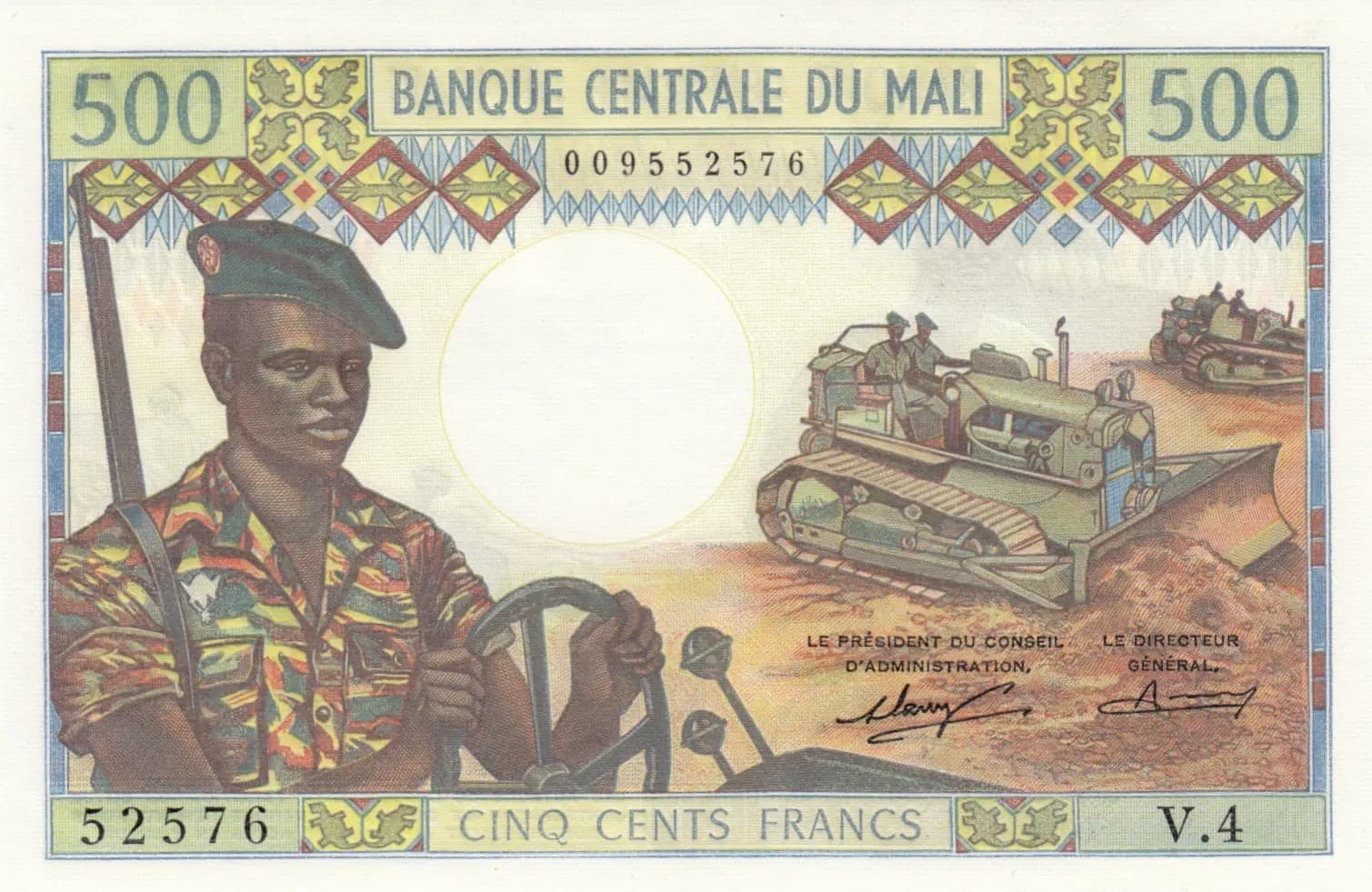
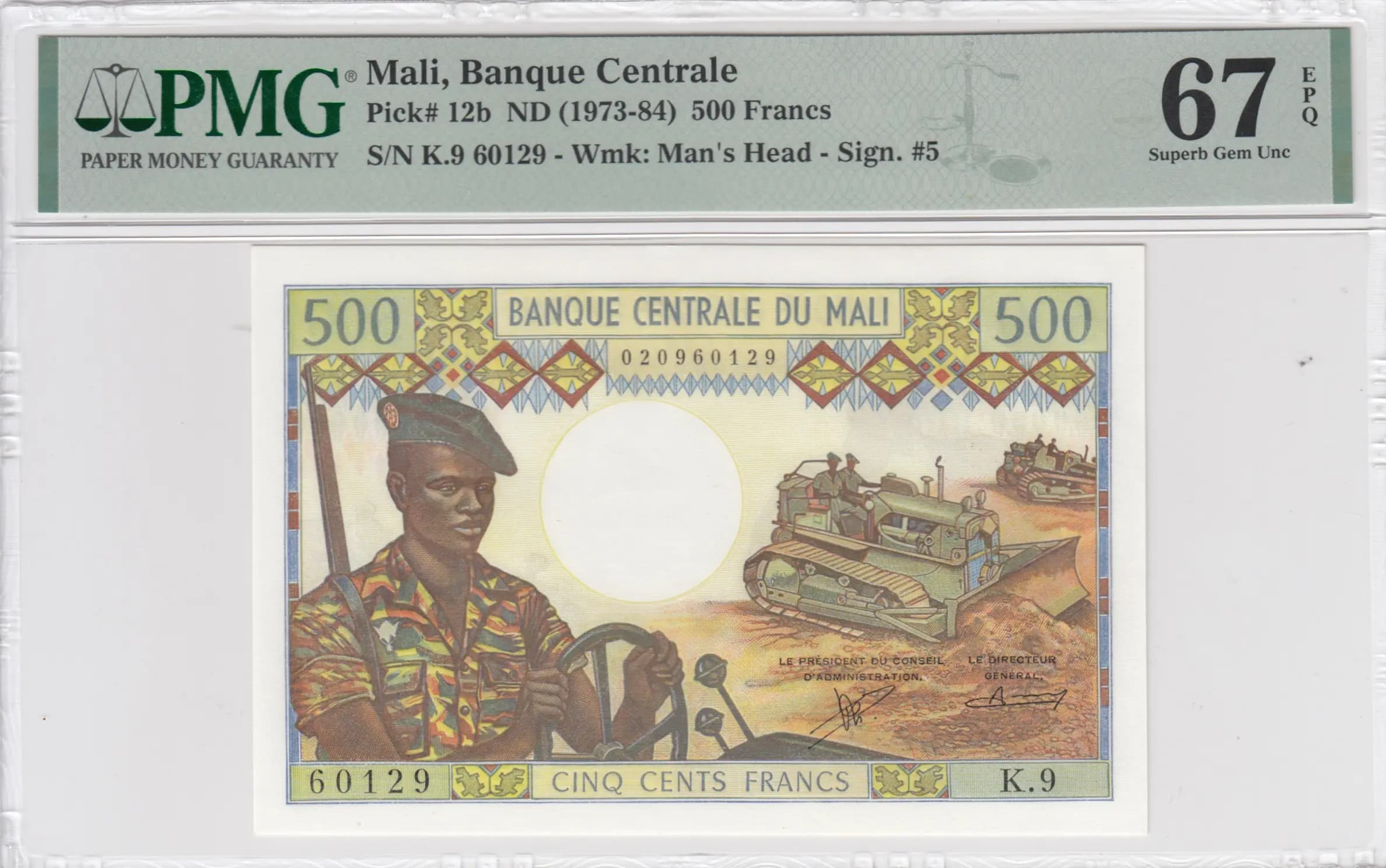
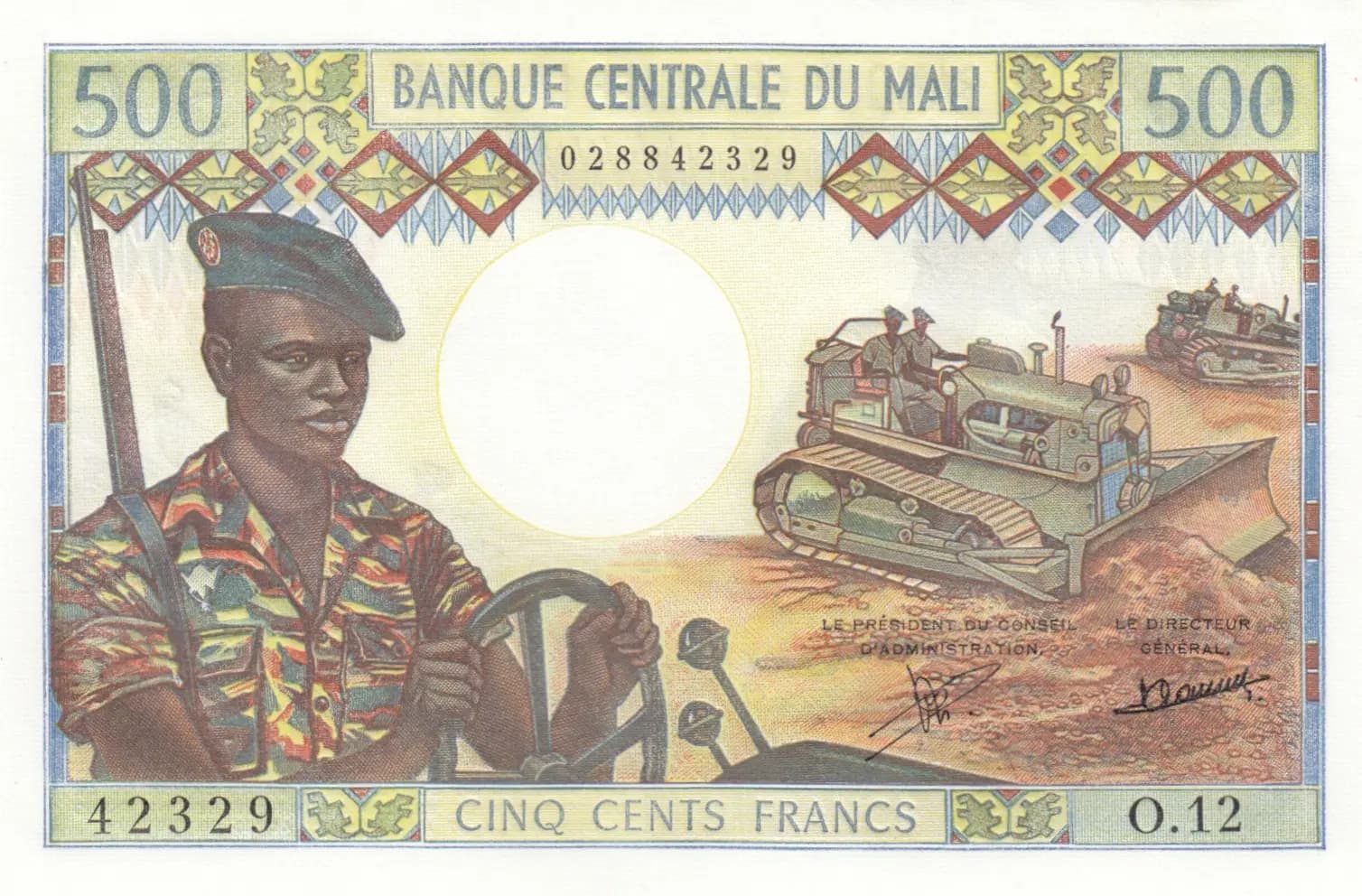
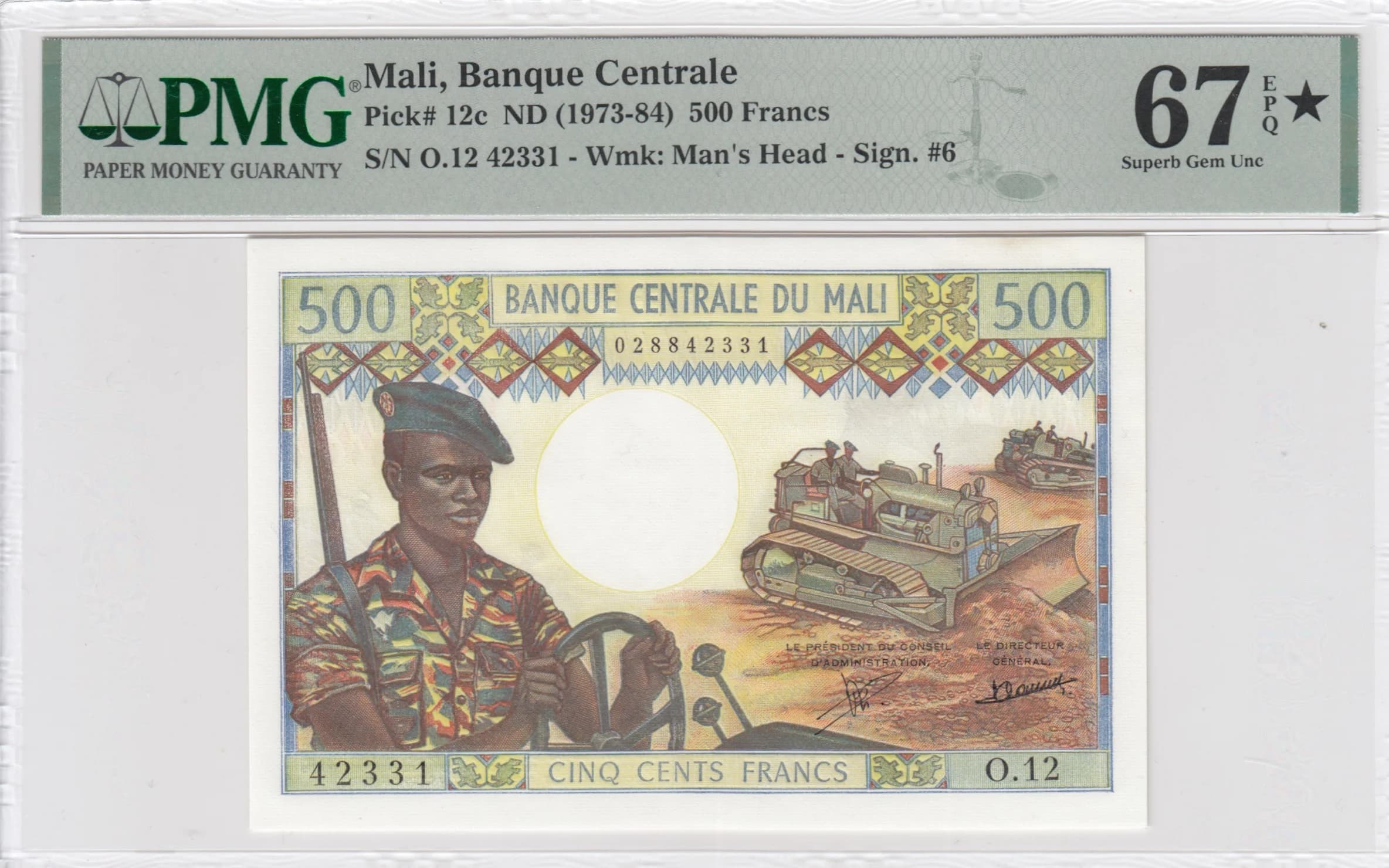
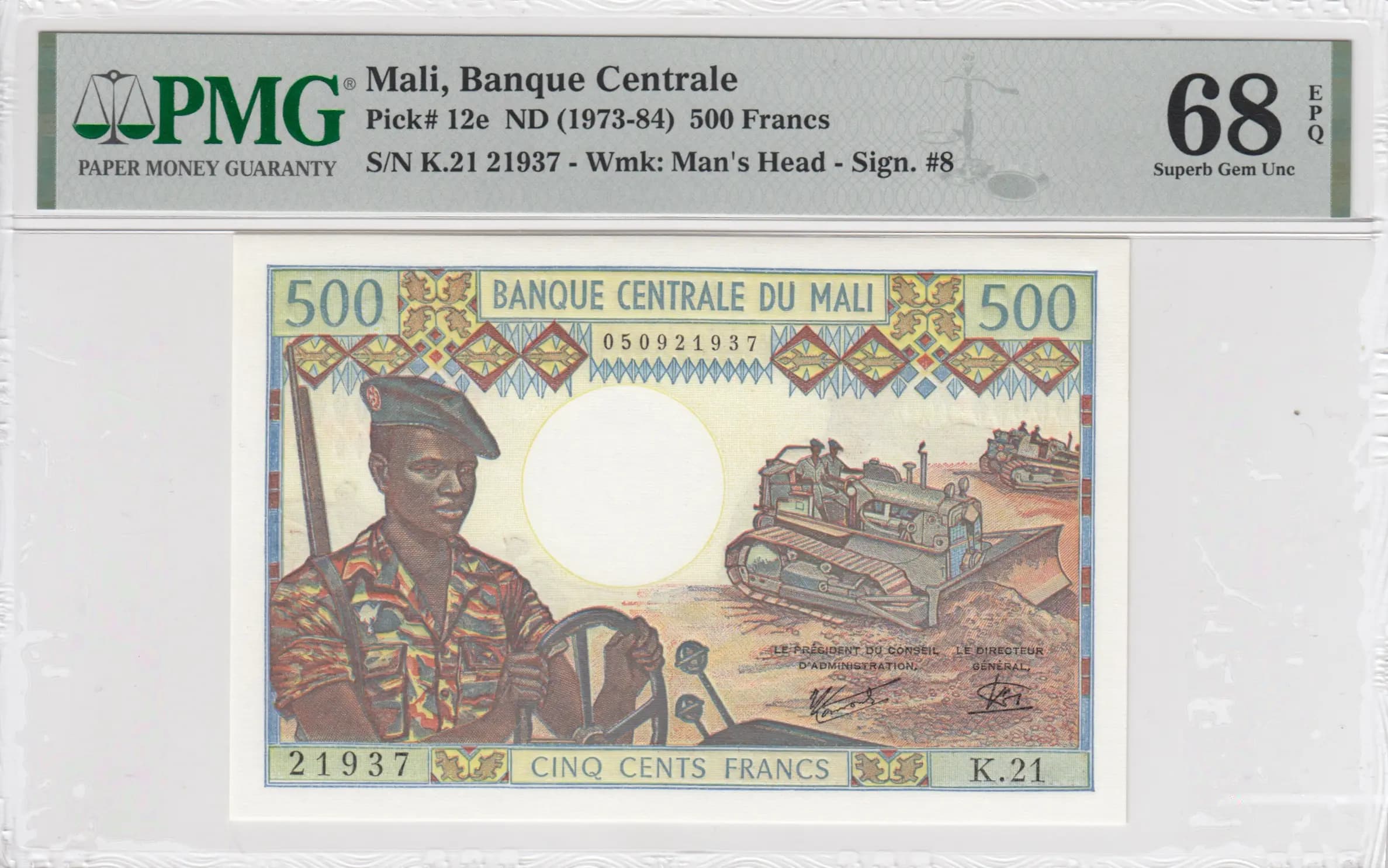
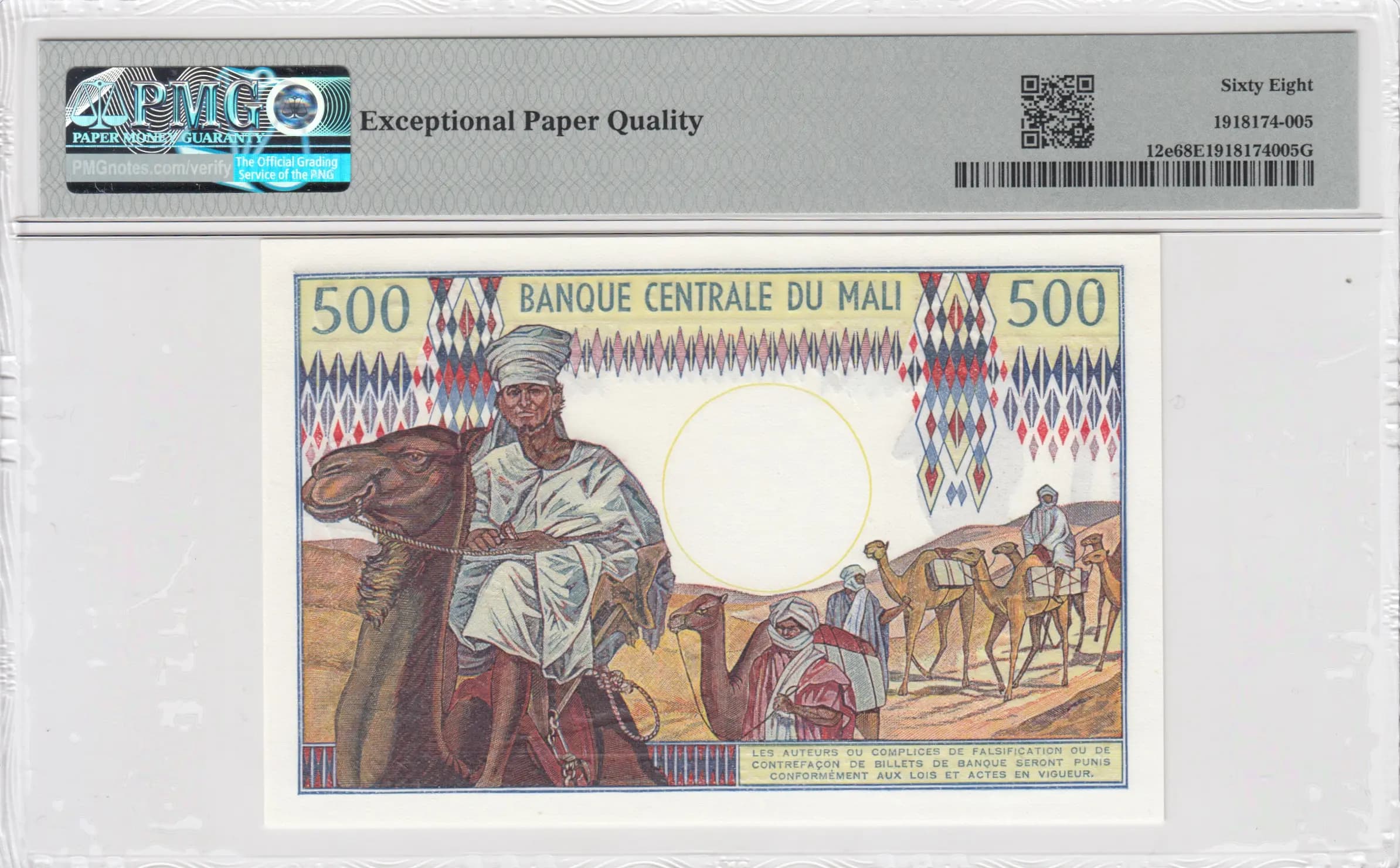
This is a PMG 68 EPQ example of Mali's 500 Francs note from 1973, representing an exceptional specimen in the upper grades of preservation. The obverse features a soldier in military dress with a colorful patterned shirt alongside an industrial construction scene with bulldozers, while the reverse depicts a traditional Saharan caravan with a man in white robes riding a camel and trading figures. The note exhibits pristine uncirculated condition with sharp detail, vibrant multicolor printing in greens, yellows, browns, and reds, and appears virtually untouched from the moment of printing.
Common. Secondary market data shows consistent trading activity across multiple grades (PMG 63-67 specimens regularly selling for $64-$104 on eBay), with numerous uncirculated examples selling in the $50-$90 range historically. The note was in regular circulation for over a decade (1973-1984 per banknote.ws) and remains relatively available in the collector market. PMG 68 EPQ examples command a premium over lower grades, but the denomination and production history indicate this was not a scarce issue. Current catalog value for UNC condition is approximately $70.
This note was issued during Mali's post-independence economic development period under the Banque Centrale du Mali, reflecting the nation's efforts to modernize infrastructure and agriculture in the early 1970s. The juxtaposition of industrial machinery (bulldozers and construction equipment) on the obverse with traditional desert commerce imagery (camel caravans) on the reverse symbolizes Mali's attempt to balance modernization with preservation of its Saharan cultural heritage. The 1973 date places this note during the early years of Mali's Second Republic, a period marked by nation-building initiatives and infrastructure development.
The obverse features a uniformed Mali soldier on the left side, rendered in traditional formal portrait style wearing military dress with a characteristically patterned shirt, representing the armed forces and national defense. The right side depicts an active construction or development scene with heavy machinery including bulldozers engaged in earth-moving operations, symbolizing Mali's modernization and infrastructure projects of the era. The reverse portrays a Saharan trader or nomad in traditional white robes and head covering mounted on a camel on the left, with an additional scene of multiple figures and camels arranged in a traditional caravan composition on the right, representing the historic trans-Saharan trade routes central to Mali's cultural identity. Both sides incorporate a prominent yellow circular element, likely a watermark or security feature. Decorative geometric diamond patterns and ornamental corner designs frame the entire composition in multiple colors including blue, red, green, and yellow, creating a visually complex and authentically Mali-specific design.
FRONT: '500' (denomination in numerals), 'BANQUE CENTRALE DU MALI' (Central Bank of Mali), 'CINQ CENTS FRANCS' (Five Hundred Francs), 'LE PRÉSIDENT DU CONSEIL D'ADMINISTRATION' (The President of the Board of Directors), 'LE DIRECTEUR GÉNÉRAL' (The General Director), serial number '050921937', variety designation 'K.21'. BACK: '500' (denomination in numerals), 'BANQUE CENTRALE DU MALI' (Central Bank of Mali), '500' (denomination in numerals), 'LES AUTEURS OU COMPLICES DE FALSIFICATION OU DE CONTREFAÇON DE BILLETS DE BANQUE SERONT PUNIS CONFORMÉMENT AUX LOIS ET ACTES EN VIGUEUR.' (The authors or accomplices of falsification or counterfeiting of banknotes will be punished in accordance with the laws and acts in force.)
Multicolor intaglio printing (engraved banknote printing), a standard security printing method for African central bank notes of this era. The crisp detail, fine line work, geometric patterns, and color registration observed in the visual analysis are characteristic of professional security printing from the 1970s. The complexity of the decorative borders and multiple color layers indicate professional-grade banknote production facilities, likely produced by an international security printer specializing in African currency production.
This note is identified as Pick-12e, one of six cataloged variants (P-12a through P-12f) in the Pick catalog for Mali's 500 Francs series. The variety designation 'K.21' visible on the obverse and the serial number prefix '050921937' may indicate specific printing batches or signature combinations distinguishing this example from other variants within the P-12 series. PMG grading specifically identifies this as the P-12e variety, suggesting distinctions from P-12a, P-12b, P-12c, P-12d, and P-12f based on signature combinations, date variations, or printer marks typical of notes issued during the 1973-1984 circulation period.