100 dollars 1945
Market Prices
13 salesAbout This Note
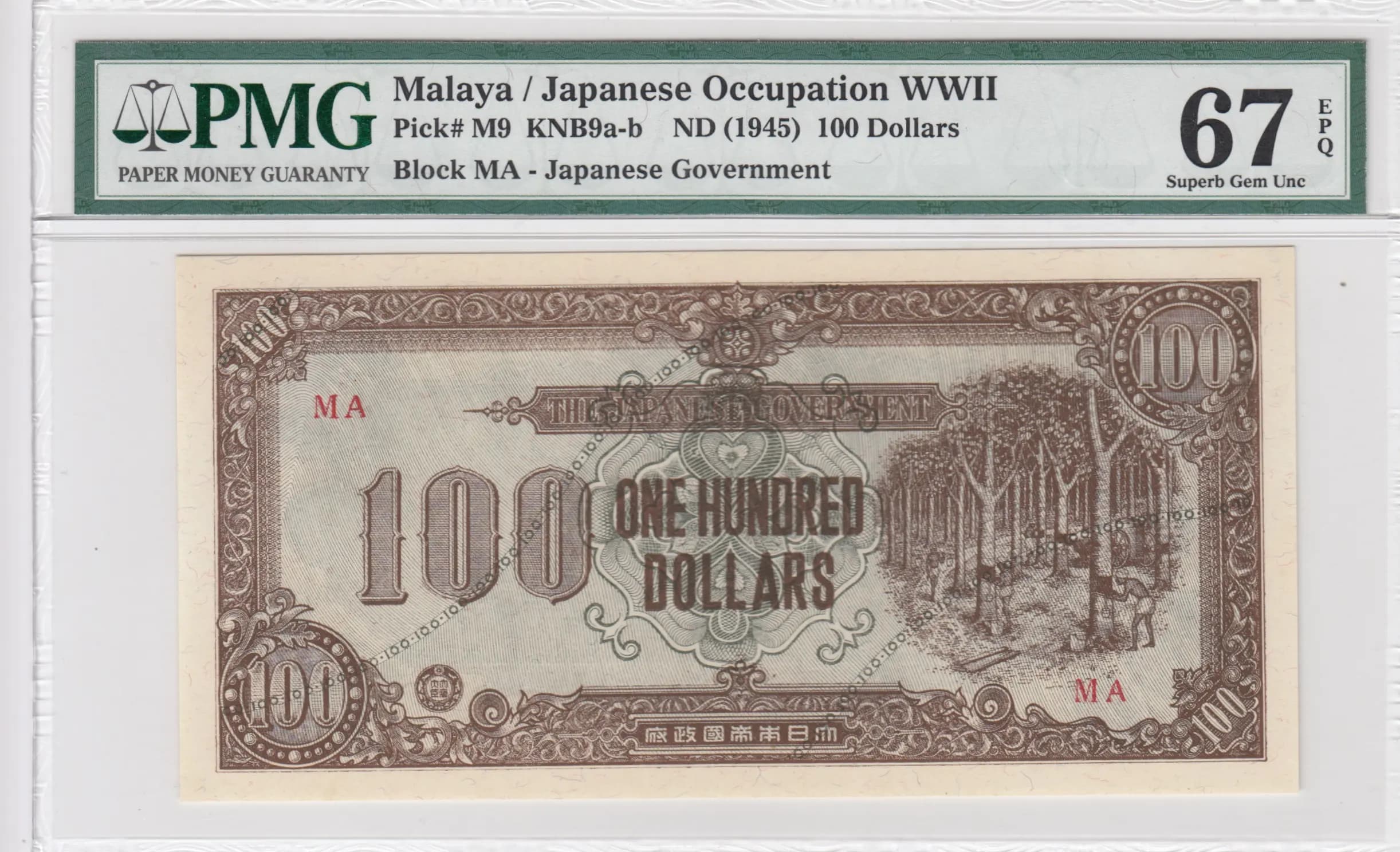
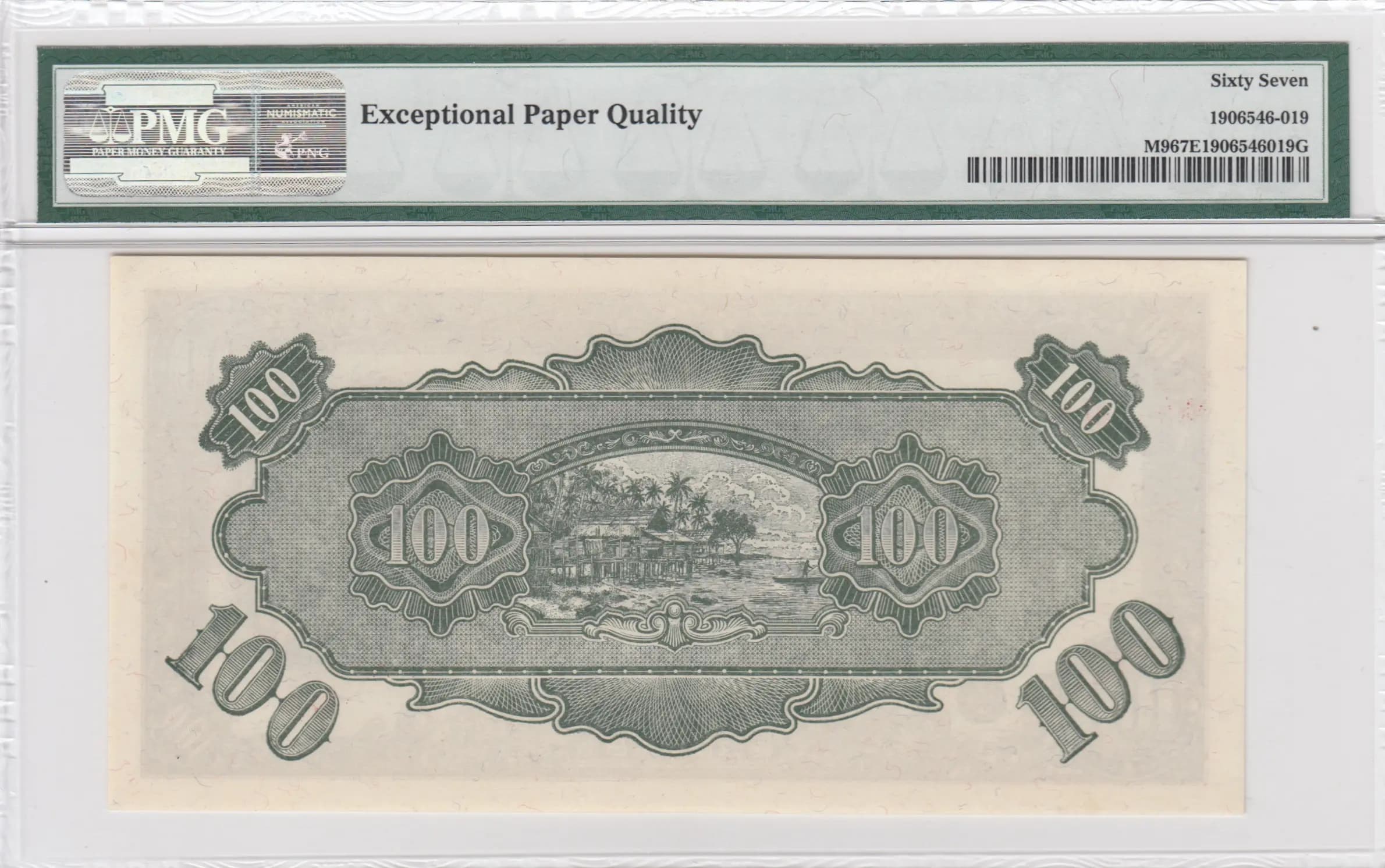
This is a PMG 67 EPQ example of the Japanese Government's 100 Dollar Military Payment Note issued for Malaya in 1945, representing an exceptional specimen of this WWII-era occupation currency. The note displays pristine uncirculated condition with crisp printing, clean margins, and no visible wear, handling, or preservation issues. Its desirability is enhanced by the historical significance of Japanese occupation currency and the superior grade, making it an important piece of WWII numismatic history.
Common. The eBay price tracking data shows consistent sales in the $5–$35 range across multiple condition grades from 2009–2025, with even lower-grade examples (VF, F) selling for under $20. The 2016 catalog values list UNC at only $50. These market indicators, combined with the note's appearance in standard catalogs and regular auction availability, confirm this is a commonly encountered issue despite its historical significance. The higher PMG 67 grade commands a premium, but the underlying note itself remains readily available to collectors.
This note was issued by the Japanese Government during their occupation of Malaya in 1945, the final year of World War II, serving as the official currency of the occupied territory. The colonial-style architecture depicted on the reverse—with its pitched roof and palm tree-lined tropical setting—represents the British colonial infrastructure that Japan sought to control and repurpose during their regional expansion. The ornate English-language denominations alongside Japanese characters reflect the dual administrative structure of the occupation period.
The note features a symmetrical, highly ornamental design characteristic of Japanese occupation currency. The front depicts a tropical landscape vignette on the right side showing palm trees and colonial-era buildings representative of Malaya's British colonial infrastructure. The reverse showcases a more prominent central landscape engraving featuring a colonial-style pitched-roof building surrounded by tropical vegetation and palm trees, enclosed within an ornamental frame. Both sides employ elaborate decorative borders with scrollwork and floral patterns, ornamental shield and circular frames around the denomination numerals, and heart-shaped ornamental designs within text banners. The cream/beige background with brown/sepia toning on the obverse and green/teal toning on the reverse creates visual distinction between the two sides.
Front side: 'THE JAPANESE GOVERNMENT' (English, top center), 'ONE HUNDRED DOLLARS' (English, center), '100' (numeric denomination, upper right and lower left), 'MA' (block designation marker in red, left and right sides). Back side: '100' (numeric denomination, all four corners in shield-shaped frames). Japanese characters appear on the front at bottom center, representing official government authorization text typical of Japanese occupation currency.
Intaglio/engraving process, evidenced by the fine line work, intricate scrollwork detail, sharp denomination numerals, and the crisp impression quality visible throughout the note. The ornate borders and landscape vignettes show the characteristic depth and detail only achievable through traditional engraving. Japanese occupation notes of this series were typically produced by Japanese government printing facilities; specific printer attribution for Pick M9 would require consultation of Japanese wartime printing records.
Block designation 'MA' is visible on the obverse, indicating this is from the MA block of the 1945 Malaya 100 Dollar issue. Serial number details are not clearly legible in the provided images, but Japanese occupation currency is known to have multiple block designations (MA, MB, MC, etc.). No date appears on this design, which is typical for Japanese Government occupation notes. No varieties of particular rarity are known for Pick M9 based on standard numismatic references; condition grade remains the primary determinant of collector value.