1 pound 1964
Market Prices
2 salesAbout This Note
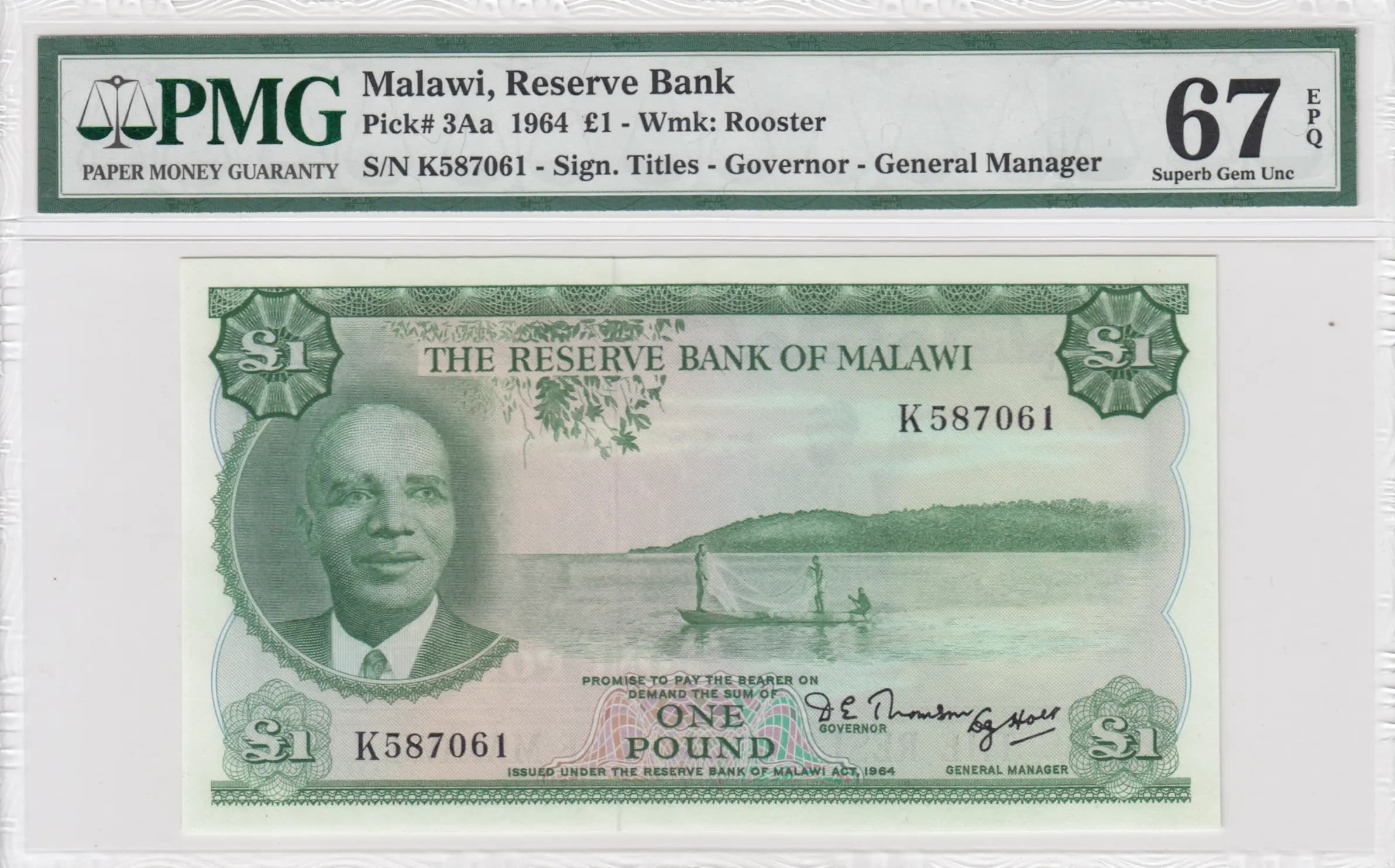
This PMG 67 EPQ graded 1 Pound note from Malawi's 1964 inaugural issue represents an exceptional example of early postcolonial African currency design. The note exhibits pristine, uncirculated condition with crisp paper quality, sharp engraving details, and no visible wear—characteristics that place it well above typical circulated examples and align with PMG's Superb Gem designation. The single-signature variety (P-3Aa) is notably scarcer than its two-signature counterpart, making this an important acquisition for collectors of early Malawi currency and Commonwealth colonial transition issues.
Common. While the P-3Aa single-signature variety is acknowledged as scarcer than the two-signature P-3A variant, the 1964 Malawi pound remains a relatively common note in the overall numismatic market. eBay price tracking shows VF examples selling for $40-89 and UNC examples catalogued at $225 (2019 values), which are moderate market prices indicating adequate supply. The PMG population report confirms multiple graded examples exist. The note's scarcity is primarily driven by condition grade (this PMG 67 EPQ represents exceptional preservation) rather than inherent rarity of the issue itself.
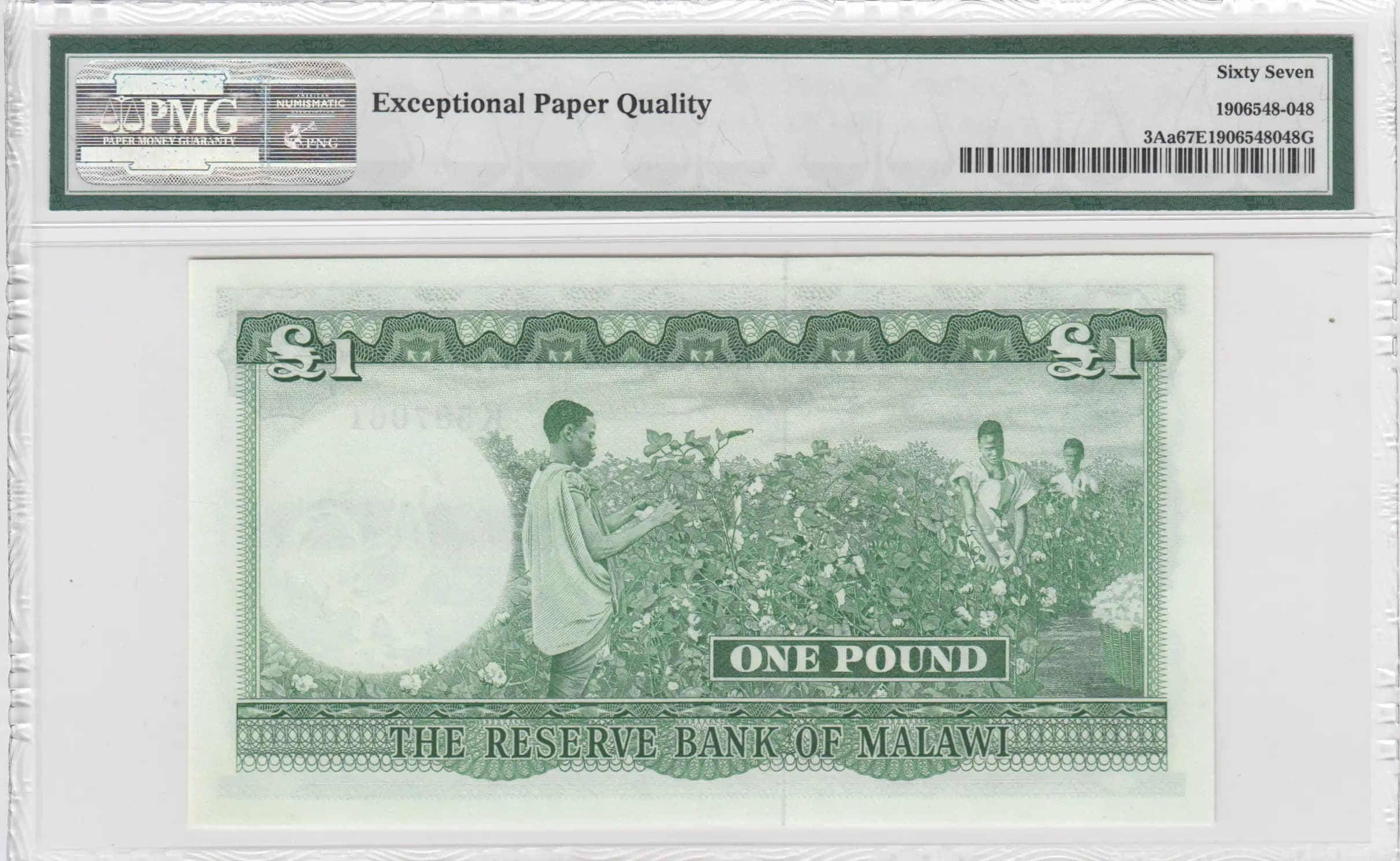
Issued in 1964 under the Reserve Bank of Malawi Act following Malawi's independence from British colonial rule, this note commemorates the nation's economic sovereignty through imagery celebrating its natural and agricultural wealth. The obverse portrays President Dr. Hastings Kamuzu Banda, the founding leader of independent Malawi, positioned alongside Lake Malawi—the nation's defining geographic feature and primary economic resource visible through the depicted fishing scene. The reverse's cotton harvest imagery reflects Malawi's agricultural foundation and colonial-era economic reliance on cash-crop production, now presented as a symbol of the newly independent nation's productive capacity and identity.
The obverse features a formal portrait of President Dr. Hastings Kamuzu Banda in three-quarter profile facing right, rendered in classical engraving style within an oval cartouche on the left side. The right side depicts a traditional fishing scene on Lake Malawi with a small wooden or reed boat on calm waters, mountainous shoreline visible in the background—representing the nation's primary freshwater resource and traditional livelihoods. The reverse presents an agricultural tableau showing multiple workers harvesting cotton in full bloom, their figures rendered in fine detail across a cotton field landscape. The entire design employs a green and white/cream color palette with ornamental rosette corner designs and denomination symbols (£1) positioned in all four corners. Fine-line engraving throughout provides anti-counterfeiting security through intricate detail work and precise registration.
FRONT: 'THE RESERVE BANK OF MALAWI' (issuing authority identification); 'PROMISE TO PAY THE BEARER ON DEMAND THE SUM OF ONE POUND' (legal tender promise); 'GOVERNOR' and 'GENERAL MANAGER' (signature authority titles); 'ISSUED UNDER THE RESERVE BANK OF MALAWI ACT, 1964' (legal authorization); Serial number 'K587061'. BACK: 'ONE POUND' (denomination); 'THE RESERVE BANK OF MALAWI' (issuing authority). All text appears in English, reflecting Malawi's colonial heritage and continued Commonwealth ties post-independence.
Intaglio (engraved) printing on high-quality banknote paper, characteristic of Reserve Bank of Malawi's 1964 inaugural currency issue. The fine-line engraving patterns, sharp portrait definition, crisp text rendering, and precise ornamental details visible in both the obverse and reverse indicate professional security printing. The printer for early Malawi issues was typically De La Rue or similar Commonwealth-preferred security printer, though specific attribution is not definitively established from catalog sources provided.
This note is catalogued as P-3Aa, the single-signature variety of the 1964 Malawi £1 note. The Pick catalog distinguishes between P-3Aa (one signature—GOVERNOR only) and P-3A (two signatures—GOVERNOR and GENERAL MANAGER). The visual analysis confirms only one signature line is present with 'GOVERNOR' and 'GENERAL MANAGER' as printed titles, indicating the single-signature variant. The watermark is a rooster. Serial number observed: K587061. No overprints or additional varieties are evident.