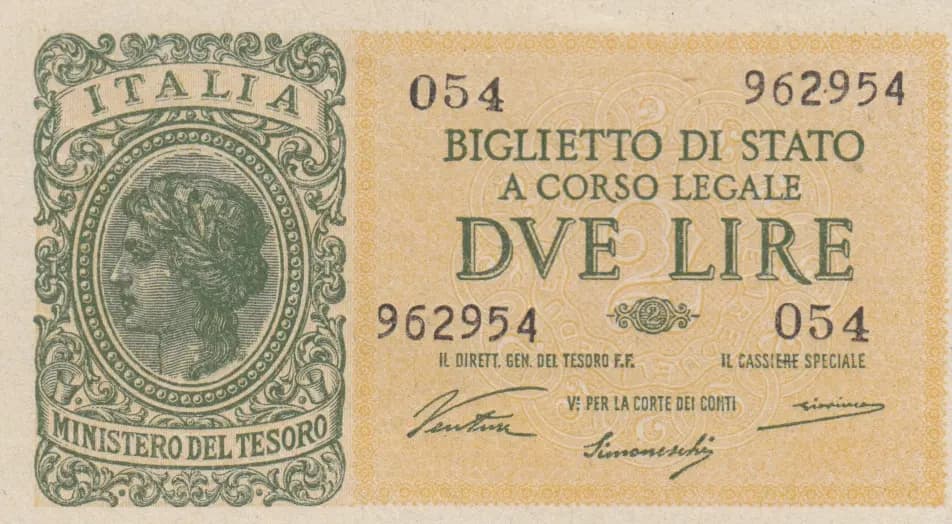
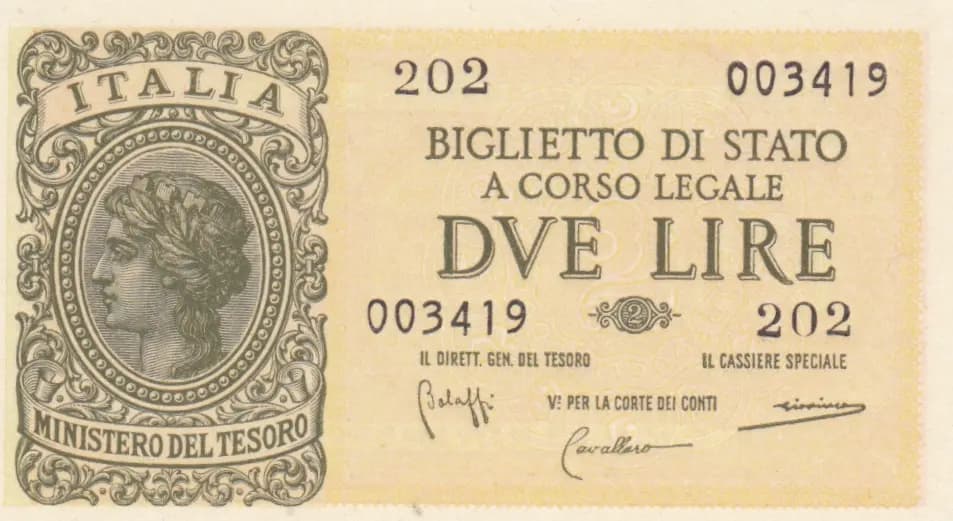
2 lire 1935
Market Prices
22 salesAbout This Note
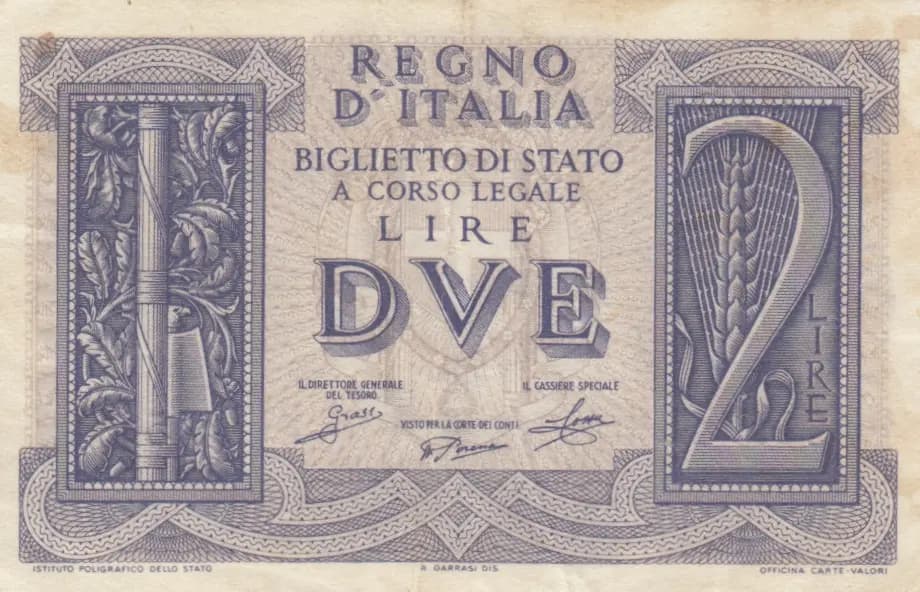
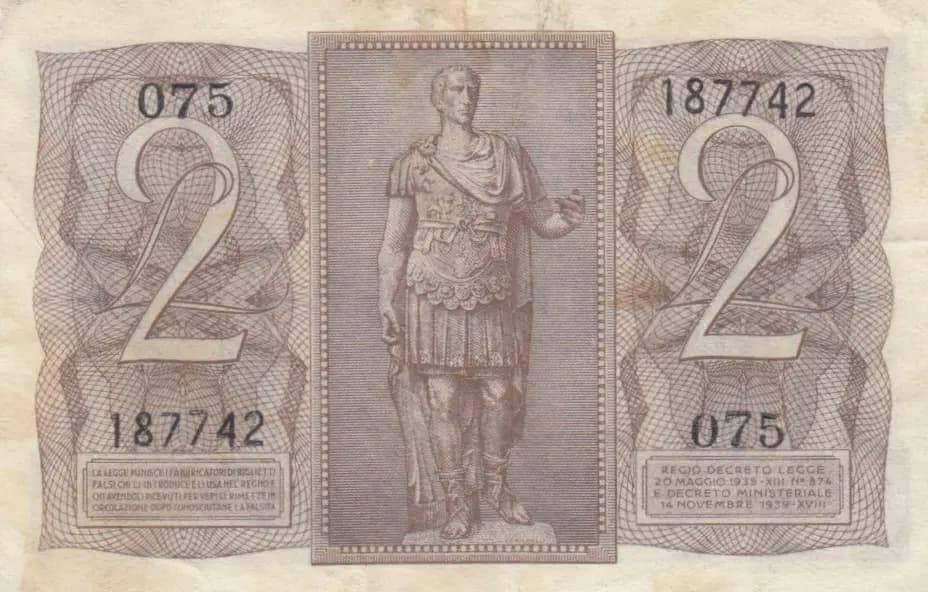
A well-preserved example of Italy's 2 Lire Biglietto di Stato from 1935, graded VF, displaying the characteristic purple-violet and cream color scheme typical of this issue. The note features exceptional clarity in its fine-line engraving, with ornate classical borders on the obverse and a striking classical portrait on the reverse, showing only moderate aging patina consistent with nearly 90 years of age. This denomination represents an important part of Italian monetary history during the Fascist era, with the wheat and fasces symbolism reflecting the regime's agrarian and nationalist ideology.
Common. Market data from realbanknotes.com documents consistent sales activity across multiple condition grades from 2012-2025, with VF examples selling in the $0.99-$3.32 range historically (2012-2021), and recent PMG-graded examples at higher grades ($11.50-$21.50) reflecting certification premiums rather than underlying rarity. The 2016 catalog value for VF is listed at only $0.30, and the denomination's straightforward design and full production run indicate no scarcity factors. This is a common, standard-issue banknote from a major nation's ongoing monetary circulation.
Issued under Royal Decree in 1935 during Mussolini's Fascist regime, this 2 Lire note reflects the state's control over currency and imagery during the Italian Fascist period (1922-1945). The obverse features wheat sheaves symbolizing agricultural self-sufficiency and the fasces representing state authority, while the reverse depicts a classical Roman military figure—likely Julius Caesar—evoking Italy's imperial Roman past, which the regime consciously invoked as justification for contemporary expansionism. The 'Biglietto di Stato' (State Banknote) designation underscores the government's direct control over currency issuance during this authoritarian period.
The obverse features an ornate symmetrical design with classical architectural elements flanking the central text. The left vertical panel displays a classical column with elaborate Corinthian capital, while the right panel showcases a wheat sheaf bundled with ties—references to agricultural themes and the Fascist regime's agrarian policies. The entire surface is protected by an intricate network of fine-line cross-hatching and geometric patterns serving as anti-counterfeiting measures. The reverse presents a commanding classical engraving of Julius Caesar in full Roman military regalia, depicted as a standing figure wearing ornate segmented armor (lorica segmentata) with draped cloth, positioned centrally within an elaborate ornamental frame. Large denomination numerals '2' occupy the left and right margins, with dual serial numbers (075 187742) flanking the central portrait. A complex geometric mesh pattern fills the background, and the entire design demonstrates masterful classical revival aesthetic consistent with Fascist-era Italian state iconography.
OBVERSE: 'REGNO D'ITALIA' (Kingdom of Italy); 'BIGLIETTO DI STATO A CORSO LEGALE' (State Banknote in Legal Tender); 'LIRE DUE' (Two Lire); 'IL DIRETTORE GENERALE DEL TESORO' (The Director General of the Treasury); 'IL CASSIERE SPECIALE' (The Special Cashier); 'VISTO PER LA CORTE DEI CONTI' (Checked by the Court of Accounts); 'ISTITUTO POLIGRAFICO DELLO STATO' (Polygraphic Institute of the State); 'R. GARRONI DIS.' (R. Garroni design); 'OFFICINA CARTE VALORI' (Security Printing Works). REVERSE: Serial numbers and denomination marking '2'; 'REGIO DECRETO LEGGE 20 MAGGIO 1935 - XIII - (N. 876 - DECRETO MINISTERIALE 14 NOVEMBRE 1938 - XVII)' (Royal Decree Law of May 20, 1935 - XIII - (N. 876 - Ministerial Decree of November 14, 1938 - XVII)); counterfeiting warning text regarding penalties per Royal Decree law.
Intaglio engraving (line engraving) on high-quality banknote paper, as evidenced by the fine detail preservation, precise geometric patterns, and complex cross-hatching visible throughout both obverse and reverse. Produced by the Istituto Poligrafico dello Stato (State Polygraphic Institute) in collaboration with Officina Carte-Valori in Rome, employing advanced security printing techniques standard for Italian state banknotes of the 1930s. The multiple layers of protective engraving patterns, fine-line borders, and dual serial number registration demonstrate professional state-level security printing practice.
Serial number combination observed: 075-187742. The note displays the Ministerial Decree date of 14 November 1938 (XVII in Fascist calendar notation), consistent with the cataloged 1939 issue date referenced in external sources. Signature varieties and date progression stamps may exist across the print run, but the visual analysis does not reveal overprints or other obvious variety markers. Designer R. Garroni is credited on the obverse. No additional varieties are distinctly identifiable from this single specimen without comparative reference material.