5 somali 1951 specimen
About This Note
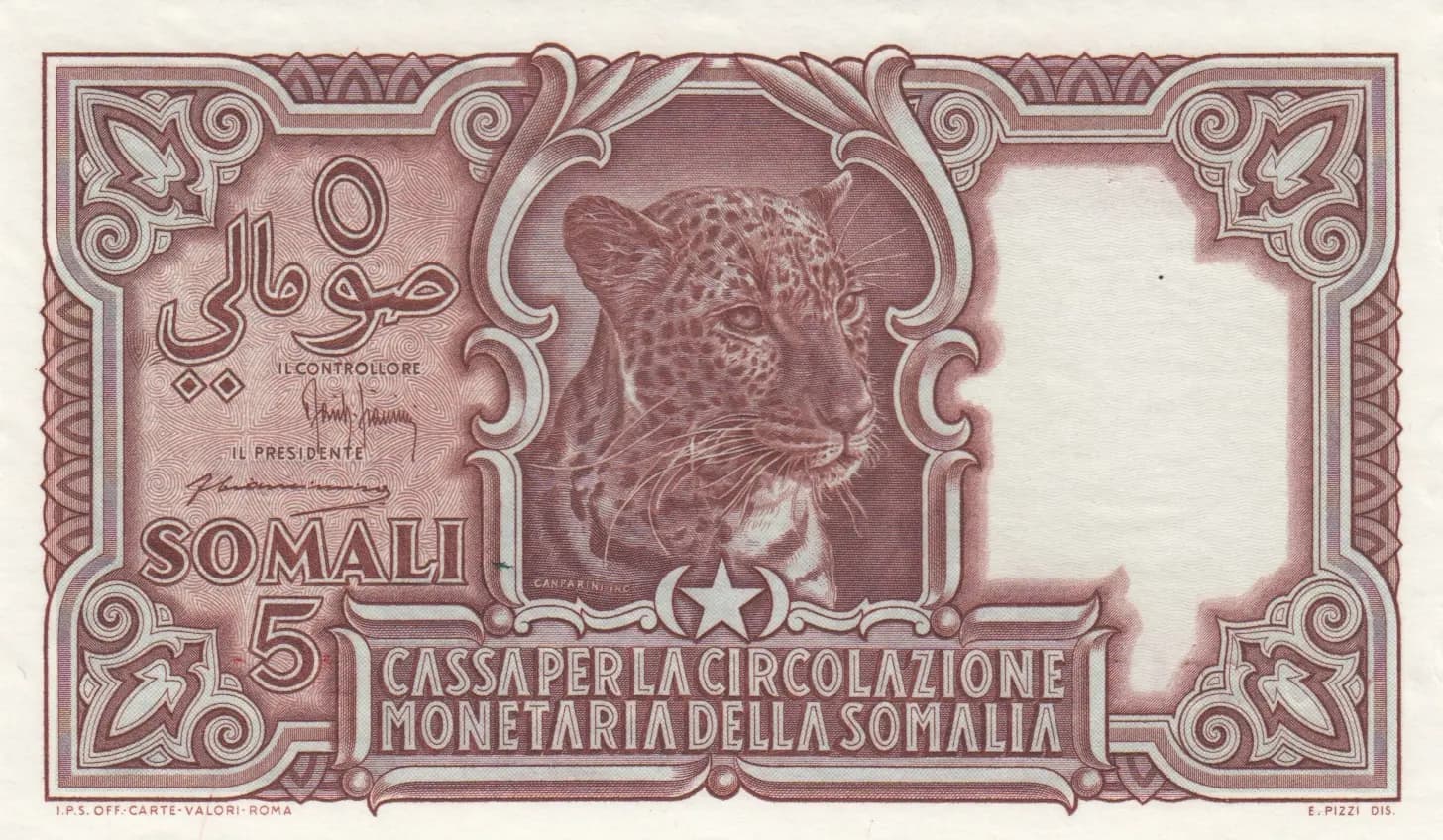
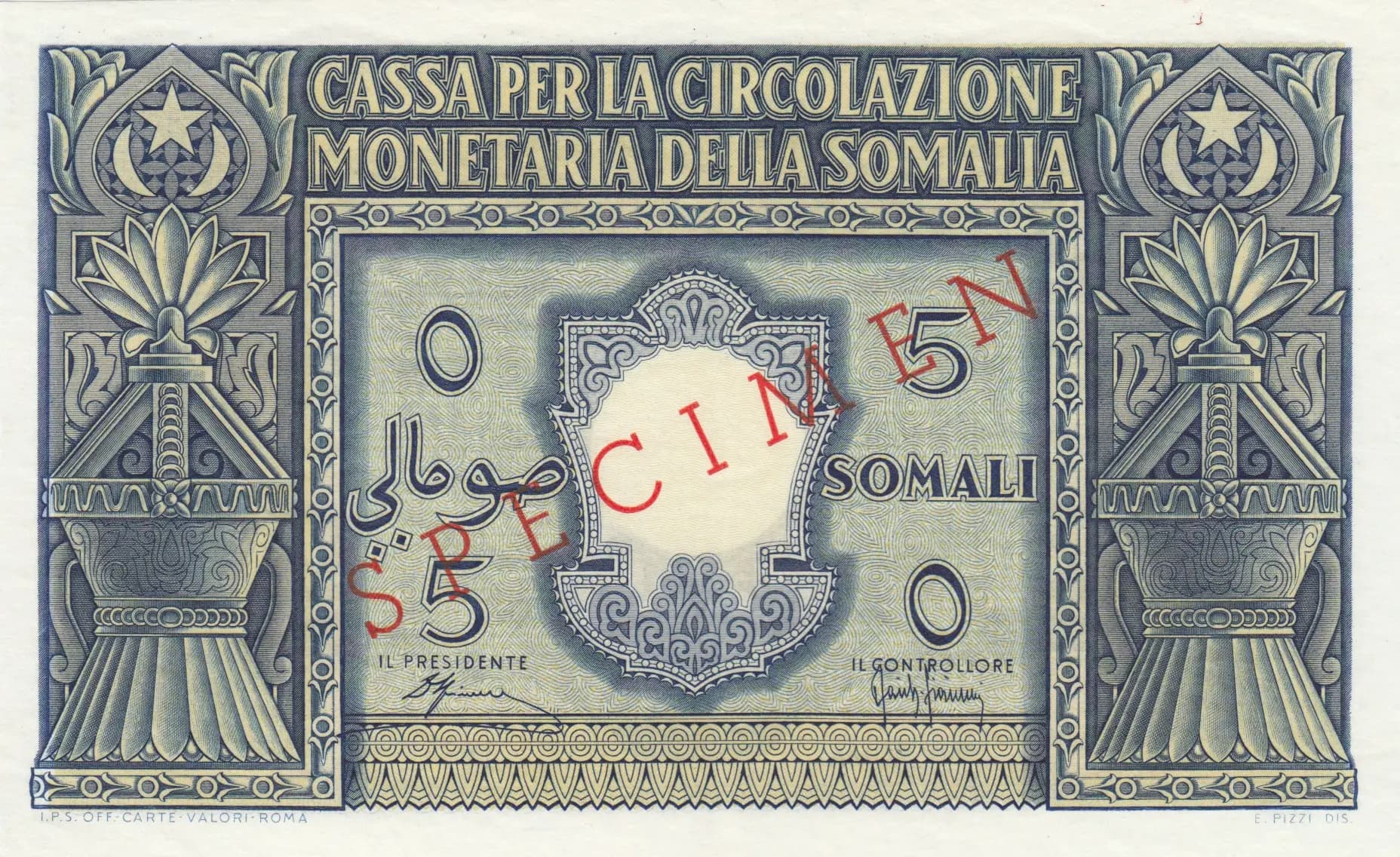
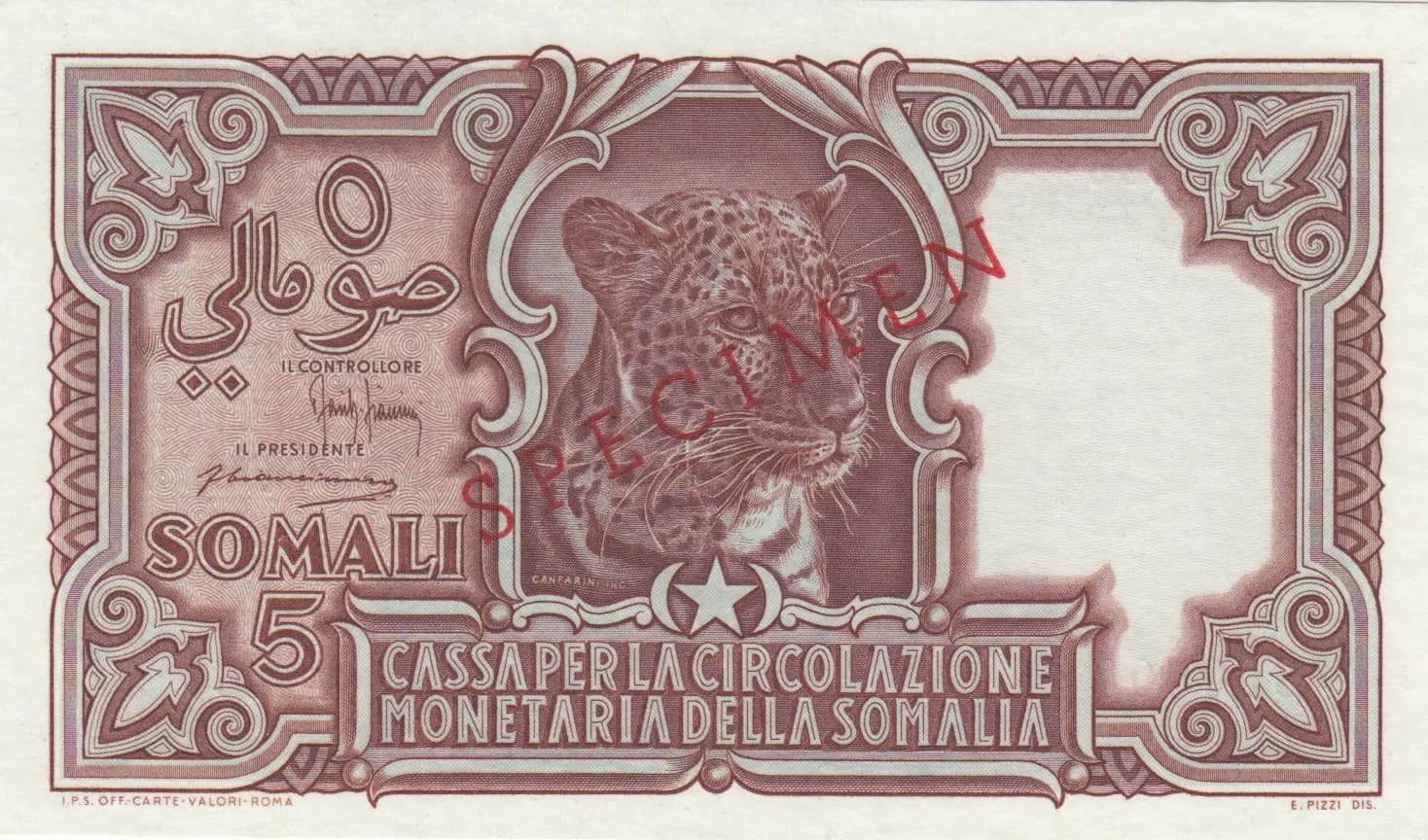
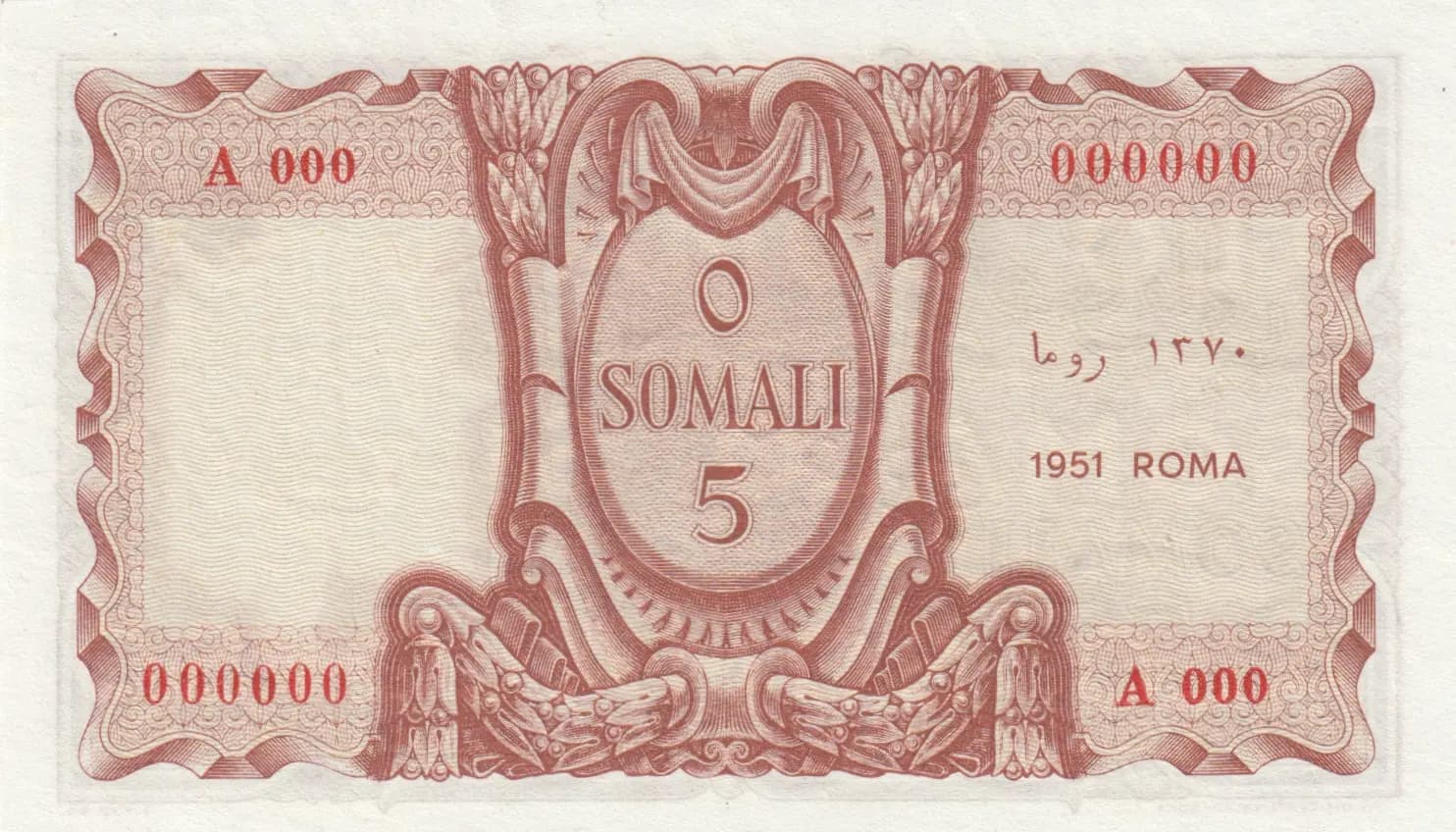
This is an exceptional UNC specimen of the 1951 Italian Somaliland 5 Somali note, featuring a striking engraved portrait of a leopard's head in profile—the national symbol of Somalia—rendered with meticulous detail on the obverse. The reverse displays an ornate central medallion containing the denomination numeral, all executed in fine mauve and burgundy tones with elaborate decorative scrollwork. As a specimen note (indicated by the zero serial numbers and red cancellation marks), this example represents an important piece of the short-lived Italian Somaliland currency period and showcases the sophisticated engraving standards of the Cassa per la Circolazione Monetaria della Somalia.
Common. While specimen notes (marked P-16s) are less frequently encountered than circulation notes (P-16), the Italian Somaliland 5 Somali from 1951 was part of a standard currency series issued during a period of institutional stability under Italian trusteeship. No evidence exists of exceptionally limited production or early recall. Specimen notes by definition were produced in smaller quantities than circulating currency but were not rare within their class. PMG's cataloging of this variant indicates availability sufficient for professional grading populations. As a mid-20th-century specimen from a currency that remained in circulation until 1960, this note is relatively accessible to collectors.
This note was issued during the final years of Italian trusteeship in Somalia (1950-1960), a period of institutional transition following World War II. The leopard's head—prominently featured on the obverse and referenced in the watermark—served as a powerful national emblem for the emerging Somali state, appearing on currency as a symbol of sovereignty and national identity. The Italian-language inscriptions and Rome-based printer (I.P.S. Rome) reflect the currency's transitional status, bridging Italian colonial monetary systems with the independent Somali monetary authority that would follow independence in 1960.
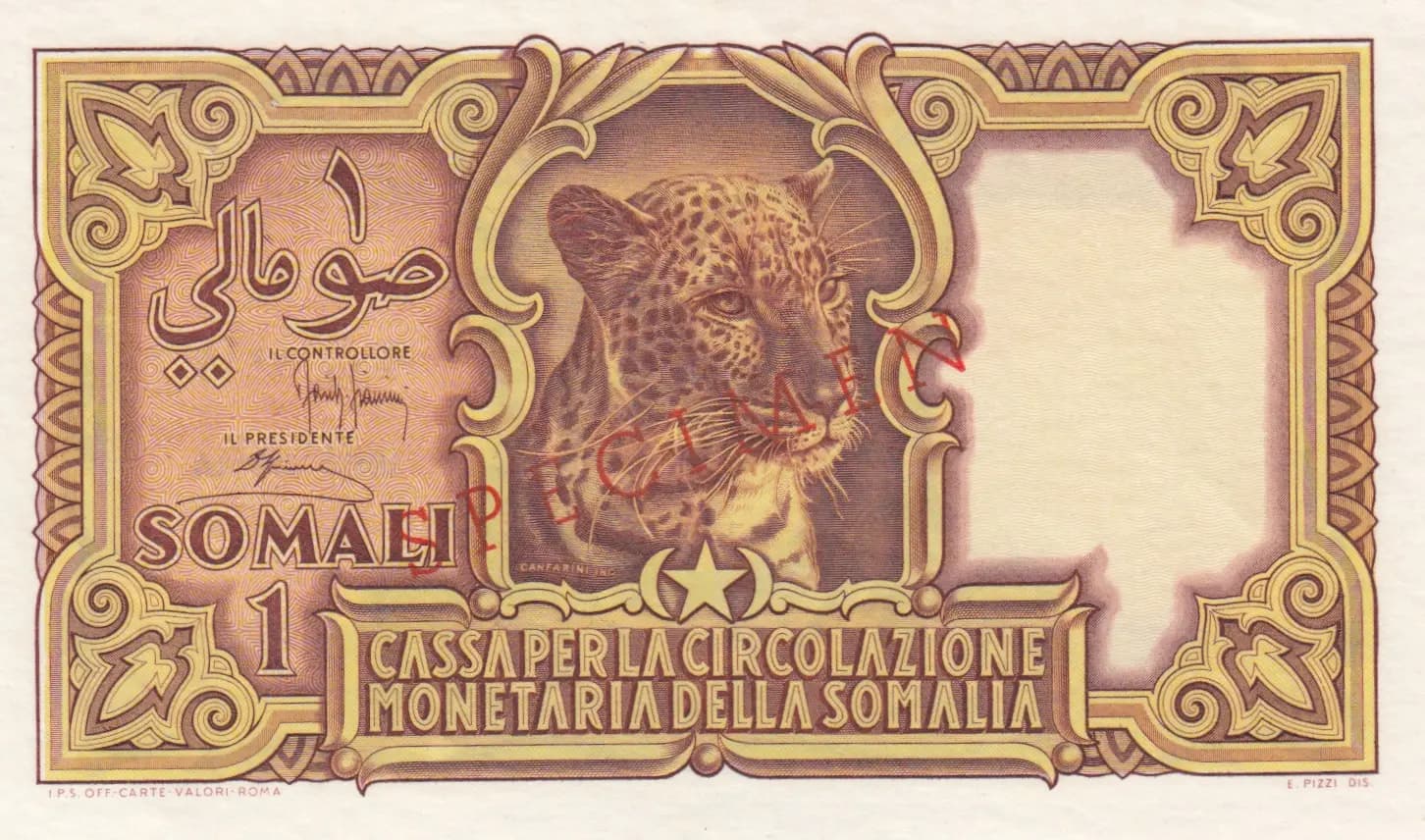
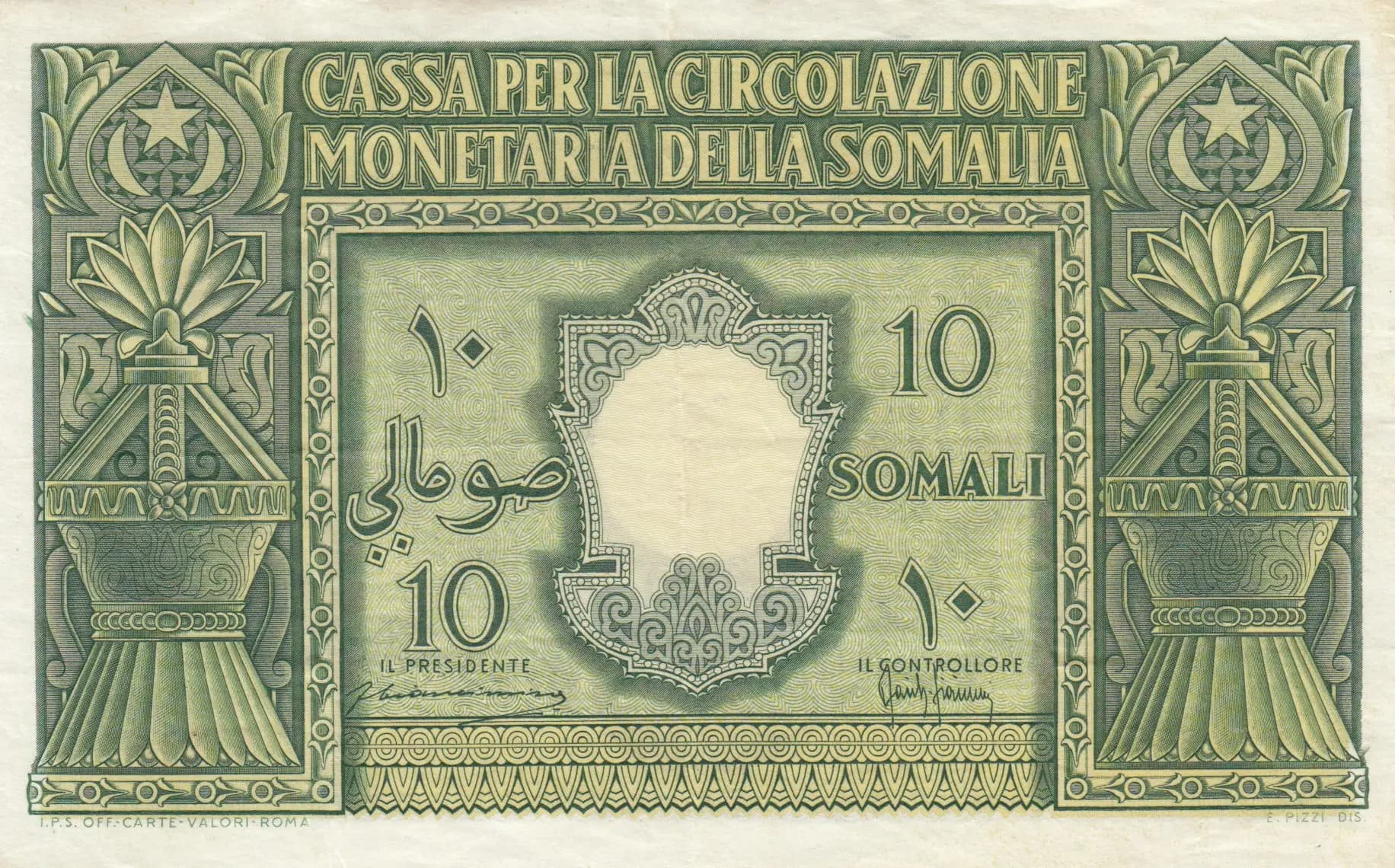
The obverse features a centrally positioned leopard's head in left-facing profile, meticulously rendered with detailed cross-hatching to show the spotted fur pattern, whiskers, and facial anatomy. The leopard serves as the primary heraldic and national symbol of Somalia. Surrounding the portrait is an elaborate decorative border composed of ornate scrollwork, flourishes in all four corners, and geometric and floral patterns in mauve and burgundy tones. A single-pointed star is centered below the leopard portrait, further emphasizing Somali national iconography. The reverse displays a symmetrical design centered on an oval medallion containing the large numeral '5', framed by decorative drapery and curtain swags at the top. The entire design employs fine line engraving with complex ornamental borders, reflecting the aesthetic standards of Italian security printing of the mid-20th century.
Front: 'SOMALI' (Somali); '5' (denomination); 'IL CONTROLLORE' (The Controller); 'IL PRESIDENTE' (The President); 'CASSA PER LA CIRCOLAZIONE MONETARIA DELLA SOMALIA' (Treasury for the Monetary Circulation of Somalia); 'I.P.S. OFF.-CARTE-VALORI-ROMA' (I.P.S. Office - Security Printing - Rome); 'E. PIZZI DIS.' (E. Pizzi Designer/Draftsman). Back: '5' (denomination); 'SOMALI' (Somali); 'A 000' and '000000' and '00000' (specimen serial numbers with zeros); '1951 ROMA' (1951 Rome); '۱۲۷۷' (Islamic calendar equivalent: AH 1277, corresponding to 1860-1861 in the Islamic calendar, likely a printer's mark or reference date).
Intaglio (line engraving) produced by I.P.S. (Istituto Poligrafico dello Stato) in Rome. The fine cross-hatching visible on the leopard portrait, the intricate geometric border work, and the delicate floral patterns are characteristic of high-quality intaglio engraving. The printer's imprint 'I.P.S. OFF.-CARTE-VALORI-ROMA' confirms production by Italy's state security printer, indicating the use of steel plates and traditional engraving techniques. The red cancellation marks visible on the specimen are typical of security printer specimen overprints used to distinguish non-circulating presentation samples.
This note is specifically cataloged as P-16s (specimen variant) by Pick, distinguished from P-16 (circulation issue) by the presence of zero serial numbers and specimen markings. Both variants share the Leopard's Head watermark. The specimen designation is confirmed by the serial number fields displaying 'A 000', '000000', and '00000' on the reverse, and the visible red cancellation marks across the obverse. The design credit to 'E. Pizzi' (engraver) and the printer attribution to I.P.S. Rome (1951) are consistent across specimens of this issue. No alternative signature blocks, date variations, or prefix variants are evident in the visual analysis.