20 kronen 1920
Market Prices
1 saleAbout This Note
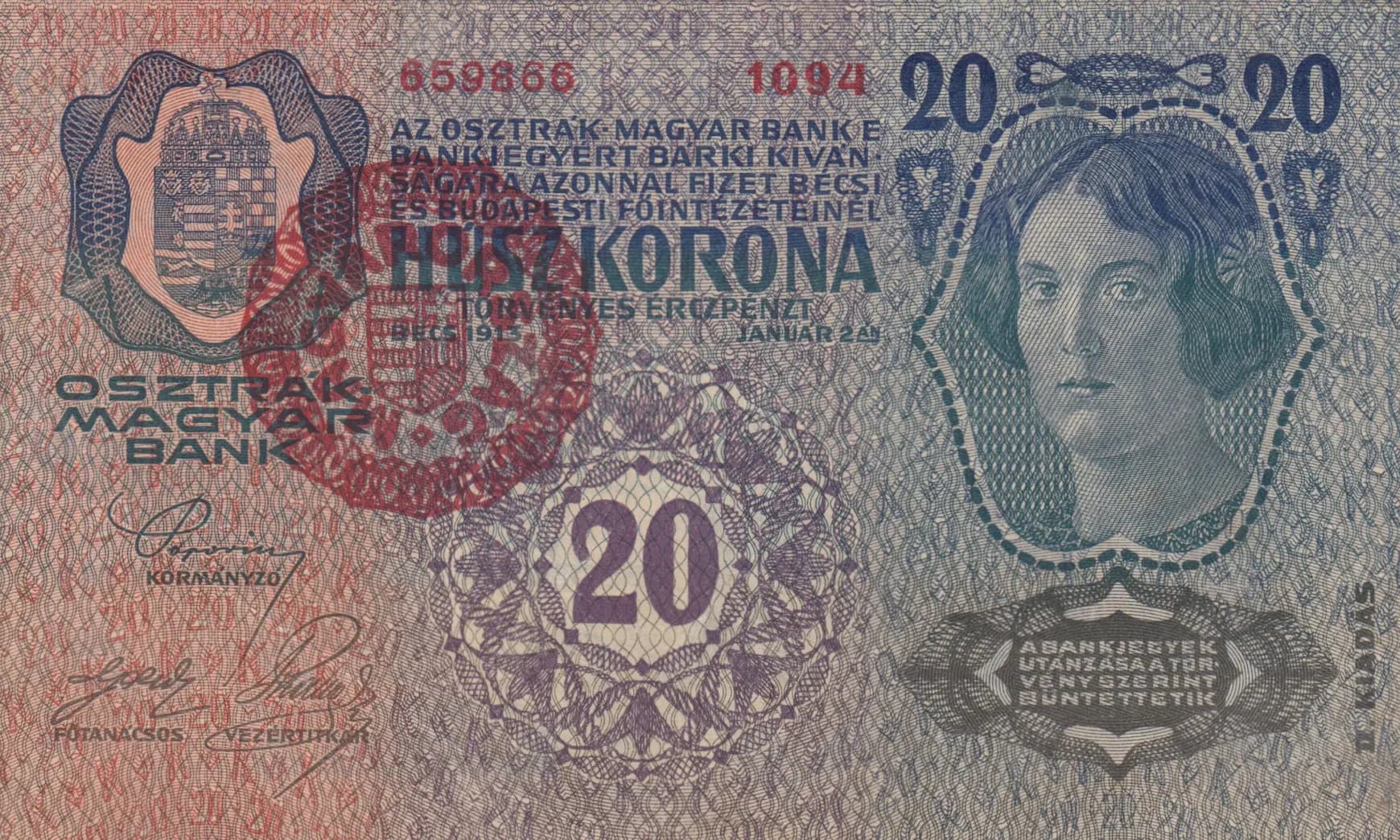
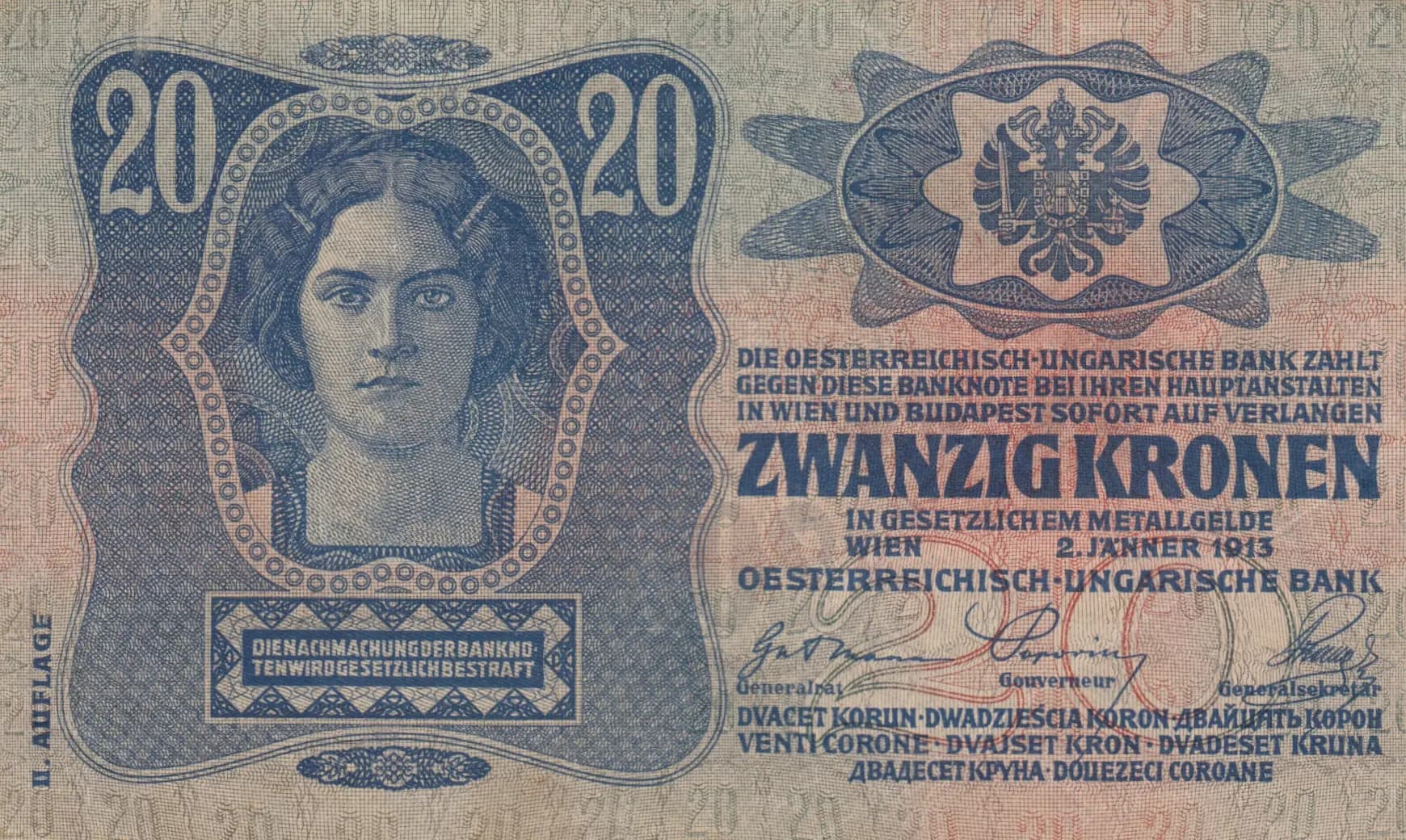
This is a VF-grade 20 Korona banknote from the Austro-Hungarian Bank, issued in 1913 but circulated during the 1920 currency transition period. The note displays characteristic early 20th-century engraving with dual-language inscriptions (Hungarian and German) and features elegant female portraits on both sides within ornamental frames. The condition shows expected aging for a note of this era—visible creasing, foxing, and color fading—but retains good structural integrity and legibility of all major design elements.
Common. This is a standard regular-issue banknote from the extensive 1913 Austro-Hungarian 20 Korona series. eBay market pricing data confirms common status, with PMG 58 specimens selling for approximately $59 and VF-graded notes cataloging at only $2, indicating substantial circulation and availability. The print run was large, and millions of these notes were issued during the empire's final years and circulated extensively through the 1920 transition period. No specific scarcity factors are documented for Pick-21.
This banknote represents the final era of the Austro-Hungarian Empire's currency system, issued by the Österreichisch-Ungarische Bank (Austro-Hungarian Bank) before the empire's dissolution in 1918. The dual-language inscriptions in German, Hungarian, Czech, Slovak, Serbo-Croatian, Italian, and Romanian reflect the multinational character of the empire. The note's continued circulation into 1920 documents the transitional period when Austria-Hungary's currency remained in use even as successor states were establishing their own financial systems.
The obverse features a forward-facing female portrait positioned on the right side within an ornamental baroque frame, accompanied by the Hungarian coat of arms (heraldic shield with crown and cross) in the upper left. The reverse displays a larger female portrait in an oval decorative frame on the left, balanced by an elaborate double-headed eagle coat of arms (the imperial Austro-Hungarian symbol) on the upper right. Both sides employ intricate guilloche patterns and baroque ornamental borders typical of high-security currency design of the period. The color scheme utilizes red/pink and blue printing on cream/tan paper stock. The denomination '20' appears prominently on both sides. The multilingual inscriptions and officer signature lines reflect the empire's administrative structure spanning multiple ethnic regions.
FRONT SIDE: 'MAGYAR BANK' (Hungarian Bank); 'HUSZ KORONA' (Twenty Crowns); '1894' (date reference); '20' (denomination); 'KORMANYZO' (Governor); inscription regarding the Austro-Hungarian Bank's banking institutions in Vienna and Budapest. BACK SIDE: 'OESTERREICHISCH-UNGARISCHE BANK' (Austro-Hungarian Bank); 'DIE OESTERREICHISCH-UNGARISCHE BANK ZAHLT GEGEN DIESES SCHEIN IHREN HALTER IN WIEN UND BUDAPEST SOFORT VERLANGEN' (The Austro-Hungarian Bank pays to the bearer of this note on demand in Vienna and Budapest); 'ZWANZIG KRONEN' (Twenty Crowns); '2. JÄNNER 1913' (2 January 1913); 'IN GESETZLICHEM METALLGELDE WIEN' (In legal metal currency Vienna); Officer titles: 'Generaldirektor' (General Director), 'Gouverneur' (Governor), 'Generalissekretär' (General Secretary); Multilingual denomination inscriptions: 'DVAEET KORUN' (Czech), 'DVADZESIA KORON' (Slovak), 'DVADZESET KRUNA' (Serbo-Croatian), 'VENTI CORONE' (Italian), 'DVAJASET KORUN' and 'DOUEZECI COROANE' (Romanian); 'DIENACHMACHTDERBANKNOTENWIRGESETZLICHBESTRAFT' (Counterfeiting the banknote is punishable by law).
This banknote was produced using classical steel-plate engraving and intaglio printing methods, the standard security printing technique for Austro-Hungarian currency. The intricate fine-line engraved patterns, decorative guilloche elements, and detailed portraiture visible throughout both sides are characteristic of intaglio printing. The Austro-Hungarian Bank contracted with state security printers; this denomination series was typically printed by the Austrian State Printing Works (Österreichische Staatsdruckerei) in Vienna. The multicolor printing combining red/pink and blue inks on a single impression demonstrates the sophisticated security printing capabilities of the period.
This note represents the standard 1913 issue (Pick-21), distinguished by the '2. JÄNNER 1913' (2 January 1913) date on the reverse. The specific variety may be identified by examination of the signature lines for the three authorized officers (Generaldirektor, Gouverneur, and Generalissekretär), though the visual analysis does not provide sufficient detail to confirm the specific signature variants. No serial number prefixes, overprints, or other distinguishing technical varieties are documented as known for this Pick number. The note's classification as a 1920 circulation example indicates it remained in use during the post-empire transition period.