1 dollar 1942
About This Note
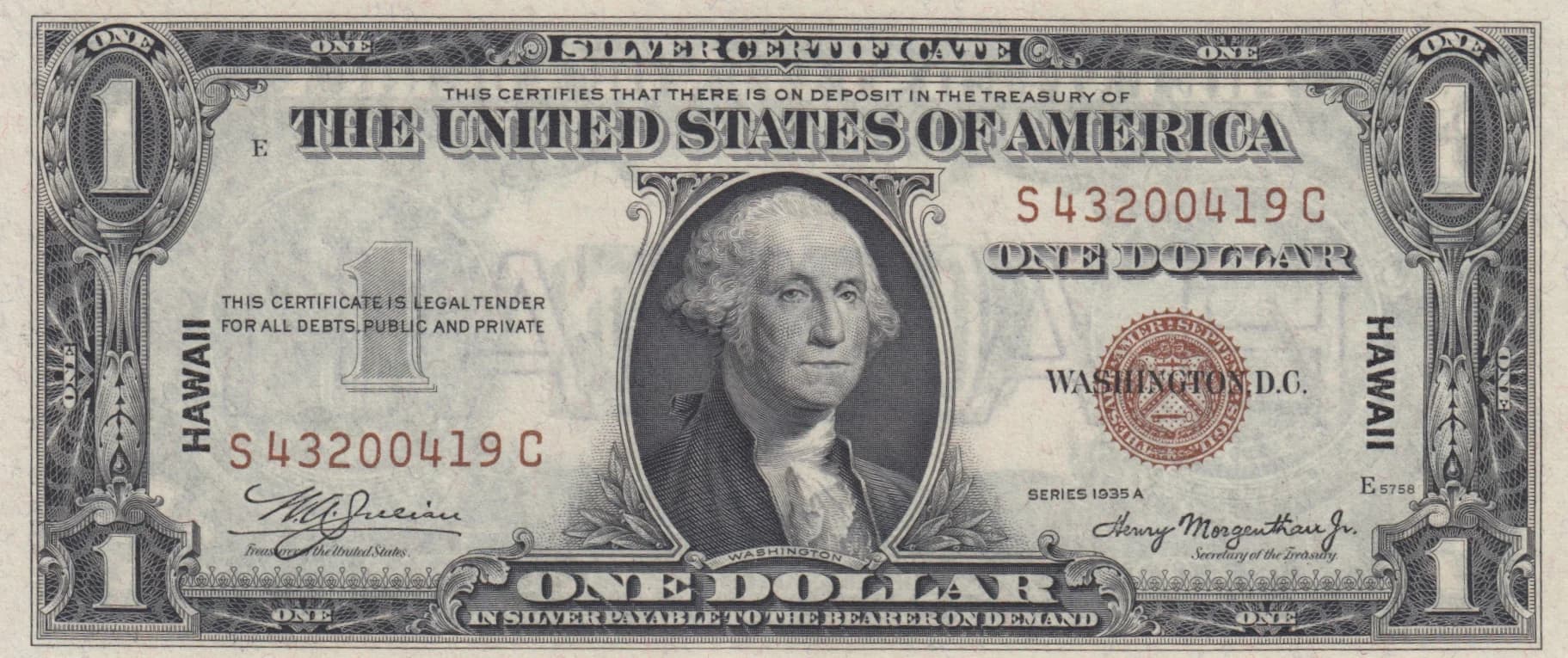
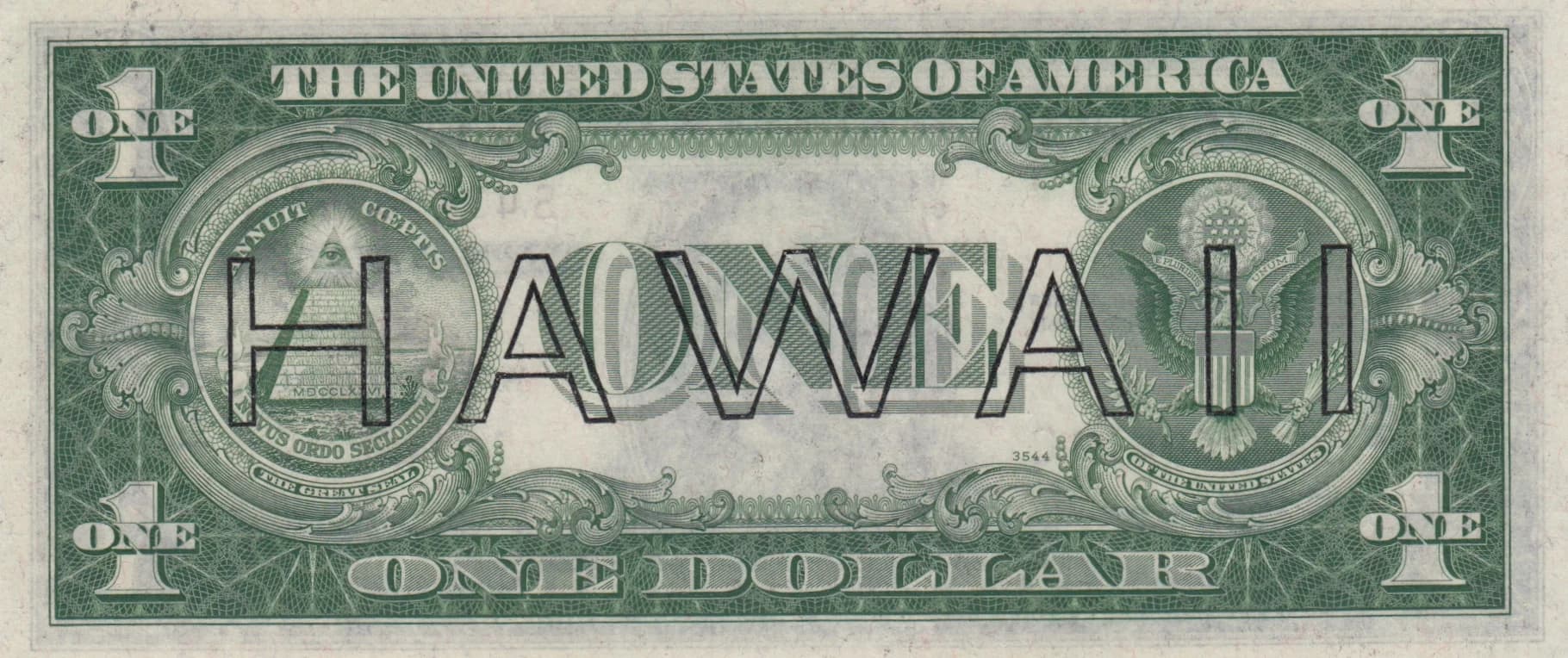
This is a 1942 Hawaii overprint $1 Silver Certificate (Pick P-36a) in uncirculated condition, representing a fascinating piece of American wartime numismatic history. The note features the distinctive brown seal and prominent 'HAWAII' overprint across both obverse and reverse, applied as an emergency financial precaution following the December 7, 1941 attack on Pearl Harbor. The exemplar exhibits excellent preservation with minimal aging, sharp engraving details, and vibrant green coloring on the reverse—hallmarks of a well-maintained uncirculated specimen.
Uncommon. While Hawaii overprint $1 Silver Certificates from 1942 were produced in substantial quantities (over 2 million pieces), most surviving examples circulated extensively and show considerable wear. Uncirculated specimens like this represent a small percentage of the original mintage, making them scarce in the collector market. The specific serial number and Treasury seal combination may further affect individual note rarity, but the Hawaii overprint $1 as a type is well-represented in collections and typically prices between $40–$150 depending on condition grade and signature varieties. The UNC grade elevates this significantly above typical circulated examples.
This Silver Certificate was issued under extraordinary circumstances following the Japanese attack on Pearl Harbor, when U.S. Treasury officials feared a potential invasion and capture of Hawaii. The overprint served as identification to isolate Hawaiian currency in case of occupation, allowing the government to invalidate any notes seized by enemy forces. The note's 1935A series date with 1942 issuance reflects the standard practice of continuing series designations while dating actual release to production, capturing a pivotal moment of wartime monetary policy and national security strategy.
The obverse features a center oval portrait of President George Washington in profile facing left, rendered in classical engraving style with his distinctive curled/wavy hair characteristic of period coinage and currency design. Large ornate numerals '1' flank the portrait on left and right sides in the upper corners. A circular Treasury seal with radial pattern detailing appears on the right side. The reverse displays the Great Seal of the United States—the heraldic eagle with shield design—positioned symmetrically on both left and right sides, with matching circular emblems. The denomination numeral '1' appears in all four corners of the reverse in ornate format. Throughout both sides, intricate scrollwork and decorative borders provide the characteristic security design of 1930s–1940s U.S. currency. The 'HAWAII' overprint is prominently displayed across the reverse center and appears on the obverse as well, making this variety immediately distinguishable from standard 1935A $1 Silver Certificates.
FRONT SIDE: 'ONE DOLLAR' / 'THIS CERTIFIES THAT THERE IS ON DEPOSIT IN THE TREASURY OF THE UNITED STATES OF AMERICA' (standard silver certificate phrasing certifying backing by silver reserves) / 'THIS CERTIFICATE IS LEGAL TENDER FOR ALL DEBTS, PUBLIC AND PRIVATE' (legal tender declaration) / 'HAWAII' (overprint denoting territorial origin) / 'SERIES 1935 A' (series designation) / 'IN GOD WE TRUST' (motto) / 'WASHINGTON, D.C.' (issuing location) / Serial number S43200419C and Treasury seal designation E5758. BACK SIDE: 'ONE' / 'THE UNITED STATES OF AMERICA' / 'HAWAII' (prominent overprint across center) / 'ONE DOLLAR' / Plate number 3544.
This note was produced using intaglio engraving and printing, the standard security printing method for U.S. currency of this era. The detailed line work, cross-hatching, and three-dimensional relief visible in the intricate borders, portrait details, and seal designs are characteristic of Bureau of Engraving and Printing (BEP) production. The brown seal overprint and 'HAWAII' text were applied as additional security measures using the same intaglio process. The color separation visible between the black/gray front design and green back design reflects the multi-pass printing standard for currency production.
This specimen is identified as Pick P-36a, the standard Hawaii overprint 1935A $1 Silver Certificate with brown seal. Serial number S43200419C indicates production in one of the standard printing runs. Key identifiers for this variety include: (1) Series 1935A designation with 1942 release date; (2) Brown Treasury seal (distinguishing it from green-seal notes); (3) 'HAWAII' overprint on both obverse and reverse; (4) Treasury seal code E5758 visible on obverse. Known varieties for this Pick number include signature combinations (Secretary of Treasury and Treasurer signatures vary by printing period) and seal positions. The plate number 3544 on the reverse aids in identifying specific printing sessions. Collectors should note that some Hawaii overprints exist with red seals or different overprint placements—variants within the broader category that affect relative scarcity.