5 dollars 1966
Market Prices
1 saleAbout This Note
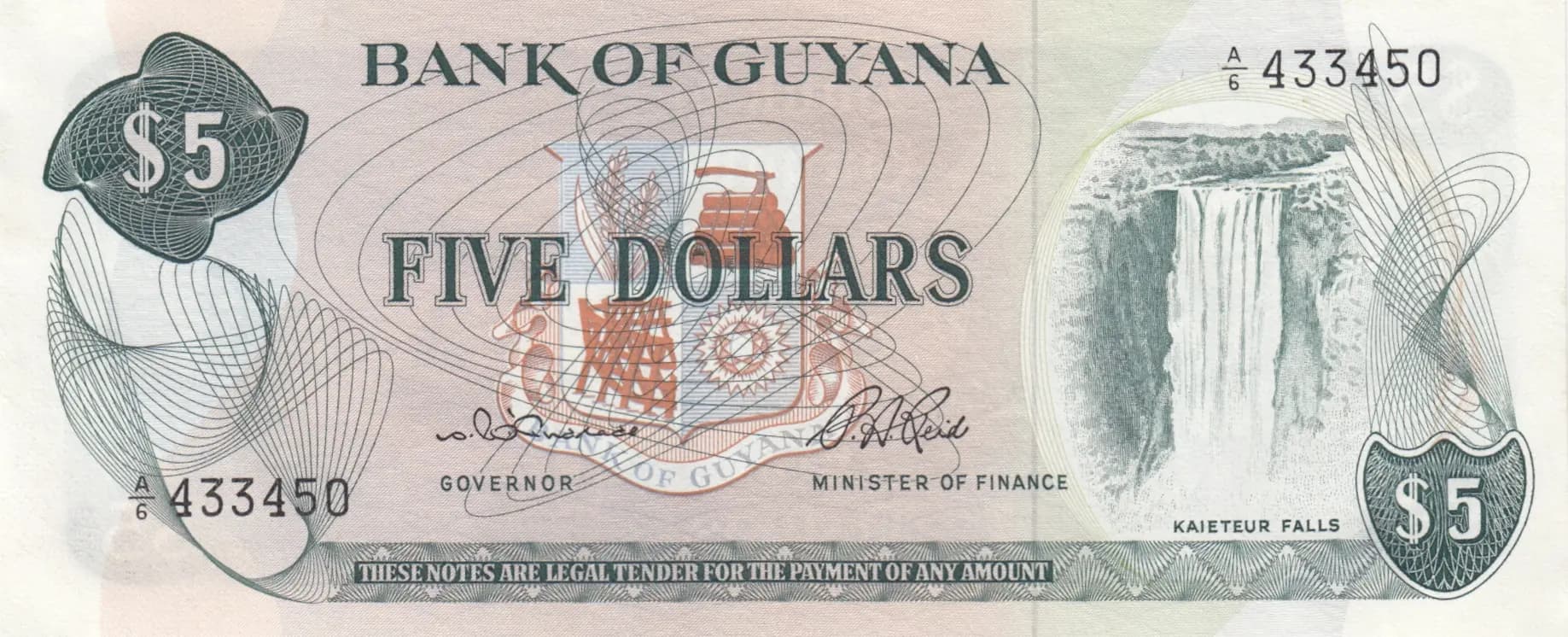
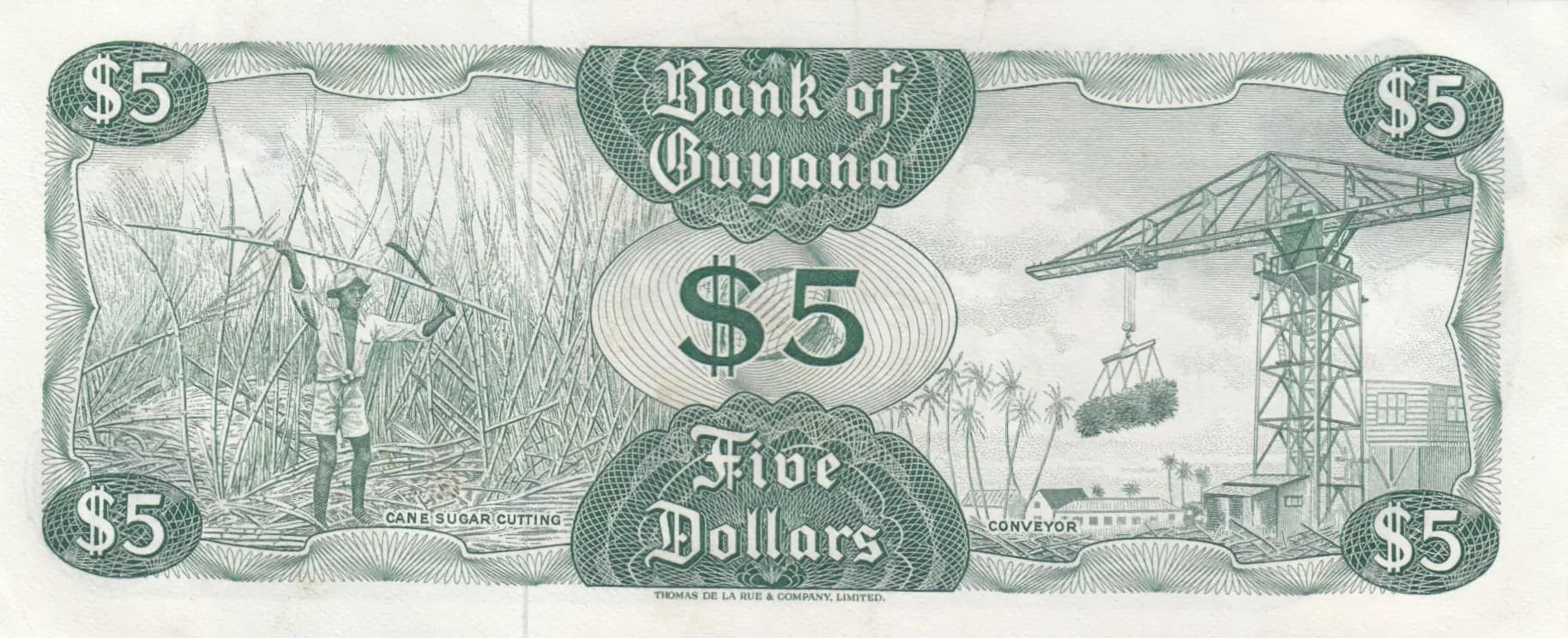
This is an exceptional example of the 1966 Bank of Guyana $5 note (Pick 22a), printed by Thomas de la Rue in uncirculated condition. The note showcases vibrant green and multicolor printing with crisp, sharp detail throughout, featuring the iconic Kaieteur Falls on the obverse and scenes of Guyana's sugar industry on the reverse. This particular specimen displays no wear, creasing, or damage, representing a pristine example of this early Bank of Guyana issue.
Common. This is a regular issue of the Bank of Guyana from the early independence period with substantial circulation and no indication of limited mintage or recall. The catalog value of $45 in UNC (as of 2019) and eBay sales averaging under $10 in lower grades confirm this is a widely available note. While early issues in high grades command modest premiums, the Pick 22a variant itself is not scarce.
Issued in 1966, coinciding with Guyana's independence from British colonial rule, this banknote celebrates the nation's natural and economic heritage. The prominent depiction of Kaieteur Falls—one of the world's highest single-drop waterfalls—symbolizes Guyana's natural resources, while the reverse imagery of sugar cane cutting and industrial conveyor systems reflects the sugar industry that was central to the country's post-independence economy. The Bank of Guyana was establishing its identity as the national monetary authority during this formative period.
The obverse features a sophisticated layout with the Bank of Guyana coat of arms or central emblem flanked by a stylized dollar sign motif on the left and a detailed landscape photograph of Kaieteur Falls on the right, rendered in green and beige tones with intricate security line work. The reverse presents two important vignettes representing Guyana's economy: on the left, a worker engaged in sugar cane harvesting in a tropical field, and on the right, an industrial sugar processing facility with a prominent conveyor belt and loading structure. All four corners display dollar sign symbols within decorative frames. The overall design employs fine engraving with complex geometric security patterns throughout, creating a visually balanced and secure composition in predominantly green inks.
FRONT: 'Bank of Guyana' (issuing authority), '$5' and 'Five Dollars' (denomination), 'Kaieteur Falls' (landmark identification), 'Governor' and 'Minister of Finance' (signature lines for authorization), 'These notes are legal tender for the payment of any amount' (legal tender declaration), and serial number 'A/6 433450'. BACK: 'Bank of Guyana' (issuing authority), '$5' and 'Five Dollars' (denomination), 'Cane Sugar Cutting' (left vignette label), 'Conveyor' (right vignette label), and 'Thomas de la Rue & Company, Limited' (printer attribution).
Intaglio (engraving and line engraving) combined with multicolor offset printing, executed by Thomas de la Rue & Company, Limited, London—the premier British security printer of the era. The visual evidence of fine line work, intricate geometric patterns, and the crisp detail throughout the note are characteristic of TDLR's high-security currency production standards. Multiple color layers and fine detail registration are evident in the preserved condition.
This note is identified as Pick 22a, the first major variety of the 1966 $5 issue. The PMG population data indicates at least 10 documented varieties (P-22a through P-22f, with both regular and specimen 's' variants noted). Distinguishing features among these varieties typically include signature combinations, serial number prefixes, and printer variants. The serial number prefix 'A/6' and the absence of visible overprints indicate this is a standard circulation issue of the 22a type. No specimen or special designation markings are visible.