10 shillings 1958
Market Prices
10 salesAbout This Note
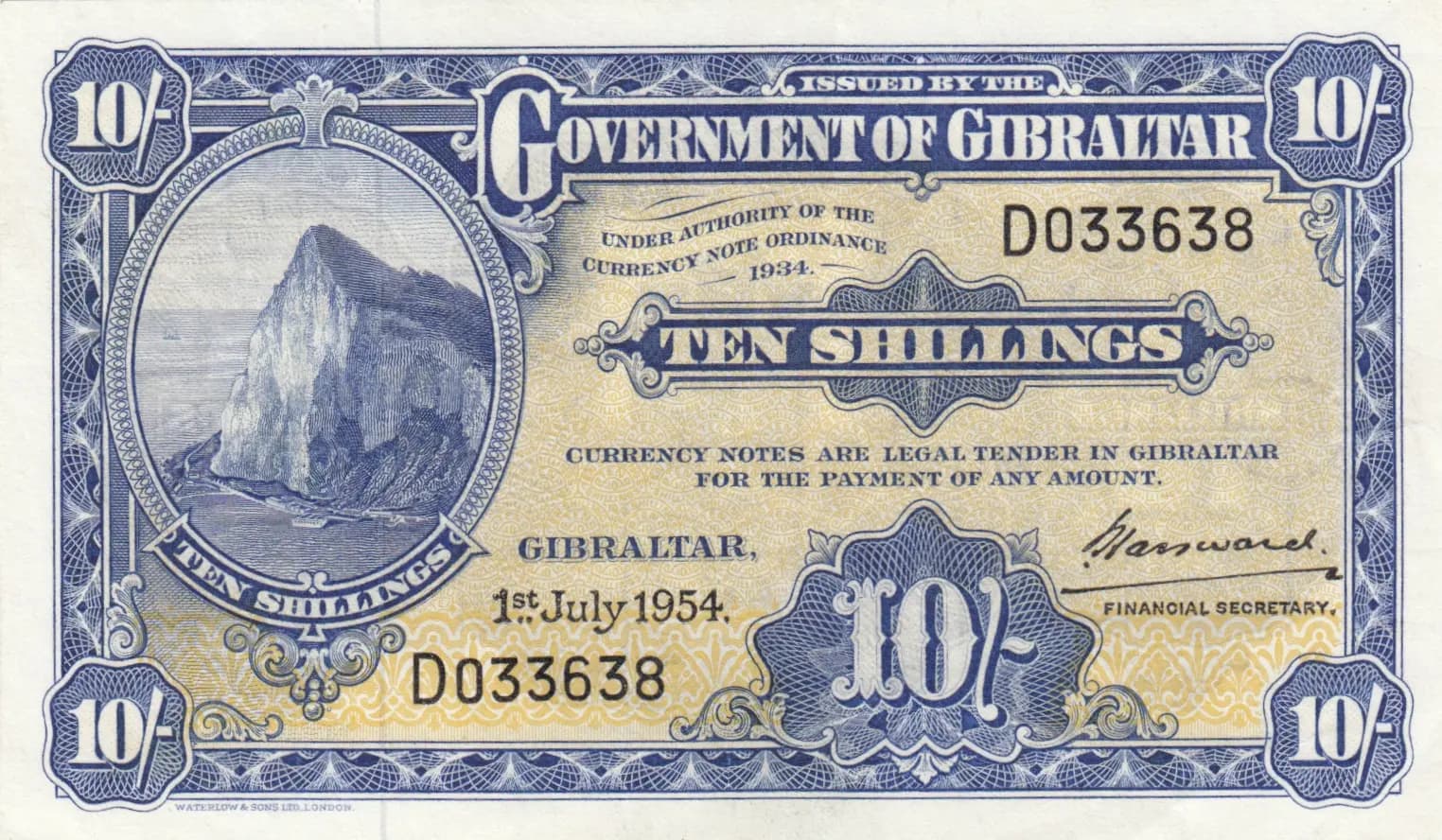
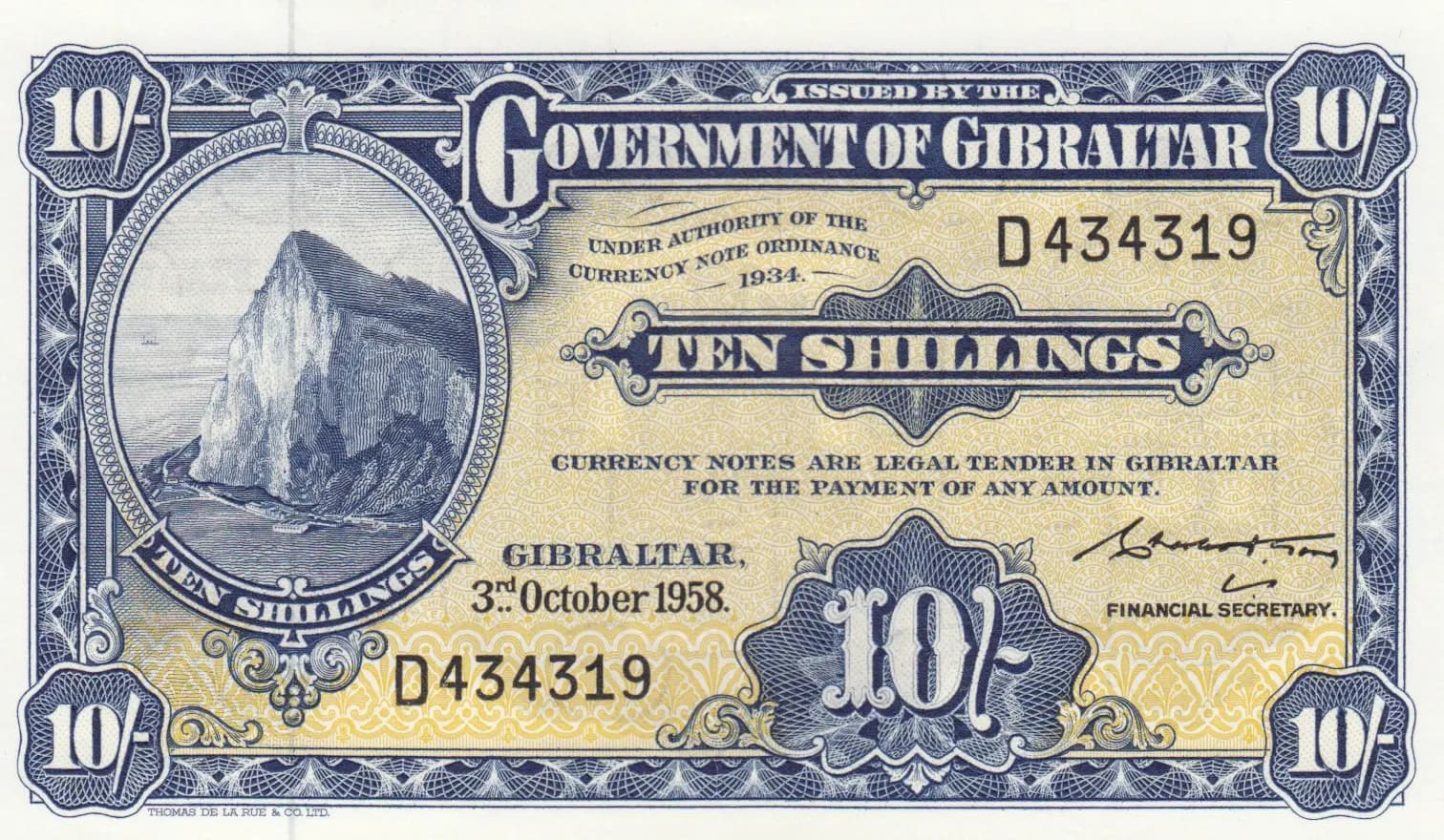
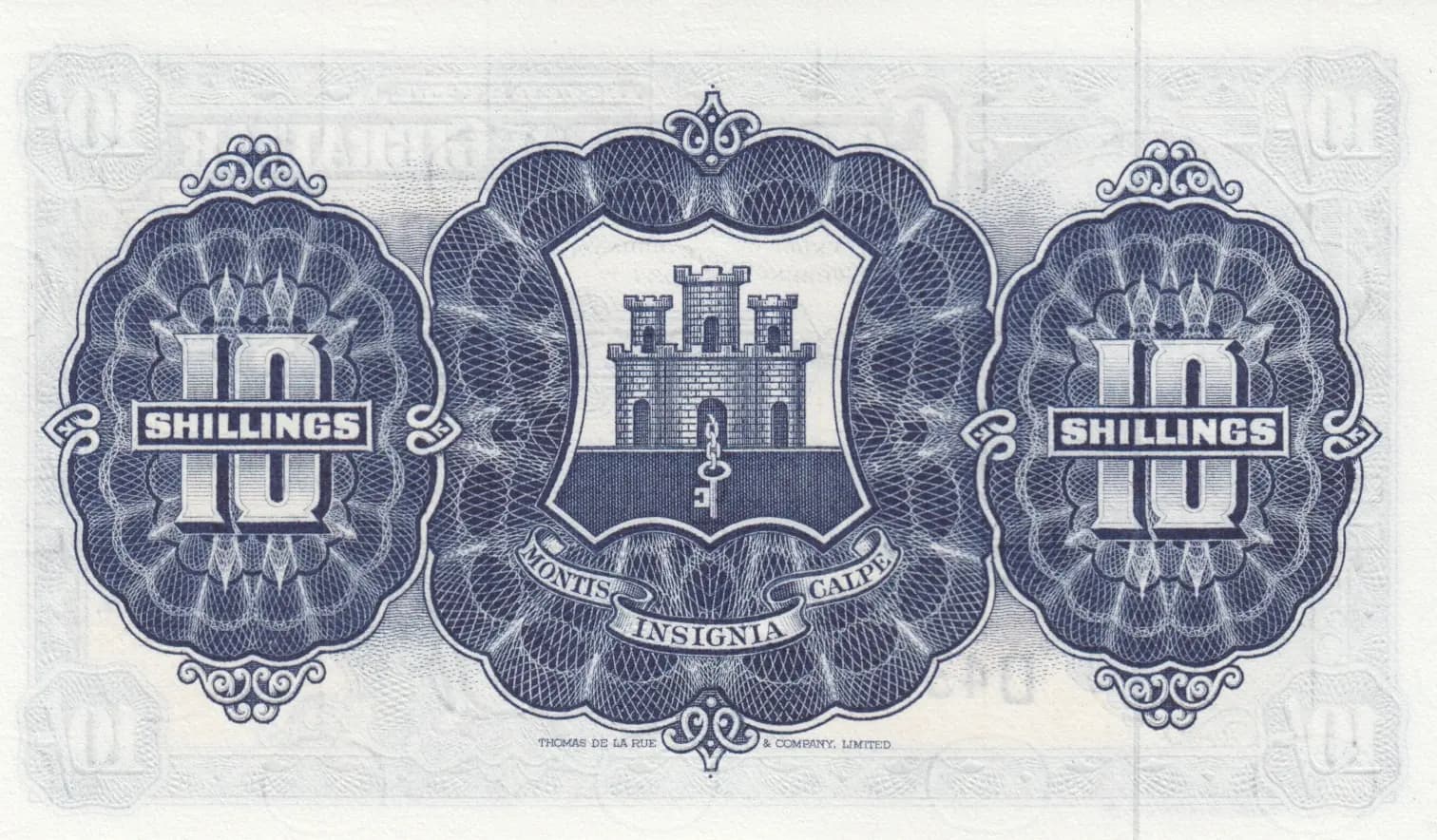
A pristine uncirculated example of Gibraltar's 1958 10 Shillings currency note, featuring a striking blue and beige design with an engraved vignette of the Rock of Gibraltar dominating the obverse. The reverse displays the heraldic arms of Gibraltar—a fortified tower with key beneath—referenced by the Latin inscription 'Montis Calpe Insignia,' all executed in fine line engraving by Thomas de la Rue. This note represents an important transitional period in Gibraltar's monetary history, issued under the 1934 Currency Ordinance and remains notable for its ornate design quality and historical significance as a Commonwealth territory currency.
Common. The eBay market data shows this note in UNC condition has sold in the $270–$380 range historically, with examples in lower grades (F-VF) selling for $15–$115, and high-grade certified examples (PMG 65–68) commanding $300–$500. The note was issued in substantial quantities and remains readily available to collectors. The 2019 catalog valuation of $380 in UNC reflects its status as a standard, regularly traded item in the Gibraltar banknote collecting market.
Issued on 3 October 1958, this note predates Gibraltar's currency reform and represents a period when Gibraltar maintained its own currency under British colonial oversight. The Rock of Gibraltar imagery on the obverse serves as the territory's most recognizable symbol, while the reverse's 'Montis Calpe Insignia' (insignia of Mount Calpe, the ancient Roman name for the Rock) reinforces Gibraltar's historical identity. The note was issued under the authority of the Currency Note Ordinance of 1934, reflecting the legal framework that governed Gibraltar's monetary system during the mid-20th century.
The obverse features the Rock of Gibraltar as the primary design element, rendered as a large detailed engraved vignette in an ornate oval frame positioned at the left side of the note. The Rock is depicted as a dramatic rocky formation in a seascape setting, emphasizing its geographical prominence. The denomination 'TEN SHILLINGS' is prominently displayed in the center on a beige background enriched with intricate geometric rosette patterns and decorative flourishes. The reverse is dominated by a symmetrical heraldic composition with a central escutcheon featuring a crenellated fortress tower (representing the fortifications of the Rock) with a key beneath it—the key being a historic symbol of Gibraltar's strategic importance. This central shield is flanked by ornamental shields bearing the Roman numeral 'X' representing the denomination. The entire design is executed in fine line engraving with elaborate scrollwork, crown ornaments, and decorative borders throughout. Denomination numerals '10' appear in all four corners.
FRONT: 'ISSUED BY THE GOVERNMENT OF GIBRALTAR' / 'UNDER AUTHORITY OF THE CURRENCY NOTE ORDINANCE 1934' / 'TEN SHILLINGS' / 'CURRENCY NOTES ARE LEGAL TENDER IN GIBRALTAR FOR THE PAYMENT OF ANY AMOUNT' / 'GIBRALTAR, 3rd October 1958' / 'FINANCIAL SECRETARY' / 'THOMAS DE LA RUE & CO LTD' (printer attribution). BACK: 'SHILLINGS' (appears twice flanking the central arms) / 'MONTIS CALPE INSIGNIA' (Latin: Insignia of Mount Calpe) / 'THOMAS DE LA RUE & COMPANY, LIMITED' (printer attribution).
Intaglio engraving (line engraving) executed by Thomas de la Rue & Company Limited, London. The fine line work, cross-hatching, and intricate geometric pattern backgrounds are characteristic of intaglio security printing of the mid-20th century. The sharp definition of all design elements and the crisp impression visible in the uncirculated state confirm high-quality steel plate engraving.
This is the standard Pick 17 (P-17) variety printed by Thomas de la Rue & Company. The note is dated 3 October 1958 and bears the serial number D434319. PMG records indicate two cataloged variants for P-17: the standard P-17 and P-17s, both printed by TDLR. This example appears to be the standard P-17 variety. The date and signature block (Financial Secretary designation visible) are consistent with the 1958 issue variety.