500 mark 1922
Market Prices
32 salesAbout This Note
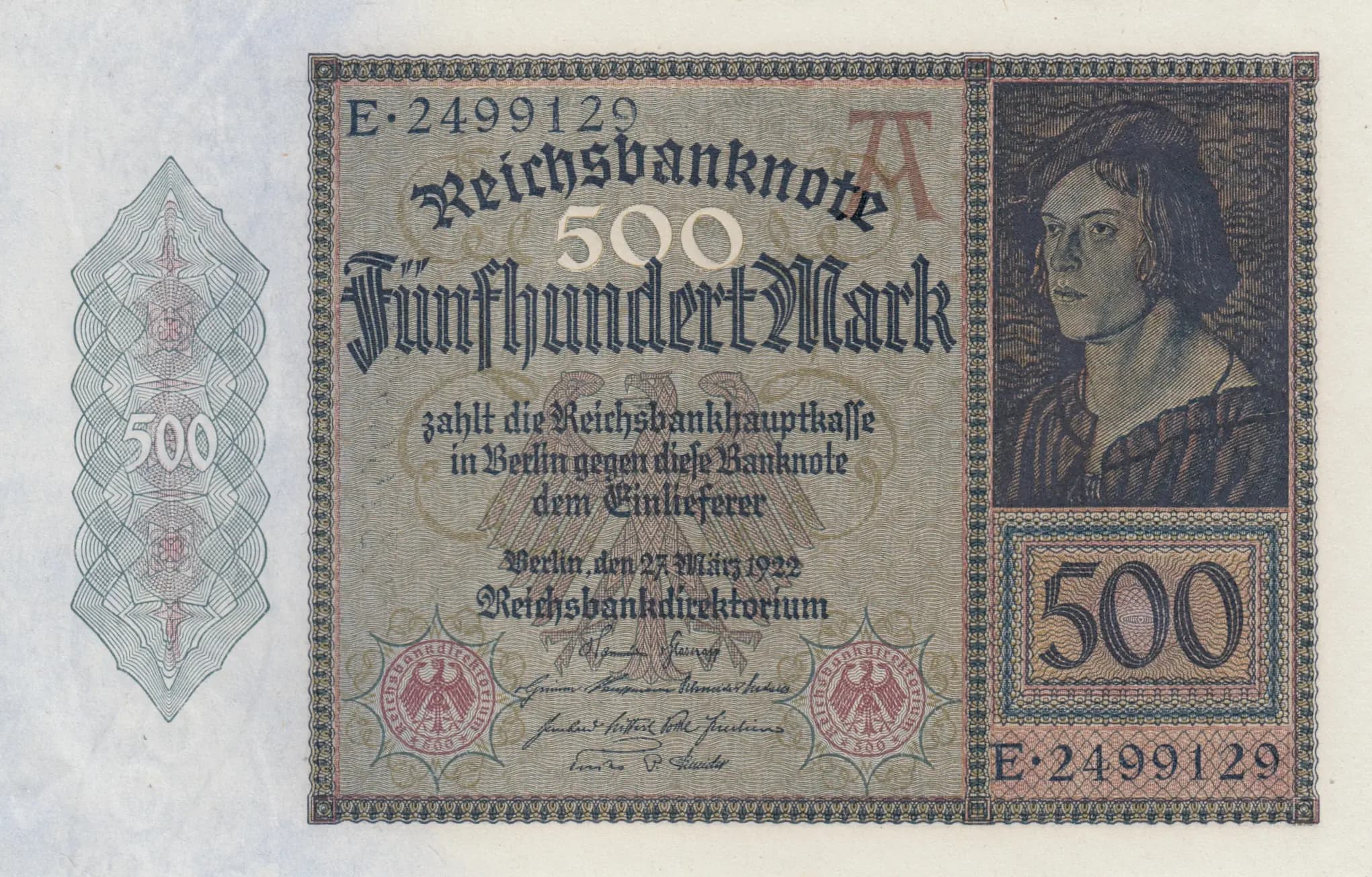
This 500 Mark note from 1922 represents a striking example of Weimar-era German currency, featuring the portrait of Junker Mayer rendered in fine engraving on the obverse. The note displays excellent condition with sharp, clear printing throughout and no visible wear, creasing, or fading—consistent with VF grading. The dual-color design employing dark blue, olive-green, purple, and tan creates a sophisticated aesthetic typical of high-denomination Reichsbank notes of the period.
Common. While this is a Weimar-era note from the early hyperinflation period, the 500 Mark denomination was issued in substantial quantities in 1922. eBay sales data demonstrates consistent availability at modest prices ($1.74–$10.50 for VF specimens over the past decade), with 2016 catalog values listing VF at $40. The proliferation of these notes in the collector market and the lack of any known special varieties, short print runs, or recall status all indicate widespread circulation and survival. High-grade specimens (PMG 64–66) command only $44–$110, further confirming common status.
Issued on May 24, 1922, this note falls within the final year of relative monetary stability before the German hyperinflation crisis of 1923. The Imperial Eagle (Reichsadler) prominently displayed on the obverse symbolizes continuity with the pre-war German state, while the issuer's identification and security warnings reflect the Reichsbank's attempt to maintain public confidence in the currency. The elaborate engraved security features—complex guilloche patterns and geometric designs—represent state-of-the-art anti-counterfeiting measures of the early Weimar Republic.
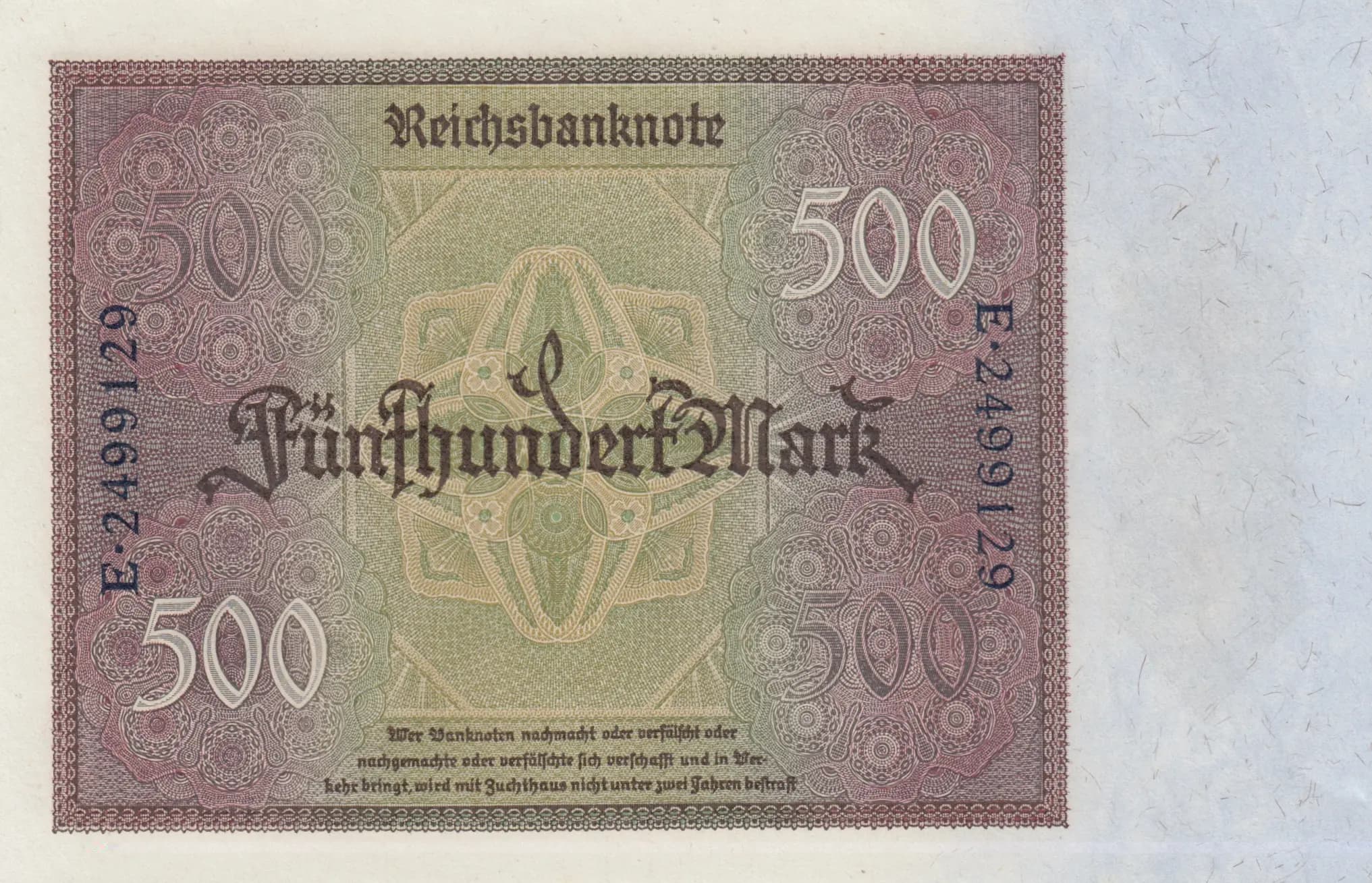
The obverse features a left-facing portrait of Junker Mayer positioned in the upper right, rendered in classical engraving style with fine detail characteristic of the period. The left side displays an intricate geometric pattern of repeating diamonds and circular motifs serving as security ornamentation. The German Imperial Eagle (Reichsadler) with spread wings is prominently placed in the center upper area. Ornate circular seals with decorative elements occupy the lower portion. The reverse presents a symmetrical design dominated by a large central ornamental medallion featuring elaborate geometric and arabesque patterns in purple and gold tones, with ornate circular rosette designs positioned in all four corners. The denomination '500' appears prominently in corner positions on both sides. Gothic script typography reinforces the note's formal character.
FRONT: 'Reichsbanknote' (Reichsbank note); '500' and 'Fünfhundert Mark' (Five hundred Mark); 'zahlt die Reichsbankhaustkasse in Berlin gegen diese Banknote dem Einlieferer' (the Reichsbank main office in Berlin pays the bearer of this banknote); 'Berlin, den 24 Mai 1922' (Berlin, May 24, 1922); 'Reichsbankdirektorium' (Reichsbank Directorate); Serial number 'E·2499129' (printed twice). BACK: 'Reichsbanknote' (Reichsbank note); '500' and 'Fünfhundert Mark' (Five hundred Mark); Serial number 'E·2499129' (printed twice); Warning text: 'Über Banknoten nachmacht oder verfälscht oder nachgemacht oder verfälschte sich verschaffet und in Verkehr bringt, wird mit Zuchthaus nicht unter zwei Jahren bestraft' (Whoever counterfeits or forges banknotes or acquires counterfeit or forged banknotes and brings them into circulation will be punished with imprisonment for not less than two years).
Intaglio engraving (copperplate printing), the standard security printing method for German Reichsbank notes of this era. The fine line engraving throughout, complex guilloche patterns, and the sharp clarity of all design elements visible in the images confirm this technique. The Reichsbank contracted with established German security printers such as Giesecke+Devrient or the Reichsdruckerei for production of high-value denominations.
This specimen carries serial number prefix 'E·2499129', which is consistent with standard issue numbering. The date of May 24, 1922, matches the official issue date of this Pick-73 note. No major varieties (such as different signature combinations, significant overprints, or security printer variations) are noted for this denomination and date. The note represents the standard regular-issue variety.