50 mark 1914
Market Prices
38 salesAbout This Note
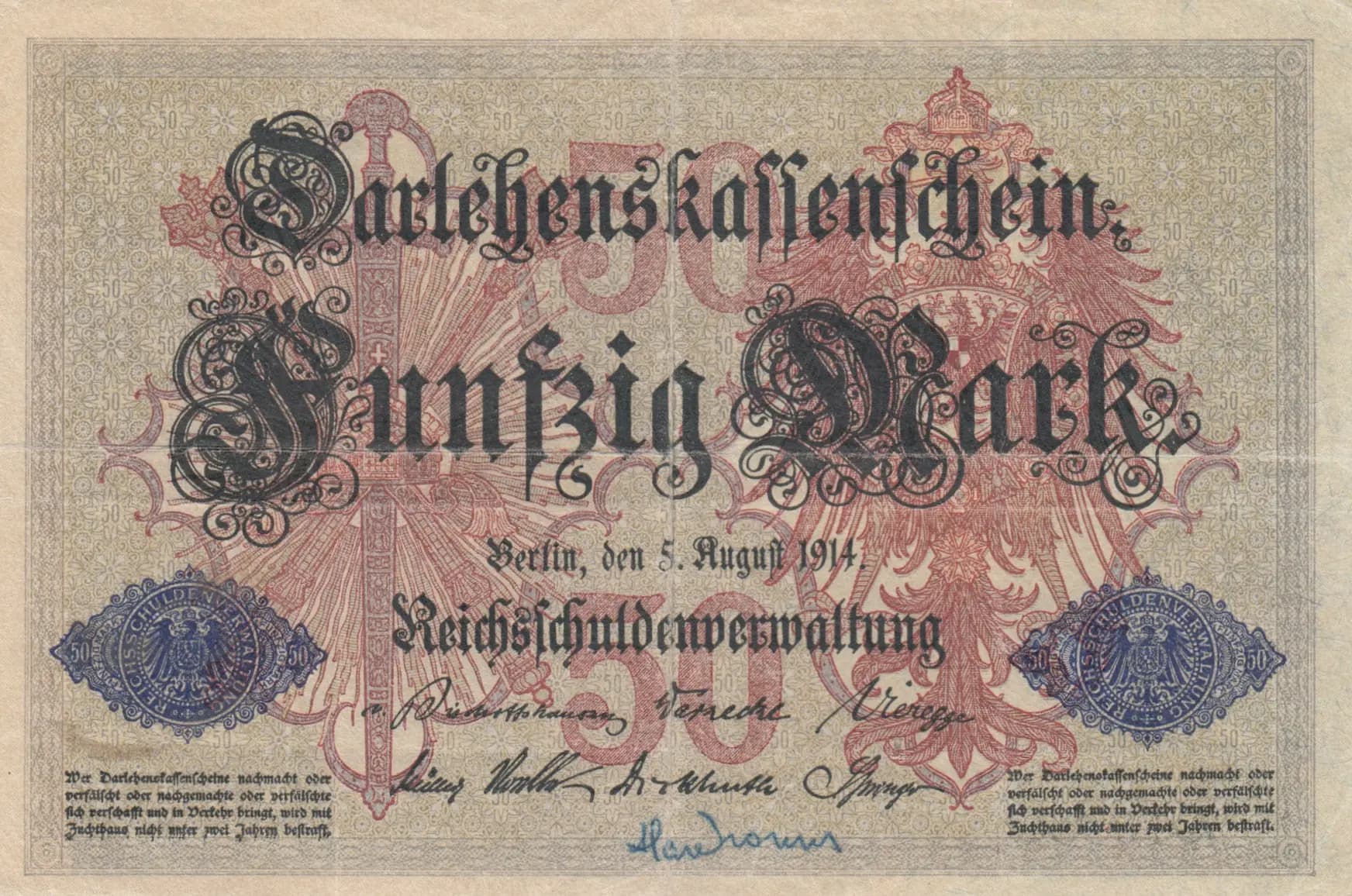
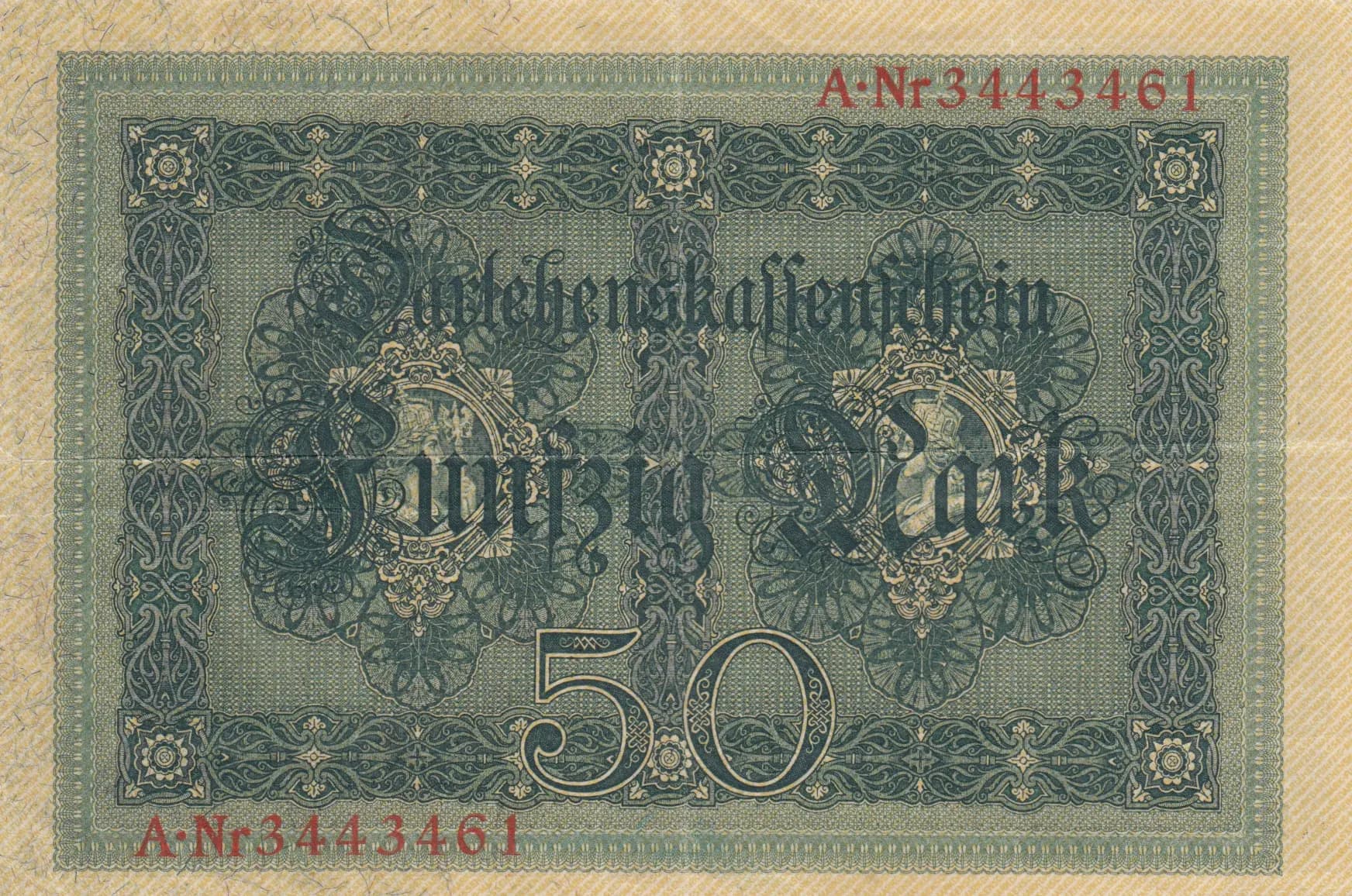
This is a German 50 Mark emergency banknote issued by the Reichschuldenverwaltung on August 5, 1914, at the outbreak of World War I. The note exhibits significant circulation wear with multiple creases and fold marks, consistent with VF (Very Fine) condition. The front features ornate red and black decorative design with imperial eagles in circular seals and elaborate Gothic script, while the reverse displays green-toned baroque ornamentation with the prominent denomination '50' and serial number A.Nr.3443461.
Common. This 50 Mark note from 1914 is widely available in the collector market. eBay pricing data shows consistent sales of VF examples in the $1.50–$4.00 range over a 14-year period (2012–2026), with catalog values listing VF at $15 (2016). Even premium graded examples (PMG 65–66) typically sell in the $30–$100 range. The high volume of transactions and stable low pricing across multiple decades indicates substantial print runs and ready market availability. This is a common WWI-era German emergency issue.
This note was issued during the first days of World War I, when Germany implemented emergency currency measures. The Reichschuldenverwaltung (Imperial Debt Administration) issued these notes to finance wartime expenditures, and the imagery—dominated by imperial eagles, crowns, and the German Empire designation—reflects the authority and sovereignty of the German state during this critical period. The August 5, 1914 date places this note at the very beginning of the conflict, making it historically significant as a monetary artifact of Germany's entry into the Great War.
The obverse features a symmetrical baroque design dominated by the imperial double-headed eagle of the German Empire, displayed in circular seals at the lower corners. The central design incorporates elaborate Gothic script and ornamental flourishes in red and black against a cream underprint, with intricate geometric and floral patterns throughout serving as the security design. Large decorative capital 'S' characters flank the central denomination text. The reverse displays green-toned ornamentation with imperial eagles and crown symbols in an elaborate baroque scrollwork arrangement, with the large '50' denomination prominently featured at the center bottom. Both sides are extensively signed by authorized Reichsbank officials. The 7-digit serial number (A.Nr.3443461) appears in red on the reverse.
Front Side: 'Deutsches Kaiserreich' (German Empire); 'Fünfzig Mark' (Fifty Mark); 'Berlin, den 5. August 1914' (Berlin, August 5, 1914); 'Reichschuldenverwaltung' (Imperial Debt Administration); Anti-counterfeiting warning: 'Whoever forges or counterfeits or attempts to bring into circulation forged or counterfeit notes will be punished with imprisonment of not less than two years.' Multiple authorized official signatures appear (Paulshauser, Vereche, Hierges, and others). Back Side: 'Deutsches Kaiserreich' (German Empire); 'Fünfzig Mark' (Fifty Mark); '50' (denomination numeral); 'A.Nr.3443461' (Serial Number 3443461, printed in red, repeated at top and bottom).
This note was produced using traditional intaglio (engraved) printing, the standard method for German banknotes of the period. The intricate baroque scrollwork, fine line details in the ornamental patterns, and the crisp impression of the signatures indicate high-quality steel plate engraving. The multi-color printing (red/black on front, green on back) was achieved through sequential passes of different color inks, typical of Reichsbank security printing practices. The watermark design visible throughout the paper is characteristic of German Imperial-era banknote security features.
This note is cataloged as Pick P-49b, representing a specific variety of the August 5, 1914 issue. The serial number A.Nr.3443461 with the 'A' prefix is consistent with standard Reichschuldenverwaltung numbering of this period. The signature combination (Paulshauser, Vereche, Hierges, and others) represents the authorized officials of this particular printing batch. Multiple signature varieties exist for this denomination and date, differentiated by the combinations of authorized signatures, though these do not typically command premium values among collectors.