5 mark 1917
Market Prices
10 salesAbout This Note
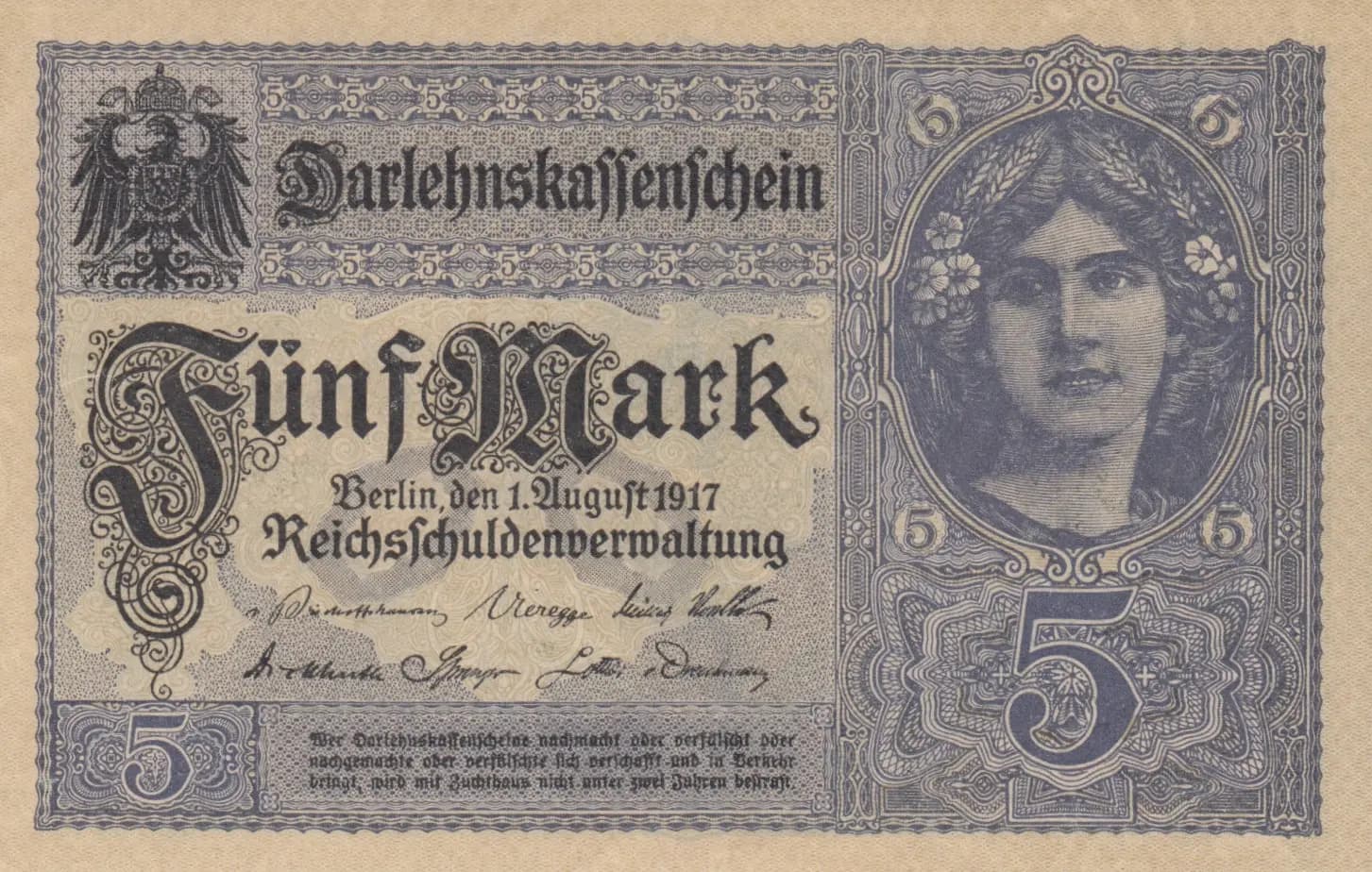
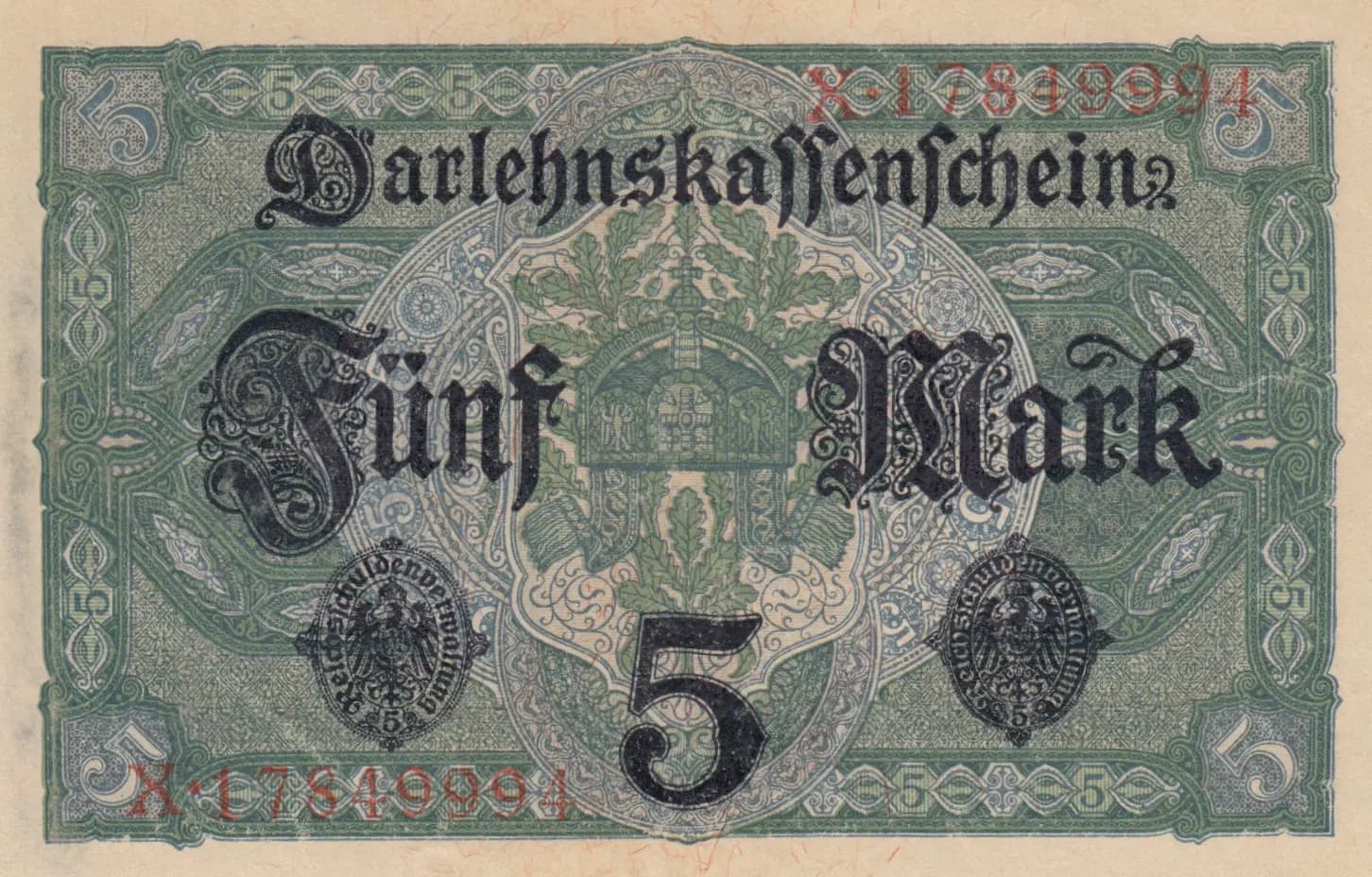
This is a German 5 Mark Darlehnskassenschein (Loan Certificate) from August 1, 1917, graded UNC. The note exemplifies the ornate Art Nouveau design aesthetic of WWI-era German currency, featuring an elegant female portrait with floral crown on the obverse and a Gothic cathedral in an elaborate oval frame on the reverse. The uncirculated condition with minimal age-related discoloration makes this an excellent example of Imperial German emergency currency during the First World War.
Common. Market data clearly demonstrates this note trades at modest prices across all grades: eBay sales spanning 2013-2021 show even PMG-graded examples (65 grade) selling for $15-30, with VF and lower grades moving for under $10. The 2016 catalog values list UNC at $15, indicating this is a standard, frequently encountered issue from the 1917 Darlehnskassenschein series. These emergency certificates were issued in substantial quantities to finance German wartime debt and remain readily available to collectors.
Issued by the Reichsschuldenverwaltung (Imperial Debt Administration) on August 1, 1917, this Darlehnskassenschein represents Germany's emergency financing during the final years of World War I. The note's imagery—featuring the Imperial Eagle, Gothic architectural elements symbolizing German heritage, and allegorical female figures—reflects the propagandistic aesthetic of wartime currency designed to inspire confidence in Germany's financial stability and cultural continuity despite the ongoing conflict.
The obverse features an ornate Art Nouveau border of interlocking geometric and floral patterns in blue-gray and cream tones. The left side displays a large Gothic-style numeral '5' with elaborate scrollwork. The upper left corner bears the Imperial German Eagle with crown and shield, the traditional symbol of the German Reich. The right side showcases the central design element: an allegorical female figure (representing Prosperity or Patriotism, common in German WWI imagery) with long curled hair adorned with flowers, enclosed in an ornate oval portrait frame with decorative flourishes. Additional '5' numerals appear in decorative squares at corners. The reverse employs a predominantly green color scheme with a prominent oval frame containing a Gothic cathedral with spires and architectural detail, representing German cultural and historical heritage. Circular seals containing the Imperial Eagle appear in the bottom corners. Black overprinted '5' numerals dominate the center-left, and red text and numerals appear on the lower portion, with repeating decorative border motifs.
FRONT: 'Darlehnskassenschein' (Loan Certificate); 'Fünf Mark' (Five Mark); 'Berlin, den 1.August 1917' (Berlin, August 1, 1917); 'Reichsschuldenverwaltung' (Imperial Debt Administration); '5' (denomination); Warning text: 'Counterfeiting, falsifying, imitating or falsifying this loan certificate in Berlin results in imprisonment of not less than two years.' BACK: 'Darlehnskassenschein' (Loan Certificate); 'Fünf Mark' (Five Mark); Various denomination numerals '5'; Serial reference 'K540498'.
Intaglio (engraved) printing, the standard security printing method for German Imperial banknotes and Darlehnskassenscheine. The intricate fine line work visible throughout the decorative borders, portrait details, architectural elements, and ornamental frames are characteristic of high-quality intaglio engraving. The precise color separation between obverse (blue-gray/cream) and reverse (green/cream) with distinct black and red overprints indicates multi-plate engraved production typical of German state printing works (Reichsdruckerei or contracted security printers) of the WWI period.
This example carries the serial number designation visible as 'K540498' or similar on the reverse. The Pick-56a designation indicates this is the standard variety of the 5 Mark Darlehnskassenschein dated August 1, 1917. Known varieties of this issue may include different serial number prefixes (typically single letters followed by numerals), but without access to comprehensive variety cataloging specific to this issue's serial ranges, no specific variety assignment beyond Pick-56a can be definitively made from the observed details. The 7-digit serial number format is consistent with 1917 issue specifications.