20 mark 1915
Market Prices
47 salesAbout This Note
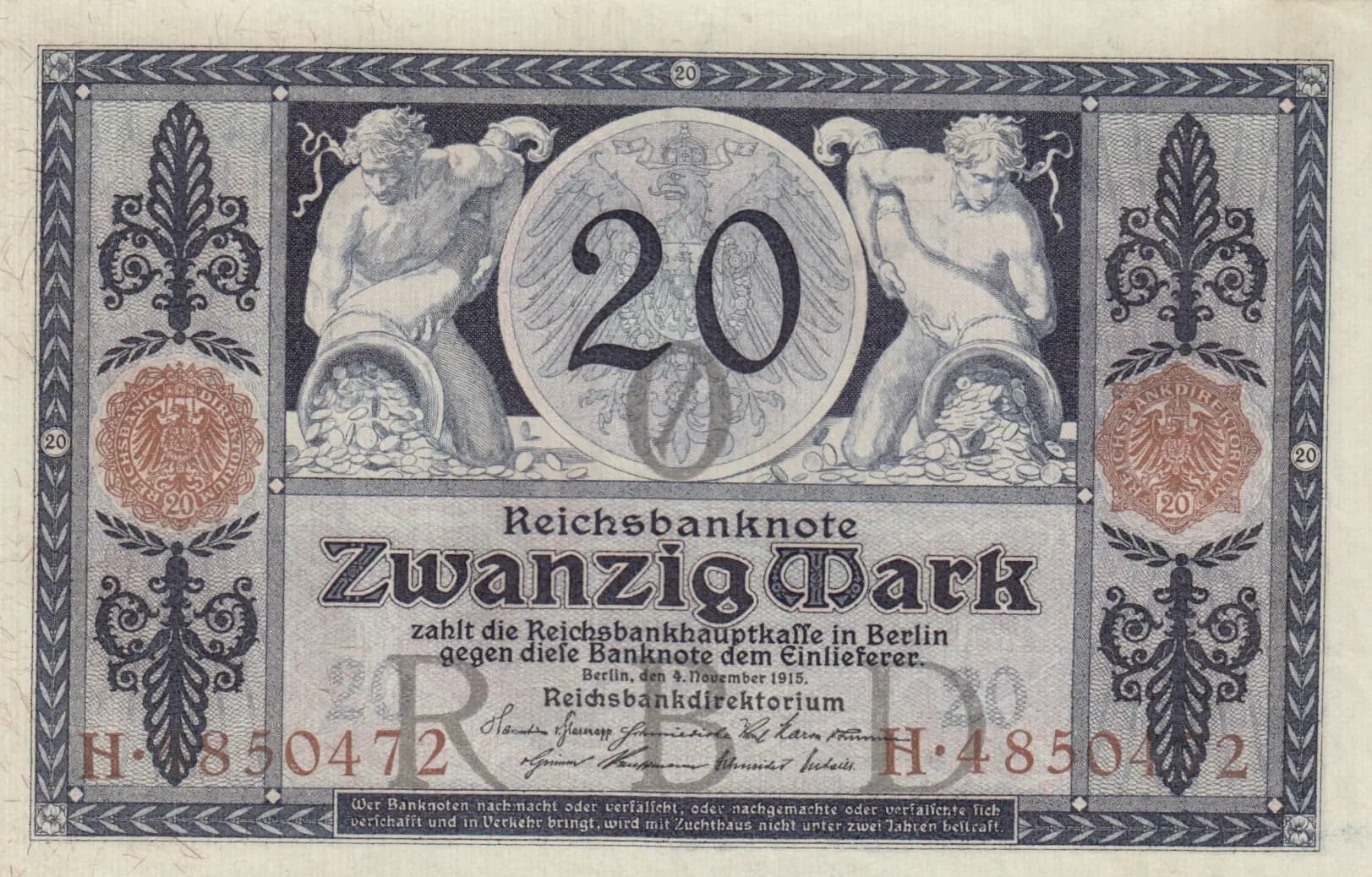
This is a German 20 Mark Reichsbanknote issued on November 4, 1915, during the final years of the German Empire and World War I. The note displays classical allegorical imagery with cherub figures and portrait medallions, rendered in fine black and gray engraving on a cream background. While showing age-appropriate foxing, creasing, and yellowing consistent with historical circulation, the note retains good detail definition and presents as a genuine period artifact from Germany's pre-Weimar era.
Common. eBay auction data shows numerous sales across a wide range of grades (F to PMG 66) with prices predominantly under $20 for lower grades and typically $30-$55 for PMG 64-66 specimens. The 2016 catalog value for UNC grade is listed as $20. The regular, large-scale issue date and consistent market availability across multiple decades of auction records indicate this is a standard-issue note with no scarcity. Serial number evidence and circulation patterns show this was produced in substantial quantities for the German economy during WWI.
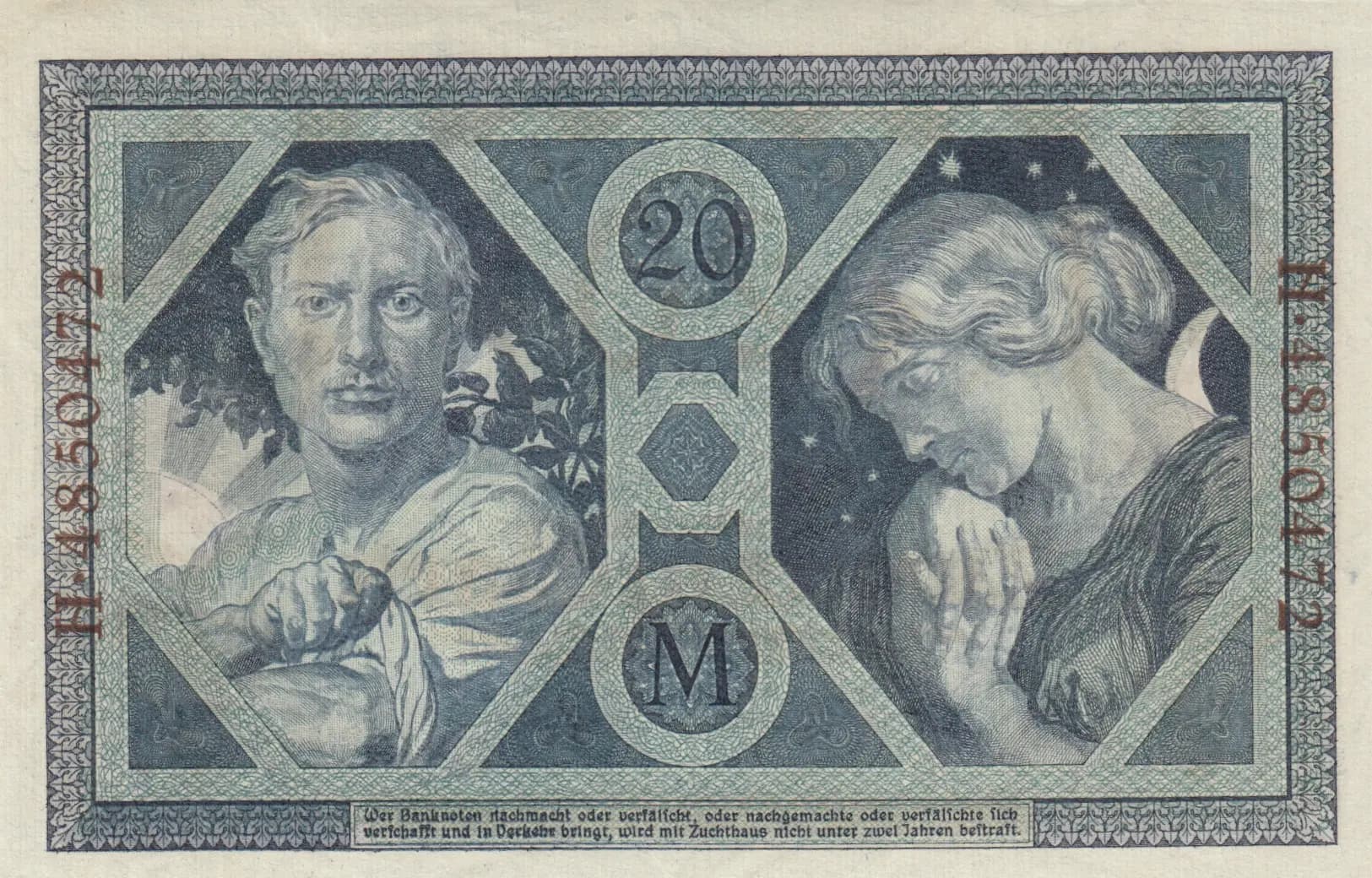
Issued during World War I by the Reichsbank, this 1915 note reflects Imperial German monetary policy under the Kaiser Wilhelm II regime. The classical allegorical imagery—featuring cherubs with cornucopiae symbolizing 'Wealth' on the obverse and paired male-female portrait medallions on the reverse—represents the artistic and nationalistic aesthetic of pre-war German design. The dated inscription 'Berlin, den 4. November 1915' anchors this note firmly within the war period, when the Reichsbank's currency increasingly served to finance military operations.
The obverse features two allegorical cherub or putti figures in classical style flanking a central circular medallion containing the numeral 20 and an Imperial German eagle. Shield-shaped heraldic devices with imperial eagles and ornamental floral scrollwork flank the composition on left and right. An ornate geometric and baroque-influenced border frames the entire design. The reverse presents two portrait medallions—a male figure on the left and a female figure in profile on the right—separated by geometric ornamental elements and flanked by decorative borders. A central circular medallion displays the denomination 20, with the letter M (likely indicating a specific printing facility or series) positioned below. The allegorical imagery and portraiture serve both artistic and security functions typical of Reichsbank note design from this period.
FRONT SIDE: 'Reichsbanknote' (Reichsbanknote); 'Zwanzig Mark' (Twenty Mark); 'zahlt die Reichsbankhäuptkaffe in Berlin gegen diese Banknote dem Einlieferer' (The Reichsbank headquarters in Berlin pays against this banknote to the bearer); 'Berlin, den 4. November 1915' (Berlin, November 4, 1915); 'Reichsbankdirektorium' (Reichsbank Directorate); 'Wer Banknoten nachmacht oder verfälscht, oder nachgemachte oder verfälschte sich verschafft und in Verkehr bringt, wird mit Zuchthaus nicht unter zwei Jahren bestraft' (Whoever counterfeits or forges banknotes, or obtains counterfeited or forged notes and puts them into circulation will be punished with imprisonment not less than two years). BACK SIDE: Serial indicators 'M' and repeated warning text against counterfeiting. Serial numbers visible: H 8 50472 and H 4850 2.
Steel engraving (intaglio process), which was the standard security printing technique for German Reichsbank notes of this era. The fine, detailed line work visible throughout the design—particularly in the portraiture, border ornamentation, and security patterns—is characteristic of steel engraved currency. The Reichsbank notes of this period were typically produced by the Reichsbank's own printing facilities or contracted German security printers. The intricate engraved patterns and portrait medallions would have been executed using traditional copperplate and steel engraving methods.
This specimen bears serial number prefix 'H' with numbers 8 50472 and 4850 2, which relates to the printing batch and sheet position. Varieties of the 20 Mark 1915 (Pick 63) are primarily distinguished by serial number prefixes and signatures of Reichsbank officials. The serial prefix 'H' appears to be one of several documented prefixes for this issue. Collectors should note that signature variants (Reichsbankdirektorium signatories) and serial number prefixes constitute the primary varieties for this note type, though no major varieties affecting value have been formally catalogued for this denomination and date.