1000 mark 1910
Market Prices
24 salesAbout This Note
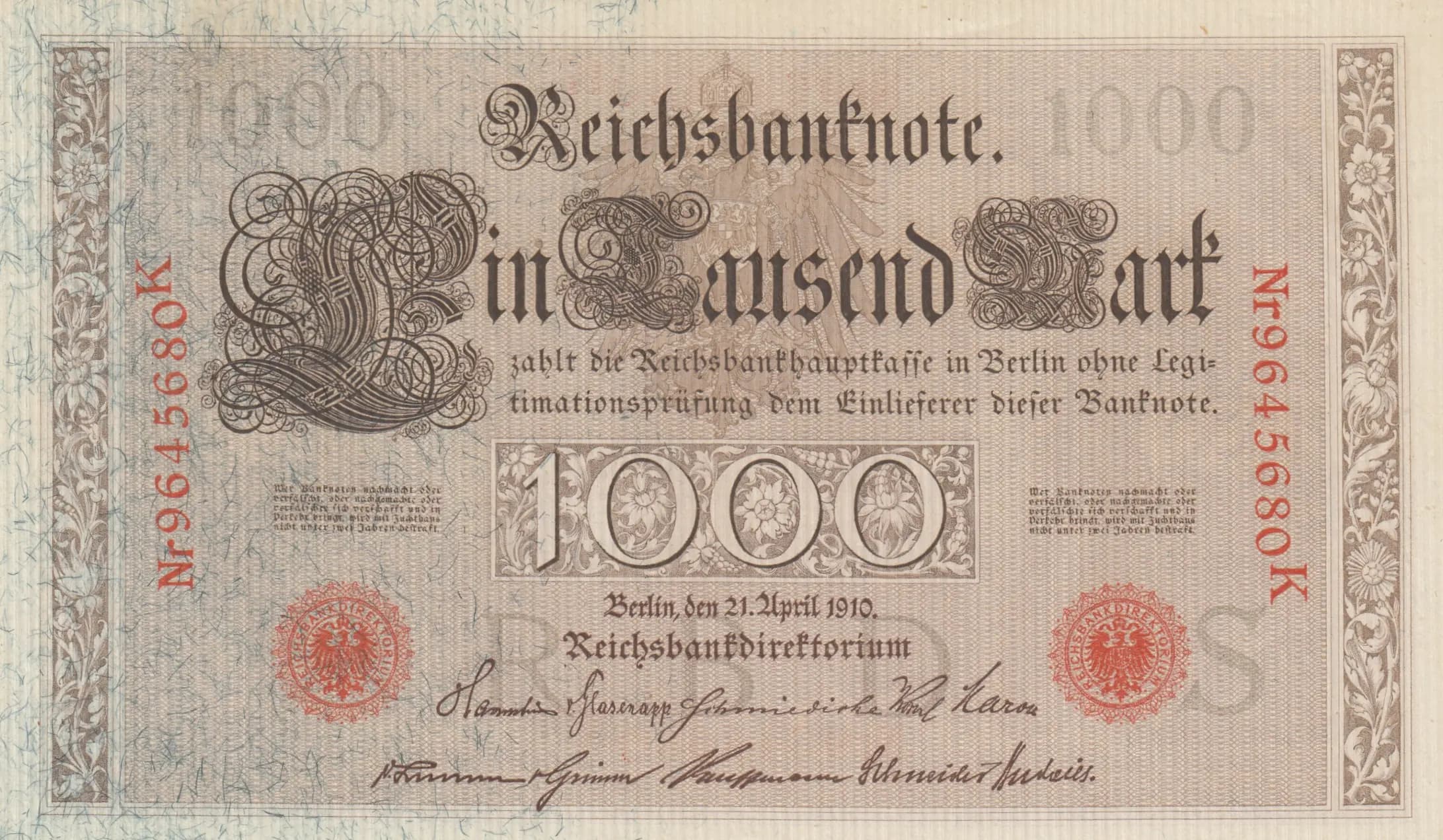
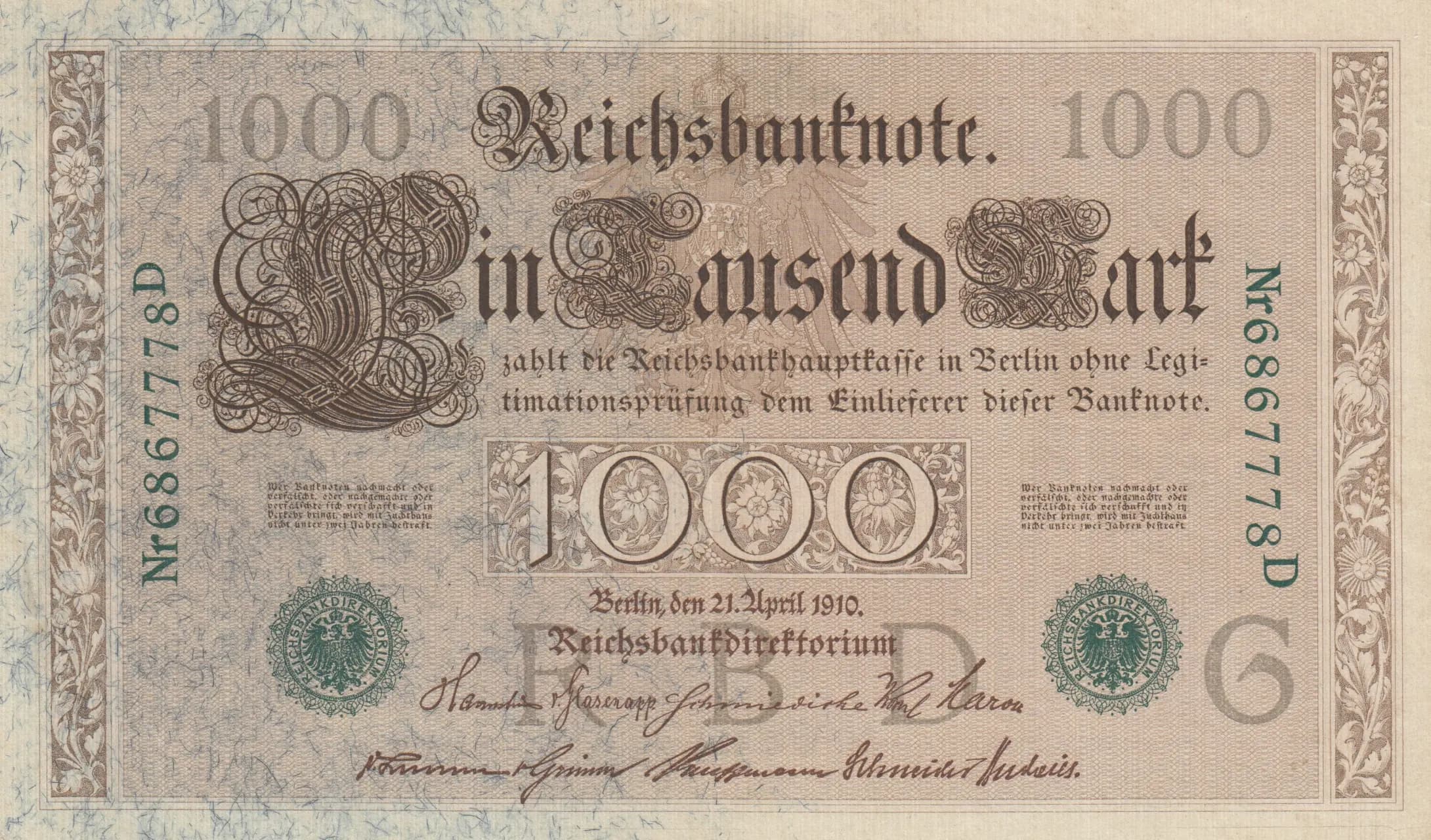
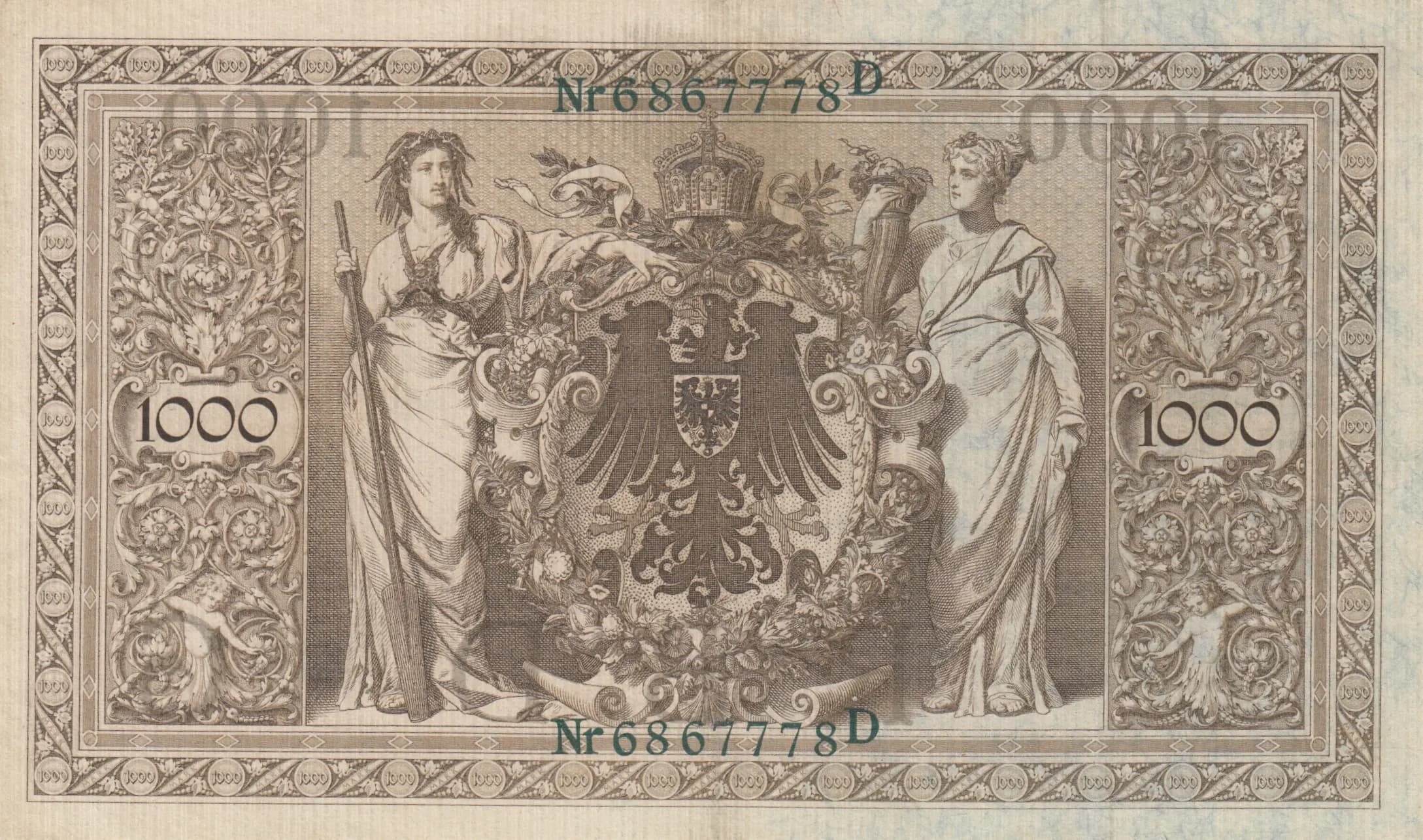
A VF-graded 1000 Mark Reichsbanknote from 1910, issued on 21 April by the German Reichsbank. The note displays the characteristic dark brown intaglio printing on tan underprint with green serial numbers and Imperial seals typical of P-45b varieties. Despite visible aging with foxing and creasing consistent with circulation, the ornate borders, denomination numerals, and reverse allegorical design remain sharply detailed, making this an accessible example of high-denomination Imperial German currency.
Common. This is a regular issue note produced in significant quantities during 1910, and eBay market data confirms consistent availability: VF-graded examples regularly sell for $1–$7, with even professionally graded PMG specimens (63–66) selling in the $22–$81 range. The 2016 catalog value of $4 VF further supports common status. Although it is historically significant as Imperial German currency, no evidence suggests limited print runs or rarity in this grade.
This note was issued during the late Imperial German period under the Reichsbank, which held monopoly over banknote issuance in unified Germany. The reverse design features classical allegorical female figures (representing Navigation and Agriculture) flanking the Imperial German double-headed eagle, symbolizing the economic and industrial strength of the German Empire at its peak before World War I. The bearer-on-demand redemption clause printed on the obverse reflects the gold-standard monetary system and Reichsbank's credibility during this era.
The obverse features an ornate, symmetrical layout typical of high-value Imperial German banknotes. The denomination '1000' appears in large decorative numerals in the upper center, framed by elaborate floral and foliate borders on both sides. Two circular Imperial seals bearing the German eagle occupy the lower section flanking the redemption text and signatures of the Reichsbankdirektorium. The reverse displays a more elaborate allegorical composition: two classical female personifications (Navigation on the left, holding a staff or maritime symbol; Agriculture on the right in passive pose) flank a central Imperial coat of arms featuring a double-headed eagle and ornate shield. The entire design is rendered in deep brown/sepia tones with masterful intaglio line work. Geometric border patterns with repeated numismatic elements frame the design, creating a visually complex and security-conscious composition characteristic of Reichsbank high-denomination notes.
FRONT: '1000 Reichsbanknote 1000' (top center); 'Ein Tausend Mark' (One Thousand Mark); 'Reichsbanknote' (Reichsbank Note); 'zahlt die Reichsbankhauptkasse in Berlin ohne Legitimationsprüfung dem Einlieferer dieser Banknote' (The Reichsbank main office in Berlin pays to the bearer of this banknote without presentation examination); 'Berlin, den 21. April 1910' (Berlin, 21 April 1910); 'Reichsbankdirektorium' (Reichsbank Board of Directors); serial numbers 'Nr 687780' and 'Nr 6877880D'. BACK: Repeated denomination '1000' in ornamental frames; serial number 'Nr6867778D'; repeating pattern '1899' in geometric borders.
Intaglio (engraved) printing on banknote paper, a security technique standard for Reichsbank notes of this period. The fine line detail visible in the decorative borders, allegorical figures, and security elements reflects the high-quality craftsmanship of Imperial German banknote production. Reichsbank notes of this era were typically produced by the Reichsbank's own printing facilities or contracted security printers; the sharp detail retention despite aging suggests excellent original impression quality.
This note is cataloged as Pick P-45b, the green serial number and seal variant issued in 1910 (reprinted 1918–22). The visual analysis confirms green serial numbers and seals characteristic of P-45b. A related variant, P-44, exists with red serial numbers and seals from an earlier date. The observed 7-digit serial numbers (687780, 6877880D, 6867778D noted in images) are consistent with this issue type. No signature variants or other significant distinguishing marks are noted beyond the standard green printing elements that define this variety.