100 mark 1908
Market Prices
46 salesAbout This Note
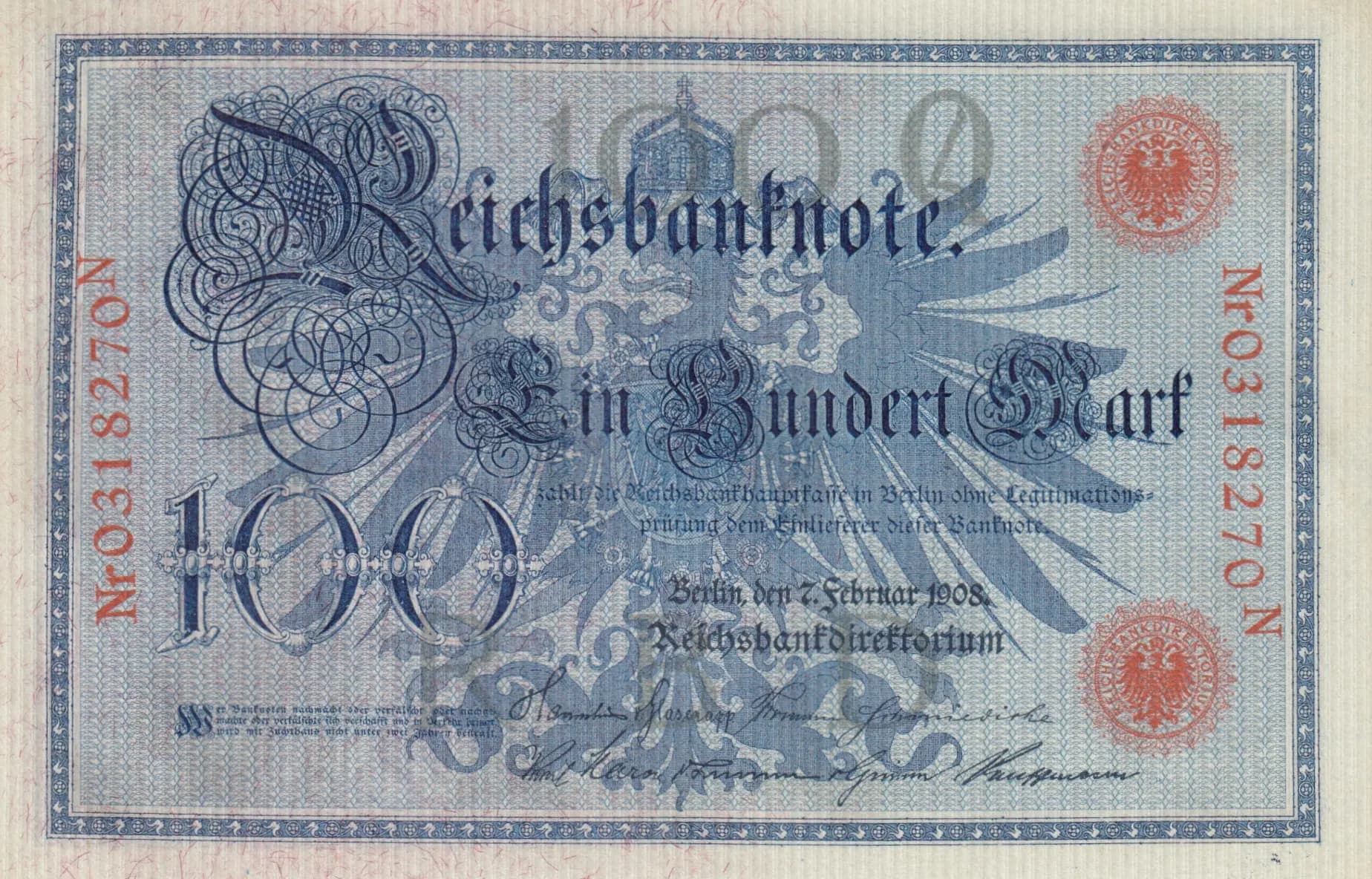
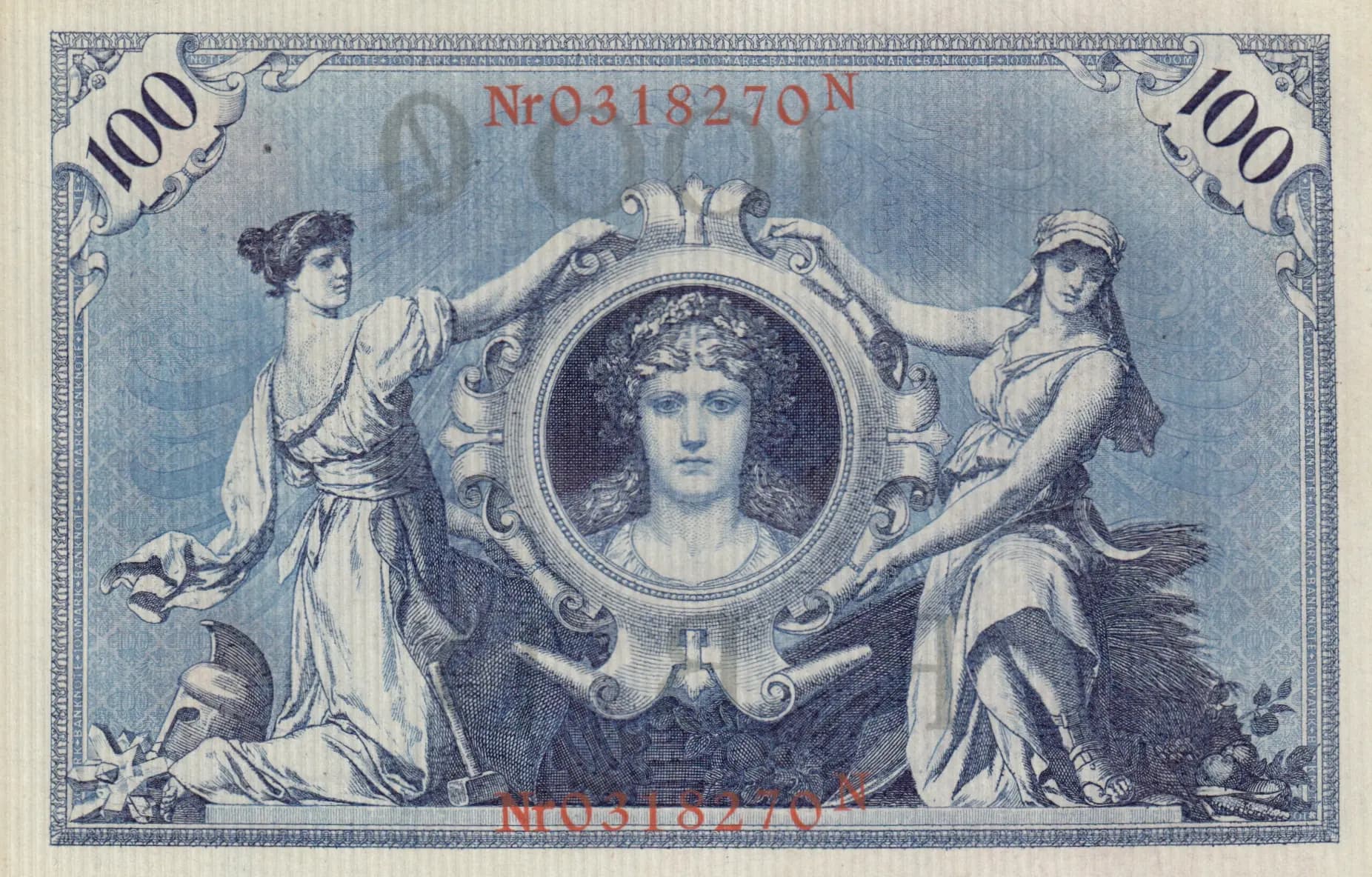
This is a German Imperial 100 Mark banknote from 1908, issued by the Reichsbank on February 6, 1908. The note displays the characteristic blue and red color scheme of the period with an impressive central Imperial Eagle (Reichsadler) on the obverse and classical allegorical female figures flanking a medallion portrait on the reverse. Despite over 115 years of age, the note retains good visual clarity with intricate engraving details still legible, though it shows expected age-related yellowing, foxing, and creasing consistent with circulation use—this represents a historically significant example of Imperial German currency from the late Kaiserreich period.
Common. This is a standard regular-issue Reichsbank note from 1908, part of a large print run typical for a high-denomination currency note of the Imperial German period. The eBay price tracking data provided demonstrates consistent market activity with notes selling regularly in the $2-$60 range depending on condition grade, with most circulated examples trading under $20. UNC examples command premium prices (documented sales around $36-$56 for PMG 66), but the note itself was produced in substantial quantities. There are no indicators of a limited print run, recall, or special scarcity for this Pick number. The abundance of historical sales data confirms this is a commonly encountered note in the collector market.
This 100 Mark note was issued during the reign of Kaiser Wilhelm II, at the height of the German Empire's economic power before World War I disrupted the international financial system. The prominent Imperial Eagle (Reichsadler) with spread wings served as the official heraldic symbol of German imperial authority and nationalism, while the classical allegorical female figures on the reverse—representing virtues or national concepts—reflected the artistic conventions and nationalist symbolism of Wilhelmine Germany. The Reichsbank, as the central banking authority, maintained strict control over currency circulation and security, employing the finest engraving techniques available to prevent counterfeiting.
The obverse features a magnificent Imperial Eagle (Reichsadler) positioned centrally with fully spread wings in heraldic style, serving as the dominant symbolic element of German imperial sovereignty. The numeral '100' is prominently displayed in the center with 'REICHSBANKNOTE' and 'EIN HUNDERT MARK' inscriptions flanking the eagle. Ornate decorative scrollwork and floral border patterns frame the entire note in an elaborate Art Nouveau-influenced design. Red circular seals with imperial emblems appear on both left and right sides of the obverse. The reverse depicts a classical allegorical composition with two female figures in flowing classical dress—one on the left holding drapery and one on the right wearing a cap or bonnet—flanking a central circular medallion containing a female portrait in profile. This allegorical arrangement was typical of Germanic nationalist and imperial imagery of the period, representing virtues such as strength, wisdom, or prosperity. The serial number '0318270 N' appears in red ink on both sides. The overall design employs the finest line engraving techniques with intricate stippling and decorative elements throughout.
FRONT SIDE: 'Reichsbanknote' (Reich Bank Note) | 'Ein Hundert Mark' (One Hundred Mark) | '100' (numerical denomination) | 'Nr 0318270 N' (Serial Number 0318270 N) | 'Berlin, den 6. Februar 1908' (Berlin, February 6, 1908) | 'Reichsbankdirektorium' (Reichsbank Directorate) | 'Gültig zur Reichsbanknote Berlin ohne Legitimationszwang während der Geltungsdauer Banknote' (Valid as a Reichsbank note Berlin without legitimacy requirement during the validity period of the banknote) | Signature line: 'Unterschrift Nummern der vertreter verschiedenen Abteilungen der Reichsbank mit Ausnahme hier oben fehlt' (Signatures of numbers of representatives of various departments of the Reichsbank with the exception here above is missing). BACK SIDE: '100' (numerical denomination, upper corners) | 'Nr 0318270 N' and 'Nr 0318270' (Serial Numbers matching the obverse).
Steel plate engraving and intaglio printing, the standard security printing method for Reichsbank notes of this period. The note exhibits the characteristic fine line work, detailed stippling, and complex portrait rendering that could only be achieved through hand-engraved steel plates and high-pressure intaglio presses. The printer was the official Reichsbank printing works in Berlin. Red serial numbers and seals were applied using a separate printing pass, adding an additional security layer. The intricate decorative borders, scrollwork, and fine detail work throughout the design reflect the highest standards of security printing of the Edwardian era, making counterfeiting extremely difficult with the technology available at the time.
This note is catalogued as Pick P-33a, the variant with RED serial numbers and red seals. The related P-34 variant features the same design but with GREEN serial numbers and seals instead. The visual analysis confirms red serial number '0318270 N' and red circular seals, definitively identifying this as the P-33a variety. The issue date of February 6, 1908 matches the catalog date of 07.02.1908 (using German date format DD.MM.YYYY). Serial number prefixes and letter designations (the 'N' suffix observed) represent standard Reichsbank numbering conventions but do not constitute distinct varieties for this Pick number.