10 000 000 mark 1923
Market Prices
19 salesAbout This Note
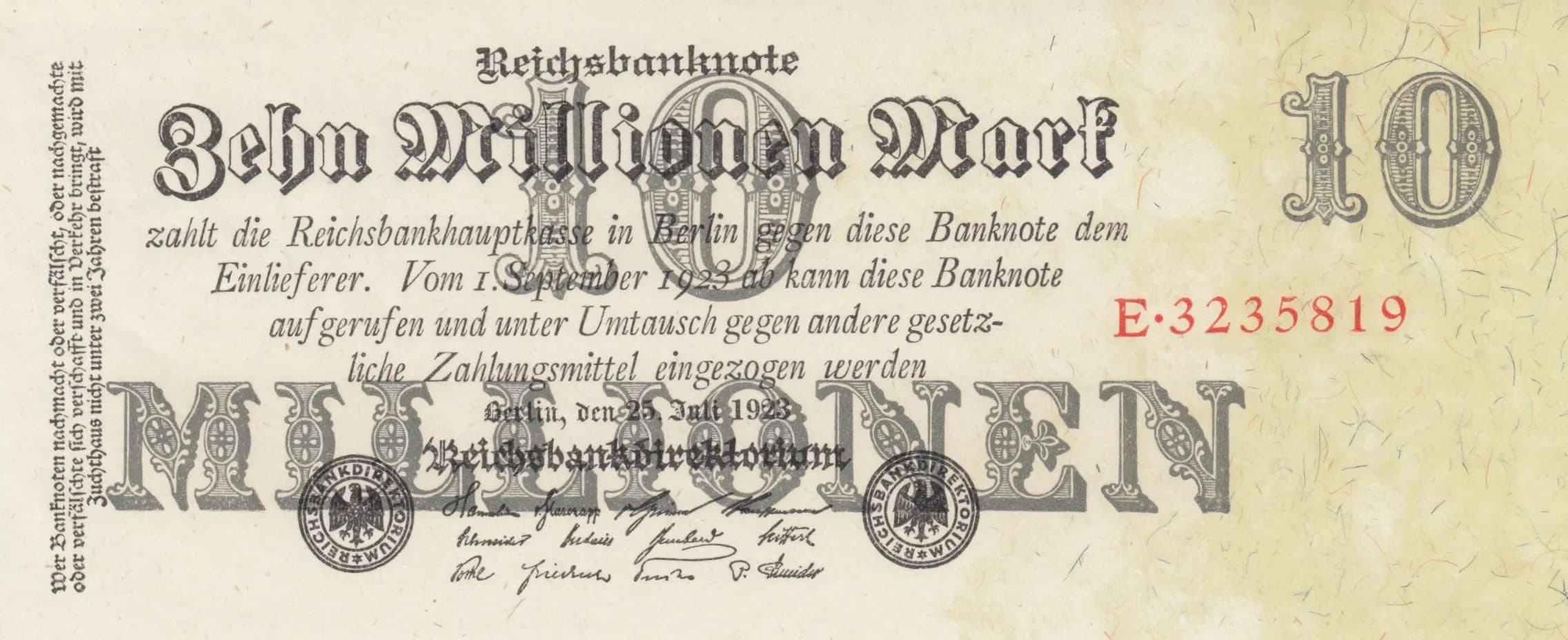
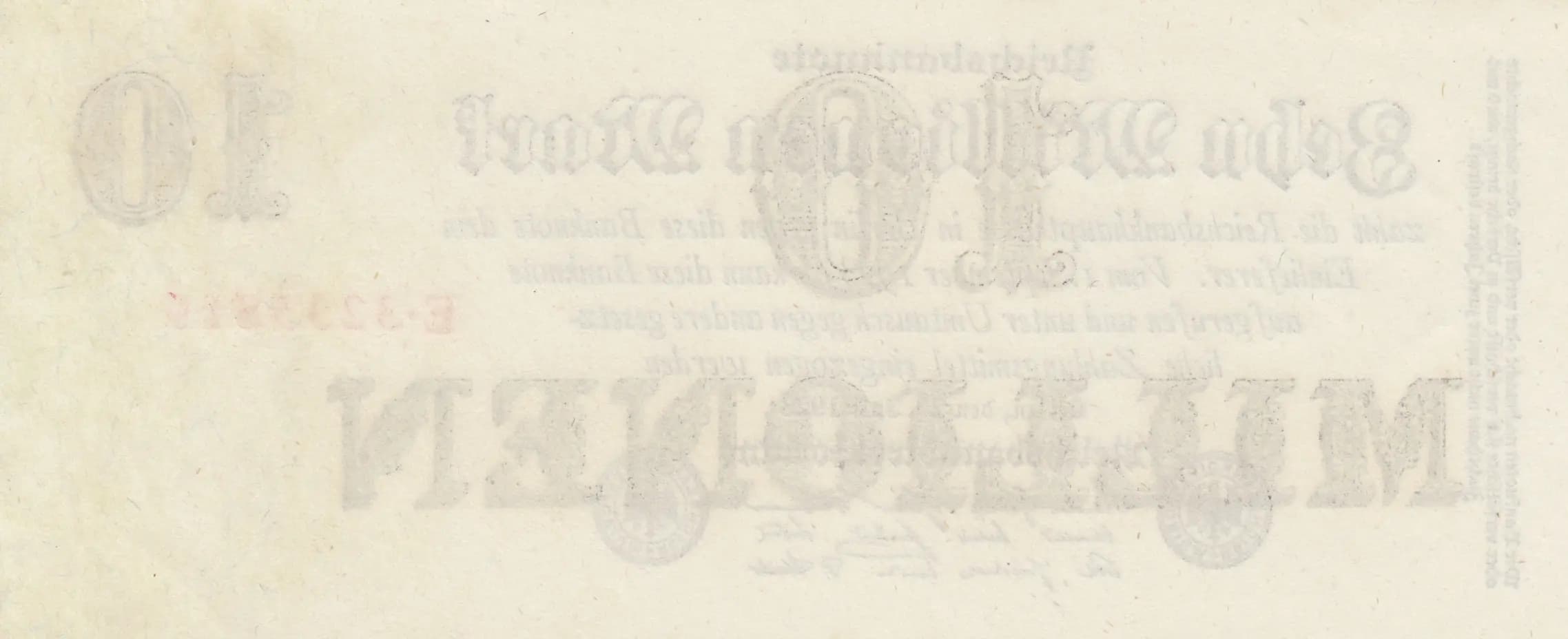
This is a German Reichsbanknote for 10 Million Mark issued on July 25, 1923, during the peak of the Weimar hyperinflation crisis. The note exhibits substantial circulation wear with visible creasing, foxing, yellowing, and fading throughout both sides, particularly on the reverse where printed details are nearly illegible. Despite its heavily circulated appearance, the front retains legible inscriptions and the characteristic ornate Germanic design elements including Imperial Eagle seals and serial number in red ink, making it a tangible artifact of one of history's most dramatic monetary collapses.
Common. The eBay market data clearly indicates robust trading activity across multiple condition grades, with examples regularly selling for under $25 even in premium grades (PMG 67 at $103.50 represents an outlier). Standard circulated examples (VF-EF) consistently sell for $1-5, and catalog values from 2016 list UNC at only $25. These prices, combined with the obvious prevalence of surviving examples, confirm this Pick-96 note is abundantly available. Hyperinflation-era German notes were printed in enormous quantities and millions survive today, making individual notes from this period common regardless of denomination.
This banknote represents a critical moment in German economic history—July 1923 marked the catastrophic acceleration of hyperinflation under the Weimar Republic, when the Mark's value collapsed entirely. The note's explicit disclaimer dated September 1, 1923 (when it could be called in and exchanged for other legal tender) reflects the desperate monetary situation where denominations doubled within days. The Reichsbank's formal signatures and emblem on the front underscore the government's attempt to maintain institutional credibility even as the currency became worthless.
The front design exemplifies Classical German banking aesthetics of the early Weimar period with an ornate, cream-colored layout featuring black and grey printing. The denomination is displayed in large decorative numerals reading '10' prominently on the right side, with 'MILLION' emphasized in elegant lettering flanked by two Imperial German Eagle seals (Reichsadler) positioned left and right. The Reichsbank emblem and official seals appear as circular impressions. The note incorporates formal legal text in ornate typeface detailing payment terms and conditions. Red ink is used for the serial number 'E·3235819' to enhance security and visibility. The reverse side, now heavily faded and worn beyond legibility, originally contained mirrored decorative elements and seals typical of German banknote design standards of the era.
FRONT SIDE: 'Reichsbanknote' (Reichsbank Note); 'Zehn Millionen Mark' (Ten Million Mark); Main text: 'The Reichsbank main office in Berlin pays against this banknote to the bearer. From September 1, 1923 onwards this banknote can be called in and withdrawn in exchange for other legal tender'; 'MILLION' (Million); Serial number 'E·3235819'; 'Berlin, den 25 Juli 1923' (Berlin, July 25, 1923); 'Reichsbankdirektorium' (Reichsbank Directorate); 'Der Präsident' (The President); Additional regulatory text regarding government recognition of legal tender issued through prescribed stock exchange procedures. REVERSE SIDE: Illegible due to severe fading and deterioration.
This note was produced using traditional letterpress/relief printing combined with steel engraving for the fine-line ornamental elements and seals, consistent with Reichsbank security printing standards of 1923. The color separation (black/grey text with red serial numbers) indicates multi-pass printing. The crisp, ornate lettering and finely detailed Imperial seals are characteristic of work by the Reichsbank's primary security printer, Giesecke+Devrient, though definitive attribution would require printer marks or documentation.
Serial number E·3235819 with red ink printing is consistent with the standard July 25, 1923 issue. The note bears signatures of the Reichsbankdirektorium and Der Präsident as authorized for this date. No overprints or unusual varieties are evident from the visual examination. This represents the standard variety of Pick-96, with no documented major varieties affecting collectibility or rarity for this particular note type.