1 000 000 mark 1923
About This Note
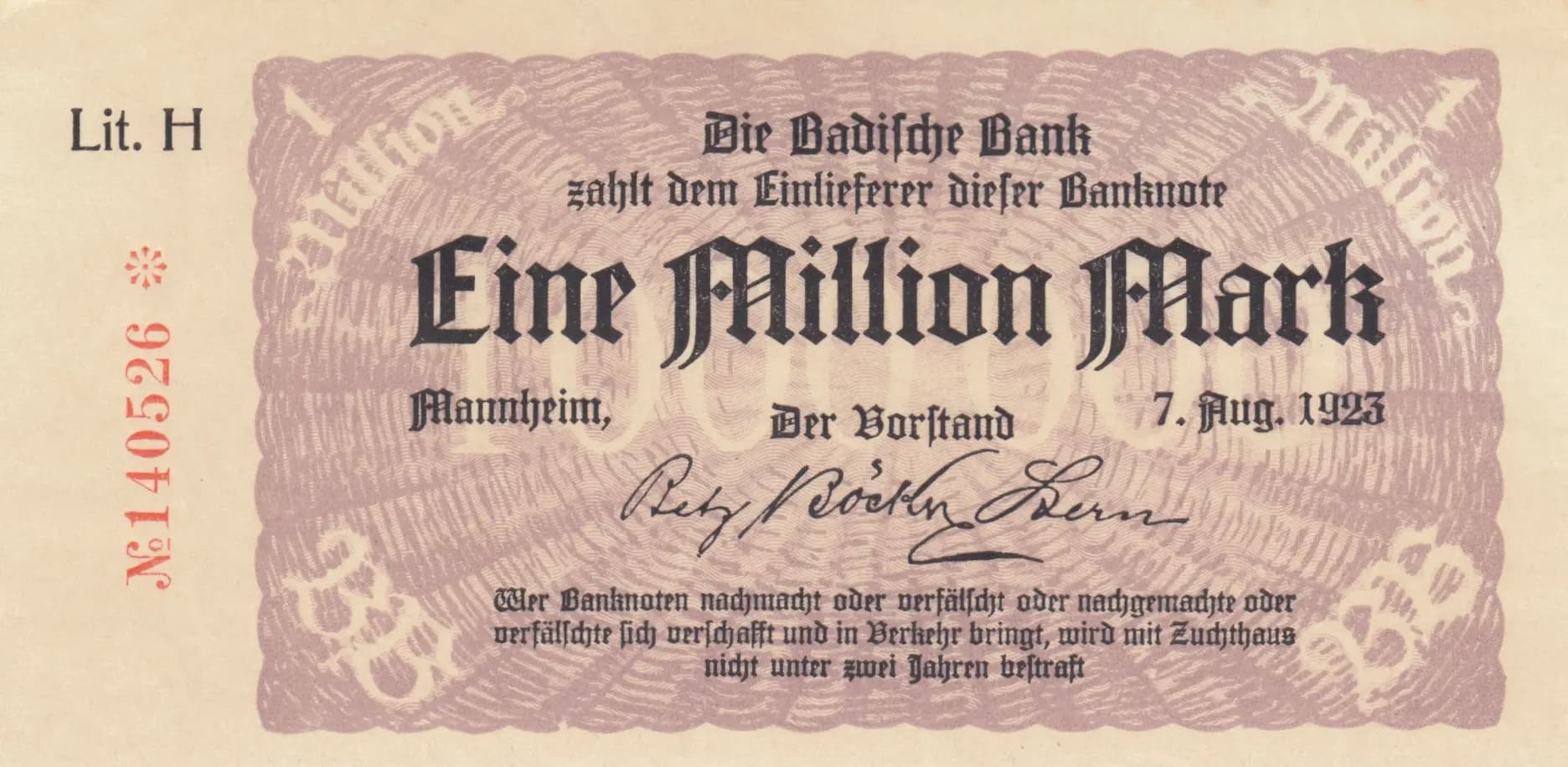
This is a German 1,000,000 Mark note issued by the Badische Bank on August 7, 1923, during the height of the Weimar hyperinflation crisis. The front displays elegant wavy line background patterns in purple and mauve tones with clear typography and a red serial number (No. 1405926), showing excellent preservation consistent with AU grade condition. The note represents a fascinating artifact of Germany's monetary collapse, when denominations reached astronomical levels within weeks as the currency became increasingly worthless.
Common. This is a standard issue from a major German regional bank during the hyperinflation period. Millions of such high-denomination notes were printed in 1923 as emergency currency measures, and they survive in relatively large quantities today. The Badische Bank's million-mark notes are frequently encountered in collections and on the market. Pick S912 represents a standard circulation issue rather than a special, limited, or recalled variety.
This note was issued at the absolute peak of German hyperinflation in summer 1923, just weeks before the introduction of the Rentenmark stabilized the currency in November. The Badische Bank, headquartered in Mannheim and dated August 7, 1923, issued emergency high-denomination notes as the Mark's purchasing power evaporated. The stern warning inscribed on the note about counterfeiting reflects the desperation of the period and the government's attempts to maintain control over currency production despite the economic chaos.
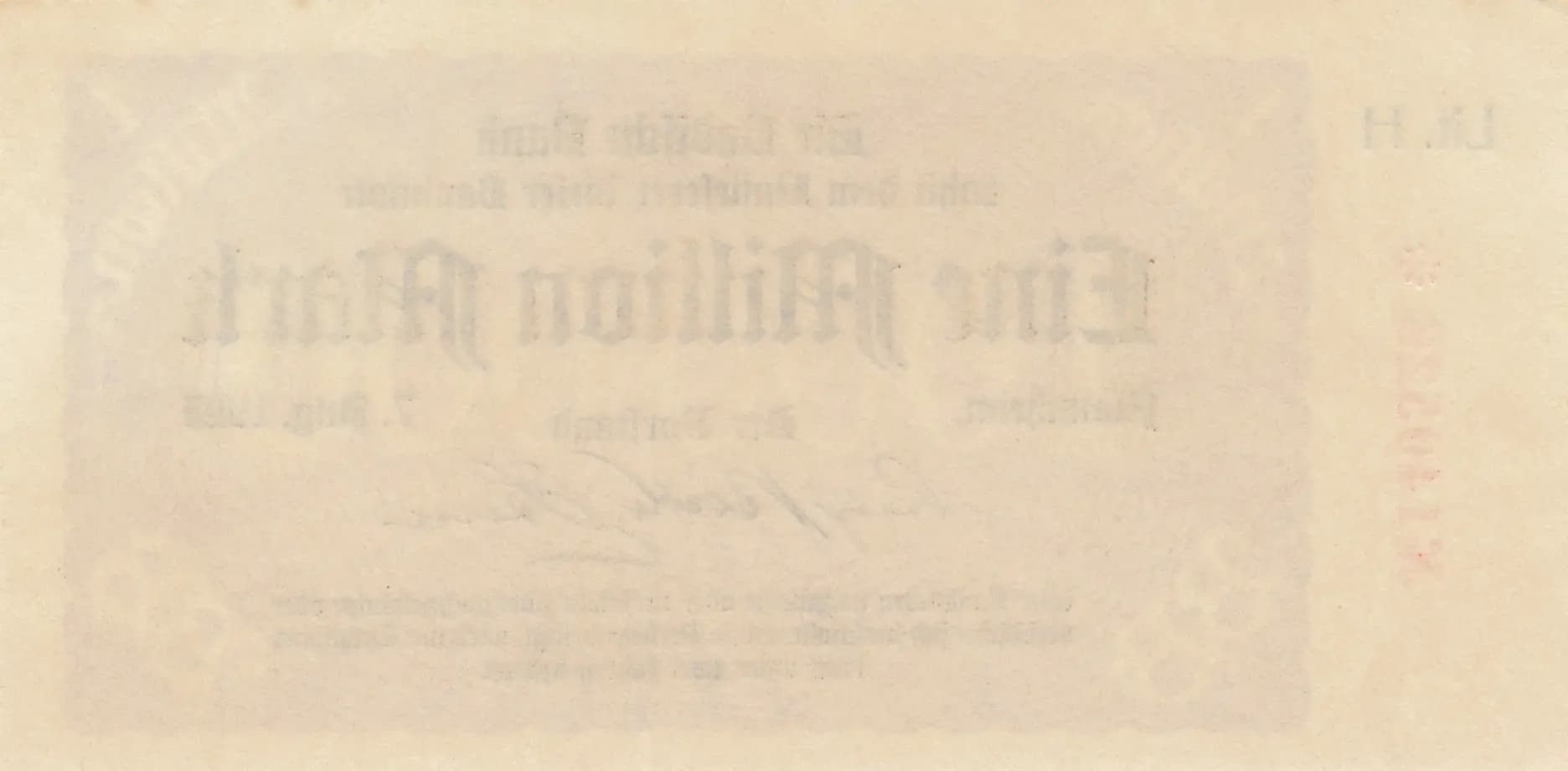
The front of this emergency-issue banknote features a classical geometric security design composed of intricate wavy line patterns that fill the background in a regular, repeating motif. This decorative lattice-work serves both aesthetic and security purposes, typical of early 20th-century bank security printing. The denomination 'Eine Million Mark' (One Million Mark) is prominently displayed in dark purple-mauve typography. The note is centered with balanced composition, featuring the official text of the Badische Bank's promise to pay, institutional identification, the issue date of August 7, 1923, and three authorized signatures. The red serial number printed on the left margin provides individual note identification. The back of the note is too faint to discern specific design elements from the photograph provided, though remnants of purple-mauve printing suggest mirrored or complementary design elements.
FRONT: 'Lit. H' (Lithography H - printing notation) | 'Die Badische Bank' (The Badische Bank) | 'zahlt dem Einlieferer dieser Banknote Eine Million Mark' (pays the depositor of this banknote One Million Mark) | 'Mannheim,' (location) | 'Der Vorstand' (The Board of Directors) | '7. Aug. 1923' (August 7, 1923 - date of issue) | 'Betz Böckin Benn' (signatures of bank officials) | 'Wer Banknoten nachmacht oder verfälscht oder nachgemachte oder verfälschte sich verschafft und in Verkehr bringt, wird mit Zuchthaus nicht unter zwei Jahren bestraft' (Whoever counterfeits or forges banknotes or procures counterfeit or forged banknotes and puts them into circulation will be punished with hard labor for not less than two years) | 'No 1405926' (serial number) | BACK: Unable to determine due to image clarity and faintness of printing.
This note was produced using lithography, as indicated by the 'Lit. H' notation on the front. The refined wavy line background pattern and clear typography are characteristic of lithographic printing, which was the standard security printing method for German banknotes during the Weimar period. The use of multiple ink colors (dark purple-mauve for primary text and design, red for the serial number) indicates a multi-pass lithographic process. The precision of the geometric patterns and the clarity of typography visible even after 100 years of aging demonstrate the quality of German security printing technology of the era.
This specific note is identified as Pick catalog number P-S912, representing the standard 1,000,000 Mark issue of the Badische Bank dated August 7, 1923. The serial number No. 1405926 indicates this is a mid-to-late range printing from the production run. The signatures of 'Betz Böckin Benn' represent the authorized signatories for this issue. No overprints, regional variations, or special markings are apparent. Varieties of this Pick number may exist based on signature combinations, date variations within August 1923, and serial number ranges, but this example represents the standard variety.