10 francs 1947
About This Note
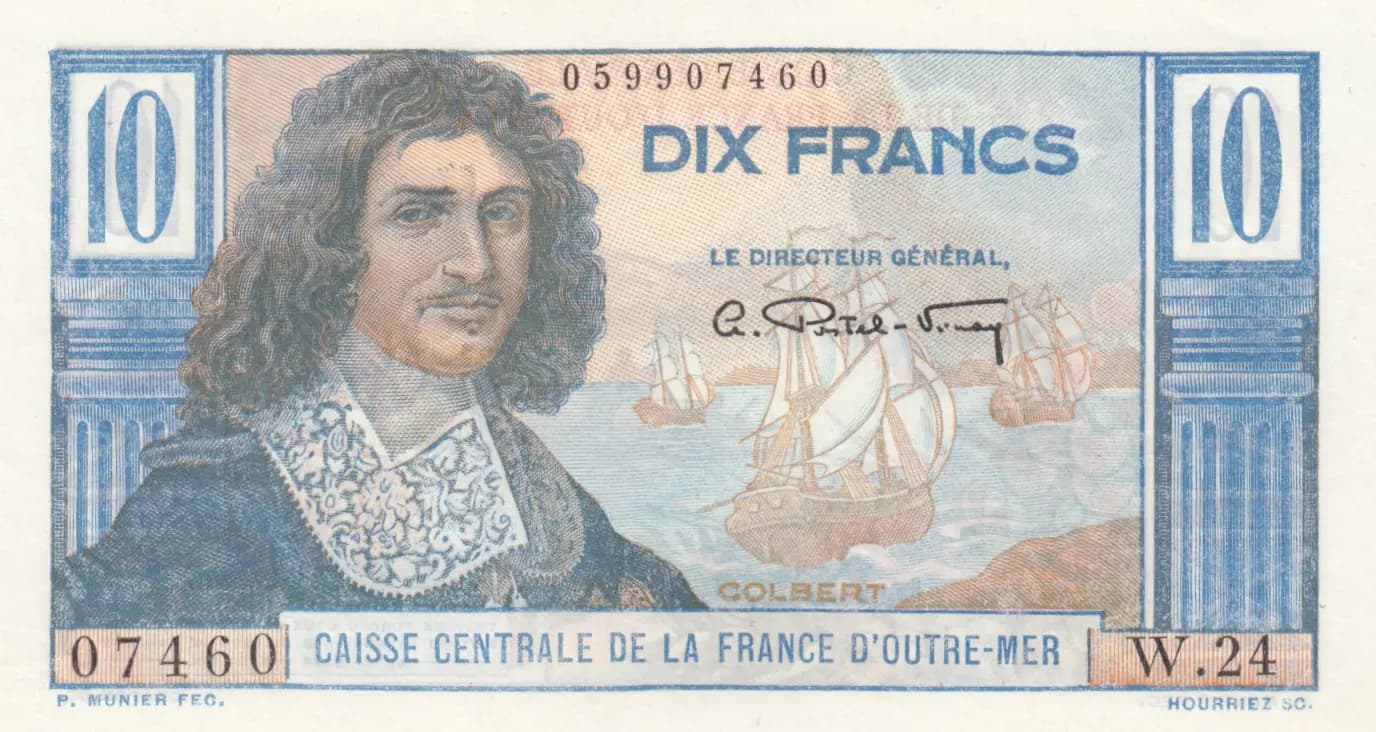
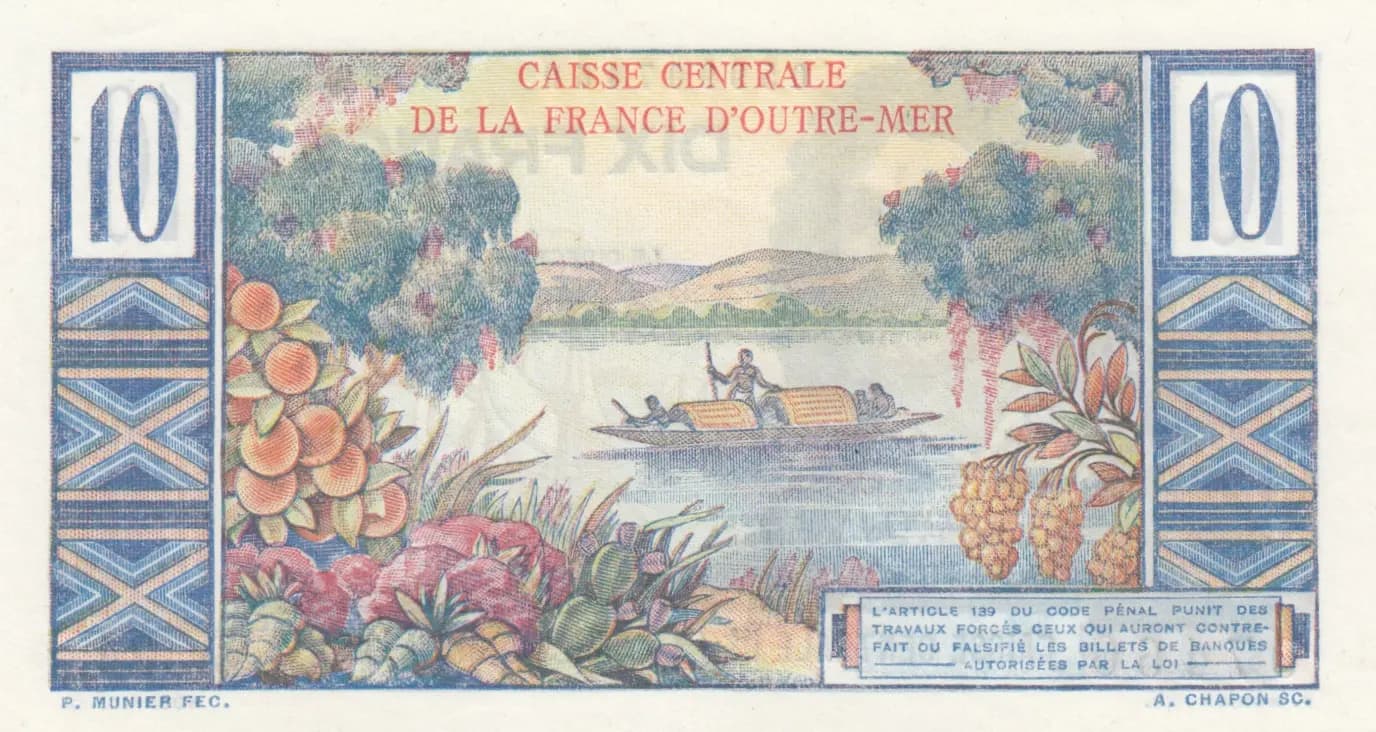
An exceptional uncirculated example of the French Equatorial Africa 10 Francs from 1947, issued by the Caisse Centrale de la France d'Outre-Mer. The note displays the classical engraved portrait of Jean-Baptiste Colbert on the obverse with an accompanying maritime scene, while the reverse features a romantic tropical landscape with a river raft and lush vegetation. The pristine condition with no visible wear, creases, or stains, combined with fine intaglio engraving detail throughout, makes this a desirable specimen for collectors of French colonial currency.
Common. The 10 Francs denomination from this series was a standard circulation note issued by the Caisse Centrale de la France d'Outre-Mer for French Equatorial Africa. While these notes are no longer in circulation and have historical value, they were produced in substantial quantities across the late 1940s. No evidence suggests this particular Pick number (P-21) had limited production runs or was recalled, and such colonial French notes appear regularly in the numismatic market at modest valuations. UNC examples command premiums over circulated pieces, but the note itself remains common in the collecting sphere.
This banknote was issued during the immediate post-World War II period when France was reasserting control over its overseas territories and establishing new monetary institutions. The choice of Jean-Baptiste Colbert, the 17th-century French statesman and naval administrator, reflects France's historical maritime dominance and colonial aspirations. The reverse imagery depicting a tropical river landscape and indigenous watercraft symbolizes the colonial territories themselves and the economic activities (such as agriculture and trade) that justified French overseas expansion.
The obverse features a classical three-quarter portrait of Jean-Baptiste Colbert (1619-1683), identifiable by his long, curled hair and period-appropriate 17th-century clothing with an ornate white lace collar characteristic of the era. Beside the portrait is an elaborate maritime vignette depicting multiple fully-rigged sailing vessels on open water, referencing Colbert's role in developing French naval power. Large denominational numerals '10' in decorative boxes occupy the top corners. The reverse presents a scenic tropical or sub-tropical landscape composition centered on a river or waterway with indigenous figures in a traditional boat (raft), surrounded by lush vegetation including fruiting and flowering trees, with mountains visible in the distance. Decorative geometric patterns in blue and orange/tan create framing borders on the sides. The color palette combines blues, greens, browns, and warm earth tones, creating visual balance between the classical European portraiture and the exotic colonial landscape.
FRONT: 'DIX FRANCS' (Ten Francs), 'CAISSE CENTRALE DE LA FRANCE D'OUTRE-MER' (Central Treasury of Overseas France), 'LE DIRECTEUR GÉNÉRAL' (The General Director), 'COLBERT' (Colbert), 'P. MUNIER FEC.' (Engraved by P. Munier), 'HOURRIEZ SC.' (Engraved by Hourriez), 'W.24' (Plate/Series identifier). BACK: 'CAISSE CENTRALE DE LA FRANCE D'OUTRE-MER' (Central Treasury of Overseas France), 'L'ARTICLE 139 OU CODE PÉNAL PUNIT DES TRAVAUX FORCÉS CEUX QUI AURONT CONTREFAIT OU FALSIFIÉ LES BILLETS DE BANQUES AUTORISÉES PAR LA LOI' (Article 139 of the Penal Code punishes by forced labor those who have counterfeited or falsified banknotes authorized by law), 'P. MUNIER FEC.' (Engraved by P. Munier), 'A. CHAPON SC.' (Engraved by A. Chapon).
Intaglio (copperplate) engraving, evidenced by the fine line work, intricate detail in the portrait facial features, complex background scenes with multiple sailing vessels, and delicate floral and landscape rendering. The engravers P. Munier and Hourriez (front), and P. Munier and A. Chapon (back) are credited, indicating the work of the Banque de France or its contracted security printers, utilizing traditional high-security banknote production methods of the period.
Pick catalog identifies two variants for this base number: P-21 (standard) and P-21s (specimen). The observed note appears to be a standard P-21 issue, as evidenced by the standard serial numbering (059907460) visible on the obverse. The plate identifier 'W.24' is noted. No evidence of overprints, signature varieties, or date variations is apparent in the images. Collectors should note potential serial number range variations; reference catalogs mention similar notes with serial ranges 2,520,001-2,550,000 and 19,100,001-19,200,000, with related P-19 issues for Saint Pierre & Miquelon.