2 colones 1967
Market Prices
13 salesAbout This Note
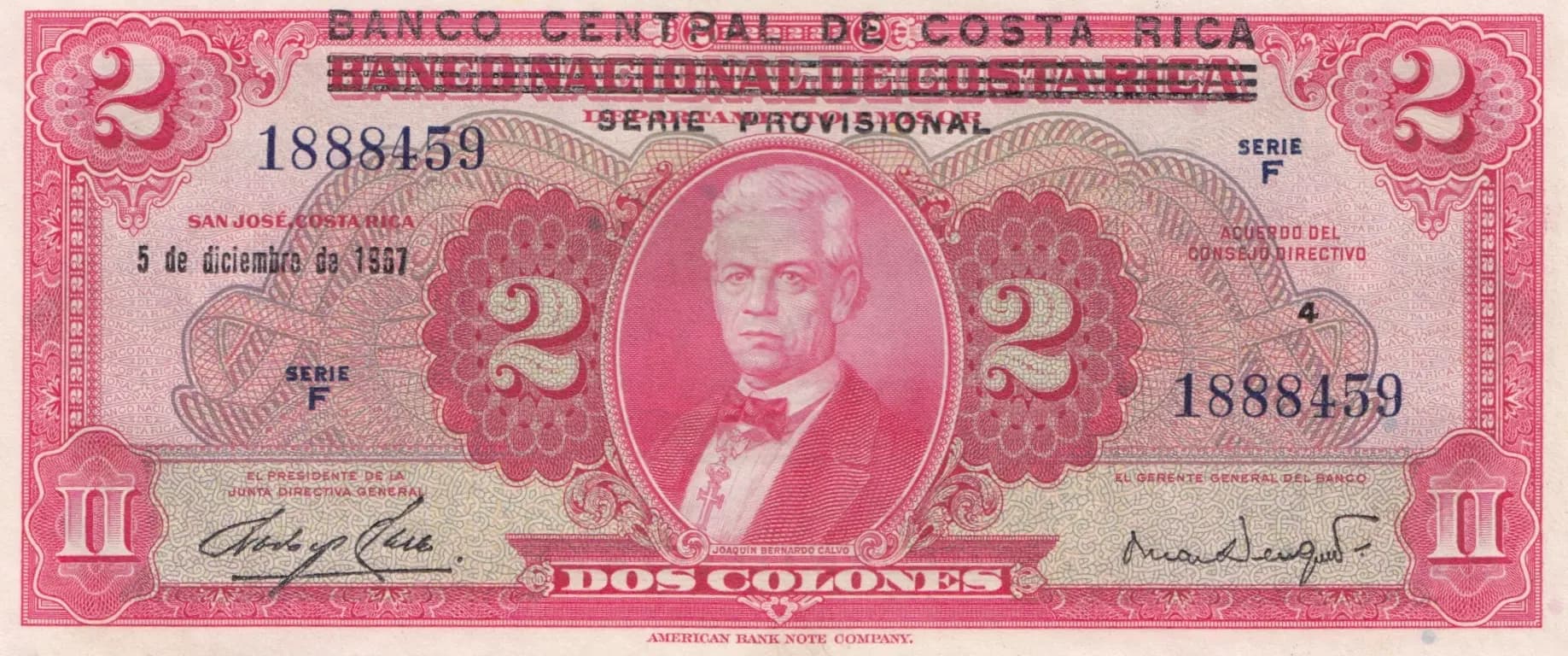
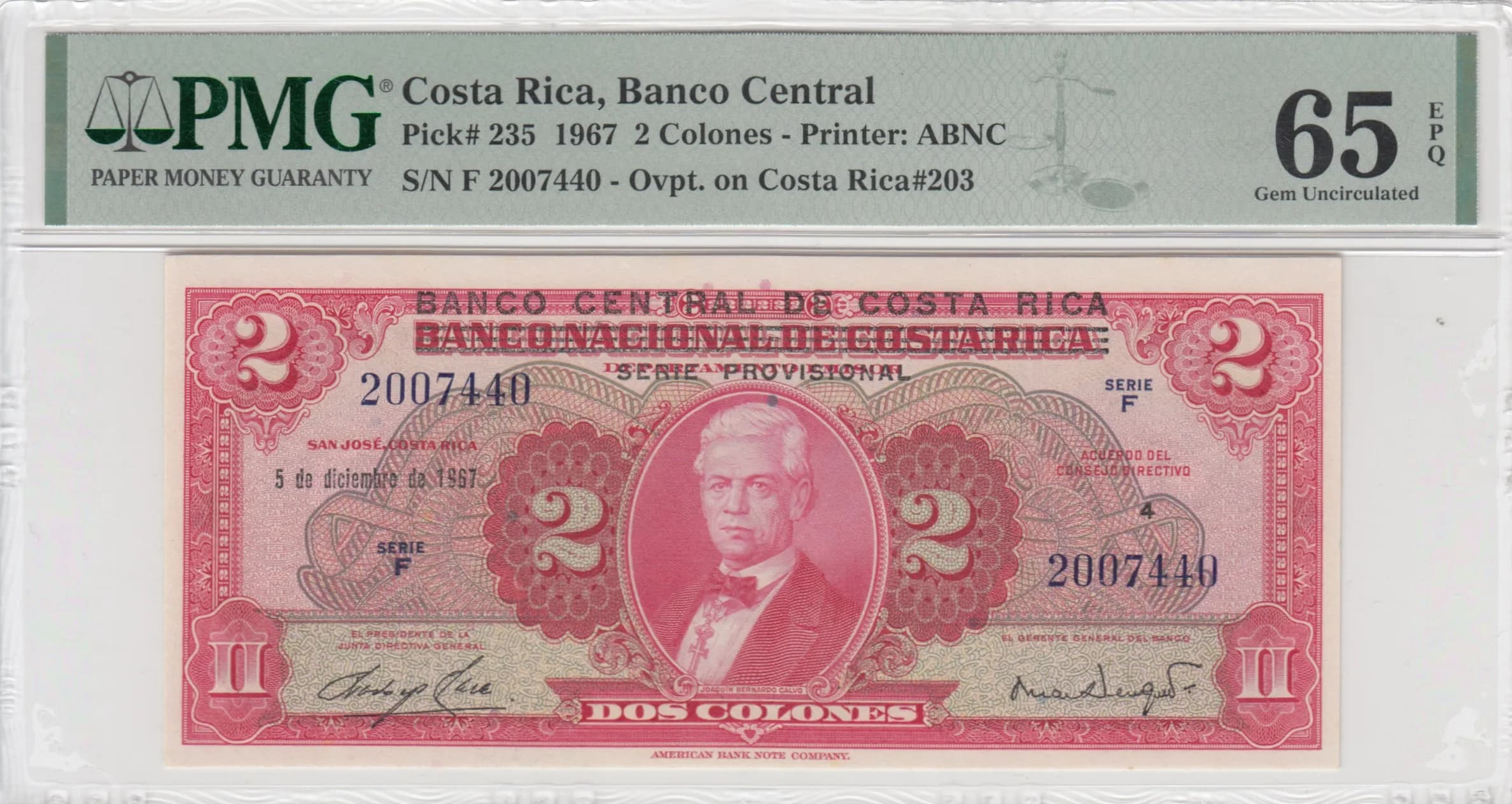
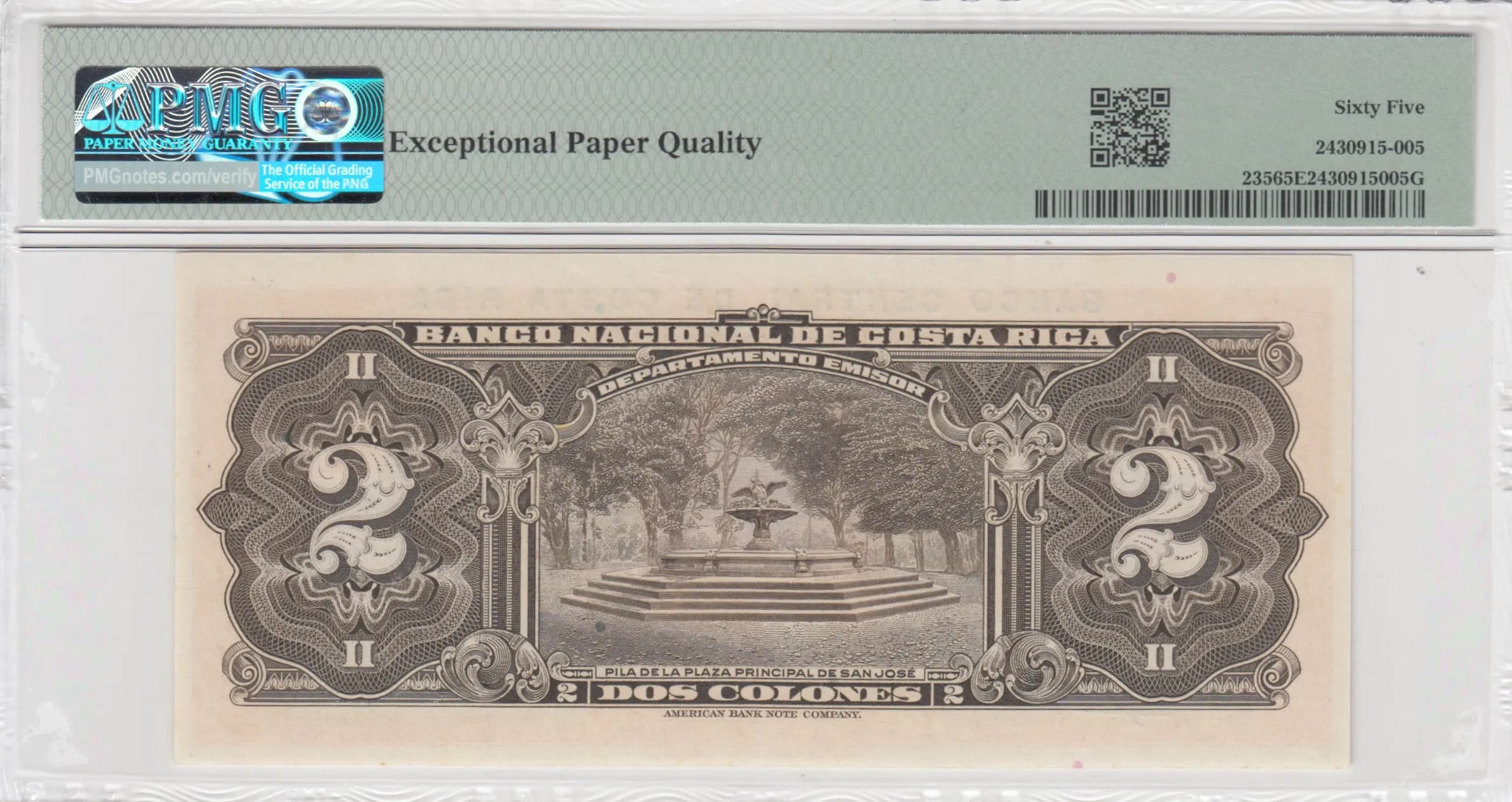
This is a Costa Rican 2 Colones note from December 5, 1967, issued by the Banco Central de Costa Rica and printed by the American Bank Note Company. The note is graded PMG 65 EPQ, indicating it is in Choice Uncirculated condition with exceptional paper quality—displaying crisp printing, sharp details, and no visible wear, folds, or creases. The note features an ornate design with a formal portrait on the obverse and an engraved vignette of the Plaza Principal fountain on the reverse, making it an attractive example of mid-20th century Costa Rican currency design.
Common. Market data from realbanknotes.com shows this note in various grades regularly selling at modest prices, with VF examples at $15–$24 and UNC examples at $40–$62 (2014–2023). Even the PMG 64 and PMG 67 examples realized only $33–$74 at auction, indicating healthy supply. The print run for this 1967 provisional issue appears to have been sufficient to maintain availability in the collector market. No evidence of rarity or scarcity is present.
This 1967 provisional issue represents a transitional period in Costa Rican currency, marked by the overprinted text 'SERIE PROVISIONAL' indicating it was an interim emission by the Banco Central. The note's design elements—particularly the engraved fountain of Plaza Principal in San José on the reverse—reflect Costa Rica's national pride and the architectural heritage of its capital city during a period of post-war stability and institutional development. The use of American Bank Note Company as the printer underscores the common practice of Central American nations contracting with established U.S. security printers for their currency production.
The obverse features a formal portrait of Joaquín Bernardo Calvo, a notable Costa Rican statesman, positioned in an ornate oval frame at the center. The portrait depicts him in formal 19th/early 20th century attire with suit and bow tie, rendered in fine engraving detail. The design employs a predominantly pink-red color scheme with brown and tan accents, complemented by elaborate ornamental borders featuring classical scrollwork, floral motifs, and geometric patterns. Large decorative numeral '2' cartouches appear at all four corners. The reverse presents an engraved landscape vignette of the 'Pila' (fountain) at Plaza Principal de San José, surrounded by trees and classical architectural elements with columns, rendered in black and white line engraving. This landmark vignette demonstrates the detailed fine-line cross-hatching characteristic of ABNC's security printing.
FRONT SIDE: 'BANCO CENTRAL DE COSTA RICA' (Central Bank of Costa Rica), 'BANCO NACIONAL DE REGISTRO BANCARIO' (National Bank of Banking Registry), 'ISEREA PROVISIONAL' (Provisional Issue), 'SERIE F' (Series F), Serial number '2007440', 'DOS COLONES' (Two Colones), '5 de diciembre de 1967' (December 5, 1967), 'SAN JOSE, COSTA RICA' (San Jose, Costa Rica). BACK SIDE: 'BANCO NACIONAL DE COSTA RICA' (National Bank of Costa Rica), 'DEPARTAMENTO DE EMISION' (Emission Department), 'PILA DE LA PLAZA PRINCIPAL DE SAN JOSE' (Fountain of the Principal Plaza of San Jose), 'DOS COLONES' (Two Colones), 'II' (Roman numeral for Two), 'AMERICAN BANK NOTE COMPANY' (printer attribution).
Intaglio (engraving) printing by American Bank Note Company (ABNC), New York. The note exhibits the hallmark characteristics of high-security engraved currency: fine line work, intricate cross-hatching in both portrait and landscape vignettes, complex ornamental borders, and multi-color printing with precise registration. The detailed engraving of both the portrait and the Plaza Principal fountain serve as anti-counterfeiting measures through their reproduction difficulty.
This example is identified as Series F (SERIE F) with serial number 2007440, representing the standard provisional issue variety. The visual analysis confirms the characteristic 'SERIE PROVISIONAL' overprint on what appears to be a base Banco Nacional design with ABNC overprinting, consistent with PMG's cataloging of P-235 as a single primary variant. No signature varieties or date variants are evident; the standardized December 5, 1967 date is consistent across this issue.