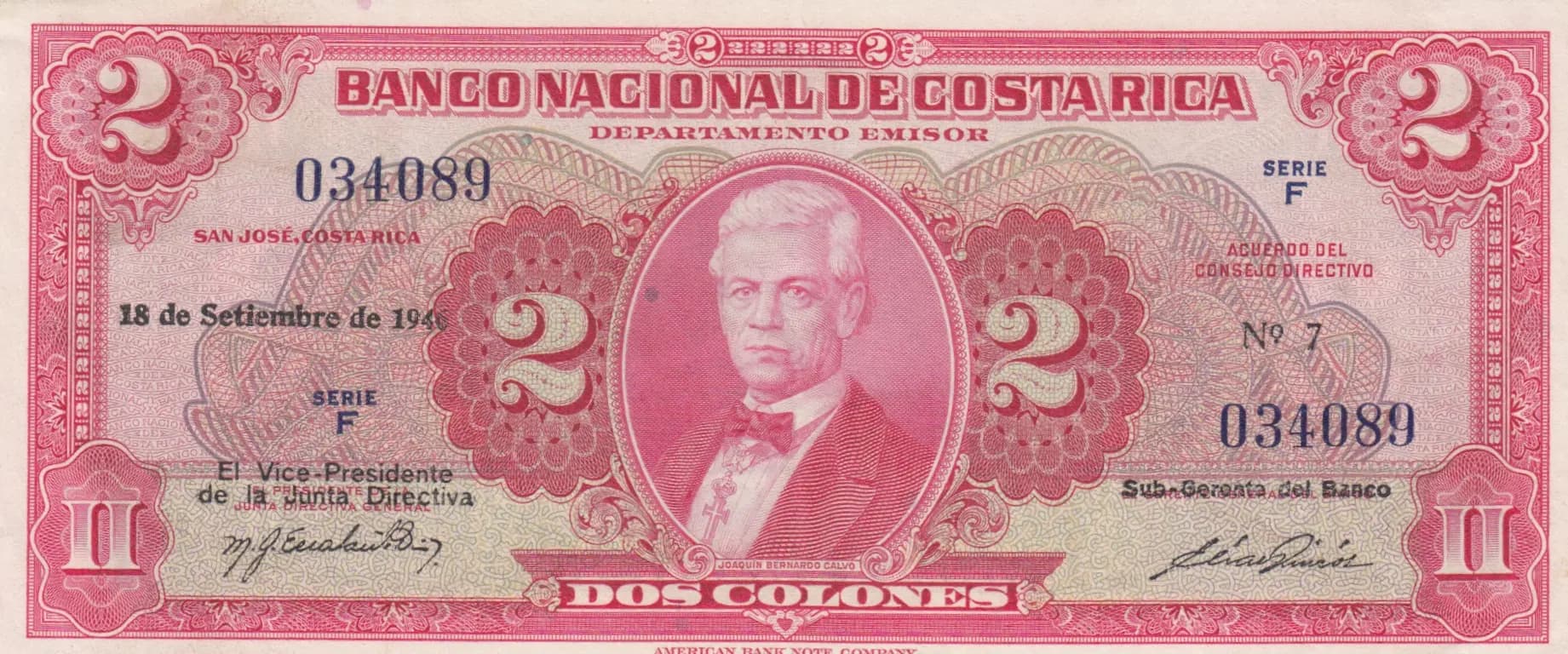
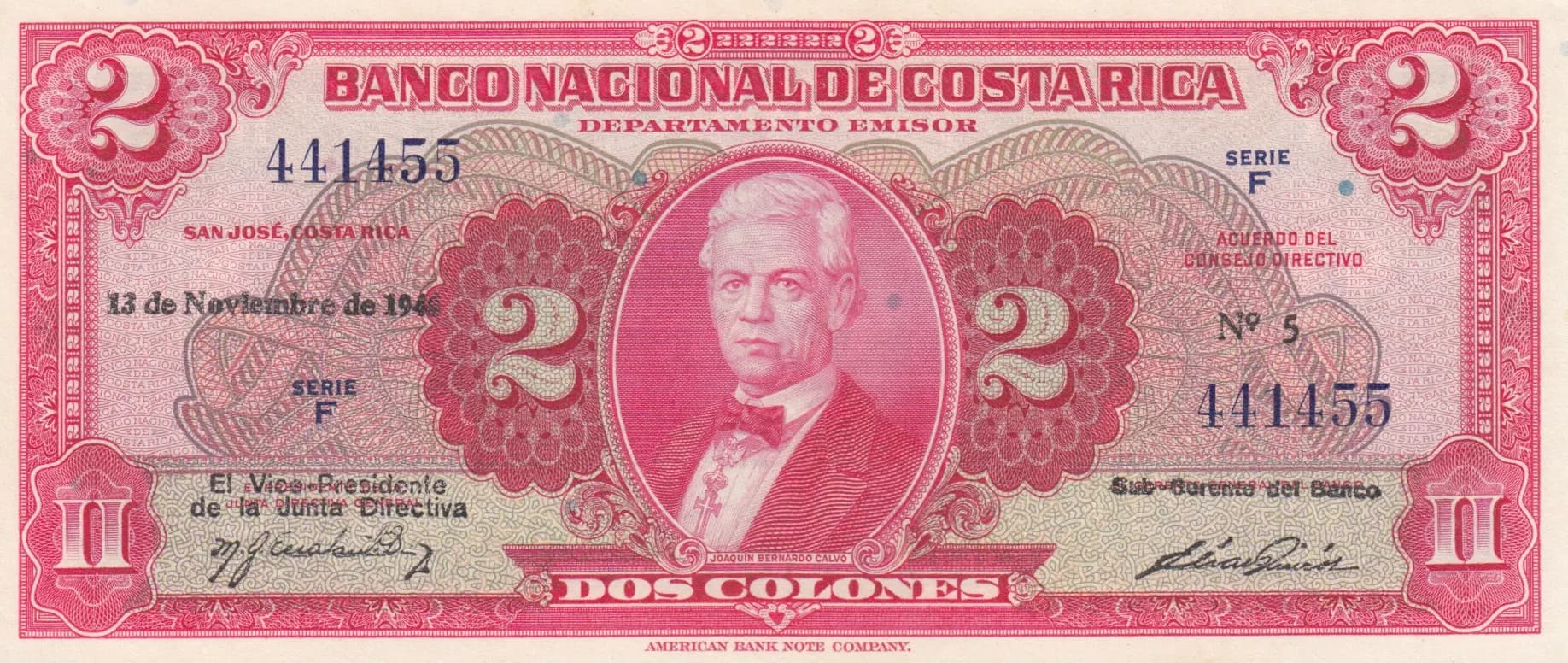
2 colones 1940
Market Prices
2 salesAbout This Note
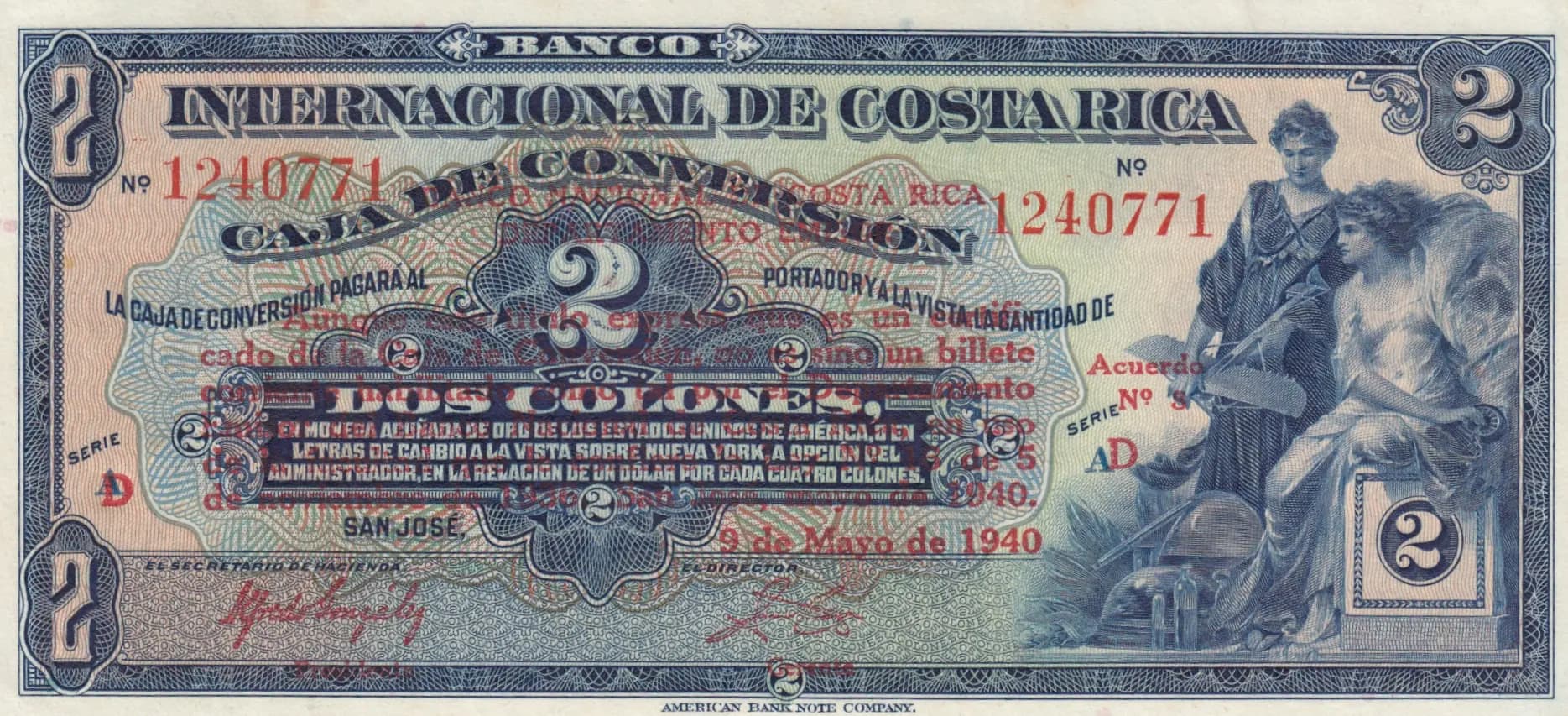
This is a 1940 Costa Rican 2 colones note issued by the Banco Internacional de Costa Rica, printed by the American Bank Note Company. The note presents an excellent example of early 20th-century Central American currency design, featuring fine line engraving with an allegorical female figure in classical style on the front and ornate baroque-inspired decorative elements throughout. Despite catalog notation of UNC condition, the visual analysis reveals significant age-related foxing, staining, and paper degradation consistent with a circulated 1940-era note, making this an authentic period example rather than a preserved uncirculated specimen.
Common. The eBay market data shows comparable VG-condition examples selling in the $39-72 range (2011-2021), with catalog values for EF condition at $75 as of 2016. These price points indicate a readily available note with consistent collector demand but no scarcity premium. The Banco Internacional de Costa Rica issued this denomination across multiple years and series, and circulation records suggest adequate print runs. The Pick catalog recognition of two distinct variants (P-197a and P-197b) further suggests sufficient quantities to justify variant study rather than rarity.
The Banco Internacional de Costa Rica's 1940 issue reflects Costa Rica's historical monetary system tied to gold redemption and U.S. dollar equivalency—the note explicitly states redemption in U.S. gold coin or bills of exchange on New York at a rate of one dollar per four colones. The allegorical female figure represents classical ideals of progress and commerce, common in interwar and early WWII-era banknote design across the Americas. This note predates Costa Rica's 1950 adoption of the current Banco Central de Costa Rica system, making it an artifact of the earlier private banking era.
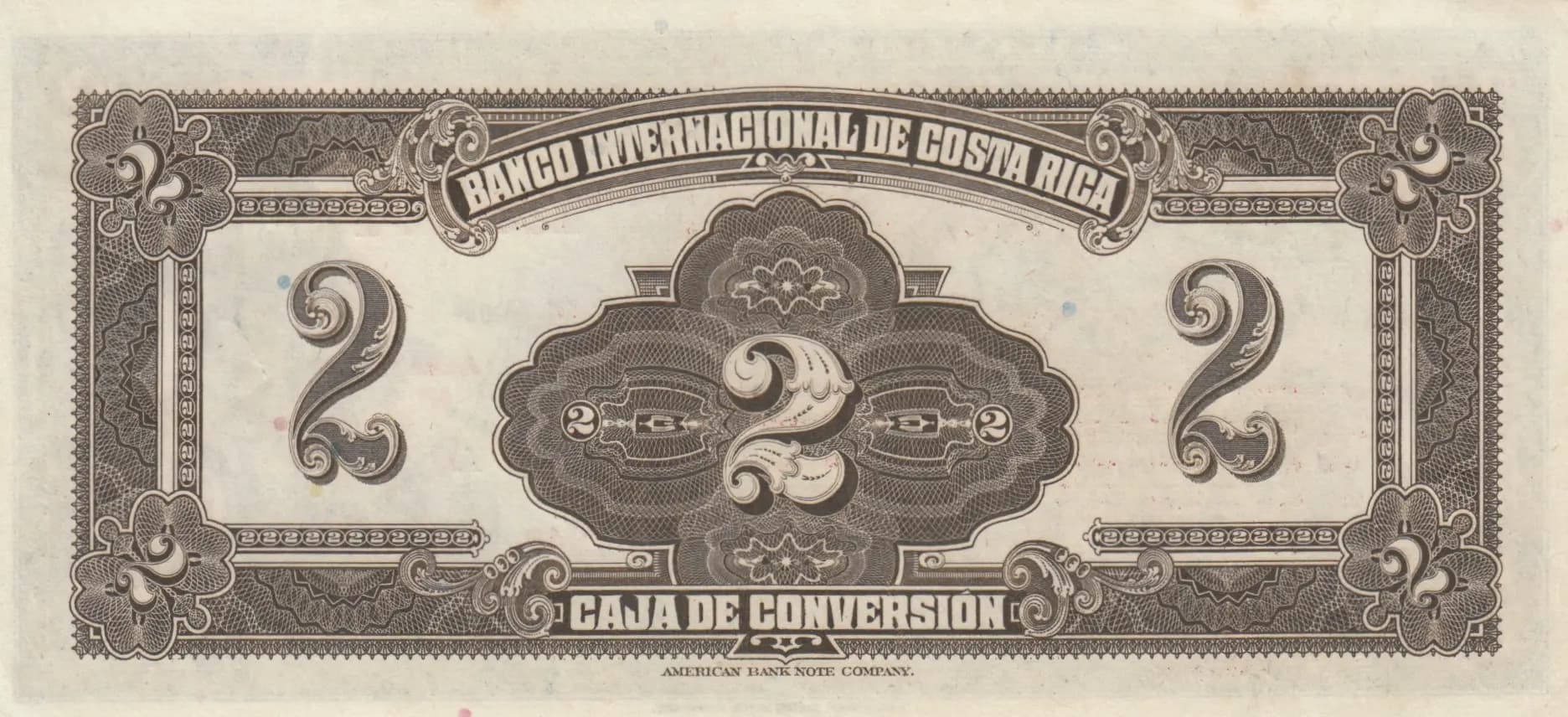
The front of this 2 colones note features a classical allegorical female figure seated on the right side, rendered in fine engraving typical of American Bank Note Company work. She represents commercial progress or prosperity, dressed in classical Greco-Roman style. The composition employs a pale blue-green background with dark blue and red overprinting, creating visual hierarchy and security through color separation. Ornate decorative numerals '2' in baroque frames anchor the upper left and right corners, while an elaborate central cartouche contains the promise-to-pay text and redemption specifications. The reverse presents a single-color (black/dark brown) design with symmetrical baroque floral scrollwork in all corners and a prominent central cartouche featuring the denomination '2' in elaborate script. The consistent ornamental vocabulary—scrollwork, floral elements, and baroque frames—across both sides emphasizes the note's security printing heritage.
FRONT: 'Banco Internacional de Costa Rica' (International Bank of Costa Rica); 'Caja de Conversión' (Conversion Fund); 'Pagará al Portador a la Vista la Cantidad de' (Will pay to bearer on demand the quantity of); 'Doce Colones' (Twelve colones); 'En Moneda Acuñada de Oro de los Estados Unidos de América, o en Letras de Cambio a la Vista sobre Nueva York a Opción del Administrador, en la Relación de un Dólar por cada Cuatro Colones' (In coined gold currency of the United States of America, or in bills of exchange on sight on New York at the option of the Administrator, in the relationship of one dollar for every four colones); 'San José' (San Jose); '9 de Mayo de 1940' (May 9, 1940); 'Serie AD No 1240771' (Series AD Number 1240771). BACK: 'Banco Internacional de Costa Rica' (International Bank of Costa Rica); 'Caja de Conversión' (Conversion Fund).
Intaglio engraving (fine line engraving) with multi-color overprinting on the obverse. The American Bank Note Company, New York utilized separate color plates for blue-green, dark blue, red, and black elements, with the allegorical figure and ornamental frames produced through deep intaglio processes. The reverse employs single-color intaglio engraving in black/dark brown. Security features rely on the complexity of engraved line work, color separation, and ornamental detail rather than modern security threads or holograms, typical of 1940s production standards.
This note is cataloged as Pick P-197b, distinguishing it from P-197a; both were printed by ABNC. The observed specimen carries Series AD and serial number 1240771, with the May 9, 1940 date. The series designation (AD) may indicate production batch or printing variant. No distinctive signatures or major overprint variations are evident in this example. The UNC condition grade designation in the catalog data conflicts with visual evidence of circulation wear and aging; this note would more accurately grade as VG-F based on the observed foxing, staining, and paper degradation.