10 colones 1944
Market Prices
1 saleAbout This Note
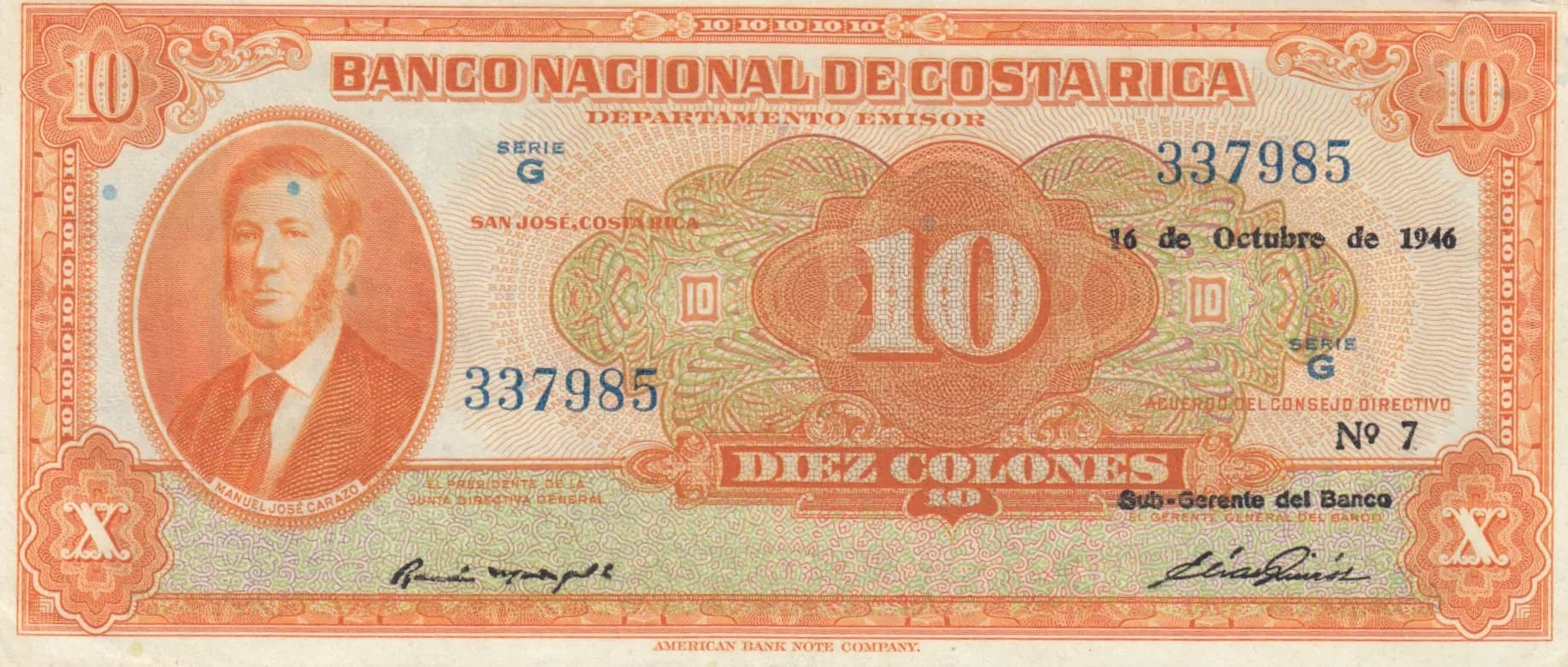
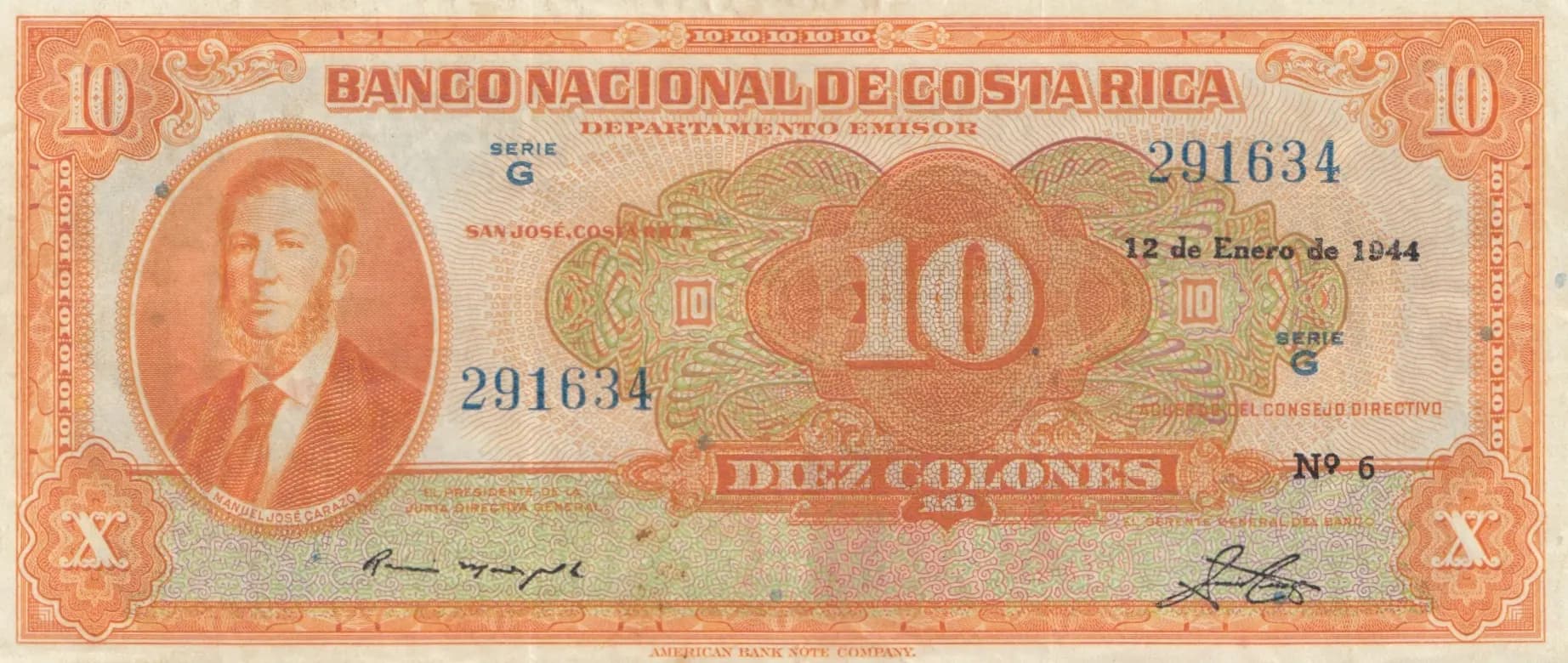
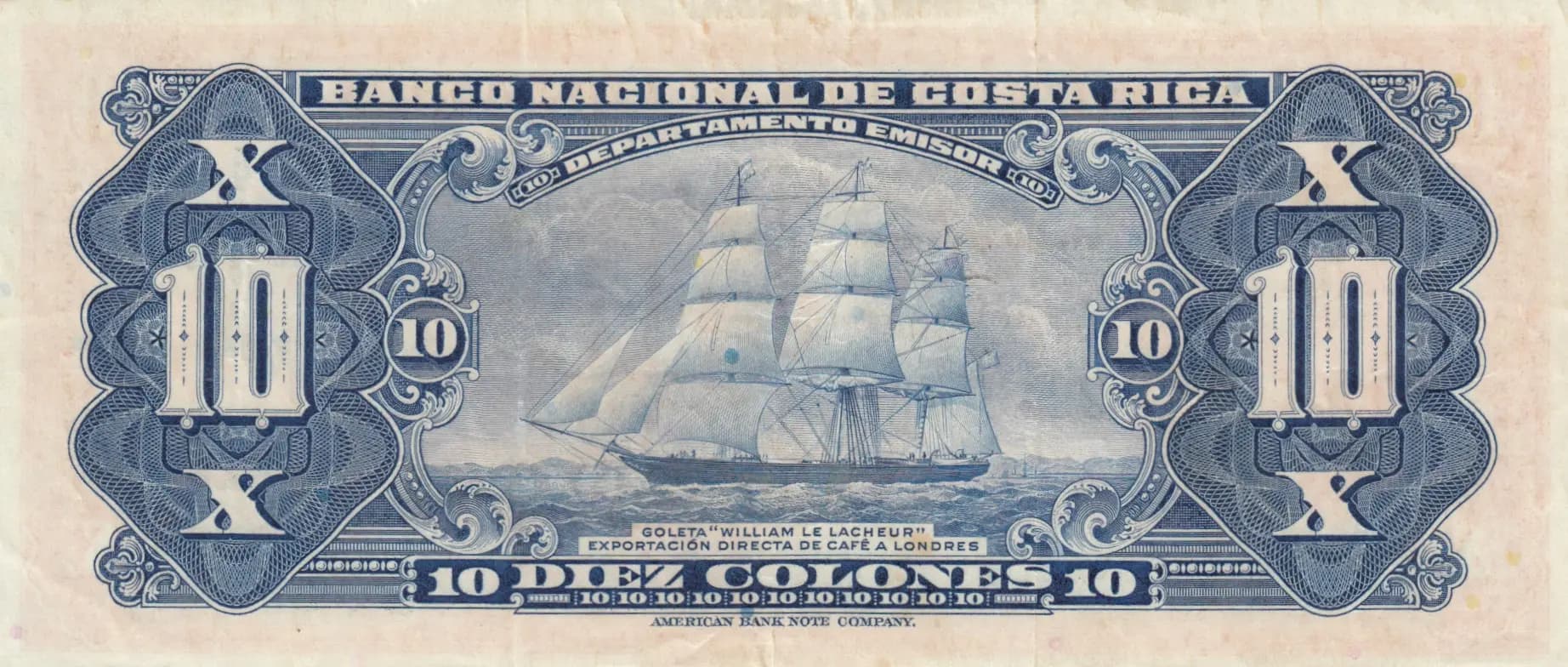
This is a VF-grade 10 Colones banknote from Costa Rica dated January 12, 1944, issued by Banco Nacional de Costa Rica and printed by American Bank Note Company. The note features an ornate orange/coral front with a portrait of Manuel J. Carazo on the left and a striking reverse depicting the full-rigged schooner 'William Le Lacheur' in blue, commemorating Costa Rica's historic direct coffee export trade to London. Despite visible creasing, foxing, and age-related wear consistent with circulation, the intricate engraving and vibrant color palette remain well-preserved, making this an attractive example of mid-20th century Central American currency design.
Common. The catalog values from 2016 (VG: $5, VF: $40, UNC: $200) and recent eBay market activity (F-grade specimen sold for $102.50 in 2020) indicate this is a regularly traded note with established collector demand but no scarcity premium. The 1942-1949 issue run was substantial, and the note appears with reasonable frequency in the secondary market. This Pick number (P-210a) represents a standard circulation issue from Banco Nacional de Costa Rica with no known recalled or short-lived printing variants that would elevate it to rare status.
This 1944 banknote reflects Costa Rica's economic ties to the British coffee trade during the mid-20th century, a period when the country's prosperity was heavily dependent on agricultural exports. The reverse design specifically celebrates the 'William Le Lacheur' schooner, which represents Costa Rica's maritime heritage and its historical role in the direct exportation of coffee to London—a significant economic achievement for the nation. Manuel J. Carazo's portrait on the obverse commemorates a key figure in Costa Rican history, linking the nation's leadership to its mercantile prosperity during this era.
The obverse features a classically ornate design in orange and coral tones with baroque-style decorative borders and scrollwork. A formal portrait of Manuel J. Carazo is positioned within an oval frame on the left side of the note, depicting him in profile-facing formal business attire. The center of the obverse displays a large numeral '10' within an ornamental cartouche, with 'X' symbols containing the denomination in the corners. The reverse presents a detailed engraved illustration of the full-rigged schooner 'William Le Lacheur' in full sail on open water, rendered in dark blue and white against a cream background. This maritime imagery is framed by matching ornate borders with X-shaped emblems containing the numeral '10' in each corner. The overall composition emphasizes both Costa Rica's political leadership and its mercantile maritime heritage.
FRONT SIDE: 'BANCO NACIONAL DE COSTA RICA' (National Bank of Costa Rica) | 'DEPARTAMENTO EMISOR' (Issuing Department) | 'SERIE G' (Series G) | 'SAN JOSE, COSTA RICA' (San Jose, Costa Rica) | '291634' (Serial Number) | '12 de Enero de 1944' (January 12, 1944) | 'DIEZ COLONES' (Ten Colones) | 'Nº 6' (Number 6) | 'AMERICAN BANK NOTE COMPANY' (American Bank Note Company). BACK SIDE: 'BANCO NACIONAL DE COSTA RICA' (National Bank of Costa Rica) | 'DEPARTAMENTO EMISOR' (Issuing Department) | 'GOLETA 'WILLIAM LE LACHEUR'' (Schooner 'William Le Lacheur') | 'EXPORTACION DIRECTA DE CAFE A LONDRES' (Direct Export of Coffee to London) | 'DIEZ COLONES' (Ten Colones) | '10' (Ten) | 'AMERICAN BANK NOTE COMPANY' (American Bank Note Company).
This note was produced using intaglio engraving, the standard security printing method employed by American Bank Note Company for high-value currency production. The fine line work visible in the portrait, the ship's rigging and sails, the scrollwork, and the intricate border patterns are all characteristic of hand-engraved intaglio plates. The multi-color printing process employed multiple passes to achieve the orange/coral and green tones on the obverse and the blue coloration on the reverse, with careful registration between color layers evident in the design's overall clarity and definition.
This note is cataloged as P-210a (variant A) and represents the standard ABNC printing. The visual analysis confirms Series G with serial number 291634, dated 12 de Enero de 1944 (January 12, 1944). The two handwritten signatures visible at the bottom of the obverse are characteristic of this issuing period. Pick catalog records identify both P-210a and P-210b variants for this denomination, though the distinguishing characteristics between these variants are not specified in the available documentation. The date January 12, 1944 falls within the documented 1942-1949 issue range, consistent with the catalog dating for this series.